
PING AN OF CHINA(601318)

Search documents
理赔服务见力度显温度
Jing Ji Ri Bao· 2026-02-04 22:17
Core Insights - The insurance industry is focusing on improving claims efficiency and addressing challenges related to slow processes, thereby enhancing its role as a social stabilizer and economic shock absorber [1] Group 1: Claims Efficiency - Multiple property insurance companies are shifting claims from a "back-end" function to a "front-end" service, making it a key indicator of their functional and service capabilities [2] - In 2025, China People's Insurance Company (CPIC) reported over 300 billion yuan in claims, with vehicle insurance making up a significant portion; the trend is towards increased online and automated processing of small claims [2] - The competition in vehicle insurance claims is evolving from merely the amount paid to the efficiency and method of payment, with a focus on remote assessments and online reporting [2] Group 2: New Energy Vehicle Claims - The rapid adoption of new energy vehicles is raising the bar for claims standards due to higher repair costs associated with components like batteries and sensors [3] - Insurance companies are enhancing their claims capabilities by collaborating with manufacturers and authorized repair networks, emphasizing the need for precise assessments and clear payouts [3] Group 3: Natural Disaster Claims - The recent earthquake in Tibet highlighted the insurance industry's ability to mobilize quickly for disaster claims, with CPIC initiating emergency mechanisms and processing claims efficiently [3][4] - The company reported handling 30,200 claims and disbursing 173 million yuan in payouts within a short timeframe, showcasing the challenges of disaster claims, such as communication disruptions [3][4] Group 4: Health Insurance Insights - Health insurance claims, particularly critical illness and medical insurance, are becoming focal points for insurers, with significant payouts reported [5][6] - In 2025, CPIC's health insurance claims included 424,300 cases totaling 20.1 billion yuan, with critical illness claims accounting for 10.53 billion yuan [5] - The most common critical illnesses vary by age group, indicating a need for insurers to adapt their products to emerging health trends [5] Group 5: Technological Integration - The insurance industry is increasingly adopting artificial intelligence to streamline claims processes, with many claims being processed within hours [8][9] - Companies like Ant Group and Tencent are implementing AI-driven solutions to enhance customer experience and expedite claims processing, including features like automatic document recognition and real-time claims updates [9][10] - The introduction of "one-day claims" for critical illnesses aims to address urgent financial needs for patients, demonstrating a commitment to customer-centric service [9]




中国人寿获中国平安增持1089.5万股
Ge Long Hui· 2026-02-04 13:09
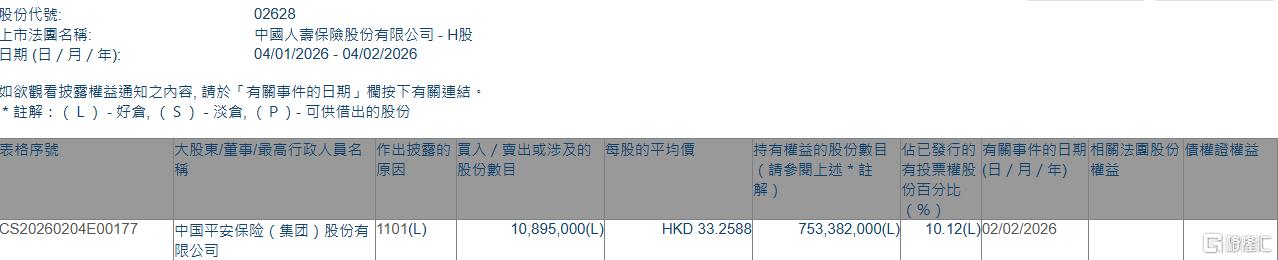
格隆汇2月4日丨根据联交所最新权益披露资料显示,2026年2月2日,中国人寿(02628.HK)获中国平安保险(集团)股份有限公司在场内以每股均价33.2588 港元增持1089.5万股,涉资约3.62亿港元。 | 2000 - 12 - 12 | 大股東/董事/最高行政人員名 作出披露的 買入 / 賣出或涉及的 海股的平均價 | | | 持有權益的股份數目 佔已發行的 有關事件的日期 | | | --- | --- | --- | --- | --- | --- | | | 原灰 | 股份數目 | 梳 * 标上 题 粉 黑 ) | | 有投票權股(日/月/年) | | | | | | | 份自分比 | | A Property of CS20260204E00177 | 中国平安保险(集团)股份有 101(L) 10,895,000(L | | HKD 33.2588 | 753,382,000(L) | 10.12(L)02/02/2026 | | | 限公司 | | | | | 增持后,中国平安保险(集团)股份有限公司最新持股数目为753,382,000股,持股比例由9.97%上升至10.12%。 | ...


中国人寿(02628.HK)获中国平安增持1089.5万股
Ge Long Hui· 2026-02-04 13:01
增持后,中国平安保险(集团)股份有限公司最新持股数目为753,382,000股,持股比例由9.97%上升至10.12%。 | 2000 - 12 - 12 | 大股東/董事/最高行政人員名 作出披露的 買入 / 賣出或涉及的 海股的平均價 | | | 持有權益的股份數目 佔已發行的 有關事件的日期 | | | --- | --- | --- | --- | --- | --- | | | 原灰 | 股份數目 | 梳 * 标上 题 粉 黑 ) | | 有投票權股(日/月/年) | | | | | | | 份自分比 | | A Property of CS20260204E00177 | 中国平安保险(集团)股份有 101(L) 10,895,000(L | | HKD 33.2588 | 753,382,000(L) | 10.12(L)02/02/2026 | | | 限公司 | | | | | 格隆汇2月4日丨根据联交所最新权益披露资料显示,2026年2月2日,中国人寿(02628.HK)获中国平安保险(集团)股份有限公司在场内以每股均价33.2588 港元增持1089.5万股,涉资约3.62亿港元。 | ...
中国平安保险增持中国人寿1089.5万股 每股作价约33.26港元
Zhi Tong Cai Jing· 2026-02-04 11:25
智通财经APP获悉,联交所最新资料显示,2月2日,中国平安保险(集团)股份有限公司增持中国人寿 (02628)1089.5万股,每股作价33.2588港元,总金额约为3.62亿港元。增持后最新持股数目约为7.53亿 股,最新持股比例为10.12%。 ...
中国平安保险增持中国人寿(02628)1089.5万股 每股作价约33.26港元
智通财经网· 2026-02-04 11:20
智通财经APP获悉,联交所最新资料显示,2月2日,中国平安保险(集团)股份有限公司增持中国人寿 (02628)1089.5万股,每股作价33.2588港元,总金额约为3.62亿港元。增持后最新持股数目约为7.53亿 股,最新持股比例为10.12%。 ...
中国平安揽获2025年金融科技、医疗健康行业专利数双榜首
Jin Rong Shi Bao· 2026-02-04 10:22
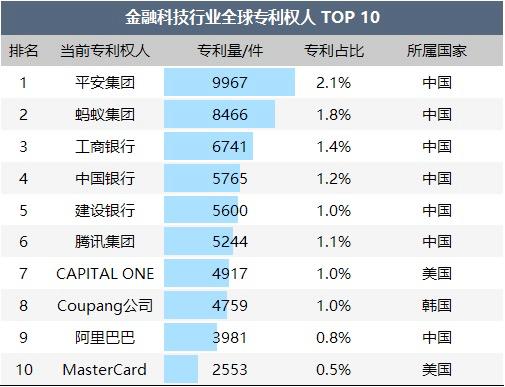
Core Insights - The white papers released by the National Intellectual Property Administration reveal that Chinese companies are solidifying their innovation leadership in the financial technology and healthcare sectors from 2019 to 2025 [1] Group 1: Patent Leadership - Ping An Group ranks first globally in both financial technology and healthcare sectors, with a total of 9,967 patents in financial technology and 5,704 patents in healthcare [2][3][4] - In financial technology, Ping An's patents are particularly strong in risk prevention (12.7% of total patents) and intelligent customer service (10.5% of total patents) [2] - In healthcare, Ping An leads in medical image processing, elder care, and intelligent consultation, showcasing a comprehensive innovation strategy [4] Group 2: Technological Drivers - Artificial intelligence (AI) and big data are identified as core technological engines driving Ping An's innovation strategy [5] - The company has integrated AI and big data into its operations, achieving a 23% increase in policy renewal efficiency through its AI-driven models [5] - Ping An's commitment to sustainable development is evident through its AI-ESG management platform, which has earned it an AAA rating in the MSCI ESG assessment [5] Group 3: Application Empowerment - Ping An has successfully transformed its patent achievements into impactful applications, such as the "Ping An Medical Assistant" and "Ping An Family Doctor" products, which address healthcare challenges [6] - The company is focused on creating a comprehensive AI medical product matrix that includes various innovative solutions for healthcare [6] - The strategic emphasis on deep application of technology has allowed Ping An to convert its extensive patent portfolio into significant business drivers [7] Group 4: Economic Impact - The technological innovations by Ping An aim to enhance the quality and efficiency of the real economy while addressing the public's desire for improved living standards [8] - The company's innovations have led to significant improvements in service efficiency, such as reducing car insurance claim processing time from hours to minutes [8]
保险板块2月4日涨1.1%,中国太保领涨,主力资金净流入3.18亿元
Zheng Xing Xing Ye Ri Bao· 2026-02-04 08:57
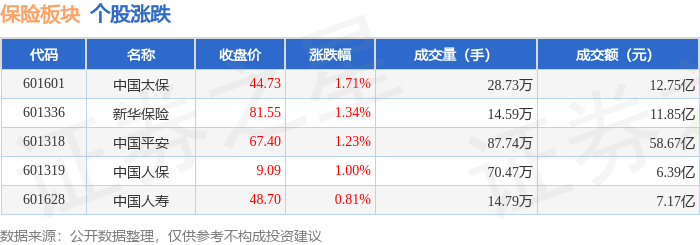
Core Viewpoint - The insurance sector experienced a 1.1% increase on February 4, with China Pacific Insurance leading the gains, while the overall market indices also showed positive movement [1] Group 1: Market Performance - The Shanghai Composite Index closed at 4102.2, up 0.85% [1] - The Shenzhen Component Index closed at 14156.27, up 0.21% [1] Group 2: Individual Stock Performance - China Pacific Insurance (601601) closed at 44.73, with a gain of 1.71% and a trading volume of 287,300 shares, totaling a transaction value of 1.275 billion yuan [1] - New China Life Insurance (601336) closed at 81.55, up 1.34% with a trading volume of 145,900 shares [1] - Ping An Insurance (601318) closed at 67.40, gaining 1.23% with a trading volume of 877,400 shares [1] - China Life Insurance (601628) closed at 48.70, up 0.81% with a trading volume of 147,900 shares [1] - China Reinsurance (601319) closed at 9.09, gaining 1.00% with a trading volume of 704,700 shares [1] Group 3: Capital Flow - The insurance sector saw a net inflow of 318 million yuan from institutional investors, while retail investors experienced a net outflow of 28.0153 million yuan [1] - The capital flow for major stocks showed that Ping An Insurance had a net inflow of 281 million yuan from institutional investors, but a net outflow of 265 million yuan from speculative investors [2] - China Pacific Insurance had a net inflow of approximately 36.6 million yuan from institutional investors, while retail investors saw a net outflow of about 61.9 million yuan [2]

探索中国式健康管理新路径 访北大医疗董事长、平安健康险董事长兼首席执行官朱友刚
Jin Rong Shi Bao· 2026-02-04 06:39
Core Viewpoint - The article discusses the transformation of the healthcare model from a disease treatment-centric approach to a more diversified health management system, highlighting the role of private healthcare providers like Peking University Health in this shift, particularly through the integration of insurance capital and medical services [1][2]. Group 1: Advantages and Challenges of the "Insurance + Healthcare" Model - The core advantages of the "Insurance + Healthcare" model include the potential to create a closed loop of "payment + service," leveraging over 250 million personal financial customers of Ping An to design proactive health management solutions [2][3]. - Another advantage is the long-term strategic patience for investment, allowing for necessary infrastructure and innovation without the pressure of short-term financial returns [2]. - The main challenge faced by Peking University Health is the cultural integration and capability reconstruction between the rigorous medical professionalism of Peking University and the market-driven, efficiency-oriented culture of Ping An [2][3]. Group 2: Strategic Focus Areas - Peking University Health is focusing on a comprehensive health management approach that spans the entire lifecycle of health, emphasizing proactive health management, rehabilitation, and corporate health services [3][4]. - The organization aims to transform traditional health check-ups into health management centers, providing customized health screening packages and continuous health management services [4][5]. - In the medical aspect, Peking University Health is implementing a multidisciplinary team (MDT) approach to ensure comprehensive and precise treatment for patients, particularly in oncology [5][6]. Group 3: Future Strategic Vision - The long-term vision of Peking University Health is to become a model akin to a combination of West China Hospital and Kaiser Permanente, focusing on top-tier medical technology and an integrated healthcare and insurance service model [7][8]. - The organization has outlined five core strategic projects for the next five years, including a comprehensive medical project targeting high-mortality diseases, a family health project, a rehabilitation care project, an AI and digital intelligence project, and a medical-insurance collaboration project [8][9][10].
融资融券2月月报:主要指数全部上涨,两融余额继续上升-20260204
BOHAI SECURITIES· 2026-02-04 06:33
Content: --------- <doc id='1'>融资融券月报 13307 主要指数全部上涨,两融余额继续上升 ――融资融券 2 月月报</doc> <doc id='2'>| 分析师:王雪莹 | SAC NO:S1150525020001 2026 年 2 月 4 日 | | --- | --- | | 证券分析师 | 核心观点: | | 王[Table_IndInvest] 雪莹 | | | | 市场概况 | | 022-23839121 | | | wangxy4430@bhzq.com | 本月(1 月 1 日-1 月 30 日)A 股市场主要指数全部上涨,其中科创 50 | | | 涨幅最大,上涨了 12.29%;上证 50 涨幅最小,上涨了 1.17%。此外, | | | 上证综指上涨 3.76 %,深证成指上涨 5.03%,创业板指上涨 4.47%, | | | 沪深 上涨 上涨 300 1.65 %,中证 500 12.12%。 | | | 截至 1 月 30 日,沪深两市两融余额为 27,064.74 亿元,较上月末增加 | | | 1,737.60亿元。其中融资余额为 26,898.76 亿元,较上月末增加 1,736.88 | | | 亿元;融券余额为 165.99 亿元,较上月末增加 0.72 亿元。市场 ETF | | | 融资余额为 亿元,较上月末增加 亿元;融券余额为 1128.80 33.06 73.71 | | | 亿元,较上月末增加 亿元。户均融资融券余额为 元,较 0.94 1,414,996 | | | 上月末增加 35,599 元;有融资融券负债的投资者数量占全体融资融券 | | | 投资者数量的占比为 23.97%,较上月末增加 0.73 个百分点。1 月 1 日 | | | -1 月 30 日每日平均参与融资融券交易的投资者数量为 600,192 名,较 | | | 上月增长 42.73%。 | | | 板块方面,主板和科创板融资余额占沪深两市 A 股融资余额比例下降, | | | 创业板占沪深两市 A 股融资余额比例上升。融券方面,主板和科创板融 | | | 券余额占沪深两市 A 股融券余额比例上升,创业板占沪深两市 A 股融券 | | | 余额比例下降。 | | | 标的券情况 | | | 行业方面,本月有色金属、电子和非银金融行业融资净买入额较多,建 | | | 筑材料、轻工制造和美容护理行业融资净买入额较少;本月融资买入额 | | | 占成交额比例较高的行业为非银金融、通信和电子,较低的行业为纺织 | | | 服饰、轻工制造和建筑材料;本月有色金属、食品饮料和家用电器行业 | | | 融券净卖出额较多,电力设备、电子和医药生物行业融券净卖出额较少。 | | | 个股方面,本月个股融资净买入额前五名为中国平安(601318)、紫金 | | | 矿业(601899)、天孚通信(300394)、招商银行(600036)、长江电 | | | 力(600900)。本月个股融券净卖出额前五名为贵州茅台(600519)、 | | | 赤峰黄金(600988)、兴业银锡(000426)、美的集团(000333)、洛 | | | 阳钼业(603993)。 | | | 风险提示:两融业务成本超预期变动风险;两融监管政策超预期变动风 | | | 险。 | | 请务必阅读正文之后的声明 | 渤海证券股份有限公司具备证券投资咨询业务资格 1 of 20 |</doc> <doc id='3'>金 融 工 程 研 究 证 券 研 究 报 告 融 资 融 券 月 报</doc> <doc id='5'>| 1. 市场数据概览 | | 4 | | --- | --- | --- | | 2. 行业融资融券特征 | | 9 | | 3. ETF 标的券 | | 13 | | 4. 个股标的券及重大事项 | | 15 | | 5. 结论 | | 17 |</doc> <doc id='6'>| | |</doc> <doc id='7'>| 图 1:近一年沪深 300 收盘价与融资买入额占成交额比例 4 | | --- | | 图 2:本月融资业务情况 5 | | 图 3:本月融券业务情况 5 | | 图 4:近五年两融余额情况 6 | | 图 5:各板块融资余额情况(亿元) 6 | | 图 6:各板块融券余额情况(亿元) 6 | | 图 7:各指数融资余额情况(亿元) 7 | | 图 8:各指数融券余额情况(亿元) 7 | | 图 9:近一年融资融券机构投资者及个人投资者数量 8 | | 图 10:近一年参与融资融券交易的投资者数量与有融资融券负债的投资者数量 8 | | 图 11:本月申万一级行业涨跌幅及融资买入额占成交额比例(%) 9 | | 图 12:本月行业融资净买入额情况(万元) 9 | | 图 13:本月行业融券净卖出额情况(万元) 10 | | 图 14:近一年 ETF 融资融券余额情况 13 | </doc> <doc id='8'>| 表 1:A | 股市场主要指数本月表现 4 | | --- | --- | | 表 2:本月标的券所属行业融资情况 10 | | | 表 3:本月标的券所属行业融券情况 11 | | | 表 4:本月 ETF 融资净买入前 20 | 名 13 | | 表 5:本月个股融资净买入前 20 | 名 15 | | 表 6:本月融资买入额占成交额比例前 | 20 名 15 | | 表 7:本月个股融券净卖出前 20 | 名 16 |</doc> <doc id='9'>1. 市场数据概览 本月(1 月 1 日-1 月 30 日)A 股市场主要指数全部上涨,其中科创 50 涨幅最大, 上涨了 12.29%;上证 50 涨幅最小,上涨了 1.17%。此外,上证综指上涨 3.76 %, 深证成指上涨 5.03%,创业板指上涨 4.47%,沪深 300 上涨 1.65 %,中证 500 上涨 12.12%。</doc> <doc id='10'>表 1:A 股市场主要指数本月表现 | 指数名称 | 12 月 31 日收盘价 | 1 月 30 日收盘价 | 月涨跌幅(%) | | --- | --- | --- | --- | | 上证综指 | 3968.84 | 4117.95 | 3.76 | | 深证成指 | 13525.02 | 14205.89 | 5.03 | | 创业板指 | 3203.17 | 3346.36 | 4.47 | | 科创 50 | 1344.20 | 1509.40 | 12.29 | | 沪深 300 | 4629.94 | 4706.34 | 1.65 | | 上证 50 | 3031.13 | 3066.50 | 1.17 | | 中证 500 | 7465.57 | 8370.52 | 12.12 | 资料来源:同花顺,渤海证券研究所 图 1:近一年沪深 300 收盘价与融资买入额占成交额比例</doc> <doc id='12'>资料来源:同花顺,渤海证券研究所 1 月 30 日,沪深两市两融余额为 27,064.74 亿元,较上月末增加 1,737.




融合“北大底蕴”与“平安特色” 探索中国式健康管理新路径
Jin Rong Shi Bao· 2026-02-04 05:32
Core Insights - The article discusses the transformation of the healthcare model from a disease treatment-centric approach to a more diversified health management system, highlighting the role of private healthcare providers as essential complements to public healthcare systems [1] - Peking University Health is positioned as a pioneer in this field, leveraging its academic heritage and financial resources from Ping An Group to innovate and reshape the industry landscape [1][2] Group 1: Advantages and Challenges - The core advantages of the "insurance + healthcare" model include the potential to create a closed loop of "payment + service" and the ability to make long-term investments in healthcare [2] - The main challenge faced by Peking University Health is the integration of two distinct cultures: the rigorous medical professionalism of Peking University and the market-driven, efficiency-oriented culture of Ping An [2][3] Group 2: Strategic Integration - Peking University Health aims to clarify the strategic roles of both cultural elements, ensuring that the academic foundation guarantees high-quality medical services while the financial backing drives innovation [3] - The integration of Ping An's extensive customer base and technological capabilities is expected to enhance patient services and operational efficiency [3] Group 3: Shift in Healthcare Demand - There is a significant shift in public demand from disease treatment to health enhancement and quality of life, creating opportunities for private healthcare to fill service gaps left by traditional public systems [4][5] - Peking University Health is focusing on a comprehensive health service model that encompasses the entire lifecycle of health, emphasizing proactive health management and rehabilitation [4][5] Group 4: Future Vision and Strategic Planning - Peking University Health envisions becoming a model that combines the strengths of top-tier hospitals and integrated healthcare systems, aiming for excellence in medical technology and a seamless integration of insurance and healthcare services [7][8] - The company has outlined five core strategic initiatives for the next five years, including a comprehensive medical project, a family health initiative, a rehabilitation care project, an AI-driven data intelligence project, and a collaborative insurance model [8][9]