PING AN OF CHINA(601318)

Search documents
量化大势研判202602:市场△gf继续保持扩张
Guolian Minsheng Securities· 2026-02-04 05:29
- The report introduces a quantitative model framework for market trend analysis, focusing on five asset style stages: external growth, quality growth, quality dividend, value dividend, and bankruptcy value. The model evaluates assets based on their intrinsic attributes and prioritizes them using the sequence of g > ROE > D, analyzing whether there are "good assets" and whether they are "expensive" [5][8][9] - The model incorporates key factors such as expected growth (gf), actual growth (g), profitability (ROE), high dividend (D), and bankruptcy value (B/P). Each factor is associated with specific market phases, e.g., expected growth is relevant across all phases, while profitability is emphasized during maturity phases [9][12] - The quantitative model has demonstrated strong historical performance, achieving an annualized return of 27.67% since 2009. It has shown consistent excess returns in most years, particularly post-2017, with limited effectiveness in years like 2011, 2012, and 2016 [19][22] - The model's backtesting results for specific years include notable excess returns, such as 51% in 2009, 36% in 2013, and 62% in 2022. However, it also recorded underperformance in years like 2011 (-11%) and 2014 (-4%) [22] - The report details six specific strategies derived from the model, each focusing on different factors: - **Expected Growth Strategy**: Selects industries with the highest analyst-forecasted growth rates. Recent recommendations include sectors like automotive sales, lithium equipment, and tungsten [38][39] - **Actual Growth Strategy**: Focuses on industries with the highest unexpected growth (△g). Current recommendations include photovoltaic equipment, insurance, and coal chemical sectors [40][41] - **Profitability Strategy**: Targets high-ROE industries with low valuations under the PB-ROE framework. Recommended sectors include copper, liquor, and non-dairy beverages [43][44] - **Quality Dividend Strategy**: Utilizes a DP+ROE scoring system to identify industries. Current recommendations include forestry, lithium equipment, and fiberglass [46][47] - **Value Dividend Strategy**: Employs a DP+BP scoring system. Recommended sectors include security, daily chemicals, and buses [49][50] - **Bankruptcy Value Strategy**: Focuses on industries with the lowest PB+SIZE scores. Current recommendations include automotive sales, ceramics, and cotton textiles [53][54]





邯郸金融监管分局同意平安产险成安支公司变更营业场所
Jin Tou Wang· 2026-02-04 03:59
二、中国平安财产保险股份有限公司应按照有关规定及时办理变更及许可证换领事宜。 一、同意中国平安财产保险股份有限公司成安支公司将营业场所变更为:河北省邯郸市成安县青云大街 西侧、朱雀路北侧业玖大厦B座12层1201、1212。 2026年1月27日,邯郸金融监管分局发布批复称,《中国平安财产保险股份有限公司河北分公司关于变 更平安财险成安支公司营业场所的请示》(平保产冀分发〔2025〕165号)收悉。经审核,现批复如下: ...

沪深300成长ETF华夏(159523)跌0.31%,半日成交额225.97万元
Xin Lang Cai Jing· 2026-02-04 03:41
Group 1 - The core point of the article highlights the performance of the HuShen 300 Growth ETF managed by Huaxia Fund Management, which has seen a return of 28.50% since its inception on September 5, 2023, and a return of 3.61% over the past month [1][1][1] - As of the midday close on February 4, the HuShen 300 Growth ETF (159523) decreased by 0.31%, with a trading volume of 2.2597 million yuan [1][1][1] - The top holdings of the ETF include companies such as CATL, which rose by 1.58%, Kweichow Moutai, which increased by 2.01%, and Zijin Mining, which saw a slight increase of 0.05% [1][1][1] Group 2 - Other notable stock performances within the ETF include Sunlight Power, which fell by 0.27%, Haiguang Information, which dropped by 3.51%, and Heng Rui Pharmaceutical, which decreased by 2.14% [1][1][1] - The ETF's performance benchmark is the CSI Select 300 Growth Innovation Strategy Index return rate [1][1][1] - The fund manager is Zhao Zongting, indicating a specific leadership in the management of the ETF [1][1][1]




响应普惠金融高质量发展,平安推出御享金越年金完善服务体系
Cai Fu Zai Xian· 2026-02-04 03:34
Core Viewpoint - The 2025 Shanghai Inclusive Finance Forum emphasized enhancing the governance system and service quality of inclusive finance, with a focus on how financial institutions can leverage digital transformation to address financing challenges and empower the technology industry. In this context, Ping An Life's "Yuxiang Jinyue" annuity product has gained attention for its robust dividend mechanism and comprehensive service capabilities, aligning with the Shanghai Financial Regulatory Bureau's goal of elevating inclusive financial service capabilities by 2030 [1] Group 1: Product Features and Investment Strategy - The core competitiveness of the "Yuxiang Jinyue" annuity lies in its investment system, utilizing Ping An Life's "Wenguanbao" account designed for dividend insurance, implementing a "three-warehouse" allocation strategy: a long-term strategic warehouse for stable returns, a mid-term situational warehouse for market adaptability, and a short-term tactical warehouse for capturing opportunities. This strategy has resulted in a non-annualized comprehensive investment return rate of 5.4% for Ping An's insurance asset portfolio as of Q3 2025 [3] - The product design allows for continuous growth in cash value after a certain number of years post premium payment, with policyholders able to participate in the distribution of over 70% of the distributable surplus from dividend business, which can also be transferred to a universal account for secondary value appreciation [3] Group 2: Service Ecosystem and Market Differentiation - The dividend insurance market is becoming increasingly homogeneous, with mere capital appreciation failing to meet diverse needs. The "Yuxiang Jinyue" annuity transitions the insurance value from a singular economic compensation to a broader range of services including healthcare, retirement, and lifestyle support through a "product + service" model. The "Tianping An" service ecosystem launched in April 2025 supports this product by linking customers to Ping An Group's comprehensive financial and healthcare resources [4] - As of the end of October, the four major service scenarios have served over 2.01 million customers, with the sports scenario attracting 1.43 million participants, effectively transforming the role from "payer" to "companion" [4] Group 3: Real-Life Impact and Customer Experience - The warmth of financial services is often reflected in moments of risk. A case in Qingdao, Shandong, illustrates this, where a customer configured the "Yuxiang Jinyue" annuity for their father, linking it to home care services. An intelligent fall detection system triggered an alert when the elderly man collapsed, leading to timely emergency assistance. This case exemplifies the regularity of the service system associated with the product [5] - The product's flexible withdrawal customization aligns wealth planning with key life events such as education, entrepreneurship, and retirement, while the dual insured design extends the wealth accumulation period, allowing a single policy to meet the needs of two generations. In the context of high-quality development in inclusive finance, the "Yuxiang Jinyue" annuity serves as a financial contract and a connection to quality medical resources and improved living standards [5]


全年顺利收官,2026年分红险有望承接挪储流量:保险行业月报(2025年1-12月)
Huachuang Securities· 2026-02-03 10:35
Investment Rating - The industry investment rating is "Recommended" for the insurance sector, indicating an expected increase in the industry index exceeding the benchmark index by more than 5% in the next 3-6 months [4][24]. Core Insights - The insurance industry achieved a total premium income of 61,194 billion yuan in 2025, reflecting a year-on-year growth of 7.4%. The growth rate has slightly decreased compared to the previous month [7][6]. - Life insurance premiums reached 35,557 billion yuan, with a year-on-year increase of 11.4%. Health and accident insurance also showed growth, while the overall premium growth rate for life insurance has been gradually declining [7][6]. - The total assets of the insurance industry reached 41.3 trillion yuan by the end of December 2025, marking a year-on-year increase of 15.1% [7][6]. - The report anticipates that the new business for life insurance will see rapid growth due to the dual benefits of high deposit flow and the expansion of bank insurance channels [7][6]. Company Summaries - **China Pacific Insurance (601601.SH)**: Expected EPS for 2025E is 5.68 yuan, with a PE ratio of 7.21 and a PB ratio of 1.41. The stock is rated as "Recommended" [3]. - **China Life Insurance (601628.SH)**: Expected EPS for 2025E is 6.34 yuan, with a PE ratio of 11.79 and a PB ratio of 2.18. The stock is rated as "Recommended" [3]. - **Ping An Insurance (601318.SH)**: Expected EPS for 2025E is 8.02 yuan, with a PE ratio of 7.48 and a PB ratio of 1.14. The stock is rated as "Strongly Recommended" [3]. - **China Property & Casualty Insurance (02328.HK)**: Expected EPS for 2025E is 2.07 yuan, with a PE ratio of 6.54 and a PB ratio of 1.09. The stock is rated as "Recommended" [3].


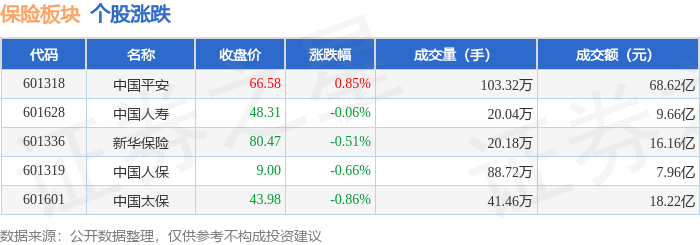
保险板块2月3日跌0.01%,中国太保领跌,主力资金净流入6.9亿元
Zheng Xing Xing Ye Ri Bao· 2026-02-03 09:03
从资金流向上来看,当日保险板块主力资金净流入6.9亿元,游资资金净流出1.18亿元,散户资金净流出5.73亿元。保险板块个股资金流向见下 表: | 代码 | 名称 | 主力净流入 (元) | | 主力净占比 游资净流入 (元) | | 游资净占比 散户净流入(元) | | 散户净占比 | | --- | --- | --- | --- | --- | --- | --- | --- | --- | | 601318 中国平安 | | | 6.47亿 | 9.43% | -1.12 Z | -1.63% | -5.36亿 | -7.80% | | 601336 新华保险 | | | 5732.65万 | 3.55% | 2205.59万 | 1.37% | -7938.24万 | -4.91% | | 601628 中国人寿 | | | 1619.42万 | 1.68% | 2616.98万 | 2.71% | -4236.40万 | -4.39% | | 601601 中国太保 | | | 650.30万 | 0.36% | -9417.22万 | -5.17% | 8766.92万 | 4.81% | | ...


全年顺利收官,2026年分红险有望承接挪储流量:保险行业月报(2025年1-12月)-20260203
Huachuang Securities· 2026-02-03 07:43
Investment Rating - The industry investment rating is "Recommended," indicating an expected increase in the industry index exceeding the benchmark index by more than 5% in the next 3-6 months [24]. Core Insights - The insurance industry achieved a total premium income of 61,194 billion yuan in 2025, reflecting a year-on-year growth of 7.4%. The growth rate has slightly decreased compared to the previous month [7][6]. - Life insurance premiums reached 35,557 billion yuan, with a year-on-year increase of 11.4%, while health and accident insurance also showed growth, albeit with a slight decline in month-on-month performance [7][6]. - The total assets of the insurance industry reached 41.3 trillion yuan by the end of 2025, marking a year-on-year increase of 15.1% [7][6]. - The report anticipates that the new business for life insurance will see rapid growth due to the dual benefits of high deposit flow and the expansion of bank insurance channels [7][6]. Company Summaries - **China Pacific Insurance (601601.SH)**: Expected EPS for 2025 is 5.68 yuan, with a PE ratio of 7.21 and a PB ratio of 1.41. The stock is rated as "Recommended" [3]. - **China Life Insurance (601628.SH)**: Expected EPS for 2025 is 6.34 yuan, with a PE ratio of 11.79 and a PB ratio of 2.18. The stock is rated as "Recommended" [3]. - **Ping An Insurance (601318.SH)**: Expected EPS for 2025 is 8.02 yuan, with a PE ratio of 8.24 and a PB ratio of 1.14. The stock is rated as "Strongly Recommended" [3]. - **China Property & Casualty Insurance (02328.HK)**: Expected EPS for 2025 is 2.07 yuan, with a PE ratio of 6.81 and a PB ratio of 1.09. The stock is rated as "Recommended" [3].
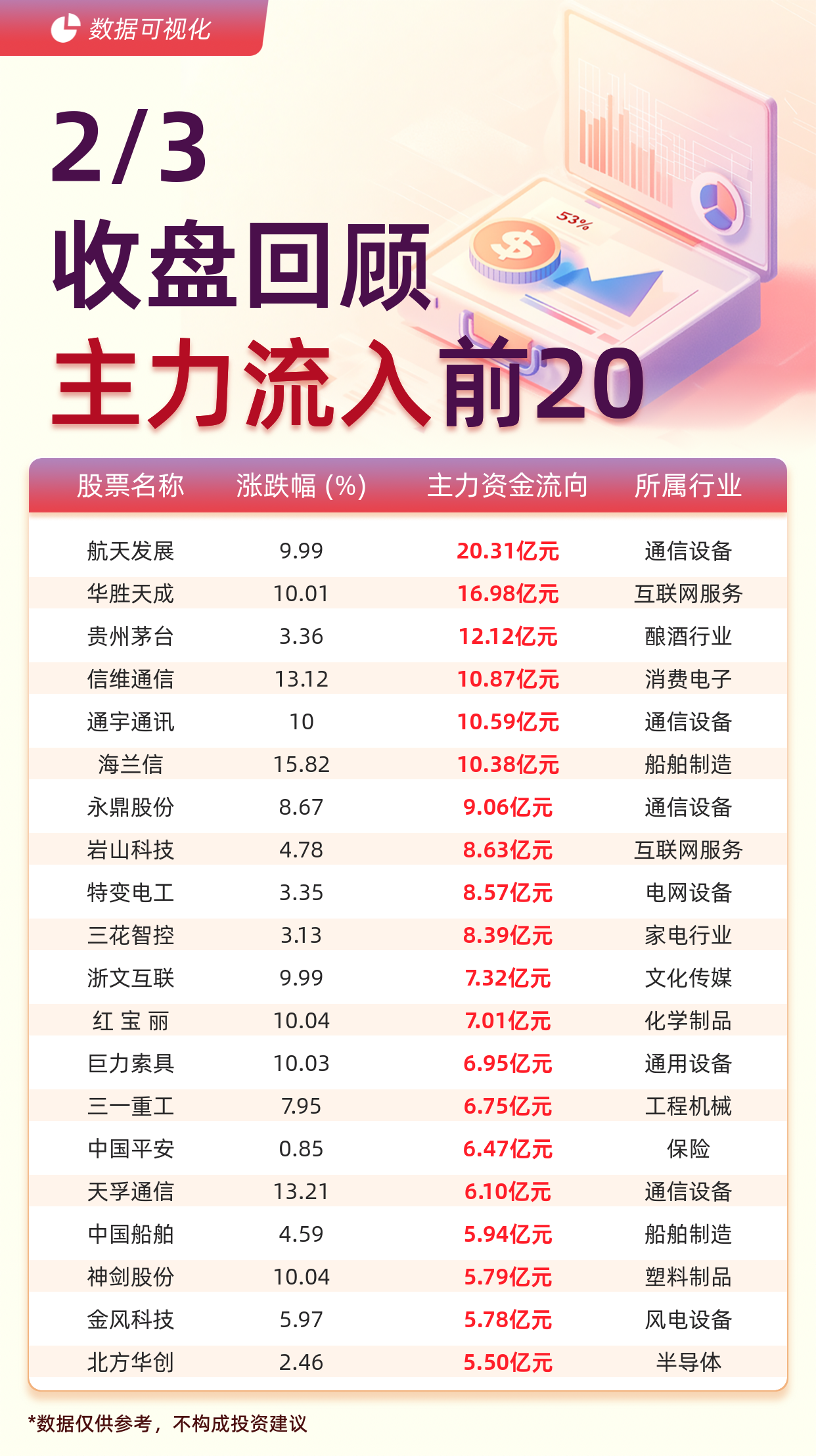
主力资金流入前20:航天发展流入20.31亿元、华胜天成流入16.98亿元
Jin Rong Jie· 2026-02-03 07:14
Core Insights - The main focus of the articles is on the significant inflow of capital into specific stocks, highlighting the top 20 stocks by principal capital inflow as of February 3rd, with notable performances in various sectors [1][2][3] Group 1: Stock Performance - Aerospace Development (航天发展) saw a capital inflow of 2.031 billion, with a price increase of 9.99% [2] - Huasheng Tiancheng (华胜天成) experienced a capital inflow of 1.698 billion, with a price increase of 10.01% [2] - Kweichow Moutai (贵州茅台) had a capital inflow of 1.212 billion, with a price increase of 3.36% [2] - Xinyi Communication (信维通信) reported a capital inflow of 1.087 billion, with a price increase of 13.12% [2] - Tongyu Communication (通宇通讯) had a capital inflow of 1.059 billion, with a price increase of 10% [2] Group 2: Sector Analysis - The telecommunications equipment sector, represented by companies like Aerospace Development, Xinyi Communication, and Tongyu Communication, showed strong capital inflows, indicating investor confidence in this sector [2][3] - The internet services sector, with Huasheng Tiancheng and Yanshan Technology (岩山科技), also attracted significant capital, reflecting growth potential in digital services [2][3] - The brewing industry, represented by Kweichow Moutai, continues to draw investment, albeit with a lower growth rate compared to technology sectors [2][3] Group 3: Additional Notable Stocks - Other notable stocks include Hailanxin (海兰信) with a capital inflow of 1.038 billion and a price increase of 15.82%, indicating strong performance in the shipbuilding sector [2][3] - Yongding Co. (永鼎股份) attracted 906 million with an 8.67% increase, also in the telecommunications equipment sector [2][3] - Sany Heavy Industry (三一重工) saw a capital inflow of 675 million with a 7.95% increase, reflecting stability in the engineering machinery sector [3]



非银行业周报(2026年第四期):2025券商业绩整体向好,关注券商估值修复-20260203
AVIC Securities· 2026-02-03 06:18
Investment Rating - The industry investment rating is "Overweight," indicating that the growth level of the industry is expected to exceed that of the CSI 300 index over the next six months [3][41]. Core Views - The securities sector has shown a positive performance with a 0.69% decline, underperforming the CSI 300 index by 0.77 percentage points. The current price-to-book (PB) ratio for the brokerage sector is 1.36 times [1][2]. - Major brokerages have reported strong earnings growth for 2025, with Citic Securities achieving a revenue of 74.83 billion yuan, a year-on-year increase of 28.75%, and a net profit of 30.05 billion yuan, up 38.46% [2]. - The growth drivers for the brokerage sector include improved market conditions, optimized business structures, and ongoing policy benefits that enhance profitability channels [2][6]. Summary by Sections Securities Weekly Data Tracking - **Brokerage Business**: The average daily trading volume of A-shares reached 30,632 billion yuan, a week-on-week increase of 9.45% [13]. - **Investment Banking**: As of January 30, 2026, the total equity financing scale for 2026 reached 132.65 billion yuan, with IPOs contributing 9.1 billion yuan [15]. - **Asset Management**: By January 30, 2026, brokerages issued 7.01 billion new asset management products, with a total market share of 32.04 trillion yuan [21]. - **Credit Business**: The margin trading balance was 27,393.27 billion yuan, reflecting a week-on-week increase of 158.78 billion yuan [23]. - **Proprietary Trading**: The CSI 300 index has increased by 1.65% year-to-date [24]. Insurance Weekly Data Tracking - **Asset Side**: As of November 2025, the total assets of the insurance industry reached 4,064.63 billion yuan, with a year-on-year growth of 15.50% [29]. - **Liability Side**: The total original insurance premium income for the industry in November 2025 was 57,628.81 billion yuan, a year-on-year increase of 7.56% [29]. Industry Dynamics - The regulatory environment is encouraging industry consolidation, with mergers and acquisitions being an effective means for brokerages to achieve external growth [3][6]. - The insurance sector is adapting to a low-interest-rate environment by reallocating assets towards private equity funds, which are becoming a crucial source of long-term capital [7][8].



十大金股出炉!2026年2月券商看好这些方向
Xin Lang Cai Jing· 2026-02-03 04:09
Core Viewpoint - The article highlights the selection of 263 stocks by brokerages as "golden stocks," with a focus on balancing growth and stability amid macroeconomic uncertainties. The selected stocks are categorized into two main themes: embracing the AI-driven technology revolution and investing in value sectors benefiting from cyclical recovery. Group 1: Growth-Focused Stocks - The "offensive" aspect of the stock selection emphasizes a comprehensive layout in the AI industry, covering everything from infrastructure to application and cloud services, directly addressing the surging global demand for AI computing power and domestic alternatives [1][2] - Key stocks include Alibaba, which is expected to see a 32% revenue growth in its cloud business due to AI demand, and Tencent, which is leveraging AI in social and gaming sectors to enhance user engagement and monetization [3][9] Group 2: Stability-Focused Stocks - The "defensive" aspect is characterized by investments in companies with strong cash flows, policy benefits, and unique brand advantages. China Ping An is highlighted for its high dividend yield and improving fundamentals, while Kweichow Moutai benefits from its brand strength and channel reforms [2][5][18] - Other stable stocks include China Duty Free, which is expected to benefit from ongoing policy advantages in Hainan, and Foster, which is expanding its electronic materials business alongside its core photovoltaic operations [2][16][14] Group 3: Individual Stock Insights - **Alibaba**: Expected net profit of 1,045.52 million yuan in 2026, with a growing user base for AI products [3] - **Haiguang Information**: Revenue of 9.49 billion yuan in the first three quarters of 2025, with a year-on-year growth of 54.65% [4] - **China Ping An**: Projected net profit of 157.55 billion yuan in 2026, with a PE ratio of 7.59 [5] - **Wanhua Chemical**: Anticipated net profit of 16.36 billion yuan in 2026, with a PE ratio of 15.37 [7][8] - **Tencent**: Monthly active users of WeChat at 1.414 billion, with AI-related capital expenditures rising to 40% [10] - **Zijin Mining**: Expected net profit of 45.70 billion yuan in the first three quarters of 2025, with significant gold resource reserves [12][13] - **Foster**: Projected net profit growth of 49.98% in 2026, with over 50% market share in photovoltaic films [15] - **China Duty Free**: Expected net profit growth of 27.10% in 2026, benefiting from policy advantages [16][17] - **Kweichow Moutai**: Net profit of 66.90 billion yuan in the first three quarters of 2025, with a gross margin of 91.29% [18]