PING AN OF CHINA(601318)

Search documents
中国平安增持中国人寿1089.5万股,最新持股比例为10.12%
Zhi Tong Cai Jing· 2026-02-05 04:05
关键词阅读:中国平安 中国人寿 增持 责任编辑:栎树 联交所最新资料显示,2月2日,中国平安保险(集团)股份有限公司增持中国人寿(02628)1089.5万股,每 股作价33.2588港元,总金额约为3.62亿港元。增持后最新持股数目约为7.53亿股,最新持股比例为 10.12%。 ...

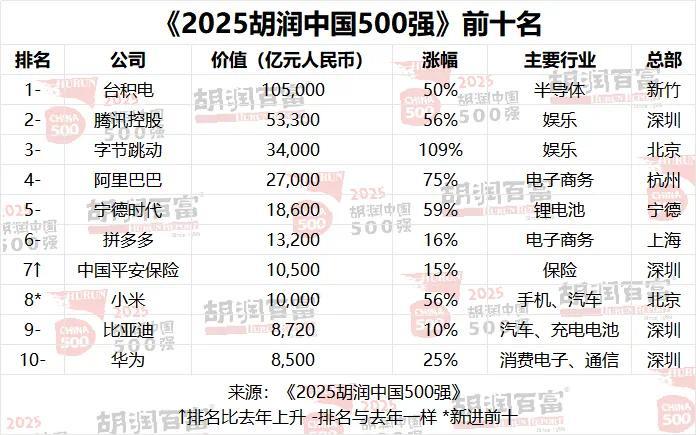
《2025胡润中国500强》发布:台积电、腾讯、字节位列前三,小米新进前十
Jin Rong Jie· 2026-02-05 04:00
Core Insights - The 2025 Hurun China 500 list shows significant growth in company valuations, with TSMC leading as the highest valued private enterprise in China at 10.5 trillion RMB, an increase of 3.5 trillion RMB [1][2] - Tencent and ByteDance follow in second and third place, with valuations of 5.3 trillion RMB (up 1.9 trillion RMB) and 3.4 trillion RMB (up 1.8 trillion RMB) respectively [1][2] - Xiaomi enters the top ten for the first time, ranking eighth with a valuation of 1 trillion RMB, an increase of 357 billion RMB [1][2] - Meituan drops out of the top ten, now ranked 17th [1] Company Summaries - TSMC: Valuation of 10.5 trillion RMB, growth of 3.5 trillion RMB, leading in the semiconductor industry [1][2] - Tencent: Valuation of 5.3 trillion RMB, growth of 1.9 trillion RMB, operating in the entertainment sector [1][2] - ByteDance: Valuation of 3.4 trillion RMB, growth of 1.8 trillion RMB, also in the entertainment industry [1][2] - Xiaomi: New entry in the top ten with a valuation of 1 trillion RMB, growth of 357 billion RMB, involved in consumer electronics and automotive [1][2] - Meituan: Dropped to 17th place, indicating a decline in valuation or market position [1] Industry Insights - The total value of the Hurun China 500 companies increased by 21 trillion RMB (38%) to reach 77 trillion RMB [2] - The semiconductor industry, led by companies like TSMC, saw the most growth, surpassing the life sciences sector to become the second largest industry in the list [2] - The industrial products sector remains the largest, while the life sciences sector ranks third [2]






2025胡润中国500强榜单发布,有101家企业将主要研发基地设在上海
Xin Lang Cai Jing· 2026-02-05 03:43
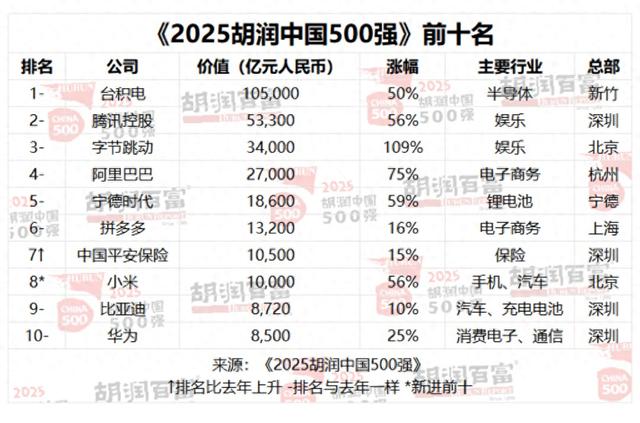
Core Insights - The "2025 Hurun China 500" list highlights the top non-state-owned enterprises in China ranked by their value, marking the seventh consecutive release of this report by Hurun Research Institute [1] Group 1: Company Rankings and Values - TSMC retains its position as the highest-valued private enterprise in China with a value of 1.05 trillion RMB, an increase of 350 billion RMB [1][2] - Tencent ranks second with a value of 530 billion RMB, up by 190 billion RMB [1][2] - ByteDance holds the third position with a value of 340 billion RMB, increasing by 180 billion RMB [1][2] - Alibaba, CATL, Pinduoduo, Ping An Insurance, Xiaomi, BYD, and Huawei complete the top ten list, with notable value increases ranging from 10% to 109% [2][3] Group 2: Overall Market Trends - The threshold for entering the top 500 has risen by 7.5 billion RMB to 34 billion RMB, reflecting a 28% increase [3] - The total value of the top 500 companies has grown by 21 trillion RMB, a 38% increase, reaching 77 trillion RMB [3] - Among the listed companies, 386 experienced value growth, including 95 new entrants, while 102 saw a decline [3] Group 3: Industry Insights - 75% of the top 500 companies provide physical products, while 25% offer software or services [3] - The semiconductor, media and entertainment, industrial products, and consumer goods sectors account for half of the total value of the Hurun China 500 [3] Group 4: Geographic Distribution - Beijing, Shanghai, and Shenzhen are the top three cities with the most companies in the Hurun China 500, with 59, 57, and 49 companies respectively [5] - Shanghai has the highest number of R&D bases with 101 companies, followed by Beijing and Shenzhen with 66 and 61 respectively [6][5] - The Yangtze River Delta region has 161 companies in the top 500, representing 32% of the total, while the Guangdong-Hong Kong-Macau Greater Bay Area has 108 companies, accounting for 22% [7]
甘南监管分局同意撤销中国平安甘南中心支公司
Jin Tou Wang· 2026-02-05 03:42
2026年2月4日,国家金融监督管理总局甘南监管分局发布批复称,《中国平安(601318)人寿保险股份 有限公司甘肃分公司关于撤销中国平安人寿保险股份有限公司甘南中心支公司的请示》(平保寿甘分发 〔2026〕8号)材料收悉。经审核,现批复如下: 一、同意撤销中国平安人寿保险股份有限公司甘南中心支公司。 二、接此批复文件后,中国平安人寿保险股份有限公司应立即停止一切经营活动,于15个工作日内向国 家金融监督管理总局甘南监管分局缴回许可证,并按照有关法律法规要求办理相关手续。 ...
沪深300ESGETF南方(560180)跌0.59%,半日成交额126.90万元
Xin Lang Cai Jing· 2026-02-05 03:37
Group 1 - The core point of the article highlights the performance of the HuShen 300 ESG ETF managed by Southern Fund Management, which has seen a return of 19.34% since its inception on April 13, 2023, and a return of 1.57% over the past month [1] - As of the midday close on February 5, the HuShen 300 ESG ETF (560180) fell by 0.59%, trading at 1.184 yuan with a transaction volume of 1.269 million yuan [1] - The top holdings of the ETF include Kweichow Moutai, which rose by 1.41%, and Zijin Mining, which fell by 5.29%, indicating mixed performance among its key stocks [1] Group 2 - The ETF's performance benchmark is the HuShen 300 ESG Index return rate, indicating its focus on sustainable investment [1] - The fund manager is Southern Fund Management Co., Ltd., with Li Jialiang serving as the fund manager [1]




2025胡润中国500强:最具价值国企前三名为农业银行、工商银行、国家电网
Xin Lang Cai Jing· 2026-02-05 03:06
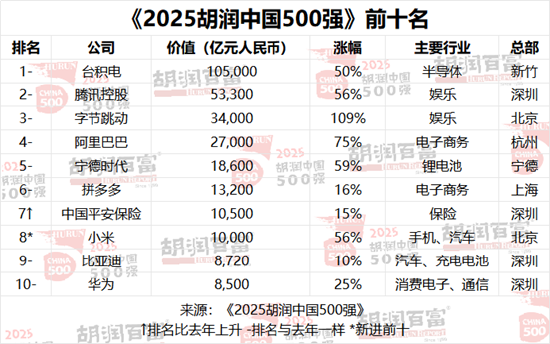
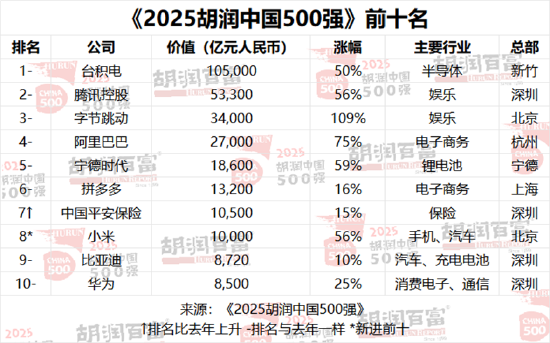
Core Insights - The "2025 Hurun China 500" report highlights TSMC as the highest-valued private enterprise in China, with a valuation increase of 3.5 trillion RMB, reaching 10.5 trillion RMB [1][4] - Tencent follows as the second highest, with a valuation growth of 1.9 trillion RMB, totaling 5.3 trillion RMB [1][4] - ByteDance ranks third, increasing its value by 1.8 trillion RMB to 3.4 trillion RMB [1][4] - Xiaomi enters the top ten for the first time, with a valuation increase of 357 billion RMB, reaching 1 trillion RMB [1][4] Top Ten Private Enterprises - TSMC: Valuation of 105,000 million RMB, growth of 50% [2][5] - Tencent: Valuation of 53,300 million RMB, growth of 56% [2][5] - ByteDance: Valuation of 34,000 million RMB, growth of 109% [2][5] - Alibaba: Valuation of 27,000 million RMB, growth of 75% [2][5] - CATL: Valuation of 18,600 million RMB, growth of 59% [2][5] - Pinduoduo: Valuation of 13,200 million RMB, growth of 16% [2][5] - Ping An Insurance: Valuation of 10,500 million RMB, decline of 15% [2][5] - Xiaomi: Valuation of 10,000 million RMB, growth of 56% [2][5] - BYD: Valuation of 8,720 million RMB, growth of 10% [2][5] - Huawei: Valuation of 8,500 million RMB, growth of 25% [2][5] Top Ten State-Owned Enterprises - Agricultural Bank: Valuation of 202,000 million RMB [3][6] - Industrial and Commercial Bank: Valuation of 274,000 million RMB [3][6] - State Grid: Valuation of 266,000 million RMB [3][6] - China National Railway Group: Valuation of 224,000 million RMB [3][6] - China Construction Bank: Valuation of 203,000 million RMB [3][6] - Kweichow Moutai: Valuation of 182,000 million RMB [3][6] - China Petroleum: Valuation of 176,000 million RMB [3][6] - Bank of China: Valuation of 170,000 million RMB [3][6] - China Mobile: Valuation of 175,000 million RMB [3][6] - CITIC Group: Valuation of 156,000 million RMB [3][6]


2025胡润中国500强发布:寒武纪价值增长3700亿元,位列第16
Xin Lang Cai Jing· 2026-02-05 03:04
来源:5D调查 胡润研究院发布2月5日发布《2025胡润中国500强》,台积电价值增长3.5万亿元,以10.5万亿元再度蝉 联中国价值最高的民营企业。腾讯价值增长1.9万亿元,以5.3万亿元稳居第二。字节跳动价值增长1.8万 亿元,以3.4万亿元保持第三。小米新进前十,价值增长3570亿元,以1万亿元位列第八。 | | | | 《2025胡润中国500强》 前十名 | | | | | --- | --- | --- | --- | --- | --- | --- | | 排名 | 公司 | 价值(亿元人民币) | | 涨幅 | 三是得行业 | SHI | | | 合肥皂 | alle Par 200 - 100, 000 | | 50% | | | | 2- | 腾讯控股 | 53,300 | | 56%500 | 娱乐 | 深圳 | | 3- | 字节跳动 | 34,000 | | 109% | 娱乐 | 北京 | | 4- | 阿里巴巴 | 27,000 | | 75% | 电子商务 | 杭州 | | | 宁德时代 | 18,600 | 1981-1991 | 59% | 一理申池 | 宁德 | | | ...

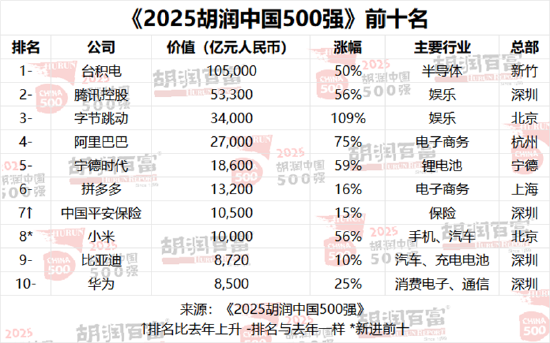
2025胡润中国500强发布:台积电、腾讯、字节跳动位列前三
Xin Lang Cai Jing· 2026-02-05 02:27
Core Insights - The 2025 Hurun China 500 list shows significant growth in company valuations, with TSMC leading as the highest valued private enterprise in China at 10.5 trillion RMB, followed by Tencent and ByteDance [1][9]. Company Performance - TSMC's value increased by 3.5 trillion RMB, driven by strong demand for artificial intelligence, advanced process technology, and a solid market position [3][11]. - Tencent's valuation rose by 1.9 trillion RMB, attributed to strong performance in gaming, advertising, and fintech [3][11]. - ByteDance's value grew by 1.8 trillion RMB, benefiting from advancements in AI [3][11]. - Alibaba's value increased by 1.2 trillion RMB, due to strategic investments in AI and cloud computing, alongside a recovery in traditional e-commerce [4][12]. - CATL's valuation rose by 690 billion RMB, supported by sustained demand in the electric vehicle market [4][12]. - Xiaomi entered the top ten with a valuation increase of 357 billion RMB, driven by growth in its automotive business and premium smartphone sales [4][12]. - Other notable companies include Cambricon, which saw a valuation increase of 370 billion RMB, and NetEase, which grew by 238 billion RMB due to strong gaming performance [4][12]. Industry Trends - The total value of the Hurun China 500 companies increased by 21 trillion RMB (38%) to reach 77 trillion RMB [2][10]. - The semiconductor industry experienced the most significant growth, surpassing the life sciences sector to become the second-largest industry in the list, while industrial products remained the largest [2][10]. - The real estate sector faced the largest decline, followed by retail [2][10]. - The average age of the top 500 companies is 29 years, indicating a relatively young corporate landscape [11]. Geographic Insights - Beijing, Shanghai, and Shenzhen are the top three cities with the most companies on the list, housing 59, 57, and 49 companies respectively [2][10]. - Suzhou emerged as the preferred manufacturing base with 68 companies, while Shanghai was the leading research and development hub with 101 companies [2][10]. New Entrants and Market Dynamics - A total of 95 companies (19%) made it to the list for the first time, with seven companies valued over 100 billion RMB [2][10]. - The threshold for entry into the 2025 Hurun China 500 increased by 7.5 billion RMB to 34 billion RMB, reflecting a 28% rise [2][10].



大摩闭门会-金融-房地产-化工行业更新
2026-02-05 02:21
Summary of Key Points from Conference Call Industry Overview Real Estate Market - The liquidity in the real estate market is constrained by sales rather than financing, with residents holding a pessimistic view on leveraging and housing prices. The cancellation of the "three red lines" has limited impact [1][3] - Recent increases in the real estate sector are primarily driven by market sentiment and capital rotation, with expectations of a pullback in February and March due to decreased transaction volumes during the Spring Festival and a generally poor outlook for 2025 [1][5] - Companies like Longfor, Greentown, and Jinmao may issue profit warnings due to expected underperformance [5] Recommendations - Companies to watch include China Resources Land and Xincheng Holdings, which are expected to benefit from commercial real estate operations and domestic demand stimulus policies. China Resources' performance in 2025 may not meet expectations, but growth in 2026 and 2027 is anticipated [1][6] Banking and Insurance Sector - The banking sector is starting the year rationally, with reasonable GDP growth across provinces supporting stable development. Strong sales in funds and insurance are beneficial for the market environment [1][7] - The insurance sector is expected to continue its growth trajectory, driven by strong sales, high profit margins, and good investment returns. Ping An Group aims for a mid-term ROE of over 15% through asset management loss reduction and improved life insurance profitability [1][8][10] Future Outlook for Insurance - The insurance industry is projected to maintain rapid growth in 2026, supported by expanded distribution networks and favorable regulatory policies [9] Chemical Industry - Recent stock performance in the chemical sector has exceeded expectations, with price increases driven by capital rotation rather than fundamental improvements. Current valuations are at high percentiles within a 10-year range, while product prices remain low [1][21] - Downgrades for companies like Xinghecheng and Wanhua are warranted due to valuations exceeding reasonable levels, with expectations of a market correction in the short term [1][22][23] Specific Company Insights - Xinghecheng faces significant pressure in 2026 due to intense competition in the methionine market and low vitamin prices, while Wanhua's MDI prices are weaker than expected [23] Additional Insights - Futu Holdings is accelerating the integration of Tianxing Bank, increasing its stake to 68%, and plans to launch more integrated banking and securities products in 2026 [1][14] - AIA (AIA Group) is expected to perform strongly in 2025, with a positive outlook for 2026, supported by a rebound in the Chinese market and ongoing share buyback plans [1][15] - Futu is also making strides in the cryptocurrency space, with applications for licenses in multiple regions, including Hong Kong, to enhance customer experience [1][16] This summary encapsulates the key points discussed in the conference call, highlighting the current state and future outlook of the real estate, banking, insurance, and chemical industries, along with specific company insights and recommendations.




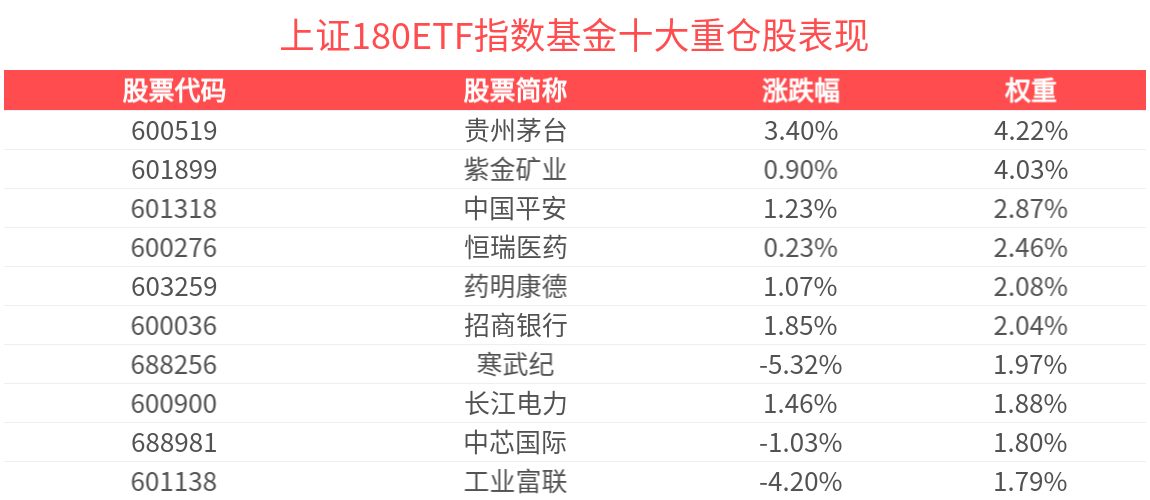
上证180指数上涨1.01%,上证180ETF指数基金(530280)备受关注
Xin Lang Cai Jing· 2026-02-05 01:40
Group 1 - The stock market style may be changing, with a notable adjustment in US tech stocks, including Oracle's price dropping nearly 60% from its peak and SNDK experiencing a significant decline [1] - A-shares may see a shift in style, with banks and dividend stocks potentially outperforming, leading to a focus on quality banks such as Jiangsu Bank, Nanjing Bank, Hangzhou Bank, Ningbo Bank, and China Merchants Bank for potential gains [1] - As of February 4, 2026, the Shanghai 180 Index (000010) rose by 1.01%, with component stocks like JinkoSolar up 20.00%, Yanzhou Coal Mining up 10.01%, and China Shenhua Energy also seeing gains [1] Group 2 - The Shanghai 180 ETF index fund (530280) has seen a net value increase of 14.84% over the past six months, with a maximum monthly return of 9.13% since inception [2] - The fund has a historical average monthly return of 3.08% and a 100% probability of profitability over one year, with a Sharpe ratio of 2.08 as of January 30, 2026 [2] - The fund's maximum drawdown this year is 4.28%, with a management fee of 0.15% and a custody fee of 0.05% [2] Group 3 - As of January 30, 2026, the top ten weighted stocks in the Shanghai 180 Index include Zijin Mining, Kweichow Moutai, China Ping An, and others, collectively accounting for 24.85% of the index [3] - The individual weightings of these stocks vary, with Kweichow Moutai at 4.22% and China Ping An at 2.87% [4]