PICC(601319)

Search documents
中国保险 - 2025 年上半年预览,新业务价值增长强劲,产险综合成本率优化,寿险与产险盈利趋势分化-China Insurance_ 1H25E Preview_ Robust NBV Growth; Enhanced P&C CoR; Diverged Earnings Trends Between Life & P&C
2025-08-11 02:58
Summary of Key Points from the Conference Call Industry Overview - The conference call focuses on the Chinese insurance industry, particularly life and property & casualty (P&C) insurance sectors, with insights into the expected performance for the first half of 2025 (1H25E) [1][2][3]. Core Insights and Arguments Life Insurance Sector - **Robust NBV Growth**: Life insurers in China are expected to report a robust new business value (NBV) growth of 18% to 43% year-over-year (yoy) in 1H25E, primarily driven by: - Strong momentum in the bancassurance channel as banks seek enhanced returns on maturing deposits [2][8]. - Margin expansion due to a pricing rate cap cut in Q3 2024 and expense rationalization across the agency channel [2][8]. - **Leading Companies**: - PICC Life is projected to lead with a 43% yoy NBV growth, followed by Ping An Life and New China Life at 39% each, and CPIC Life at 31% [2][8]. - Taiping Life and China Life are expected to have softer growth at 26% and 18% yoy, respectively, due to a focus on shifting towards par products [2][8]. Property & Casualty (P&C) Insurance Sector - **Improvement in CoR**: Traditional P&C insurers are anticipated to see a year-over-year improvement in the combined ratio (CoR) by 0.9 to 2.0 percentage points (ppt) in 1H25E, attributed to normalized natural catastrophe (NAT CAT) trends, with economic losses from catastrophes declining by 46% yoy to RMB 54 billion [3][9]. - **Top Players' Performance**: - The top three players, PICC P&C, Ping An P&C, and CPIC P&C, are expected to see CoR enhancements to 95.3%, 95.8%, and 96.1%, respectively [3][9]. Earnings Trends - **Diverging Earnings Growth**: Earnings trends are expected to diverge between life and P&C insurers in 1H25E: - P&C-focused players are forecasted to enjoy higher earnings growth, with PICC P&C and PICC Group expected to see net profit growth of 29% and 20% yoy, respectively [4][10]. - Life insurers are expected to have varied growth, with NCI leading at 25% yoy, followed by CTIH at 15%, while Ping An is projected to decline by 8% yoy [4][10]. Additional Important Insights - **Market Reactions and Ratings**: - China Life Insurance has been placed under a negative catalyst watch due to concerns that its 1H25E earnings growth may fall below expectations, with a forecasted modest growth of 5% yoy [25][26]. - Conversely, China Pacific Insurance and Ping An Insurance are under positive catalyst watches, with expectations of decent NBV growth and CoR improvements [27][29]. - **Investment Strategies**: - Analysts maintain a "Buy" rating for several companies, including China Life and China Pacific, citing strong brand recognition and growth potential from ongoing reforms in the life insurance sector [83][92]. Conclusion - The Chinese insurance industry is poised for significant growth in both life and P&C sectors in 1H25E, driven by strategic shifts in sales channels and improved operational efficiencies. However, earnings performance may vary significantly across different companies, highlighting the importance of careful stock selection in this sector.





人保寿险临沂中支代表队参加临沂市2025年保险业职工羽毛球比赛荣获团体二等奖
Qi Lu Wan Bao· 2025-08-11 02:55
Core Viewpoint - The event successfully showcased the spirit and skills of employees in the insurance industry through sports competitions, enhancing team cohesion and employee engagement [1][3]. Group 1: Event Overview - The 2025 Linyi City Insurance Industry Employee Table Tennis and Badminton Competition was held on July 29, 2025, to enrich the cultural and sports life of insurance employees [1]. - Employees from the People's Insurance Company of China (PICC) Linyi branch actively participated in the badminton event, led by Li Nan [1]. Group 2: Performance Highlights - The PICC Linyi branch athletes demonstrated strong skills, with Li Nan and Liang Bo winning second place in men's doubles, and Li Nan and Xu Guanlan securing third place in mixed doubles [3]. - The team also achieved fourth place in mixed doubles with the pairing of Yao Yimei and Liang Bo, contributing to the overall second place in the team category for the competition [3]. Group 3: Impact on Employees - The competition provided a platform for employees to showcase their skills and foster communication, effectively enriching their cultural and sports life [3]. - Participants expressed their intention to translate the competitive spirit from the sports arena into their work, aiming to contribute more to the company's high-quality development [3].


一周快讯丨300亿央企母基金正式落地;杭州上城区落地一支S基金;100亿,安徽人保基金成立;信宸资本募集45亿并购基金
FOFWEEKLY· 2025-08-10 06:20
Core Viewpoints - Recent announcements from various regions in China indicate a significant focus on establishing mother funds targeting sectors such as aerospace, new energy, new materials, intelligent manufacturing, digital economy, high-end manufacturing, and fashion light industry [2][5][29] - The establishment of the Central Enterprise Venture Capital Mother Fund marks a new phase in investment operations, with a total planned scale of 300 billion yuan, focusing on hard technology investments [5][6] - The recent policy initiatives from the central bank and other departments aim to enhance venture capital by introducing long-term funds and developing patient capital to accelerate the transformation of technological achievements [29][30] Fund Establishments - The Chengtong Science and Technology Investment Fund has completed its registration, with a total planned scale of 300 billion yuan and an initial scale of 100 billion yuan, focusing on hard technology investments [5][6] - The Zhejiang Zhanxing Industrial Relay Fund has been established with a target scale of 50 billion yuan, focusing on artificial intelligence, robotics, new energy vehicles, and new materials [2][12] - The Xiangxi Jin Furong Industrial Development Guidance Mother Fund has been launched with a total scale of 10 billion yuan, targeting ecological cultural tourism, specialty agriculture, and new energy industries [9][10] Policy Support - The People's Bank of China and six other departments have released 18 opinions to support the enhancement of industrial technology innovation capabilities and the resilience of supply chains [29][30] - Beijing's government has introduced measures to encourage local government and state-owned enterprise funds to invest in future industries, allowing for normal investment risks [32][33] - The Guangxi government plans to establish an artificial intelligence industry fund with a minimum scale of 100 billion yuan, focusing on enhancing financial support for AI-related enterprises [16][17] Investment Strategies - The Chengtong Fund aims to invest in leading technology enterprises and small to medium-sized enterprises in the industrial chain, with a focus on long-term investments [6] - The Nanjing Xinghe Investment Fund is set to focus on aerospace, new energy materials, intelligent manufacturing, and digital economy sectors, with a scale of 5 billion yuan [11][12] - The Anhui Huazhong Jianyuan Equity Investment Fund has been established with a focus on strategic emerging industries, including artificial intelligence and new energy vehicles, with an initial scale of 10 billion yuan [13][14] Market Trends - The establishment of various mother funds across different regions indicates a growing trend towards collaborative investment strategies that leverage government, enterprise, and market resources [2][5][12] - The recent fundraising activities, such as the over 45 billion yuan raised by Xincheng Capital for a new RMB merger fund, highlight the increasing interest in private equity investments despite market challenges [23][24] - The focus on hard technology and strategic emerging industries reflects a broader shift in investment priorities towards sectors that promise high growth potential and innovation [5][6][13]

保险行业周报(20250804-20250808):2024年分红落地,当前哪只保险股更契合“高股息”标签?-20250810
Huachuang Securities· 2025-08-10 06:01
Investment Rating - The report maintains a "Recommended" rating for the insurance sector, indicating an expectation of the industry index outperforming the benchmark index by more than 5% in the next 3-6 months [20]. Core Insights - The total cash dividends for the five major listed insurance companies in 2024 reached CNY 90.789 billion, reflecting a year-on-year increase of 20.2% [2]. - The report highlights that the dividend growth for listed insurance companies in 2024 varies, with New China Life Insurance showing the highest growth rate at 197%, driven by a 201% increase in net profit attributable to shareholders [3]. - The report notes a general decline in the dividend payout ratio among listed insurance companies in 2024, attributed to the inclusion of significant unrealized gains in net profit, leading to a cautious adjustment of dividend ratios [3]. - The report emphasizes that the investment performance of the insurance sector in 2024 will largely depend on equity market performance and the expected adjustments in interest rates [4]. Summary by Sections Market Performance - The insurance index increased by 0.46% during the week, underperforming the broader market by 0.77 percentage points [1]. - Individual stock performances varied, with AIA up by 3.15% and ZhongAn down by 3.61% [1]. Dividend Policies - The report discusses the dividend policies of listed insurance companies, noting that Ping An and China Pacific Insurance base their dividends on operating profit, excluding short-term investment fluctuations [3]. - The estimated dividend payout ratios for Ping An and China Pacific Insurance are 41.6% and 33%, respectively, based on their operating profits [3]. Valuation Metrics - The report provides price-to-earnings (PE) and price-to-book (PB) ratios for major insurance companies, with China Ping An rated as "Strong Buy" and China Life Insurance, New China Life, and China Property & Casualty rated as "Recommended" [9]. - The report lists the highest dividend yields among A and H shares, with New China Life leading at over 5% [4]. Future Outlook - The report anticipates that the overall performance of the insurance sector in 2024 will be influenced by equity market trends and the growth of new business value (NBV) [4]. - The report suggests that investment strategies may favor Ping An, China Pacific Insurance, and China Property & Casualty due to their stable dividend policies [4].
应对甘肃榆中山洪灾害,人保财险已支付预赔款130万元
Bei Jing Shang Bao· 2025-08-09 12:45
Core Viewpoint - The article reports on the severe mountain flood disaster in Yuzhong County, Lanzhou City, Gansu Province, caused by continuous heavy rainfall, resulting in significant casualties and property damage [1] Company Response - As of noon on August 8, China Pacific Insurance (CPIC) has paid out pre-compensation of 1.3 million yuan for the flood disaster and deployed 40 rescue personnel and 8 rescue vehicles to assist local government efforts [1] - CPIC has launched 22 emergency response service measures, including the establishment of a green channel for disaster claims, providing 24/7 insurance claim consultation services, and offering indiscriminate rescue support to the public [1]
寿险公司久期缺口观察:成因,现状和应对
ZHONGTAI SECURITIES· 2025-08-09 07:52
Investment Rating - The report maintains an "Overweight" rating for the insurance industry [2] Core Insights - The average duration gap in the insurance industry is approximately -7 years, with a trend of widening expected post-2024, particularly in the life insurance sector [5][21] - Large insurance companies generally maintain a duration gap around -5 years, while small to medium-sized insurers exhibit a widening gap, indicating a disparity in asset-liability management [5][21] - The report emphasizes the importance of managing duration gaps to mitigate interest rate risks and reinvestment risks, especially in a low-interest-rate environment [5][21] Summary by Sections 1. Introduction: Duration Gap in Insurance Asset-Liability Matching - Duration gap refers to the difference between asset duration and liability duration, categorized into various types [9] - The report highlights the increasing duration gap due to the issuance of long-term savings products by life insurers [9][10] 2. Calculation of Duration Gap and Industry Data Statistics - The average duration gap for life insurance companies from 2020 to 2022 was -6.67 years, -6.57 years, and -6.28 years, respectively [21] - The report identifies a trend where over 65% of companies have seen their duration gaps widen, with many experiencing an increase of over 2 years [23][26] 3. Significance and Measures for Duration Gap Management - Effective duration gap management is crucial for balancing asset-liability management in insurance companies [5] - Suggested measures to narrow the duration gap include increasing allocations to long-term bonds, developing long-term equity investments, and adjusting product structures to enhance liability duration [5][21] 4. Investment Recommendations - The report suggests focusing on companies like New China Life, Ping An, AIA, China Life, China Pacific, and PICC, which are well-positioned to benefit from the dual dividend attributes of insurance stocks [5][21]
LP周报丨80亿,险资大佬又出手了
投中网· 2025-08-09 02:30
Core Viewpoint - The article highlights the increasing involvement of insurance capital in local economic development through the establishment of various funds, particularly emphasizing the collaboration between insurance companies and local governments to create investment opportunities and stimulate growth in specific industries [6][7]. Fund Establishment - Anhui Renbao Fund, with a total scale of 10 billion RMB, was established with significant contributions from China Insurance, which invested 8 billion RMB [6][13]. - The Zhejiang Zhanxing Industry Relay Fund, targeting a scale of 5 billion RMB, has successfully completed its first phase of fundraising [14]. - The Shaanxi Future Low-altitude Industry Investment Fund was established with a capital of 1.5 billion RMB, focusing on the low-altitude economy [15]. - The Hubei Xianning High-tech Industry Regional Mother Fund was launched with a total scale of 3 billion RMB, aimed at supporting local industrial development [19]. - The Nanning Qiang Chain No.1 Aluminum Industry Development Fund was established with a capital of 822 million RMB, focusing on the aluminum industry [20]. Fundraising Dynamics - Haichuan Capital completed the first closing of its main RMB fund, exceeding 300 million RMB, with a significant portion of LPs coming from industrial players [9]. - Xincheng Capital announced the successful fundraising of over 4.5 billion RMB for its new RMB merger fund, with over 70% of the LPs being insurance capital [11]. Investment Trends - Insurance capital is increasingly collaborating with local government funds, which is expected to become a trend in the primary market, providing essential liquidity [7]. - The establishment of S funds is gaining attention as a response to the challenges of exiting in the primary market, with various local governments actively promoting such initiatives [14]. GP Recruitment - Nanjing is seeking market-oriented fund management institutions for its 500 million RMB investment fund, focusing on sectors like aerospace, new energy materials, and digital economy [25]. - The Xiangxi Jin Furong Industry Development Guiding Mother Fund is also open for GP selection, targeting a total scale of 1 billion RMB for various emerging industries [26].

寿险公司的负债成本改善几何?
Guolian Minsheng Securities· 2025-08-08 12:21
Investment Rating - The report maintains an "Outperform" rating for the insurance industry [1]. Core Insights - The report highlights that the improvement in liability costs for life insurance companies is expected to alleviate the pressure from interest rate differentials, driven by regulatory guidance and market conditions [15][19]. - The report emphasizes the significant decline in the break-even yield for new business value (NBV) and value of in-force (VIF) across various life insurance companies, indicating a trend of improving profitability [10][14]. Summary by Sections Current Liability Costs of Life Insurance Companies - The break-even yield for NBV has marginally decreased for major life insurance companies in 2024, influenced by lower guaranteed rates and improved channel cost efficiency [10][14]. - The NBV break-even yields for major companies in 2024 are as follows: China Life (2.43%), Ping An Life (2.42%), and China Pacific Life (2.60%) [9]. - The VIF break-even yields show a mixed trend, with China Life at 2.44% and Ping An Life at 2.50% in 2024, reflecting varying performance across companies [12][14]. Future Liability Cost Trends - Regulatory initiatives are pushing for a unified commission structure across distribution channels, which is expected to lower channel costs and improve liability costs [25][29]. - The continuous reduction in the guaranteed rates for life insurance products since August 2023 is anticipated to further decrease the liability costs for new and existing policies [29][30]. - Life insurance companies are actively adjusting their product offerings, focusing on dividend products to enhance profitability and reduce fixed liability costs [36][39]. Investment Recommendations - The report recommends maintaining an "Outperform" rating for the insurance industry, citing improvements in liability costs and potential for enhanced net profit due to favorable investment conditions [45][48]. - Specific companies highlighted for investment include China Pacific Insurance, China Life, and Ping An Insurance, based on their strong fundamentals and ability to adapt to market changes [48].
“监事会”渐次消失 保险公司治理生变
Jin Rong Shi Bao· 2025-08-08 08:53
Core Viewpoint - The implementation of the new Company Law in China has led insurance companies to abolish their supervisory boards, transitioning towards a more streamlined and efficient governance model [1][4]. Group 1: Changes in Governance Structure - China People's Property Insurance Company announced it will not establish a supervisory board, with the relevant powers transferred to the audit committee of the board of directors [1]. - Several insurance institutions, including listed companies and foreign insurance firms, have announced the dissolution of their supervisory boards this year [1]. - On July 30, China Pacific Insurance Group also confirmed it will no longer have a supervisory board, delegating those responsibilities to the audit and related party transaction control committee [1]. Group 2: Legal Framework and Implications - The revised Company Law, effective from July 1, 2024, allows state-owned companies to set up an audit committee within the board to exercise the powers of a supervisory board, eliminating the need for a supervisory board [3]. - The Financial Regulatory Bureau issued a notice in December 2024, clarifying that financial institutions can establish an audit committee within the board to perform the supervisory functions as per the new Company Law [4]. Group 3: Professional Oversight and Challenges - The audit committee, typically composed of independent directors, is expected to enhance financial oversight and compliance compared to traditional supervisory boards [4]. - However, independent directors may face challenges such as information asymmetry and insufficient time to fulfill their supervisory roles effectively [4]. - The cancellation of supervisory boards raises questions about maintaining oversight functions and balancing decision-making efficiency with power checks, which will need to be explored in practice [5].
保险板块8月8日跌1.07%,XD新华保领跌,主力资金净流出5.19亿元
Zheng Xing Xing Ye Ri Bao· 2025-08-08 08:35
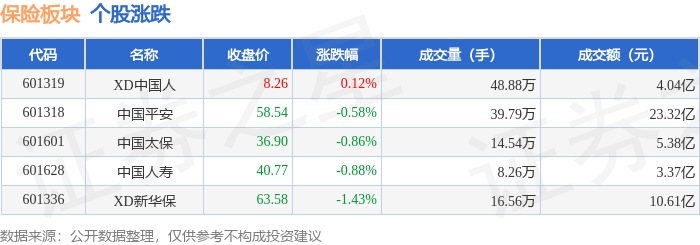
证券之星消息,8月8日保险板块较上一交易日下跌1.07%,XD新华保领跌。当日上证指数报收于 3635.13,下跌0.12%。深证成指报收于11128.67,下跌0.26%。保险板块个股涨跌见下表: | 代码 | 名称 | 收盘价 | 涨跌幅 | 成交量(手) | 成交额(元) | | --- | --- | --- | --- | --- | --- | | 601319 | XD中国人 | 8.26 | 0.12% | 48.88万 | 4.04亿 | | 601318 | 中国平安 | 58.54 | -0.58% | 39.79万 | 23.32亿 | | 601601 | 中国太保 | 36.90 | -0.86% | 14.54万 | 5.38亿 | | 601628 | 中国人寿 | 40.77 | -0.88% | 8.26万 | 3.37 Z | | 601336 | XD新华保 | 63.58 | -1.43% | 16.56万 | 10.61亿 | 从资金流向上来看,当日保险板块主力资金净流出5.19亿元,游资资金净流入5519.42万元,散户资金净 流入4.64亿元。保险板块个股资金流 ...