
PICC(601319)

Search documents
开发专属产品,强化风险保障——保险业与市场主体齐力抗疫
Xin Hua Wang· 2025-08-12 06:26
北京银保监局财险处副处长王学梅介绍,2022年一季度,北京辖内保险公司各项业务总体实现平稳 增长,累计实现原保险保费收入925.25亿元,同比增长11.66%;行业累计承担风险保障661.73万亿元, 同比增长85.63%,累计赔付支出247.33亿元,同比增长21.23%,充分发挥保险风险分担和经济补偿作 用。 北京保险行业协会副秘书长邵艳介绍,针对餐饮等关乎消费者民生保障的行业,保险机构除专项定 制了"一揽子"产品以外,还对因确诊病例或密接被迫关停,或因防控关停的餐饮企业,在营业中断期间 提供一定的损失保障,成为企业的安全后盾。 据中国人保集团总裁王廷科介绍,中国人保助力企业克服疫情影响,积极开发抗疫专属保险产品, 与北京市朝阳区政府共同推出"朝阳区服务型企业疫情防控保险",为因确诊病例或密切接触者接触导致 区级及以上政府要求关停的餐饮、零售等服务型企业员工可能面临的停薪风险提供基础保险保障。截至 4月底,累计覆盖6.2万家企业,承保约74万人,陆续完成约250家企业、1200余人的赔款支付工作,共计 赔付金额135万余元。 记者在采访中了解到,中国人保积极发展新冠疫苗接种异常反应保险,人保健康从2020 ...

低位加仓看好中长期发展 上市险企“点金”权益市场
Xin Hua Wang· 2025-08-12 06:19
Core Viewpoint - Insurance funds are significant institutional investors in the capital market, but the investment yield of major listed insurance companies in A-shares has decreased due to low long-term interest rates and market volatility, with future equity asset allocation expected to focus on sectors like consumption, technology, and new energy [1][2][4]. Group 1: Investment Performance - In the first half of the year, the total investment yield of the five major insurance companies decreased by 15.7% year-on-year, totaling 252.43 billion yuan [2][3]. - The total investment yield rates for the five major insurance companies as of June were: China Life Insurance at 5.5%, China Pacific Insurance at 4.21%, New China Life at 4.2%, China Taiping at 3.9%, and Ping An Insurance at 3.1%, all showing a decline compared to the previous year [2][3]. - The total investment assets of the five major insurance companies reached 13.56 trillion yuan, an increase of 6.57% from the beginning of the year [2]. Group 2: Future Investment Strategy - Insurance companies are optimistic about the strategic value of equity markets in the second half of the year, with expectations of economic resilience and gradual recovery driven by infrastructure investment [4][6]. - The focus for future investments will be on sectors such as consumption, technology, new energy, and healthcare, with a positive outlook on equity investments [6][7]. - Regulatory bodies have encouraged insurance funds to invest more in equity assets, emphasizing the importance of long-term investments to support the real economy [4][5]. Group 3: Investment Principles - Insurance companies are advised to prioritize principles over rigid plans, focusing on asset-liability matching and employing a barbell strategy to balance stable fixed-income investments with riskier assets [7]. - A diversified investment portfolio is recommended to achieve long-term stable returns across cycles [7].


A股五大上市险企去年保费合计增长2.9% 寿险收入“四负一正”
Xin Hua Wang· 2025-08-12 05:54
Group 1 - The core viewpoint of the articles highlights the performance of the five major listed insurance companies in China, with a total premium income of 25,597.63 billion yuan in 2022, reflecting a year-on-year growth of 2.9% [1] - China Life and New China Life experienced declines in premium income, while China Pacific Insurance showed a significant increase of 8.4% in premium income, indicating a mixed performance in the life insurance sector [1][2] - The overall life insurance business faced challenges, with four companies reporting negative growth in premium income, while only China Pacific Insurance's life segment achieved positive growth [2] Group 2 - The non-life insurance segment demonstrated strong growth, with China Property & Casualty Insurance achieving a premium income of 4,854.34 billion yuan, a year-on-year increase of 8.3% [3] - The growth in the non-life insurance sector was attributed to the recovery of auto insurance premiums, which had previously been affected by comprehensive reforms [3] - Recent regulatory changes, such as the adjustment of the pricing coefficient for commercial auto insurance, are expected to further impact the market dynamics, with potential short-term negative effects on premiums and profitability [3]




日赚7.41亿元!上市险企集体亮成绩单
Xin Hua Wang· 2025-08-12 05:48
A股五大上市险企2023年中期业绩集体亮相。8月29日,北京商报记者统计发现,2023年上半年,中国 平安、中国人寿、中国太保、中国人保、新华保险五大A股上市险企合计归母净利润1341.88亿元,按可 比口径同比增长9.97%,日均赚约7.41亿元,去年同期日均赚6.74亿元。 中国人寿副总裁刘晖在该公司2023年中期业绩发布会上表示,近期研判了市场形势,股票市场方面,当 前的估值水平已经低于历史均值,下半年随着稳定经济政策落地,经济会持续恢复,股票市场的机会大 于风险。 业内人士分析认为,以寿险板块为例,寿险产品预定利率下调,刺激了市场需求,为今年上半年人身险 市场上行奠定了基础。随着保险业资产负债两端持续复苏,保险业复苏势头下半年预计还会延续。 盈利表现分化 仅两家实现正增长 今年上半年,保险市场再迎变局,监管引导人身险公司降低负债成本、车险"二次综改"实施、监管规范 车险市场秩序等。在此背景下,各家公司盈利表现颇受市场关注。 记者统计发现,上半年A股五大上市险企净利润表现有所分化,具体表现为"两升三降"。其中,新华保 险上半年净利润同比增长8.6%至99.78亿元;中国人保上半年净利润同比增长8.7%至 ...
新华保险分红暴增200%!五大上市险企2024年派现总额冲刺千亿元
Hua Xia Shi Bao· 2025-08-12 01:13
Core Viewpoint - The five major listed insurance companies in A-shares have distributed a total of 90.789 billion yuan in cash dividends for the year 2024, reflecting a year-on-year growth of 20.21%, indicating the industry's overall profitability and the increasing emphasis on investor returns under policy guidance [2][3]. Summary by Sections Dividend Distribution - The five major insurance companies have completed their dividend distributions for 2024, with a total payout of 90.789 billion yuan, marking a 20.21% increase from the previous year [2]. - New China Life Insurance's dividend plan stands out, with a cash dividend of 1.99 yuan per share, totaling 6.208 billion yuan, and a combined cash dividend of 7.893 billion yuan for 2024, showing a nearly 200% year-on-year increase [3]. - China Pacific Insurance distributed a cash dividend of 1.08 yuan per share, totaling 10.39 billion yuan, contributing to the overall dividend total of 86.318 billion yuan for the five companies [5]. Profitability and Financial Performance - The five major insurance companies reported a total investment income of 796.92 billion yuan for 2024, a year-on-year increase of 113.91%, and a net profit attributable to shareholders of 347.6 billion yuan, up 77.72% [5]. - The strong profitability provides a solid financial foundation for the increased dividends, with companies like Ping An maintaining a stable profit and market share, allowing for consistent shareholder returns [6]. Regulatory Environment and Strategic Implications - The implementation of the new "National Nine Articles" and the "Market Value Management Guidelines" has reshaped the dividend logic of insurance companies, linking dividend distributions to controlling shareholder reductions and refinancing access [2][7]. - The regulatory environment encourages companies to increase the frequency of dividends, which aligns with the policy direction and helps maintain a balance between dividend payouts and business development [2][6]. Divergence in Dividend Strategies - There is a notable divergence in dividend strategies among the five major insurance companies, with Ping An achieving a 13-year consecutive growth in dividends, while New China Life's dividends surged nearly 200% [5][6]. - The differences in dividend strategies may stem from varying short-term performance and long-term strategic positioning, with mature companies focusing on higher dividends and growth-stage companies prioritizing business expansion [6][8]. Challenges and Future Considerations - Despite the high growth in mid-term dividends, concerns about sustainability arise due to market competition and declining interest rates, which may necessitate a balance between dividends and capital adequacy [7][10]. - To transition mid-term dividends from an "encouragement policy" to a "common practice," further institutional support is needed, including tax incentives for long-term shareholders and improved profit adjustment mechanisms [9][10].

超2000亿元险资加速入市
2 1 Shi Ji Jing Ji Bao Dao· 2025-08-11 13:52
Core Viewpoint - The recent approval for China Taiping's subsidiary to establish a private equity fund management company marks a significant advancement in the long-term investment reform pilot for insurance funds, indicating an acceleration in insurance capital entering the market [2][4]. Group 1: Investment Reform Pilot - The long-term investment reform pilot for insurance funds has seen three batches of approvals, with a total scale of 222 billion yuan (approximately 31.5 billion USD) [4][5]. - The first batch was approved in October 2023, with China Life and Xinhua Life jointly investing 50 billion yuan [4]. - The second batch, initiated in January 2025, allowed several insurance companies to participate with a total scale of 520 billion yuan [5]. - The third batch, approved in March 2025, included additional participants with a total scale of 600 billion yuan [5]. Group 2: Investment Strategies and Trends - Insurance funds are increasingly favoring large-cap blue-chip stocks and high-dividend yielding companies, reflecting a shift towards stable and well-governed investment targets [7][9]. - The types of funds being established are diversifying, with both company-type and contract-type funds being utilized, enhancing the flexibility and standardization of fund management [7][8]. - The investment focus includes sectors such as finance, energy, public infrastructure, and new energy transitions, aligning with national economic development goals [9]. Group 3: Market Participation and Trends - Insurance capital has been actively participating in the stock market, with a notable increase in stock holdings, reaching a market value of 2.65 trillion yuan (approximately 375 billion USD) in the first quarter of 2024 [2][12]. - The number of equity stakes taken by insurance funds has surged, with 22 instances recorded in 2024 alone, surpassing the total for the previous year [11][12]. - The sectors attracting the most investment include public utilities and banking, characterized by stable returns and high dividend yields [11][12].

多家险企开启精简高效治理模式
Jin Rong Shi Bao· 2025-08-11 11:00
Core Viewpoint - The implementation of the new Company Law in China has led insurance companies to abolish their supervisory boards, transitioning towards a more streamlined and efficient governance model [1][3][4] Group 1: Changes in Governance Structure - China People's Property Insurance Company announced the abolition of its supervisory board following the approval of its revised articles of association [1] - Other insurance companies, including China Pacific Insurance and Taikang Insurance, have also announced the removal of their supervisory boards, with their supervisory functions being transferred to the audit committee of the board [2][4] - The new Company Law allows state-owned companies to establish an audit committee composed of directors to exercise the powers of the supervisory board, eliminating the need for a supervisory board [3] Group 2: Role of the Audit Committee - The audit committee, typically composed of independent directors, is responsible for reviewing financial information, overseeing internal and external audits, and evaluating internal controls [4] - The shift from a supervisory board to an audit committee is expected to enhance decision-making efficiency and reduce internal coordination complexities [4] - However, potential challenges include information asymmetry and time constraints faced by independent directors in fulfilling their supervisory roles [4] Group 3: Implications for Corporate Governance - The removal of the supervisory board raises questions about maintaining effective oversight and balancing decision-making efficiency with power checks [4] - As more insurance companies adjust their governance structures in line with the new Company Law, the industry will gain insights into creating a more scientific and efficient corporate governance system [4]
又一险资系私募获批,超两千亿“长钱”加速入市
2 1 Shi Ji Jing Ji Bao Dao· 2025-08-11 10:55
Core Insights - The recent approval for China Taiping's subsidiary to establish a private equity fund management company marks a significant step in the long-term investment reform pilot for insurance funds, aimed at increasing their participation in the stock market [1][2][3] - The total approved pilot scale for insurance funds has reached 222 billion yuan, with participation from major insurance companies, indicating a broadening of the investment landscape [2][3] - The trend shows a shift towards investing in large-cap blue-chip stocks with stable dividends, reflecting a strategic focus on long-term capital deployment [4][6][7] Investment Reform Pilot - The pilot program for long-term investment by insurance funds has seen three batches of approvals, with a total scale of 222 billion yuan, including 500 billion yuan from the first batch and 1.12 billion yuan from the second batch [2][3] - The third batch, approved in March 2025, included 600 billion yuan, further expanding the scope of insurance fund participation in the capital market [3] Fund Management and Strategy - Taiping Asset aims to establish a robust fund management framework, emphasizing long-term performance evaluation and investment strategies tailored to insurance capital [2] - The types of funds have diversified, with a mix of company-type and contract-type funds being utilized, enhancing operational flexibility [4] Investment Preferences - Insurance funds are increasingly favoring investments in large, well-governed companies with stable operations and dividends, such as Yili Group and China Telecom [5][6] - The focus on sectors like finance, energy, and public infrastructure aligns with national economic development goals [6] Market Activity and Trends - There has been a notable increase in insurance capital's market activity, with 22 instances of shareholding increases reported this year, surpassing the total for the previous year [7][8] - The sectors attracting the most investment include public utilities and banking, characterized by high dividend yields and stable returns [7][8]


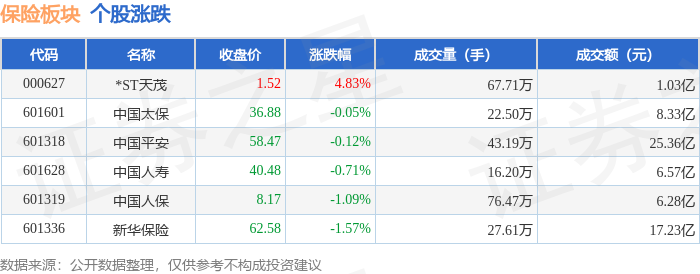
保险板块8月11日跌0.55%,新华保险领跌,主力资金净流入2.22亿元
Zheng Xing Xing Ye Ri Bao· 2025-08-11 08:40
证券之星消息,8月11日保险板块较上一交易日下跌0.55%,新华保险领跌。当日上证指数报收于 3647.55,上涨0.34%。深证成指报收于11291.43,上涨1.46%。保险板块个股涨跌见下表: | 代码 | 名称 | 收盘价 | 涨跌幅 | 成交量(手) | 成交额(元) | | --- | --- | --- | --- | --- | --- | | 000627 | *ST天茂 | 1.52 | 4.83% | 67.71万 | 1.03亿 | | 601601 | 中国太保 | 36.88 | -0.05% | 22.50万 | 8.33亿 | | 601318 | 中国平安 | 58.47 | -0.12% | 43.19万 | 25.36 Z | | 601628 | 中国人寿 | 40.48 | -0.71% | 16.20万 | 6.571Z | | 616109 | 中国人保 | 8.17 | -1.09% | 76.47万 | 6.28 Z | | 601336 | 新华保险 | 62.58 | -1.57% | 27.61万 | 17.23亿 | 从资金流向上来看,当日保险板块主力 ...
不再设立监事会 多家险企开启精简高效治理模式
Jin Rong Shi Bao· 2025-08-11 08:08
随着新公司法的落地,保险公司纷纷宣布不再设立监事会,传统的"三会一层"架构正向更为精简高效的 治理模式过渡。 《金融时报》记者注意到,今年已有多家保险机构发布撤销监事会的公告,包括上市保险公司、外资财 险公司等。7月30日,中国太平洋保险(集团)股份有限公司发布第十届董事会第十五次会议公告,宣 布审议并通过了不再设立监事会相关事项的议案,由董事会审计与关联交易控制委员会行使监事会职 权。7月2日,大家保险集团发布公告称,不再设立监事会,监事会各监事已辞任。6月23日,泰康保险 发布公告宣布,公司不再设立监事会,第三届监事会各监事自动离任。早在今年4月16日,日本财险 (中国)最先发布公告称,撤销公司监事职位,并明确由董事会下的审计与风险管理委员会行使监事会 职责。 据了解,监事会成员主要包括股东代表和适当比例的公司职工代表,可行使检查公司财务;对董事、高 级管理人员执行职务的行为进行监督,对违反法律、行政法规、公司章程或者股东会决议的董事、高级 管理人员提出解任的建议;向股东会提出提案等权力。 2024年7月1日,新修订的《中华人民共和国公司法》正式实施。新公司法指出,国有独资公司在董事会 中设置由董事组成的 ...