PICC(601319)

Search documents
尽管近期股价表现强劲,但仍需谨慎选择;买入中国人寿H股、平安和人保财险
Goldman Sachs· 2025-05-28 05:10
Investment Rating - The report maintains a "Buy" rating for China Life H, Ping An, and upgrades PICC P&C to "Buy" from "Neutral" [3][7]. Core Insights - Chinese insurers have outperformed the HSI/CSI300 indices since early March, primarily due to fund-flow related factors and expectations of increased inflows into the A-share market [1][8]. - Despite recent share price strength, most insurers are trading at or above 1 standard deviation of their 3-year historical P/B, indicating potential near-term downside risks due to challenging fundamentals [2][8]. - There has been a tangible improvement in shareholder returns, with several insurers announcing stable or progressive dividend targets and considering share buybacks, aligning with government objectives to enhance SOE valuations [3][43]. Summary by Sections Investment Ratings and Price Targets - The report raises FY25E EPS estimates by 3-46% for covered companies, reflecting better-than-expected 1Q25 results and equity market performance [4][56]. - Target prices for PICC P&C are raised to HK$16.10 from HK$12.90, implying a 1.1X FY26E P/B and 9.8X FY26E P/E [4][57]. - Target prices for PICC Group H/A are increased by 20%/11% to reflect new valuations for PICC P&C, while other life insurers see target price increases of 4-10% [4][57]. Market Performance and Valuation - H-share insurers have outperformed since early March by more than 10%, although YTD performance remains relatively unchanged compared to indices [8][9]. - The report notes that long-term bond yields have remained depressed, impacting book value and solvency, with a decline in net investment yield expected due to muted equity market performance [2][25][27]. Shareholder Returns and Capital Management - Several insurers have announced plans for stable or progressive dividends and share buybacks, with PICC P&C positioned to increase shareholder returns due to an excess capital balance of RMB 47 billion as of FY24 [3][43][51]. - China Life is highlighted as having a strong balance sheet but a low current payout ratio, indicating potential for increased shareholder returns [3][43]. Earnings and Profitability Outlook - The report anticipates muted book value growth in 2Q25, with long-term bond yields declining to levels seen at the end of 2024 [27][56]. - Net profit for most life insurers declined in 1Q25, reflecting lower equity investment gains compared to 1Q24, with expectations for small profit growth in 2Q25 but a meaningful year-over-year decline for FY25 [27][38].





险资入市实践概览:保险资金长期改革试点三期已至 持续加大新兴战略领域资产配比
Cai Jing Wang· 2025-05-28 03:54
Group 1 - The core viewpoint emphasizes the importance of long-term capital and patient capital in optimizing market structure, reducing retail investor dominance, and enhancing institutional investor influence [1][10] - Insurance funds are recognized as typical representatives of long-term and patient capital, actively entering the market to support value investment and promote the growth of quality enterprises [1][5] Group 2 - The pilot reform for long-term investment by insurance funds began in October 2023, with the establishment of the Honghu Fund, a 50 billion yuan private equity fund initiated by China Life and Xinhua Insurance [2][4] - The second batch of pilot institutions includes eight insurance companies, with ongoing efforts to establish additional funds, such as the 12 billion yuan fund by Taikang Asset [2][3] Group 3 - The total scale of long-term investment pilot programs for insurance funds is set to increase to 222 billion yuan, indicating a steady progression of insurance capital into the market [4] - Insurance companies are focusing on long-term equity investments, aiming to enhance their capital market participation and achieve a positive interaction with the market [5][6] Group 4 - Insurance funds are strategically directing investments towards key national strategic areas, emerging industries, and technology innovation sectors, with a focus on high-dividend blue chips and strategic emerging industries [6][7] - Companies like Xinhua Insurance and China Life are actively investing in technology, elderly care, and consumption sectors, aligning with national strategies [7][8] Group 5 - The recent regulatory adjustments have increased the upper limit for equity asset allocation, allowing for an estimated release of approximately 1.6 trillion yuan in incremental funds by 2025 [9][10] - Major insurance companies express confidence in the long-term value of the Chinese economy and capital market, committing to enhance their investment in strategic emerging industries and equity assets [10][11] Group 6 - The insurance sector is increasingly focusing on green investments, with companies like Sunshine Insurance planning to exceed 20 billion yuan in green investments by the end of 2024 [8][9] - Long-term capital is expected to support sustainable development projects, including technology innovation and green infrastructure, thereby enhancing market stability [13]
中证香港200指数报2278.39点,前十大权重包含中国人民保险集团等
Jin Rong Jie· 2025-05-27 15:11
数据统计显示,中证香港200指数近一个月上涨6.86%,近三个月上涨3.31%,年至今上涨12.53%。 据了解,中证香港200指数从中证香港300指数样本中选取除中证香港100指数样本以外的证券作为指数 样本,以反映在香港交易所上市的中小盘证券的整体表现。该指数以2004年12月31日为基日,以1000.0 点为基点。 从指数持仓来看,中证香港200指数十大权重分别为:泡泡玛特(6.0%)、康方生物(1.92%)、中国 铁塔(1.74%)、金蝶国际(1.4%)、中远海控(1.38%)、中国人民保险集团(1.3%)、中信证券 (1.3%)、零跑汽车(1.22%)、三生制药(1.18%)、中煤能源(1.16%)。 从中证香港200指数持仓的市场板块来看,香港证券交易所占比100.00%。 从中证香港200指数持仓样本的行业来看,可选消费占比18.18%、工业占比14.62%、医药卫生占比 13.11%、金融占比11.66%、信息技术占比9.08%、原材料占比8.20%、通信服务占比6.65%、房地产占比 5.23%、公用事业占比5.21%、主要消费占比4.73%、能源占比3.33%。 资料显示,指数样本每半年调 ...
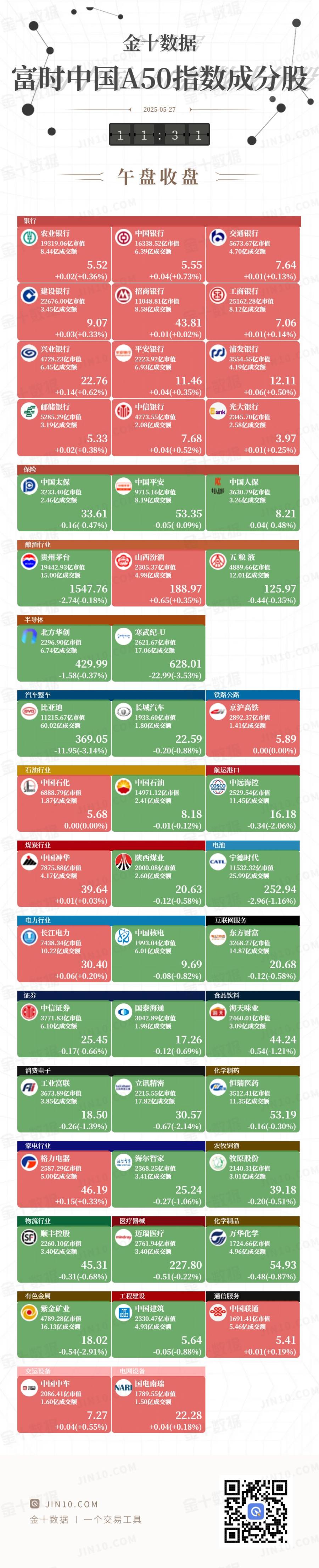
金十图示:2025年05月27日(周二)富时中国A50指数成分股午盘收盘行情一览:银行板块全线飘红,半导体、汽车板块跌幅居前
news flash· 2025-05-27 03:39
Market Overview - The FTSE China A50 Index showed a mixed performance with the banking sector seeing gains while the semiconductor and automotive sectors experienced declines [1] Banking Sector - Major banks such as China Pacific Insurance, Ping An Insurance, and China Life Insurance reported market capitalizations of 363.08 billion, 323.34 billion, and 971.52 billion respectively, with trading volumes of 246 million, 819 million, and 326 million [3] Semiconductor Sector - North China Innovation and Cambricon Technologies had market capitalizations of 229.69 billion and 262.17 billion respectively, with trading volumes of 1.706 billion and 674 million, showing declines of 1.58 (-0.37%) and 22.99 (-3.53%) [3] Automotive Sector - Great Wall Motors and BYD reported market capitalizations of 193.36 billion and 289.24 billion respectively, with trading volumes of 6.002 billion and 1.8 billion, both showing declines of 11.95 (-3.14%) and 0.20 (-0.88%) [3] Oil and Gas Sector - China Shipping and Sinopec had market capitalizations of 688.88 billion and 252.95 billion respectively, with trading volumes of 1.145 billion and 187 million, showing no significant change [3] Coal Sector - China Shenhua and Shaanxi Coal and Chemical Industry reported market capitalizations of 200.01 billion and 787.59 billion respectively, with trading volumes of 417 million and 260 million, with slight changes in stock prices [3] Power Sector - Yangtze Power and China Nuclear Power had market capitalizations of 199.30 billion and 743.83 billion respectively, with trading volumes of 1.022 billion and 601 million, showing minor fluctuations [4] Food and Beverage Sector - China Citic Securities and Haitai Flavoring reported market capitalizations of 377.18 billion and 246.00 billion respectively, with trading volumes of 198 million and 610 million, both showing slight declines [4] Consumer Electronics Sector - Industrial Fulian and Luxshare Precision reported market capitalizations of 367.39 billion and 221.56 billion respectively, with trading volumes of 1.782 billion and 1.135 billion, both showing declines [4] Logistics Sector - Mindray Medical and Wanhua Chemical reported market capitalizations of 172.47 billion and 226.01 billion respectively, with trading volumes of 340 million and 340 million, both showing slight declines [4] Construction Sector - China State Construction and Zijin Mining reported market capitalizations of 478.93 billion and 233.05 billion respectively, with trading volumes of 1.613 billion and 493 million, showing minor fluctuations [4][5]






保险助力破解“电池焦虑”
Jing Ji Ri Bao· 2025-05-26 22:10
Group 1 - The core issue facing electric vehicle owners is the anxiety over battery lifespan and the high costs associated with battery replacement, which can exceed the cost of purchasing a new vehicle [1] - The insurance industry has not yet developed products to address battery degradation concerns due to data deficiencies and high technical barriers [1] - A new insurance product, "New Energy Vehicle Battery Capacity Guarantee Insurance," has been launched in Sichuan to alleviate consumer concerns by covering battery replacement or repair if degradation exceeds agreed limits [2] Group 2 - The insurance product includes a comprehensive service system that monitors battery health and provides timely interventions to reduce degradation rates [2] - The insurance company faces challenges in pricing due to the variety of battery types and usage patterns, which affect risk assessment [2] - The insurance sector is also expanding into the energy storage market, with products designed to cover the entire lifecycle of energy storage systems, addressing risks such as capacity degradation and market fluctuations [3][4]
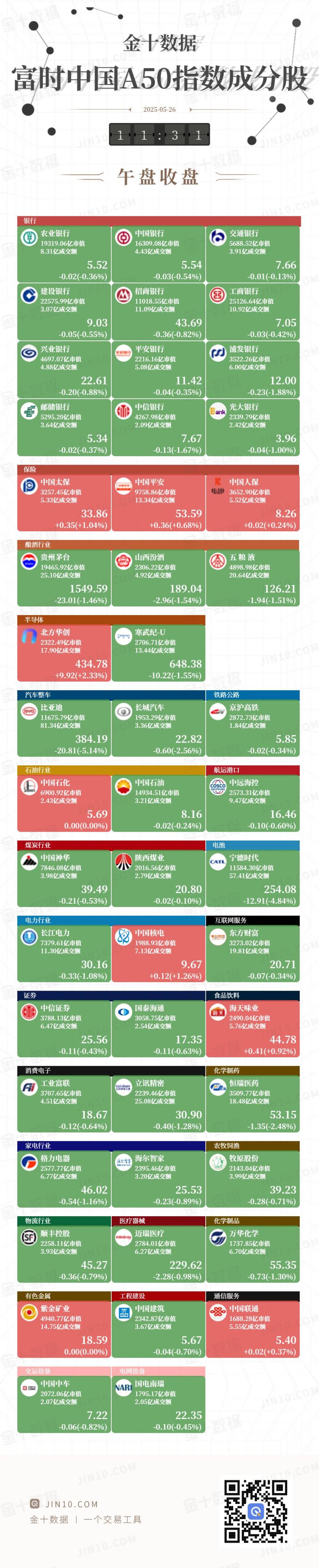
金十图示:2025年05月26日(周一)富时中国A50指数成分股午盘收盘行情一览:银行、酿酒、汽车板块全线走低,半导体板块涨跌不一
news flash· 2025-05-26 03:51
-0.04(-1.00%) -0.02(-0.37%) -0.13(-1.6/%) 保险 中国太保 中国平安 中国人保 01 3652.90亿市值 3257.45亿市值 9758.86亿市值 5.33亿成交额 13.34亿成交额 5.52亿成交额 53.59 33.86 8.26 +0.35(+1.04%) +0.36(+0.68%) +0.02(+0.24%) 酸酒行业 贵州茅台 山西汾酒 五粮液 19465.92亿市值 2306.22亿市值 4898.98亿市值 25.10亿成交额 20.64亿成交额 4.92亿成交额 1549.59 126.21 189.04 -23.01(-1.46%) -2.96(-1.54%) -1.94(-1.51%) 半导体 北方华创 寒武纪-U 2322.49亿市值 2706.71亿市值 17.90亿成交额 13.44亿成交额 434.78 648.38 +9.92(+2.33%) -10.22(-1.55%) 汽车整车 铁路公路 比亚迪 长城汽车 京沪高铁 11675.79亿市值 1953.29亿市值 2872.73亿市值 81.34亿成交额 3.36亿成交额 1.84亿 ...



黄河奔涌见证激情 人保守护兰马征程
Cai Jing Wang· 2025-05-26 02:48
Core Points - The "2025 Lanzhou Marathon" took place on May 25, with China Pacific Insurance (CPIC) Gansu Branch providing comprehensive insurance coverage for the fourth consecutive year, totaling over 60 billion yuan in risk protection for the event [1][3][10] - The marathon serves as a significant cultural and tourism event for the city, showcasing Lanzhou's charm and confidence [3][10] - CPIC established a special working group with eight functional teams to ensure event safety, including a thorough risk assessment of the marathon route and the setup of 16 medical aid stations [3][6] - The event featured a "CPIC Red" team promoting insurance services and local tourism projects, highlighting the integration of sports, insurance, and cultural tourism [6][10] - CPIC aims to continue supporting Gansu's high-quality development and contribute to the construction of a prosperous new Gansu [12]

中泰证券:权益市场信心迎来修复窗口 紧握非银板块的β机会
智通财经网· 2025-05-22 23:29
Core Insights - The overall profit growth of listed insurance companies in Q1 2025 shows significant divergence, primarily influenced by base effect differences, while the liability side remains stable. The equity market is identified as a critical factor for performance, with regulatory policies fostering a recovery in market confidence, presenting opportunities in the non-bank sector [1] Group 1: Financial Performance - Q1 2025 net profit on a comparable basis increased by 1.4% year-on-year, with non-annualized ROE slightly declining from 4.2% in Q1 2024 to 4.0% in Q1 2025, which is better than previously pessimistic expectations [1] - The average net assets attributable to shareholders of A-share listed insurance companies remained flat compared to the beginning of the year, with life insurance showing the highest growth at 4.5%, while Xinhua reported a decline of 17.0% [1] - The ratio of other comprehensive income to net profit was -98.0%, with life insurance having the smallest difference at -20.9% [1] - Underwriting profit in Q1 2025 grew by 27.3% year-on-year, mainly due to a low base in the same period last year, with life insurance performing well and property insurance seeing a significant increase in underwriting profit [1] - The average annualized net investment return rate for listed insurance companies in Q1 2025 was 3.08%, slightly down from 3.19% in Q1 2024, while the average annualized total investment return rate was 4.06%, down from 4.08% [1] Group 2: Life Insurance Business - The average NBV growth rate for listed insurance companies in Q1 2025 was approximately 20%, with value rate improvement being the core reason [2] - NBV year-on-year growth rates from high to low were: Xinhua (67.9%), Ping An (34.9%), PICC (31.5%), Taikang (11.3%), and China Life (4.8%) [2] - New single premium growth showed significant divergence, with individual insurance affected by the "opening red" period, while the structure of bank insurance new single premiums improved [2] - The improvement in value rates is attributed to: 1) a reduction in scheduled interest rates leading to a stable decline in overall liability costs; 2) optimization of product and term structures; 3) active cost reduction and efficiency enhancement [2] Group 3: Property Insurance Business - In Q1 2025, listed insurance companies achieved property insurance service revenue of 249.635 billion yuan, a year-on-year increase of 4.0%, with a significant decrease in the combined underwriting cost ratio to 95.7%, down 2.8 percentage points [3] - Underwriting profit under the new standards reached 10.653 billion yuan, nearly doubling year-on-year, primarily due to a low base in the previous year and challenges from adverse weather conditions [3] - The total premium income from auto insurance grew by 3.2% year-on-year, with effective cost control contributing to improved underwriting profits [3] - Data from the Ministry of Emergency Management indicated that natural disasters in Q1 2025 primarily involved geological disasters, with direct economic losses of approximately 10.16 billion yuan, significantly lower than 23.76 billion yuan in Q1 2024, leading to improved claims ratios, especially in February [3]

社保基金一季度持仓全景剖析来袭!如何效仿社保基金借道ETF捕捉20%超额收益?
市值风云· 2025-05-22 10:01
Core Viewpoint - The article discusses the significant presence of the "national team" in A-share companies' top ten circulating shareholders, highlighting the strategic investment role of social security funds in the market [2][3]. Group 1: Social Security Fund Overview - As of the end of 2023, the total assets of the national social security fund reached 30,145.6 billion yuan, with an average annual investment return of 7.4% since its establishment in August 2000 [3]. - The average stock position of the social security fund is approximately 30%, indicating a long-term annualized return of over 20% in the stock segment over 22 years [3]. Group 2: Q1 2025 Investment Strategy - By the end of Q1 2025, the "national team" appeared in the top ten circulating shareholders of 824 A-share companies, with a total holding market value of about 42,050 billion yuan [8]. - The social security fund held shares in 604 companies, with a total of 600.85 million shares valued at 47.2343 billion yuan [8][10]. Group 3: New Holdings in Q1 2025 - In Q1 2025, the social security fund newly held 146 listed companies, with Baosteel Co., Ltd. being the largest new holding at 1.58 million shares, valued at 114 million yuan [10][12]. - Other notable new holdings include Cangge Mining, Yiwei Lithium Energy, and Lansi Technology, each with a holding value exceeding 400 million yuan [11][13]. Group 4: Top Holdings and Sector Allocation - As of the end of Q1 2025, the top holdings of the social security fund included Agricultural Bank of China (121.84 billion yuan), Industrial and Commercial Bank of China (84.97 billion yuan), and China Pacific Insurance (38.40 billion yuan) [16][18]. - The fund's strategy reflects a focus on high-dividend assets, with banks being a stable component of its long-term allocation, while also increasing positions in cyclical leaders like Sany Heavy Industry and China National Offshore Oil Corporation [19][20]. Group 5: Investment Insights for Retail Investors - The social security fund's investment approach suggests a balanced allocation strategy for retail investors, recommending a distribution of 40% in financials, 30% in cyclical sectors, 20% in technology, and 10% in consumer sectors [20][24]. - The article emphasizes the importance of understanding the differences in funding characteristics between institutional and individual investors, advising caution in mimicking long-term holdings without considering personal liquidity needs [24][26].


分散大模型合规风险,首批生成式AI侵权责任保险落地
Nan Fang Du Shi Bao· 2025-05-22 09:41
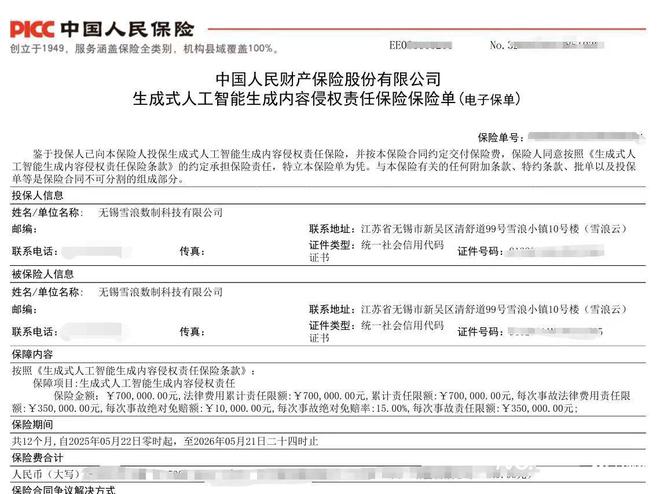
Core Viewpoint - The first generative AI content infringement liability insurance in China has been launched in Wuxi, providing risk coverage for AI-generated content, addressing potential infringement issues related to copyright, portrait rights, and reputation rights [1][2]. Group 1: Insurance Product Details - China Pacific Insurance Wuxi Branch signed a liability insurance agreement with Wuxi Xuelang Digital Technology Co., providing 700,000 yuan in risk coverage for the company's self-developed Xuelang Industrial Model [1]. - The insurance is designed to cover unintentional infringement of third-party rights during the use of the AI model, with a one-year policy period from May 22, 2025, to May 21, 2026, and a premium of 15,000 yuan [1]. - Claims will be based on actual litigation costs incurred by the insured and compensation amounts determined by court or arbitration decisions [1]. Group 2: Market Demand and Industry Context - The demand for generative AI infringement liability insurance has increased due to multiple infringement disputes since 2024, notably the "AI-generated Ultraman infringement image" case in January 2025, which raised awareness of the responsibilities of AI service providers [2]. - Xuelang Digital Technology indicated that the insurance product effectively addresses industry pain points and helps mitigate risks faced by generative AI service companies [2]. - The willingness of insurance companies to underwrite this new type of insurance is high, with discussions on premium rates reflecting the actual risks faced by Xuelang Digital Technology [2]. Group 3: Insurance Coverage Scope - Traditional liability insurance primarily focuses on hardware failures or data breaches, which are inadequate for addressing AI-generated content infringement issues [3]. - This new insurance product covers the entire process of AI training and inference, helping technology companies alleviate concerns during innovation and establishing a risk mitigation mechanism for AI users [3].