
PICC(601319)

Search documents
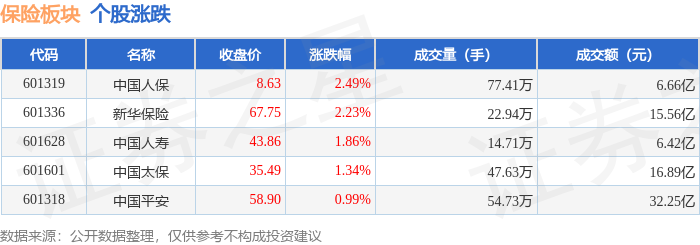
保险板块11月6日涨1.67%,中国人保领涨,主力资金净流入1.23亿元
Zheng Xing Xing Ye Ri Bao· 2025-11-06 08:51
Core Insights - The insurance sector experienced a rise of 1.67% on November 6, with China Life Insurance leading the gains [1] - The Shanghai Composite Index closed at 4007.76, up 0.97%, while the Shenzhen Component Index closed at 13452.42, up 1.73% [1] Insurance Sector Performance - China Pacific Insurance (China Life) saw a closing price of 8.63, with a gain of 2.49% and a trading volume of 774,100 shares, amounting to a transaction value of 666 million yuan [1] - New China Life Insurance closed at 67.75, up 2.23%, with a trading volume of 229,400 shares and a transaction value of 1.556 billion yuan [1] - China Life Insurance closed at 43.86, up 1.86%, with a trading volume of 147,100 shares [1] - China Taiping Insurance closed at 35.49, up 1.34%, with a trading volume of 476,300 shares and a transaction value of 1.689 billion yuan [1] - Ping An Insurance closed at 58.90, up 0.99%, with a trading volume of 547,300 shares [1] Capital Flow Analysis - The insurance sector saw a net inflow of 12.3 million yuan from institutional investors, while retail investors experienced a net outflow of 12.7 million yuan [1] - Retail investors contributed a net inflow of 4.3553 million yuan [1] Individual Stock Capital Flow - China Life Insurance had a net inflow of 59.4468 million yuan from institutional investors, while retail investors had a net outflow of 32.8861 million yuan [2] - New China Life Insurance saw a net inflow of 46.1293 million yuan from institutional investors, with a net outflow of 48.0146 million yuan from retail investors [2] - China Pacific Insurance experienced a slight net outflow of 3.81 thousand yuan from institutional investors, while retail investors had a net inflow of 3.3259 million yuan [2] - Ping An Insurance had a minimal net inflow of 1.0501 million yuan from institutional investors, with a significant net outflow of 72.2329 million yuan from retail investors [2]






狂赚超4200亿后,险资再迎“顺周期”大考
阿尔法工场研究院· 2025-11-06 00:07
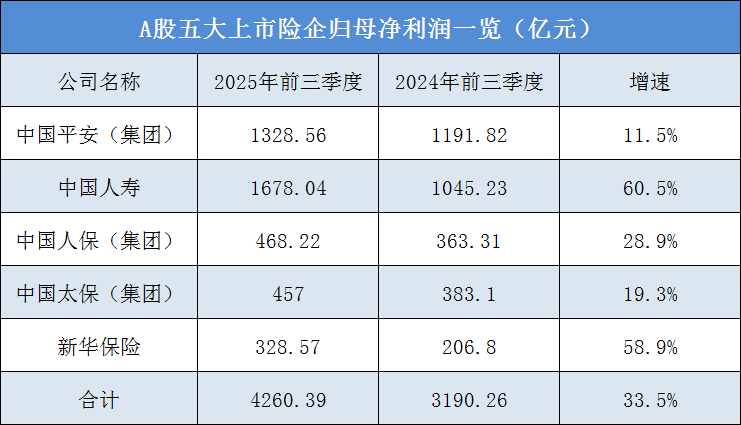
Core Viewpoint - The insurance industry has shown unexpected growth in profits for the first three quarters of the year, with major companies reporting a combined net profit of 426 billion yuan, a year-on-year increase of 33.5% [4][5]. Group 1: Profit Growth and Investment Strategies - The primary source of profit growth for the major insurance companies has been capital market gains, with investment income contributing over 60% to profits [5]. - The CSI 300 index rose by 18% in the third quarter, benefiting insurance companies with large capital and long liability durations, leading to increased equity investment ratios [6]. - Insurance companies have shifted from defensive positions to more aggressive growth strategies, with a focus on technology growth stocks and broad-based ETFs [8][9]. Group 2: Company-Specific Performance - New China Life Insurance was the most proactive player, achieving an 88% year-on-year profit increase in the third quarter, with an annualized total investment return of 8.6% [8]. - China Pacific Insurance experienced a significant turnaround, with core business profits rebounding sharply due to improved investment returns [10]. - China Ping An and China Taiping adopted more conservative investment strategies, with Ping An reporting a non-annualized investment return of 5.4% [12][13]. Group 3: Market Outlook and Future Challenges - The current profit surge may not be sustainable as the market approaches the end of the valuation recovery phase, raising concerns about balancing high returns with long-term solvency risks [16]. - The insurance industry is seeing positive signals in the liability side, with a slight increase in individual insurance agent numbers for the first time in two years [17]. - Future growth will depend on product innovation, channel optimization, and long-term interest rate management as the industry transitions to a "post-asset cycle" phase [18].

狂赚4260亿元!五大上市险企前三季度净利创新高
Guo Ji Jin Rong Bao· 2025-11-05 14:39
Core Viewpoint - The five major listed insurance companies in A-shares have reported impressive results for the first three quarters of 2025, achieving a total net profit of 426.04 billion yuan, a year-on-year increase of 33.5%, surpassing the total net profit for the entire previous year [1][2][3] Investment Performance - The total net profit for the five major insurance companies includes: China Life (167.80 billion yuan, +60.5%), Ping An (132.86 billion yuan, +11.5%), China Pacific (45.70 billion yuan, +19.3%), China Property (46.82 billion yuan, +28.9%), and New China Life (32.86 billion yuan, +58.9%) [2][3] - Investment income has significantly increased due to a recovering capital market, with companies like New China Life reporting substantial growth in investment income compared to the previous year [3][4] - The annualized total investment return rates for the companies are as follows: New China Life (8.6%, +1.8 percentage points), China Life (6.42%, +1.04 percentage points), China Property (5.4%, +0.8 percentage points), and China Pacific (5.2%, +0.5 percentage points) [5] Business Structure and Strategy - The insurance companies are optimizing their liability structures, with new business value showing strong growth, all exceeding 30% year-on-year [7][8] - The shift towards dividend insurance and floating income products is a common strategy among the companies, with New China Life reporting that dividend insurance accounted for 70% of new individual channel orders in the second and third quarters [7][8] - The comprehensive cost ratios for property insurance have improved, with China Property at 97.6% (down 1.0 percentage points), Ping An at 97% (down 0.8 percentage points), and China Property at 96.1% (down 2.1 percentage points) [8][9] Regulatory Environment - The implementation of the "reporting and pricing integration" policy for non-auto insurance is expected to enhance the financial performance of insurance companies by reducing costs and improving product innovation and service quality [9]
保险行业2025年三季报业绩综述:资、负两端均表现亮眼,3Q25A股险企利润大增68%
Shenwan Hongyuan Securities· 2025-11-05 12:12
Investment Rating - The report maintains a positive outlook on the insurance sector, recommending several companies including China Life, New China Life, Ping An, PICC, China Pacific Insurance, and AIA, while suggesting to pay attention to China Taiping [5][70]. Core Insights - In Q3 2025, A-share insurance companies saw a significant profit increase of 68%, with investment performance contributing 79% to the pre-tax profit increment. The total net profit attributable to shareholders for the first three quarters reached CNY 426 billion, a year-on-year increase of 33.5% [3][11][12]. - The new business value (NBV) continued to show strong growth, with a year-on-year increase ranging from 18% to 77% among listed insurance companies, driven by preemptive product demand due to expected interest rate cuts [3][31]. - The insurance premium growth exhibited differentiation, with property insurance companies showing varied premium growth rates, influenced by structural optimization and operational strategies [4][45]. Summary by Sections Profit Performance - A-share insurance companies reported a total net profit of CNY 263.7 billion in Q3 2025, reflecting a year-on-year growth of 68.3% [8][11]. - The profit structure showed that investment performance accounted for 79.2% of the pre-tax profit increment, with insurance service performance contributing 22.6% [12][24]. Liability Side - The NBV growth remained robust, with the first three quarters showing a year-on-year increase of 14.2% to CNY 557.8 billion, and Q3 alone saw a 38.7% increase [3][35]. - The cost of risk (COR) continued to improve, indicating effective cost management among leading insurers [4][45]. Asset Side - Investment returns showed significant improvement, with total investment income for the first three quarters reaching CNY 886.4 billion, a year-on-year increase of 36% [24][57]. - The FVOCI equity assets increased by CNY 92.5 billion, reflecting a strong performance in the equity market [3][62]. Investment Analysis - The report highlights a positive outlook for the insurance sector, driven by ongoing capital market participation and external environment improvements, suggesting a potential revaluation of the sector [5][70].
社保基金最新重仓股揭晓!新进比亚迪、隆基绿能等226只个股!
Sou Hu Cai Jing· 2025-11-05 10:26
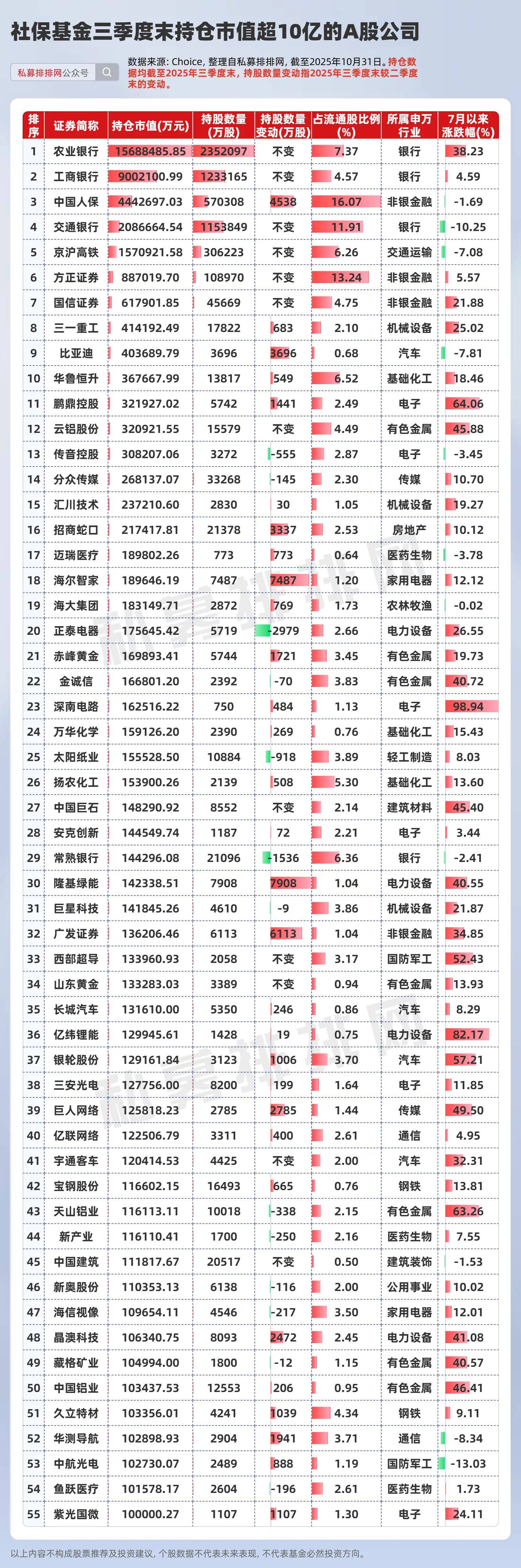
Core Viewpoint - The Social Security Fund's latest holdings in A-shares reveal significant investment activity, with a total market value of approximately 552.72 billion yuan, reflecting an increase of about 49.81 billion yuan from the previous quarter [1]. Holdings Overview - As of the end of Q3 2025, the Social Security Fund was listed among the top ten shareholders in 622 A-share companies, with a total holding value of approximately 552.72 billion yuan, up from 502.91 billion yuan at the end of Q2 2025 [1]. - The fund initiated positions in 226 new stocks, increased holdings in 153 stocks, reduced holdings in 135 stocks, and maintained positions in 108 stocks [1][19]. Sector Allocation - The majority of the fund's holdings were concentrated in the banking sector, with a market value of 270.06 billion yuan, followed by the non-bank financial sector at approximately 63.04 billion yuan [1]. - The electronics sector, which was ranked sixth in holdings at the end of Q2, moved up to third place by the end of Q3, indicating a shift in investment focus [1]. Major Holdings - Among the 622 companies, 55 had a holding value exceeding 1 billion yuan, accounting for approximately 76.67% of the total holdings [2]. - The top five stocks with holdings exceeding 10 billion yuan were primarily financial stocks, including Agricultural Bank of China, Industrial and Commercial Bank of China, China Life Insurance, and Bank of Communications [2][3]. Performance Insights - The banking sector has shown strong performance in the first half of the year, with Agricultural Bank of China leading with a 38.23% increase [2]. - The Social Security Fund's holdings in the insurance sector saw an increase in shares for China Life Insurance, with a market value of 44.43 billion yuan, despite a slight decline in stock price since July [3]. New Energy Sector Focus - The fund has maintained a significant allocation to the new energy sector, particularly in lithium battery and photovoltaic companies, with 20 new energy companies having a market value exceeding 300 million yuan [9]. - Stocks such as Yiwei Lithium Energy and Sanyuan Electric have seen substantial price increases, with average gains of 45.92% since July [9]. Notable Stock Movements - The fund's adjustments included significant increases in holdings for companies like Guangxin Co., with a 277.97% increase in shares, reflecting a strategic focus on traditional industries [23]. - The fund's new investments included companies in the AI computing and lithium battery supply chain, with some stocks experiencing over 100% price increases since July [13].





2025Q3 保险行业公募持仓分析:保险减持或受 Q3 业绩预期差影响,看好板块强贝塔属性
Huachuang Securities· 2025-11-05 10:11
Investment Rating - The report maintains a "Recommended" rating for the insurance sector, expecting the industry index to outperform the benchmark index by over 5% in the next 3-6 months [20]. Core Insights - The report indicates that the public fund holdings in the insurance sector have decreased, influenced by performance expectations for Q3. The overall non-bank financial holdings decreased by 0.17 percentage points, with the insurance sector's holdings dropping by 0.29 percentage points [3][4]. - The report highlights that major insurance companies like China Ping An and China Pacific Insurance have seen a reduction in their public fund holdings, while only a few companies like China Life and Sunshine Insurance experienced slight increases [4]. - The anticipated performance for Q3 shows significant growth for major insurers, with China Life's net profit expected to increase by 862 million yuan, and other companies like New China Life and PICC also showing positive growth [5]. Summary by Sections Overall Industry Performance - Non-bank financial holdings decreased by 0.17 percentage points, with insurance holdings at 1.1% and a decline of 0.29 percentage points [3]. - The report notes a general reduction in individual stock holdings within the insurance sector, with China Ping An maintaining the highest holding at 0.46%, despite a decrease of 0.09 percentage points [4]. Company-Specific Insights - China Life, New China Life, and PICC are projected to show substantial growth in net profit for Q3, with increases of 862 million yuan, 104 million yuan, and respective quarterly growth rates of +2094%, +174%, +151% for the quarter [5]. - The report suggests that the performance of the insurance sector is likely to remain strong in Q4 and throughout the year, contingent on the current activity levels in the equity market [8]. Investment Recommendations - For the short term, the report recommends considering stocks with performance elasticity, specifically New China Life, China Pacific Insurance, China Life, and China Taiping [9]. - For the long term, it suggests a focus on fundamental performance and valuation, recommending China Pacific Insurance, China Financial Insurance, and China Ping An [9].
上市险企寿险业务三季报扫描:银保渠道发力 分红险成主流
Jin Rong Shi Bao· 2025-11-05 09:23
Core Insights - The overall performance of five A-share listed insurance companies in the life insurance sector shows steady growth, with many institutions reporting double-digit increases in total premiums, new premiums, and renewal premiums [1][2]. Premium Growth - In the first three quarters, China Life achieved total premiums of 669.645 billion yuan, a year-on-year increase of 10.1%, marking a historical high for the same period; Taiping Life reported 263.863 billion yuan, up 14.2%; New China Life reached 172.705 billion yuan, up 18.6%; and PICC Life reported 116.963 billion yuan, up 21.1% [2]. - China Ping An did not disclose premium income data but reported a new business value of 35.724 billion yuan for its life and health insurance, a significant increase of 46.2% [2]. New Business Value - The new business value growth is attributed to the switch in the preset interest rate for life insurance products, with the industry entering a "2.0% era" starting September 1, 2025 [3]. - The quarterly data shows a divergence in premium growth rates among listed insurance companies, with China Life, PICC Life, and China Ping An showing rapid growth rates of 52%, 46%, and 21% respectively, while New China Life and Taiping Life reported declines of -4% and 2% [3]. Product Strategy Transformation - Listed insurance companies are actively transforming their product strategies, with a significant increase in the sales proportion of dividend insurance products. For instance, China Life reported that the proportion of floating income-type business in first-year premiums increased by over 45 percentage points compared to the previous year [4]. - Taiping Life disclosed that the proportion of dividend insurance in new premium income from agents further increased to 58.6% [4]. Performance of Bancassurance Channel - The bancassurance channel has shown remarkable performance, contributing significantly to premium income and business value growth. Taiping Life's bancassurance channel achieved scale premiums of 58.31 billion yuan, a year-on-year increase of 63.3% [5]. - New China Life's bancassurance channel reported premium income of 66.941 billion yuan, up 47.7%, with first-year premiums for long-term insurance increasing by 66.7% [5]. - China Ping An reported a 170.9% year-on-year growth in new business value from its bancassurance channel, contributing 35.1% to its overall new business value [5]. Agent Workforce and Productivity - The overall number of agents remains stable, with slight declines in the number of individual insurance sales agents for major companies. China Life has 607,000 agents, Ping An has 354,000, and Taiping Life has 181,000 [6]. - Despite the slight decline, the quality of the workforce is improving, with New China Life reporting a 50% year-on-year increase in per capita productivity [6].
保险行业月报(2025年1-9月):预定利率下调影响寿险,产险景气度环比提升-20251105
Huachuang Securities· 2025-11-05 07:46
Investment Rating - The report maintains a "Recommended" rating for the insurance industry, expecting the industry index to outperform the benchmark index by over 5% in the next 3-6 months [3][26]. Core Viewpoints - The insurance industry experienced a total premium income of 52,146 billion yuan from January to September 2025, reflecting a year-on-year increase of 8.8% but a quarter-on-quarter decline of 0.9 percentage points. The life insurance sector's premium income was 31,708 billion yuan, with a year-on-year growth of 12.7% [7][8]. - The report highlights that the life insurance sector is facing challenges due to a decline in sales attributed to the adjustment of the preset interest rate, which has led to a cooling in sales in September 2025 [7][8]. - The property insurance sector showed improved performance, with a total premium income of 13,712 billion yuan from January to September 2025, marking a year-on-year increase of 4.9% [7][8]. Summary by Sections Industry Overview - The life insurance sector's cumulative growth has slowed, impacting overall premium growth. The health and accident insurance segments have shown growth, with health insurance premiums reaching 8,427 billion yuan (up 2.4% year-on-year) and accident insurance at 760 billion yuan (up 3.3% year-on-year) [7][8]. - The total assets of the insurance industry reached 40.4 trillion yuan by the end of September 2025, a year-on-year increase of 12.5% [7][8]. Life Insurance Companies - Life insurance companies reported a total premium income of 38,434 billion yuan, with a year-on-year increase of 10.5%. However, September saw a decline in life insurance premiums by 4.6% year-on-year [7][8]. - The report notes that the adjustment of the preset interest rate has had a short-term impact on sales, particularly in September [7][8]. Property Insurance Companies - The property insurance sector's premium income showed a year-on-year increase of 4.9%, with car insurance accounting for 50% of the total premiums [7][8]. - The report indicates that the recent regulatory changes in non-auto insurance are expected to enhance cost efficiency in the industry, benefiting leading companies [7][8].
广发证券:投资驱动业绩+新单驱动价值 三季度险企业绩全面超预期
智通财经网· 2025-11-05 06:13
Core Viewpoint - The report from GF Securities indicates that listed insurance companies in China have shown significant growth in net profit for the first three quarters of 2025, driven by a rising equity market and improved investment performance. The trend is expected to continue into 2026 due to various factors including the expansion of dividend insurance and the optimization of non-auto insurance pricing [1][2]. Profit Performance - The net profit growth rates for listed insurance companies from Q1 to Q3 2025 are as follows: China Life (60.5%) > New China Life (58.9%) > China Property & Casualty (50.5%) > PICC (28.9%) > Taiping (19.3%) > Ping An (11.5%). The third quarter saw unexpected high growth due to the rising equity market and improved asset allocation [1][2]. - The annualized total investment returns for New China Life, Taiping, and China Life increased by 1.8 percentage points, 0.7 percentage points, and 1.0 percentage points respectively [1]. Net Asset Growth - The net asset growth rates for Q3 2025 compared to the mid-year report are as follows: New China Life (20.5%) > China Life (19.5%) > PICC (10.2%) > Ping An (4.5%) > Taiping (0.8%) [3]. Life Insurance Performance - The new business value (NBV) growth rates for the first three quarters of 2025 are: New China Life (+50.8% non-comparable basis) > PICC Life (+76.6%) > Ping An (+46.2%) > China Life (+41.8%) > Taiping (+31.2%). The growth in new policies is driven by a switch in the preset interest rate [4]. - The number of agents for China Life and Ping An increased by 2.5% and 4.1% respectively in Q3 [4]. Property and Casualty Insurance Performance - The premium growth rates for the first three quarters are: Ping An Property (7.1%) > PICC Property (3.5%) > Taiping Property (0.1%). The combined operating ratio (COR) for PICC Property (96.1%) is better than Ping An Property (97.0%) and Taiping Property (97.6%), with improvements attributed to reduced natural disaster losses and the implementation of unified reporting [5]. Investment Recommendations - The report suggests a positive outlook for the insurance sector, recommending active attention to stocks such as New China Life, China Life, China Taiping, China Pacific Insurance, and others [6].

新疆金融监管局同意撤销中国人保财险乌鲁木齐市东山支公司长山子镇营销服务部
Jin Tou Wang· 2025-11-05 05:26
Core Points - The Xinjiang Financial Regulatory Bureau has approved the request to revoke the marketing service department of China People's Property Insurance Company in Urumqi [1] - The company is required to cease all operations of the marketing service department immediately upon receiving the approval [1] - The company must return the license to the Xinjiang Financial Regulatory Bureau within 15 working days and handle related procedures according to laws and regulations [1] - The company is also obligated to inform customers and manage the servicing of existing policies following the revocation of the department [1]