
PICC(601319)

Search documents
保险板块11月3日跌0.79%,中国人寿领跌,主力资金净流出4.45亿元
Zheng Xing Xing Ye Ri Bao· 2025-11-03 08:43
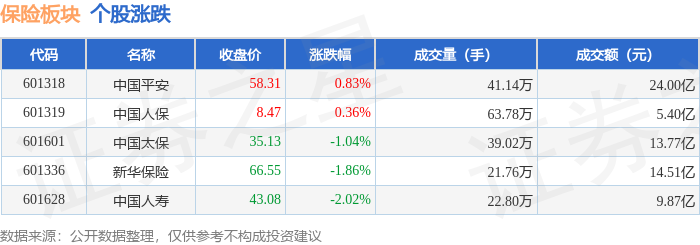
Core Insights - The insurance sector experienced a decline of 0.79% on November 3, with China Life leading the losses [1] - The Shanghai Composite Index closed at 3976.52, up 0.55%, while the Shenzhen Component Index closed at 13404.06, up 0.19% [1] Insurance Sector Performance - China Ping An (601318) closed at 58.31, with an increase of 0.83% and a trading volume of 411,400 shares, totaling a transaction value of 2.4 billion [1] - China Life (601628) closed at 43.08, down 2.02%, with a trading volume of 228,000 shares and a transaction value of 987 million [1] - China Pacific Insurance (601601) closed at 35.13, down 1.04%, with a trading volume of 390,200 shares and a transaction value of 1.377 billion [1] - New China Life (601336) closed at 66.55, down 1.86%, with a trading volume of 217,600 shares and a transaction value of 1.451 billion [1] - China People's Insurance (601319) closed at 8.47, up 0.36%, with a trading volume of 637,800 shares and a transaction value of 540 million [1] Fund Flow Analysis - The insurance sector saw a net outflow of 445 million from institutional investors, while retail investors contributed a net inflow of 290 million [1] - The detailed fund flow for major stocks shows: - China Ping An had a net inflow of 91.035 million from institutional investors, but a net outflow of 10.2 million from retail investors [2] - China Life experienced a net outflow of 151 million from institutional investors, with a net inflow of 88.466 million from retail investors [2] - China Pacific Insurance had a net outflow of 194 million from institutional investors, with a net inflow of 104 million from retail investors [2] - New China Life faced a net outflow of 213 million from institutional investors, while retail investors contributed a net inflow of 118 million [2] - China People's Insurance had a net inflow of 21.1195 million from institutional investors, but a net outflow of 31.1978 million from retail investors [2]






中国人民保险集团(01339) - 截至二零二五年十月三十一日止月份之股份发行人的证券变动月报表
2025-11-03 08:37
股份發行人及根據《上市規則》第十九B章上市的香港預託證券發行人的證券變動月報表 截至月份: 2025年10月31日 狀態: 新提交 致:香港交易及結算所有限公司 公司名稱: 中國人民保險集團股份有限公司 呈交日期: 2025年11月3日 I. 法定/註冊股本變動 本月底法定/註冊股本總額: RMB 44,223,990,583 備註: 第 1 頁 共 11 頁 v 1.1.1 FF301 FF301 由於本公司於中華人民共和國註冊成立,上文第一部分所顯示的"法定股本"信息應為本公司的"註冊資本"。 | 1. 股份分類 | 普通股 | 股份類別 | H | | | 於香港聯交所上市 (註1) | | 是 | | | --- | --- | --- | --- | --- | --- | --- | --- | --- | --- | | 證券代號 (如上市) | 01339 | 說明 | | | | | | | | | | | 法定/註冊股份數目 | | | 面值 | | | 法定/註冊股本 | | | 上月底結存 | | | 8,726,234,000 | RMB | | | 1 RMB | | 8,726, ...
【金融街发布】人保创新探索多方共建精准化应对巨灾风险新模式
Zhong Guo Jin Rong Xin Xi Wang· 2025-11-03 08:01
Core Insights - In 2024, China's direct economic losses from natural disasters reached 401.1 billion yuan, affecting 94.13 million people. The insurance sector is increasingly recognized for its role in managing catastrophic risks, enhancing social governance efficiency through market tools [1] Group 1: Catastrophe Insurance Development - Since 2008, the value of catastrophe risk management through insurance has gained prominence, becoming an essential part of the national disaster response system [1] - The insurance industry has established a catastrophe insurance community, implementing insurance schemes across various regions, and has covered 4.59 million people in 23 provinces and 137 cities [1] Group 2: Innovative Risk Management Model - A new model for catastrophe risk response has emerged, involving collaboration among seven parties, including emergency departments, meteorological agencies, local governments, insurance companies, mapping firms, technology companies, and research institutions [2] - The insurance companies act as coordinators, integrating theory, data, technology, and applications in disaster response, while emergency departments oversee resource management and meteorological agencies provide customized weather data [2] Group 3: Technological Integration and Efficiency - The model emphasizes precise and rapid simulation of rainstorm and flood scenarios, utilizing extensive data and advanced technologies to establish a simulation system for accurate risk assessment [2] - This approach allows for targeted disaster prevention and efficient resource allocation, improving the accuracy and speed of claims processing through technologies like Beidou positioning and IoT monitoring [2][3] Group 4: Positive Outcomes - The insurance industry's understanding of risk has significantly improved, leading to enhanced underwriting capabilities and optimized operational efficiency supported by technology and data [3] - Public satisfaction with the new model is high, with a reported satisfaction rate of 94.64% from third-party evaluations of catastrophe insurance performance [3]

保险行业2026年度投资策略:资负两端全面开花,估值低位攻守兼备
Soochow Securities· 2025-11-03 07:05
Group 1 - The insurance industry has shown strong growth in both the liability and asset sides, with a notable increase in net profit and net asset value for listed insurance companies in 2025 [3][13][15] - The net profit of listed insurance companies for the first three quarters of 2025 reached CNY 426 billion, a year-on-year increase of 33.5%, with Q3 alone showing a remarkable growth of 68.3% [13][14] - The new business value (NBV) for listed insurance companies grew over 30% year-on-year, driven by a significant increase in new policy premiums, particularly from the bancassurance channel [3][29] Group 2 - The insurance industry is undergoing a transformation with a shift towards floating income products and channel reforms, enhancing growth prospects [3][5] - The bancassurance channel has experienced explosive growth, contributing significantly to new business and NBV, with major companies like Xinhua and China Life seeing substantial increases in new premiums [48][49] - The historical performance of insurance stocks has been influenced by factors such as stock market trends, interest rates, and new policy premium growth, with stock market performance being a key short-term catalyst [3][5] Group 3 - The investment strategy for the insurance sector indicates continued improvement in both liability and asset sides, with significant upside potential in valuations [3][5] - The current market conditions, including high savings demand and declining bank deposit rates, favor insurance product sales, while the stock market's upward trend benefits listed insurance companies' equity investments [3][5] - As of October 31, 2025, the valuation of the insurance sector is at historical lows, with expected price-to-earnings ratios ranging from 0.56 to 0.92 times [3][5]
“国家队”资金,最新持仓曝光
Zhong Guo Zheng Quan Bao· 2025-11-03 05:35
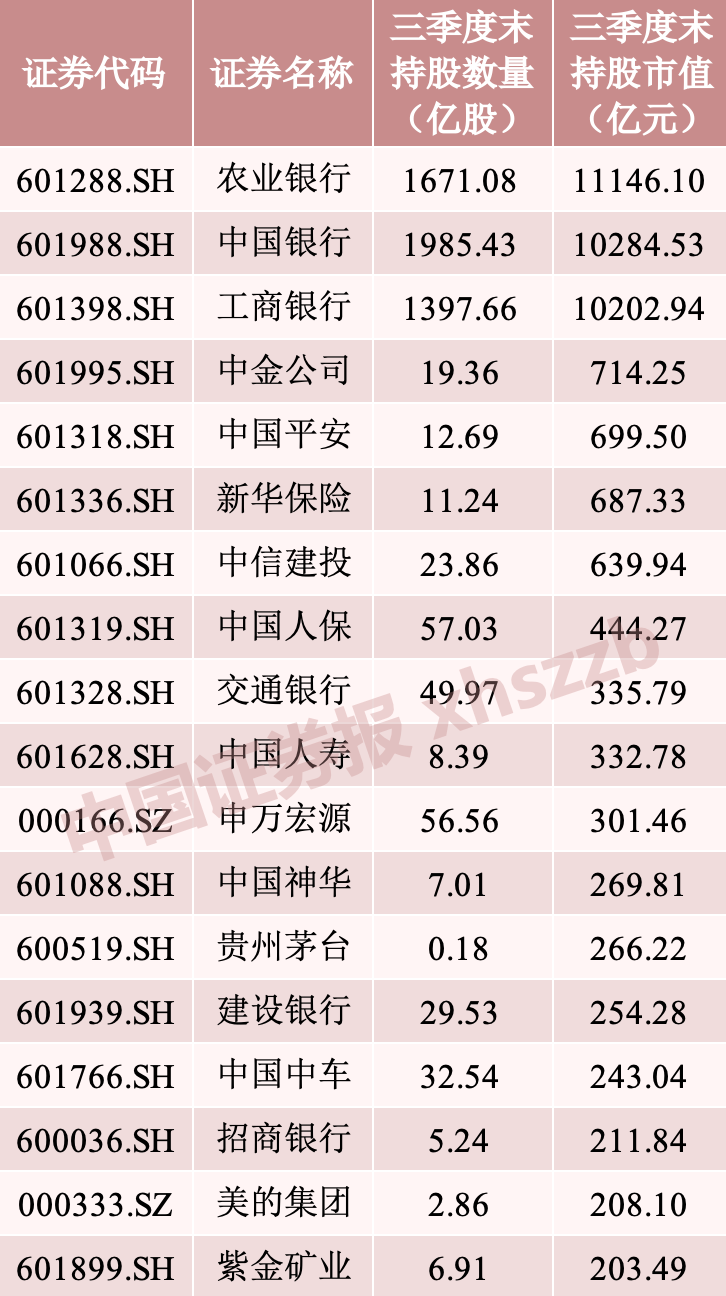
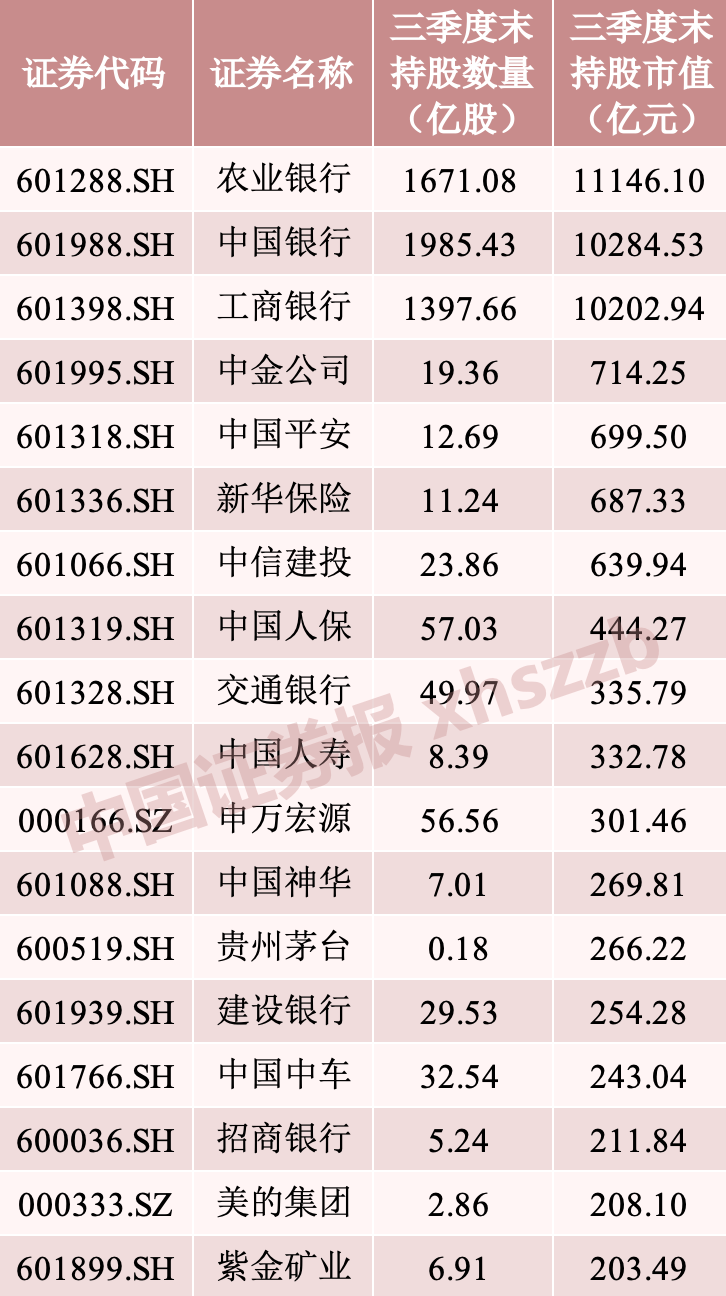
Group 1 - "National Team" funds increased holdings in insurance, resource, consumer, electronics, and communication sectors, with some stocks doubling in price during Q3 [1][8] - Over 800 A-share listed companies had "National Team" funds among their top ten shareholders by the end of Q3, with a total market value exceeding 100 billion yuan for 33 companies [2][5] - Major holdings by "National Team" funds included Agricultural Bank of China, Bank of China, and Industrial and Commercial Bank of China, with market values of 1.11 trillion yuan, 1.03 trillion yuan, and 1.02 trillion yuan respectively [2][6] Group 2 - "National Team" funds also held significant stakes in companies with market values between 300 billion yuan to 500 billion yuan, including China Life Insurance and China Pacific Insurance [3] - New entries into the top ten shareholders list included nearly 180 companies, with notable holdings in Mindray Medical and Giant Network, each exceeding 1 billion yuan [7] - The overall adjustment by "National Team" funds indicated a shift towards cyclical stocks, with increased investments in financials, resources, and consumer goods [8][9]






“国家队”资金 最新持仓曝光
Zhong Guo Zheng Quan Bao· 2025-11-03 04:54
Core Insights - "National Team" funds held over 800 A-shares as of the end of Q3, with significant investments in Agricultural Bank of China, Bank of China, and Industrial and Commercial Bank of China, each exceeding 1 trillion yuan in market value [1][3] - The "National Team" increased holdings in sectors such as insurance, resources, consumer goods, electronics, and telecommunications, with some stocks doubling in price during Q3 [1][8] - The funds exited from the top ten shareholders in sectors like securities, banking, electricity, real estate, and pharmaceuticals [1][8] Holdings Overview - As of the end of Q3, "National Team" funds were among the top ten shareholders in over 800 A-share companies, with 33 companies having a market value exceeding 10 billion yuan [3] - The top three holdings by market value were Agricultural Bank of China (1.11 trillion yuan), Bank of China (1.03 trillion yuan), and Industrial and Commercial Bank of China (1.02 trillion yuan) [3][5] - Other significant holdings included China International Capital Corporation, China Ping An, and New China Life Insurance, each with market values above 60 billion yuan [3][5] Sector Adjustments - In Q3, "National Team" funds entered the top ten shareholders of nearly 180 new listed companies, with notable investments in Mindray Medical, Giant Network, and Unisoc, each exceeding 1 billion yuan in market value [6] - The funds increased their positions in financial stocks such as New China Life Insurance and China Pacific Insurance, as well as resource stocks like Baosteel and China Aluminum [8] - Growth-oriented stocks that saw increased holdings included electronic companies like Pengding Holdings and Sanan Optoelectronics, with some stocks like Deep South Circuit and EVE Energy experiencing price increases around 100% [9]


分红险的复兴
HTSC· 2025-11-03 03:37
Group 1 - The insurance industry is expected to shift towards participating insurance products in 2026 due to resilient liability growth despite a low interest rate environment. Sales of participating insurance have exceeded earlier expectations, which may drive positive growth in new individual premium income and sustain high growth in bank insurance channels [1][2][3] - The participating critical illness insurance is anticipated to boost the sales of protection products, optimize product structure, and diversify revenue sources. However, challenges remain on the asset side, as low interest rates continue to pressure cash investment returns, squeezing the space to cover the rigid costs of life insurance [1][4] - High-quality sales channels and asset-liability matching are deemed crucial for insurance companies to maintain competitive advantages amid uncertainties. Companies such as AIA, Ping An, PICC, and China Taiping are recommended for attention [1][4][10] Group 2 - Participating insurance is rapidly regaining mainstream status after years of stagnation, driven by a rebalancing of interests between insurance companies and customers in a low interest rate environment. Compared to traditional insurance, participating insurance aligns the interests of policyholders and insurers more closely, making it more suitable for the current low-rate context [2][14] - The expected growth rate of new business value (NBV) for listed companies in 2026 is projected to reach around 20%, driven by the resurgence of participating insurance [2][14] Group 3 - The competitive strategy for participating insurance is more complex than traditional insurance, with a focus on establishing an appropriate market image or product persona. Strategies can be categorized into low-risk and high-risk approaches, depending on the target customer’s risk preference and the product's design [3][25] - Companies with high-quality sales channels have more flexibility in choosing their strategic direction, which should align with market image, customer positioning, product design, channel capabilities, and asset matching [3][25] Group 4 - The main challenges for insurance investments in 2026 include stabilizing cash returns and maintaining capital gains. The low interest rate environment is expected to compress cash investment returns, continuing to pose difficulties in covering rigid costs [4][30] - The past two years have seen excellent performance in equity investments, significantly boosting overall investment returns and profits for insurance companies. However, maintaining this level of performance in 2026 will require further advancements [4][32]
关于公司旗下基金改聘会计师事务所的公告
Zhong Guo Zheng Quan Bao - Zhong Zheng Wang· 2025-11-02 22:21
上述变更事项,已经公司董事会审议通过。并已按照相关规定及基金合同约定通知基金托管人。 特此公告。 中国人保资产管理有限公司 关于公司旗下基金改聘会计师事务所的公告 公告送出日期:2025年11月03日 1 公告基本信息 基金管理人名称中国人保资产管理有限公司公告依据《公开募集证券投资基金信息披露管理办法》、各 基金的《基金合同》及《招募说明书》等法律文件改聘日期2025年11月03日改聘前会计师事务所名称信 永中和会计师事务所(特殊普通合伙)改聘后会计师事务所名称毕马威华振会计师事务所 (特殊普通 合伙)基金名称基金简称基金主代码人保货币市场基金人保货币004903人保双利优选混合型证券投资基 金人保双利混合004988人保研究精选混合型证券投资基金人保精选混合005041人保转型新动力灵活配置 混合型证券投资基金人保转型混合005953人保鑫利回报债券型证券投资基金人保鑫利债券006114人保鑫 瑞中短债债券型证券投资基金人保鑫瑞中短债债券006073人保鑫裕增强债券型证券投资基金人保鑫裕增 强债券006459人保中证500指数型证券投资基金人保中证500006611人保鑫盛纯债债券型证券投资基金人 保鑫盛 ...
社保与基本养老保险基金 追求高性价比投资
Zhong Guo Zheng Quan Bao· 2025-11-02 21:40
Core Insights - The social security fund has significantly expanded its investment scope in the third quarter, particularly favoring the financial sector, while the basic pension insurance fund shows a preference for electronic-related stocks [1][2]. Social Security Fund Investments - As of the end of the third quarter, the social security fund entered the top ten shareholders of 617 stocks, an increase from 574 at the end of the second quarter and 379 year-on-year [2]. - The total market value held by the social security fund in A-shares exceeded 550 billion yuan, and by October 31, this value increased to over 590 billion yuan if no changes were made to the holdings [2]. - The Agricultural Bank of China was the most significant holding, with approximately 23.52 billion shares and a market value of 156.88 billion yuan at the end of the third quarter, which increased by over 30 billion yuan by October 31 [2]. Basic Pension Insurance Fund Investments - The basic pension insurance fund was a top ten shareholder in 176 stocks by the end of the third quarter, remaining stable compared to the second quarter [4]. - The top three holdings in the electronic sector included Spring Wind Power, Zhejiang Chint Electrics, and Transsion Holdings, with total market values exceeding 20 billion yuan, 1.5 billion yuan, and 1.46 billion yuan respectively [4]. - The fund reduced its holdings in Transsion Holdings, Blue Sky Technology, and Zhejiang Chint Electrics compared to the second quarter, while new investments were made in Guangfa Securities and Hongfa Shares [5]. Investment Trends - The social security and basic pension insurance funds have shown a tendency to increase holdings in relatively less popular sectors such as finance, real estate, agriculture, and chemicals, contrasting with the market's focus on technology stocks [6][8]. - The top three stocks with the largest increase in holdings by the social security fund were China Pacific Insurance, Guangxin Co., and China Merchants Shekou, with increases of 45.38 million shares, 34.63 million shares, and 33.37 million shares respectively [7]. - The basic pension insurance fund also increased its holdings in lesser-known stocks such as Xiantan Co., YTO Express, and COSCO Shipping, indicating a strategic approach to long-term investments in undervalued sectors [8].

社保与基本养老保险基金追求高性价比投资
Zhong Guo Zheng Quan Bao· 2025-11-02 20:16
Core Insights - The social security fund has significantly expanded its investment scope in the third quarter, particularly favoring the financial sector, while the basic pension insurance fund has shown a preference for electronic stocks [1][2]. Social Security Fund Investments - As of the end of the third quarter, the social security fund entered the top ten shareholders of 617 stocks, an increase from 574 at the end of the second quarter and 379 year-on-year [1]. - The total market value held by the social security fund in A-shares exceeded 550 billion yuan, and by October 31, this value increased to over 590 billion yuan if no changes were made to the holdings [1]. - The Agricultural Bank of China was the most significant holding, with approximately 23.52 billion shares and a market value of 156.88 billion yuan at the end of the third quarter, which increased by over 30 billion yuan by October 31 [1]. Basic Pension Insurance Fund Investments - The basic pension insurance fund was a top ten shareholder in 176 stocks by the end of the third quarter, remaining stable compared to the second quarter [2]. - The top three holdings in the electronic sector were Spring Power, Zhejiang Chint Electrics, and Transsion Holdings, with total market values of over 2 billion yuan, 1.5 billion yuan, and 1.46 billion yuan, respectively [3]. Notable Changes in Holdings - The basic pension insurance fund reduced its holdings in Transsion Holdings, Blue Sky Technology, and Zhejiang Chint Electrics, while increasing positions in Guangfa Securities and Hongfa Shares [3][4]. - The social security fund increased its holdings in China Pacific Insurance, Guangxin Co., and China Merchants Shekou, with significant increases in share counts [4]. Investment Trends - The social security and basic pension insurance funds have shown a tendency to invest in less popular sectors such as finance, real estate, agriculture, and chemicals, contrasting with the market's focus on technology stocks [5].