
NCI(601336)

Search documents
保险行业周报(20251117-20251121):报行合一再深化,《人身险产品费用分摊指引》出炉-20251123
Huachuang Securities· 2025-11-23 09:45
Investment Rating - The report maintains a "Recommendation" rating for the insurance industry, expecting the industry index to outperform the benchmark index by over 5% in the next 3-6 months [21]. Core Insights - The insurance index fell by 3.06% this week, outperforming the broader market by 0.71 percentage points. Major insurance stocks experienced declines, with notable drops from Sunshine Insurance (-4.8%) and China Pacific Insurance (-4.57%) [1]. - The China Actuarial Society released the "Guidelines for Expense Allocation of Life Insurance Products," which aims to enhance the scientific management of expenses within insurance companies and supports the implementation of the "reporting and operation integration" policy [2][4]. - As of the end of 2024, 34 insurance asset management companies managed a total of CNY 33.30 trillion, reflecting a year-on-year growth of 10.60% [2]. - The report highlights that 172 insurance companies have disclosed their solvency data for Q3 2025, with 14 achieving an AAA risk rating, while 4 companies fell below solvency standards [2]. Summary by Sections Market Performance - The insurance sector's performance was characterized by a 3.06% decline in the insurance index, with individual stocks like China Life and Ping An also showing significant decreases [1]. Regulatory Developments - The newly released guidelines categorize life insurance business expenses into variable and fixed costs, specifying which expenses should not be allocated and providing methods for expense allocation [4]. Financial Data - The total market capitalization of the insurance sector is CNY 32,109.56 billion, with a circulating market value of CNY 22,103.29 billion [6]. Valuation Metrics - The report provides PEV valuations for major life insurance companies, with China Life at 0.83x and Ping An at 0.71x [5]. - For property insurance, the PB valuations are noted, with China Re at 0.58x and PICC at 1.2x [10]. Investment Recommendations - Short-term recommendations focus on companies with performance elasticity, suggesting investments in New China Life, China Property & Casualty, and China Life. Long-term recommendations include China Pacific Insurance and China Ping An based on fundamental and valuation considerations [10].





“报行合一”落实再迎新要求;有平台宣称推出炒股保险;阳光人寿投资200亿私募基金|13精周报
13个精算师· 2025-11-22 03:03
Core Insights - The article highlights significant developments in the insurance industry, including regulatory updates, company dynamics, and emerging trends in insurance products and services. Regulatory Dynamics - Seven departments support the development of specialized agricultural insurance for the silk industry [4] - The Ministry of Finance welcomes qualified German insurance companies to expand their business in China [8] - The Ministry of Finance has allocated a budget of 45.6 billion for agricultural insurance premium subsidies for 2026 [9] - The central bank maintains the 1-year and 5-year LPR at 3.0% and 3.5% respectively [10] - The Financial Regulatory Bureau reports that the balance of funds utilized by insurance companies reached 37.46 trillion, a 12.6% increase from the beginning of the year [11] Company Dynamics - Sunshine Life plans to invest 20 billion in establishing a pilot fund [23] - Sunshine Life has reduced its stake in Huishang Bank by 11.438 million shares [24] - China Life Insurance provided insurance coverage of nearly 83 trillion for strategic emerging industries in the first three quarters [29] - New China Life has been approved to increase its capital in New China Asset Management (Hong Kong) [30] - Dongwu Property Insurance's Beijing branch has been approved to commence operations [31] Industry Trends - The insurance asset management sector has seen a 10.6% year-on-year increase, managing over 33 trillion in funds [46] - The net profit of PICC Health surged by 200% in the first three quarters [47] - Sixteen insurance companies issued over 600 billion in bonds to supplement capital [49] - The insurance industry is experiencing a shift towards more flexible and innovative insurance products, including a new "per day" drone insurance product launched in Jiangsu [67] - The insurance sector is increasingly focusing on long-term care insurance and products tailored for the elderly [18][19] Personnel Changes - Huang Zhiwei has been approved as the chairman of China Merchants Jinhe Life Insurance [33] - The former general manager of Bank of China Samsung Life, Qiu Zhikun, is now acting chairman [34] - Zhang Yaohui has been appointed as the deputy general manager of Zhonghui Mutual Insurance [37] Product and Service Innovations - New China Life launched a celebratory version of its whole life insurance product, emphasizing dual growth advantages [64] - The 2026 Beijing Inclusive Health Insurance offers a 10% discount on medication purchases for policyholders [65] - Jiangsu has introduced a pioneering "per day" insurance product for drones, enhancing risk management in the low-altitude economy [67]



分红险“霸屏”背后: 险企从“卷收益”到“拼服务”
Zhong Guo Jing Ying Bao· 2025-11-21 19:12
Core Viewpoint - The insurance industry is shifting towards dividend insurance products as a consensus in response to the ongoing decline in interest rates [1][2]. Group 1: Market Trends - A significant number of new insurance products launched by various life insurance companies are dividend insurance, with over 40 out of 50 life insurance products currently on sale being dividend-type [2]. - Major life insurance companies like Xinhua Insurance, Ping An Life, and China Life have introduced various dividend insurance products, indicating a trend towards these offerings [3]. - The design of dividend insurance products, such as the "Taiping Guowei No.1" from Taiping Life, combines guaranteed benefits with dividends, allowing for both asset security and market participation [3]. Group 2: Product Structure and Performance - The maximum preset interest rate for dividend insurance from leading insurers is generally set at 1.75%, with some joint venture companies offering rates as low as 1.5% [4]. - The reduction in preset interest rates for traditional and dividend insurance products has been noted, with dividend products experiencing a smaller decline, thus enhancing their yield advantage over traditional products [4]. - Dividend insurance provides a combination of guaranteed benefits and non-guaranteed dividends, which helps mitigate the liability pressure on insurance companies [5]. Group 3: Marketing Challenges - The complexity of dividend insurance products poses challenges for insurance agents, requiring them to possess a solid understanding of product configurations and benefits [6][7]. - The shift from traditional fixed-return products to dividend insurance has created difficulties in marketing, as agents must now explain the intricacies of dividend structures to clients [7][8]. - Some agents continue to use outdated marketing strategies, misrepresenting dividend insurance as quick-return products, which may lead to consumer confusion [8]. Group 4: Service Integration - Dividend insurance is evolving beyond mere insurance products to become gateways for integrated services in healthcare, retirement, and wellness, forming a "product + service" model [9][10]. - Companies are increasingly linking their insurance products with healthcare and retirement ecosystems, offering a range of services from family doctors to retirement communities [10][11]. - This integration allows insurers to meet diverse customer needs and enhances the overall value proposition of dividend insurance products [11].
【财闻联播】小米王化首次回应转岗!储蓄国债(电子式)纳入个人养老金产品范围
券商中国· 2025-11-21 15:04
Macro Dynamics - In the first ten months of 2025, China attracted foreign investment of 621.93 billion RMB, a year-on-year decrease of 10.3% [2] - The number of newly established foreign-invested enterprises reached 53,782, marking a 14.7% increase year-on-year [2] - The manufacturing sector attracted 161.91 billion RMB, while the service sector attracted 445.82 billion RMB [2] - High-tech industries received 192.52 billion RMB in foreign investment, with significant growth in e-commerce services (173.1%), medical equipment manufacturing (41.4%), and aerospace manufacturing (40.6%) [2] - Investment from the UAE, UK, and Switzerland increased by 48.7%, 17.1%, and 13.2% respectively [2] Financial Institutions - Xinhua Insurance has been approved to increase its capital by 154.45 million HKD in Xinhua Asset Management (Hong Kong) [8] - The independent director of Xi'an Bank, Cao Huitao, resigned due to work reasons [9][10] - Huang Zhiwei has been approved to serve as the chairman of China Merchants Renhe Life Insurance [11] Market Data - The Hang Seng Index fell by 2.38%, and the Hang Seng Tech Index dropped by 3.21% on November 21 [12] - The Shanghai Composite Index decreased by 2.45%, closing below 3900 points, with significant declines in lithium, titanium dioxide, and energy metal sectors [13] Company Developments - China Nuclear Power announced a share buyback of 37.99 million shares, utilizing a total of 345 million RMB [17] - Changsha Beidou Industry Safety Technology Research Institute's IPO on the Sci-Tech Innovation Board has been accepted, aiming to raise 709 million RMB for various projects [18] - Xiaomi Group's public relations manager Wang Hua confirmed his transfer to the Xiaomi Wuhan headquarters [19]


电厂 | 保险巨头迎来黄金周期 但如何才能进入“黄金时代”
Xin Lang Cai Jing· 2025-11-21 11:17
Core Insights - The insurance giants in China are experiencing a significant upturn, driven by a recovery in the capital markets and stable growth in the new business value of life insurance [1][4][10] - The combined revenue of the five major insurance companies reached 2.37 trillion yuan, with a net profit of 426.04 billion yuan in the first three quarters, indicating a revenue growth of 13.6% and a net profit growth of 33.54% [1][4] - The net profit growth in Q3 alone was remarkable, with an increase of 68.34%, surpassing market expectations [1][4] Revenue and Profit Growth - The five major insurance companies reported the following revenues for the first three quarters: China Ping An (832.94 billion yuan), China Life (537.895 billion yuan), China Pacific Insurance (344.904 billion yuan), China Property & Casualty Insurance (520.99 billion yuan), and New China Life (137.252 billion yuan) [4] - The corresponding profit figures were: China Ping An (132.856 billion yuan), China Life (167.804 billion yuan), China Property & Casualty Insurance (46.822 billion yuan), China Pacific Insurance (45.7 billion yuan), and New China Life (32.857 billion yuan) [4] - The net profit growth rates were significantly higher than revenue growth, with China Life and New China Life showing around 60% growth [4][7] Business Value and Channel Quality - The new business value for the five major insurance companies saw substantial increases, with China Life up 41.8%, Ping An Life and Health up 46.2%, and China Property & Casualty Insurance up 76.6% [7] - The improvement in channel quality and the growth of new business value were identified as key drivers for the profit increases [4][7] - The insurance giants are focusing on channel transformation, enhancing productivity, and developing bancassurance channels to boost new business value [4][6] Investment Performance - The total investment income for the five major insurance companies reached 887.5 billion yuan, a year-on-year increase of 35.64% [11] - The investment asset scale reached 20.26 trillion yuan, with significant growth in stock investments, which increased by 36.2% [11][13] - The companies are benefiting from a favorable capital market environment, which has strengthened their financial foundations [11][13] Cost Efficiency and Operational Improvements - The insurance sector has made notable progress in cost reduction and efficiency improvements, with life insurance companies reducing costs by 350 billion yuan since 2024 [14][15] - Companies are leveraging technology, such as AI, to enhance operational efficiency and reduce costs [15] - The overall industry is witnessing a shift towards more reliable and stable operations, driven by the reforms initiated by the major players [18] Industry Outlook - The insurance industry is entering a new growth phase, with the potential for high-quality development contingent on continuous internal improvements and reforms [18] - While the major companies are thriving, some smaller firms are struggling, indicating a polarization within the industry [16][18] - The overall health and standardization of the industry are expected to improve as the major companies lead the way in reforms and operational excellence [18]

保险板块11月21日跌2.39%,新华保险领跌,主力资金净流出8.56亿元
Zheng Xing Xing Ye Ri Bao· 2025-11-21 09:33
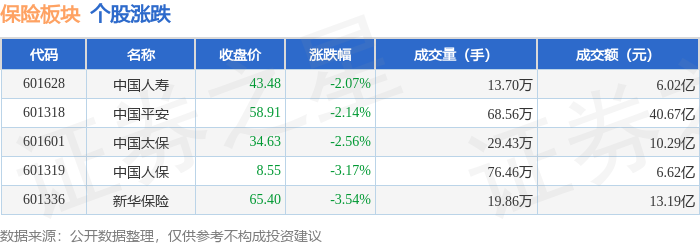
Core Points - The insurance sector experienced a decline of 2.39% on November 21, with Xinhua Insurance leading the drop [1] - The Shanghai Composite Index closed at 3834.89, down 2.45%, while the Shenzhen Component Index closed at 12538.07, down 3.41% [1] Insurance Sector Performance - China Life (601628) closed at 43.48, down 2.07% with a trading volume of 137,000 shares and a turnover of 602 million yuan [1] - Ping An Insurance (601318) closed at 58.91, down 2.14% with a trading volume of 685,600 shares [1] - China Pacific Insurance (601601) closed at 34.63, down 2.56% with a trading volume of 294,300 shares and a turnover of 1.029 billion yuan [1] - China Reinsurance (601319) closed at 8.55, down 3.17% with a trading volume of 764,600 shares and a turnover of 662 million yuan [1] - Xinhua Insurance (601336) closed at 65.40, down 3.54% with a trading volume of 198,600 shares and a turnover of 1.319 billion yuan [1] Capital Flow Analysis - The insurance sector saw a net outflow of 856 million yuan from institutional investors, while retail investors had a net inflow of 733 million yuan [1] - The detailed capital flow for individual stocks shows that China Reinsurance had a net outflow of 51.58 million yuan from institutional investors [2] - China Life experienced a net outflow of 52.08 million yuan from institutional investors, while retail investors contributed a net inflow of 64.48 million yuan [2] - China Pacific Insurance had a net outflow of 56.32 million yuan from institutional investors, with retail investors contributing a net inflow of 85.31 million yuan [2] - Xinhua Insurance faced a significant net outflow of 258 million yuan from institutional investors, while retail investors had a net inflow of 185 million yuan [2] - Ping An Insurance had a net outflow of 43.91 million yuan from institutional investors, with retail investors contributing a net inflow of 35.8 million yuan [2]
保险板块11月20日跌0.05%,中国太保领跌,主力资金净流入1.54亿元
Zheng Xing Xing Ye Ri Bao· 2025-11-20 09:04
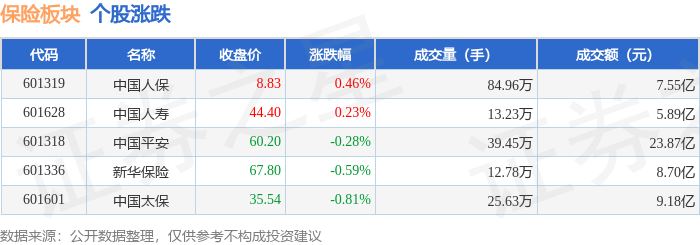
Core Insights - The insurance sector experienced a slight decline of 0.05% on November 20, with China Pacific Insurance leading the drop [1] - The Shanghai Composite Index closed at 3931.05, down 0.4%, while the Shenzhen Component Index closed at 12980.82, down 0.76% [1] Insurance Sector Performance - China Life Insurance (601628) closed at 44.40, up 0.23% with a trading volume of 132,300 shares and a transaction value of 589 million [1] - China Pacific Insurance (601601) closed at 35.54, down 0.81% with a trading volume of 256,300 shares and a transaction value of 918 million [1] - China Ping An (601318) closed at 60.20, down 0.28% with a trading volume of 394,500 shares and a transaction value of 2.387 billion [1] - New China Life Insurance (601336) closed at 67.80, down 0.59% with a trading volume of 127,800 shares and a transaction value of 870 million [1] - China Reinsurance (601319) closed at 8.83, up 0.46% with a trading volume of 849,600 shares and a transaction value of 7.551 billion [1] Capital Flow Analysis - The insurance sector saw a net inflow of 154 million from institutional investors, while retail investors experienced a net outflow of 31.98 million [1] - China Life Insurance had a net inflow of 58.50 million from institutional investors, while retail investors had a net outflow of 30.28 million [2] - China Pacific Insurance experienced a net outflow of 32.81 million from institutional investors, but a net inflow of 70.61 million from retail investors [2]
中国银行A股股价创新高;现货黄金站上4100美元/盎司 | 金融早参
Mei Ri Jing Ji Xin Wen· 2025-11-19 23:24
Group 1: Central Bank Operations - The central bank conducted a 310.5 billion yuan 7-day reverse repurchase operation, with a bid amount and winning amount of 310.5 billion yuan, maintaining an operation rate of 1.40% [1] Group 2: Banking Sector Performance - A-shares in the banking sector experienced fluctuations but generally rose, with China Bank's stock price increasing over 2% to reach a new high, alongside significant gains from other banks such as Everbright Bank and CITIC Bank [2] - The rise in bank stock prices reflects positive market expectations for future growth in the financial industry, likely driven by economic recovery expectations and policy support [2] Group 3: Insurance Sector Performance - The insurance sector in A-shares continued to rise, with China Life and China Property & Casualty Insurance both increasing over 3%, along with other major insurers [3] - The notable growth in the insurance sector indicates investor optimism, potentially influenced by market perceptions of economic stability and increased risk management awareness among individuals [3] Group 4: Gold Market Trends - Spot gold prices reached 4,100 USD per ounce, reflecting a 0.85% increase during the day [4] - The rise in gold prices indicates a sustained preference for safe-haven assets, driven by increasing geopolitical risks and inflation pressures, showcasing gold's appeal as a traditional safe-haven investment [4]


保险业偿付能力总体稳健 5家险企亮“红灯”
Jin Rong Shi Bao· 2025-11-19 21:58
Core Insights - The insurance industry shows a strong solvency position with a comprehensive solvency adequacy ratio of 186.3% and a core solvency adequacy ratio of 134.3% as of Q3 2025 [2][9] - A total of 172 insurance companies have disclosed their solvency data, with 14 achieving the highest AAA risk rating, while 5 companies failed to meet solvency requirements [2][3] Solvency Ratios - The solvency ratios for property insurance, life insurance, and reinsurance companies are 240.8%, 175.5%, and 246.2% respectively, indicating robust financial health [2] - Core solvency ratios for these segments are 212.9%, 118.9%, and 216.7% respectively, all exceeding the regulatory minimums [2] Risk Ratings - The risk rating system categorizes companies into four classes (A, B, C, D), with 14 companies rated AAA, while 4 companies received a C rating due to governance issues [3][5] - Companies like Anhua Agricultural Insurance and Qianhai Property Insurance have been cited for governance-related risks affecting their ratings [5][6] Company Performance - Huawhai Life is the only life insurance company rated C, primarily due to ongoing governance issues, and has implemented measures to improve its risk management [5] - Changsheng Life reported a significant drop in solvency ratios to 38.9% and 61.3%, leading to non-compliance with regulatory standards [6] Industry Trends - Approximately 87% of insurance companies reported profitability in the first three quarters of the year, despite a general decline in solvency ratios for nearly 70% of firms [9][11] - Companies are actively pursuing capital increases and issuing supplementary bonds to enhance their solvency ratios [10] Investment Performance - Over 90 insurance companies achieved an investment return rate of 3% or higher, with Fubon Property Insurance leading at 22.77% [11] - The positive performance in the equity market, with the CSI 300 index rising about 18%, has contributed to improved investment returns for insurance firms [11]
李全 死缓!
Zhong Guo Ji Jin Bao· 2025-11-19 12:56
2025年11月19日,山东省济南市中级人民法院一审公开宣判新华人寿保险股份有限公司原党委书记、董 事长李全贪污、受贿案,对被告人李全以贪污罪判处无期徒刑,剥夺政治权利终身,并处没收个人全部 财产;以受贿罪判处死刑,缓期二年执行,剥夺政治权利终身,并处没收个人全部财产,决定执行死 刑,缓期二年执行,剥夺政治权利终身,并处没收个人全部财产。对追缴在案的李全贪污所得财物返还 被害单位,不足部分继续追缴,对追缴在案的李全受贿所得财物及孳息依法上缴国库。 据悉,济南市中级人民法院于2025年5月14日公开开庭审理了该案。庭审中,检察机关出示了相关证 据,被告人李全及其辩护人进行了质证,控辩双方在法庭的主持下充分发表了意见,李全进行了最后陈 述,并当庭表示认罪悔罪。人大代表、政协委员、被告人亲属和各界群众30余人旁听了庭审。 来源:央视新闻客户端 经审理查明:2015年6月至2024年3月,被告人李全利用担任新华资产管理股份有限公司总裁、董事长, 新华资产管理(香港)有限公司董事长职务上的便利,伙同他人以非法占有为目的,采用欺骗、隐瞒等 手段,非法占有相关业务收益,共计折合人民币1.08亿余元。2010年至2023年, ...