
ICBC(601398)

Search documents
党建引领聚合力 金融活水润沃土——临城县人民政府与中国工商银行邢台分行签署战略合作协议
Xin Hua Wang· 2026-01-20 12:49
Group 1 - The core viewpoint of the news is the signing of a strategic cooperation agreement between the People's Government of Lincheng County and the Xingtai Branch of the Industrial and Commercial Bank of China, aimed at injecting new financial support for high-quality economic and social development in Lincheng County [1] - The cooperation is a significant initiative to implement the central government's directives on rural revitalization and economic work, focusing on financial assistance to stimulate economic vitality in rural areas [1] - The agreement emphasizes a collaborative approach led by party building and financial support, with a focus on effectively promoting rural revitalization through practical financial measures [1] Group 2 - A "4+5+3" working mechanism will be established, which includes four major support systems focused on organizational coordination, resource aggregation, precise policy implementation, and a people-oriented approach [2] - The cooperation will concentrate on five key areas to strengthen the foundation for collaboration, including enhancing rural grassroots party organization construction and promoting the development of local economies [2] - The parties will maintain mechanisms for work promotion, information sharing, and summarizing and promoting best practices to ensure the effective implementation of rural revitalization efforts [2]

冬季达沃斯发布2026年全球品牌价值500强榜单:品牌总价值双位数跃升,中国品牌表现多维并进
Xin Lang Cai Jing· 2026-01-20 12:21
Group 1 - The Brand Finance 2026 Global Brand Value 500 report shows that Apple continues to lead the rankings, with the United States having 192 brands contributing 53.4% of the total brand value [34][36] - China ranks second with 68 brands, accounting for 15.1% of the total brand value, with TikTok having the highest brand value among them [34][40] - Germany follows with 26 brands contributing 5.6% of the total brand value, while Japan and France rank fourth and fifth, each with 33 brands contributing 4.7% and 4.1% respectively [3][36] Group 2 - The banking industry remains the highest contributing sector with 79 brands, accounting for 12.5% of the total brand value, followed by the media industry with 25 brands at 10.9% and the electronics industry with 17 brands at 8% [4][36] - In 2026, Apple's brand value increased by 5.8% to $607.6 billion, while Microsoft saw a 22.6% growth to $565.2 billion, solidifying its leadership in AI and cloud services [6][38] - TikTok's brand value surged by 45.1% to $153.5 billion, making it the sixth most valuable brand globally, reflecting its strong influence in the short video and social media sectors [8][40] Group 3 - The State Grid of China ranks first in the global utilities sector with a brand value of $102.4 billion, achieving a 19.6% increase [9][41] - China Southern Power Grid experienced a 33.2% growth in brand value, reaching $11.96 billion, becoming the fastest-growing brand in the global utilities sector [11][43] - The banking sector in China shows strong performance with 13 banks collectively valued at $417 billion, a 1.4% increase year-on-year, with the Industrial and Commercial Bank of China leading at $90.9 billion [13][45] Group 4 - The oil and gas sector also performed well, with China National Petroleum and Sinopec both achieving positive growth in brand value [17][49] - Moutai remains the top brand in the global spirits industry with a slight increase of 2.2% to $59.63 billion, while Wuliangye holds the second position with a brand value of $27.3 billion [21][53] - The insurance sector saw significant growth, with China People's Insurance increasing its brand value by 12% to $16.82 billion, moving up five places in the global rankings [25][57]





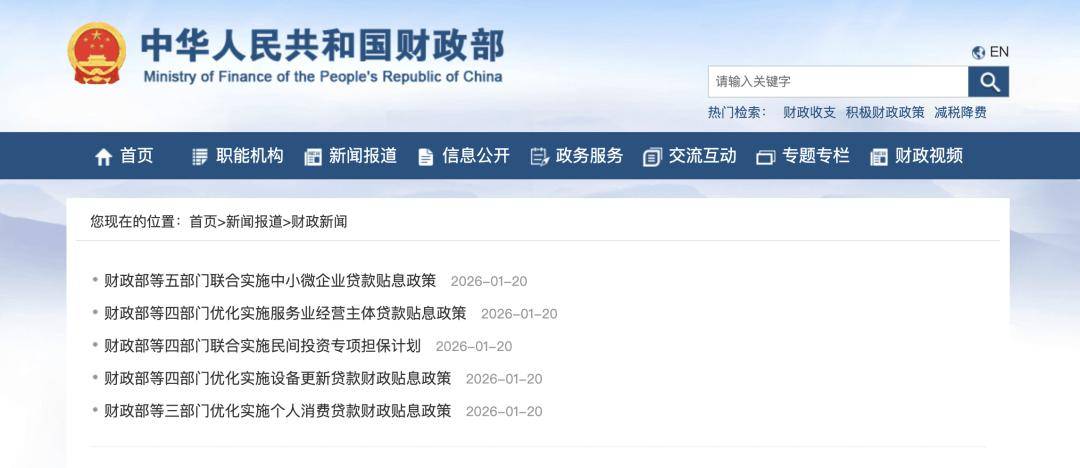
财政部连发多份重要文件,事关贷款贴息、民间投资贷款担保等 一揽子政策全文公布
Sou Hu Cai Jing· 2026-01-20 09:03
Group 1 - The core viewpoint of the news is the implementation of a financial subsidy policy for equipment renewal loans to support businesses in reducing financing costs and promoting effective investment [3][4][5] - The policy includes a 1.5% interest subsidy on fixed asset loans for equipment renewal projects, applicable for a maximum of two years, and is effective until December 31, 2026 [3][4] - The scope of support has been expanded to include various sectors such as construction, aviation, digital technology, and green energy, emphasizing high-end, intelligent, and digital equipment updates [4][6] Group 2 - A total of 26 banks are designated as eligible for processing the interest subsidy loans, including major national banks and several regional banks [4][5] - The subsidy process has been optimized to include a "pre-allocation + settlement" method, streamlining the application and approval process for banks and provincial financial departments [5][6] - The policy aims to enhance the experience of businesses by ensuring timely communication regarding subsidy payments through modern technology [6][7] Group 3 - The policy for small and micro enterprises includes a 1.5% interest subsidy on fixed asset loans, with a maximum loan amount of 50 million yuan, effective from January 1, 2026 [8][9] - The targeted sectors for this subsidy include new energy vehicles, medical equipment, and various service industries, aiming to stimulate investment and production [9][10] - The operational mechanism involves a "total-to-total" model for coordination between financial institutions and fiscal departments to ensure efficient processing of subsidy funds [11][12] Group 4 - The service industry loan subsidy policy has been extended until December 31, 2026, with an increased maximum loan amount of 10 million yuan and a 1% interest subsidy for one year [16][17] - New sectors such as digital, green, and retail have been added to the support scope, enhancing the policy's relevance to current economic trends [17][18] - The funding allocation process has been refined to improve efficiency and reduce redundancy in the approval process [18][19] Group 5 - A special guarantee plan for private investment has been introduced with a total quota of 500 billion yuan over two years, aimed at supporting small and micro enterprises [22][24] - The plan includes risk-sharing mechanisms where banks bear at least 20% of the loan risk, while the government guarantee fund covers up to 80% [24][25] - The initiative encourages innovative financing models and aims to enhance the capital strength of the government guarantee fund to support private investments effectively [26][27]





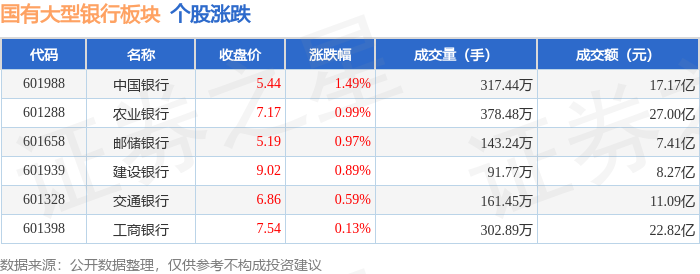
国有大型银行板块1月20日涨0.78%,中国银行领涨,主力资金净流入7.21亿元
Zheng Xing Xing Ye Ri Bao· 2026-01-20 08:56
Group 1 - The core viewpoint of the news is that the state-owned large bank sector experienced a rise of 0.78% on January 20, with China Bank leading the gains [1] - The Shanghai Composite Index closed at 4113.65, down 0.01%, while the Shenzhen Component Index closed at 14155.63, down 0.97% [1] - The trading performance of individual stocks in the state-owned large bank sector showed varied results, with China Bank closing at 5.44, up 1.49%, and Agricultural Bank at 7.17, up 0.99% [1] Group 2 - The net inflow of main funds into the state-owned large bank sector was 721 million yuan, while retail investors saw a net outflow of 177 million yuan [1] - The detailed fund flow for individual banks indicated that Agricultural Bank had a net inflow of 210 million yuan from main funds, while it experienced a net outflow of 140 million yuan from speculative funds [2] - Industrial and Commercial Bank had a net inflow of 181 million yuan from main funds, but a significant net outflow of 254 million yuan from speculative funds [2]


中国工商银行取得外联业务的密钥更新方法及装置专利
Sou Hu Cai Jing· 2026-01-20 05:13
Group 1 - The core point of the article is that the Industrial and Commercial Bank of China (ICBC) has obtained a patent for a method and device related to key updating in external business operations, with the patent announcement number CN118449689B and an application date of May 2024 [1] Group 2 - ICBC was established in 1985 and is located in Beijing, primarily engaged in monetary financial services [1] - The registered capital of ICBC is approximately 35.64 billion RMB [1] - According to data analysis, ICBC has invested in 28 companies, participated in 5,000 bidding projects, has 976 trademark information entries, and holds 5,000 patent information entries, along with 79 administrative licenses [1]
四部门:扩大设备更新贷款财政贴息支持范围
Bei Jing Shang Bao· 2026-01-20 05:08
Core Viewpoint - The Chinese government has announced a policy to optimize the implementation of financial subsidies for equipment renewal loans, aimed at supporting various industries and promoting technological innovation and modernization [1][2]. Group 1: Policy Details - The central government will provide a subsidy of 1.5% on the principal of fixed asset loans for equipment renewal projects, applicable for a maximum period of 2 years from the loan issuance date [1]. - The policy will include new technology innovation loans issued by banks starting in 2026, expanding the scope of financial support [1]. - The implementation of this policy is set to last until December 31, 2026, with the possibility of extension based on future evaluations [1]. Group 2: Supported Industries - The policy expands support beyond existing sectors such as industrial, energy, transportation, and tourism to include construction, municipal services, energy equipment, aviation materials, electronic information, safety production, and more [1]. - Additional focus areas for support include high-end, intelligent, green, and digital equipment updates, as well as sectors like artificial intelligence, elderly care, and waste recycling [1]. Group 3: Participating Banks - A total of 26 banks are designated to handle the subsidized loans, including major state-owned and commercial banks such as the China Development Bank, Agricultural Bank of China, and Industrial and Commercial Bank of China [2].
财政部等四部门发布关于优化实施设备更新贷款财政贴息政策的通知
Xin Lang Cai Jing· 2026-01-20 04:32
Core Viewpoint - The Ministry of Finance and other departments have issued a notice to optimize the implementation of the equipment renewal loan interest subsidy policy, aimed at supporting enterprises in equipment updates and technological transformation, reducing financing costs, and promoting effective investment [1] Group 1: Support Scope and Areas - The central government will subsidize 1.5% of the principal on fixed asset loans for equipment renewal projects, applicable for a maximum of 2 years from the loan issuance date [1] - The policy will include new technology innovation loans issued by banks starting in 2026, expanding the support to various sectors including construction, aviation, and artificial intelligence, among others [1] Group 2: Implementation and Management - A total of 26 banks will handle the interest subsidy loans, including major state-owned and commercial banks [2] - The subsidy process will be optimized through a "pre-allocation + settlement" method, with specific timelines for fund requests and approvals [3] - The Ministry of Finance and other regulatory bodies will oversee the implementation, ensuring compliance and monitoring of fund usage [4][5] Group 3: Supervision and Reporting - Joint inspections will be conducted to ensure compliance, with penalties for serious violations by enterprises or banks involved in the subsidy process [5] - Banks are required to report on the execution of the policy, including loan issuance and subsidy usage, within specified timeframes [6]


五部门发布实施中小微企业贷款贴息政策通知 支持以人工智能等为代表的新兴领域
智通财经网· 2026-01-20 04:27
Core Viewpoint - The Chinese government has announced a loan interest subsidy policy aimed at supporting small and micro enterprises in key industries, effective from January 1, 2026, with a subsidy rate of 1.5% for loans up to 50 million yuan per enterprise [1][4]. Group 1: Policy Content - The policy targets small and micro private enterprises involved in key industrial chains and their upstream and downstream sectors [3]. - Eligible industries include new energy vehicles, industrial mother machines, pharmaceuticals, medical equipment, software, civil aircraft, servers, mobile communication devices, new displays, industrial robots, and agricultural machinery [4]. - The subsidy will be provided for fixed asset loans and new policy financial tools used by small and micro enterprises [4]. Group 2: Subsidy Standards - The central government will provide a 1.5% annual interest subsidy for eligible loans, with a maximum loan amount of 50 million yuan per enterprise and a term not exceeding 2 years [4]. - The policy is initially set to last for one year, with the possibility of extension based on future evaluations [4]. Group 3: Implementation Mechanism - The policy will be executed through a "total-to-total" model, where financial departments will coordinate directly with banks [5][6]. - Banks will be responsible for loan approvals based on market principles and will manage the disbursement of funds [7]. - Monthly reporting on loan issuance and subsidy usage will be required from banks to ensure compliance and oversight [9]. Group 4: Supervision and Management - The Ministry of Finance will oversee the implementation and conduct audits to ensure proper use of subsidy funds [10]. - Banks are required to monitor the flow of loan funds to prevent misuse, such as investment in speculative activities [10].
金融赋能助推养老产业发展
Jin Rong Shi Bao· 2026-01-20 02:12
Core Insights - The high-quality development of pension finance has become a focal point due to the aging population trend, with Luoyang's population aged 60 and above reaching 1.471 million and an aging rate of 20.8% by the end of 2024 [1] Group 1: Policy Guidance - The People's Bank of China Luoyang Branch is actively formulating guiding opinions for the development of pension finance, enhancing communication with local government and financial institutions to improve policy awareness and coverage [2] - A project library of 30 key quality projects in the pension service sector has been established, facilitating targeted support from banks to eligible enterprises [2] Group 2: Financial Product Innovation - The first "pension loan" of 760,000 yuan was issued to a healthcare service company, showcasing the innovation in pension finance products and providing a model for the province [3] - Financial institutions are encouraged to develop a comprehensive financial product system tailored to the needs of pension enterprises, ensuring timely and effective funding [3] Group 3: Warm Financial Services - Financial institutions are creating a warm pension finance service system, including the establishment of demonstration outlets and various convenient services for the elderly [5] - Over 100 bank outlets have completed renovations to cater to the elderly, enhancing their service experience [6] Group 4: Overall Progress - Significant progress has been made in building the pension finance service system in Luoyang, with various banks conducting over 200 promotional activities benefiting more than 100,000 people [6]
商业银行赋能“冷资源”变“热经济”
Zheng Quan Ri Bao· 2026-01-19 16:44
Core Insights - The winter ice and snow economy is becoming a significant driver for consumption upgrades, regional development, and industrial integration, supported by innovative financial services from banks [1] Group 1: Financial Support for the Ice and Snow Economy - Banks are embedding services throughout the entire ice and snow economy chain, providing differentiated financial support tailored to various segments such as infrastructure, equipment manufacturing, and tourism [2] - Construction Bank's Heilongjiang branch has provided billions in loans for major infrastructure projects to enhance tourism connectivity between key ice and snow attractions [2] - Agricultural Bank of China quickly issued a 2.73 million yuan loan to a local beverage company facing cash flow issues during peak tourism season, demonstrating the banks' responsiveness to small and micro enterprises [2][3] Group 2: Support for Small and Micro Enterprises - Small and micro enterprises are crucial to the ice and snow economy, with Construction Bank providing over 100 million yuan in credit support to more than 130 hotels and restaurants in Heilongjiang since 2025 [3] - Financial institutions are actively identifying and addressing the funding needs of local businesses, ensuring they can upgrade facilities and meet increased demand during the winter season [3] Group 3: Consumer Experience and Payment Solutions - Banks are enhancing consumer experiences by integrating financial services into consumption scenarios, such as the "Love Ice and Snow Carnival" campaign by Industrial and Commercial Bank of China, which offers discounts to stimulate spending [4] - Agricultural Bank and Construction Bank have established "Ice and Snow Stations" to provide free services like hot drinks and luggage storage, improving visitor satisfaction [5][6] - The introduction of comprehensive payment solutions, including support for international card payments, aims to accommodate diverse consumer payment preferences [5] Group 4: Future Projections and Strategic Directions - The "China Ice and Snow Tourism Development Report (2026)" predicts that ice and snow tourism will attract 360 million visitors and generate 450 billion yuan in revenue during the 2025-2026 winter season [6] - Financial institutions are encouraged to leverage technology and green finance to support high-tech equipment production and eco-tourism projects, enhancing the overall ice and snow industry [6]
