
ICBC(601398)

Search documents
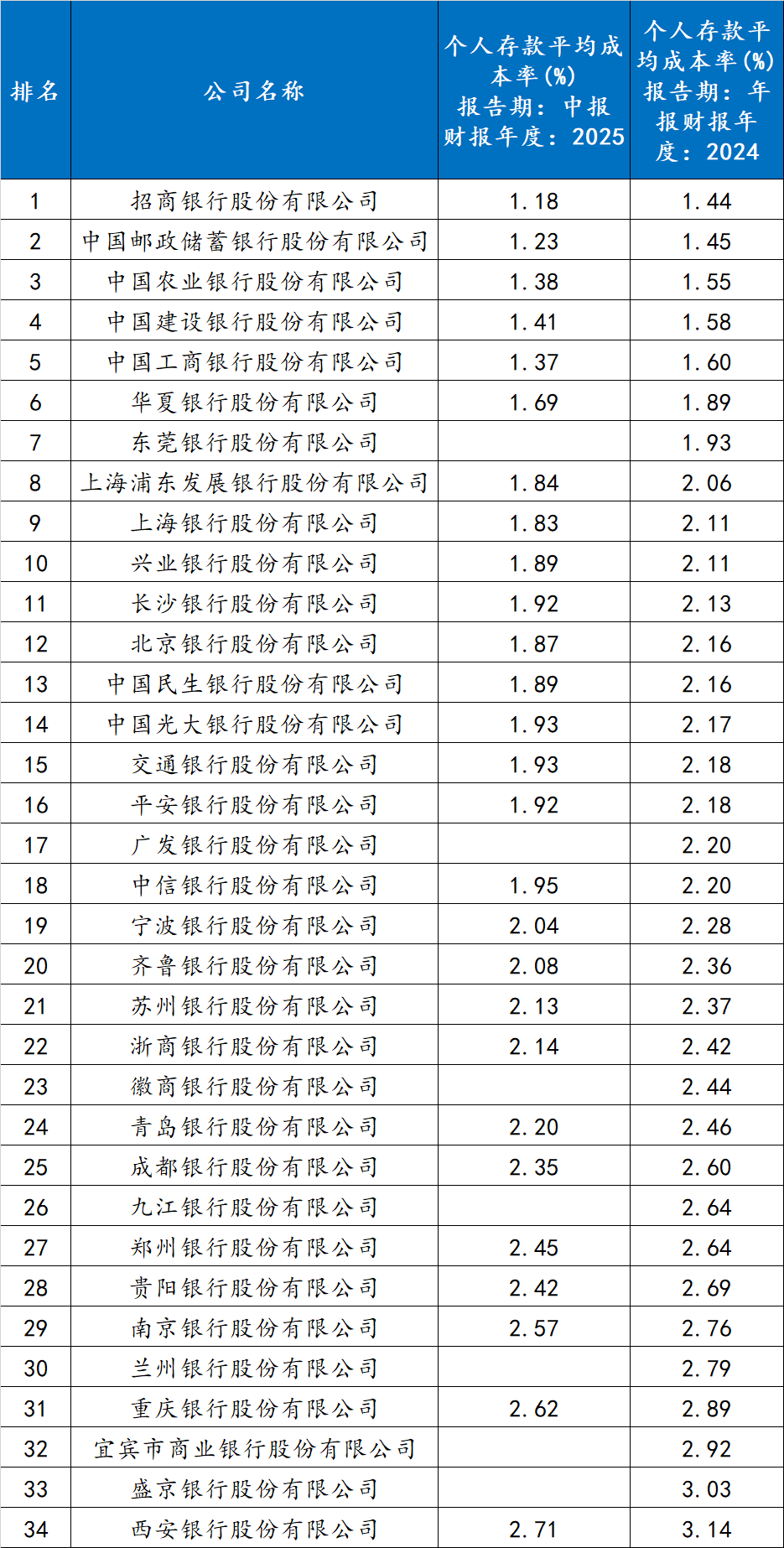
银行个人负债成本排名
Xin Lang Cai Jing· 2026-01-19 13:16
Core Insights - The average cost of personal deposits is a key indicator of banks' liability costs, with lower rates indicating stronger competitiveness in attracting deposits [1][7]. Group 1: Ranking of Banks by Deposit Cost - The banks with the lowest average cost of personal deposits are primarily state-owned large banks and some retail-focused joint-stock banks, with China Merchants Bank leading at 1.18% for the 2025 mid-year report [2][8]. - Following China Merchants Bank are China Postal Savings Bank at 1.23% and Agricultural Bank of China at 1.38%, benefiting from extensive branch networks and strong customer bases [2][8]. - The top six banks all have costs below 2%, indicating strong deposit cost control capabilities [2][8]. Group 2: Cost Trends and Observations - A notable trend is the general decline in average deposit costs across most banks when comparing 2024 annual reports to 2025 mid-year reports, with China Merchants Bank decreasing from 1.44% to 1.18% [6][12]. - This decline reflects a reduction in liability cost pressures for the banking industry, positively impacting net interest margins and profitability [6][12]. - However, lower deposit costs must align with asset yield and risk management capabilities, as a healthy bank seeks to balance these factors [12]. Group 3: Challenges for Joint-Stock and Regional Banks - Joint-stock banks and regional commercial banks generally face higher average deposit costs, often exceeding 2%, which can challenge their net interest margin management [5][11]. - National joint-stock banks like Industrial Bank and Minsheng Bank have costs ranging from 2.11% to 2.18%, while some regional banks experience even greater cost pressures [5][11].




银行股配置重构系列八:指数基金波动,优质银行股超跌
Changjiang Securities· 2026-01-19 12:44
Investment Rating - The investment rating for the banking sector is "Positive" and is maintained [13]. Core Insights - The market sentiment has significantly improved since the beginning of the year, leading to substantial net outflows from major index funds like CSI 300 and SSE 50, with bank stocks experiencing the highest decline among primary sectors [2][6]. - Despite the recent pressure on bank stocks due to net outflows from index funds, there is an expectation that the market will continue to focus on high-quality bank stocks with stable or improving fundamentals, presenting good investment opportunities [2][8]. - The pricing power of fundamental factors for bank stocks is expected to increase in 2026, with a projected reversal in net interest income growth and stable performance from major banks [10]. Summary by Sections Market Dynamics - Since Q3 2025, bank stocks have been under pressure due to capital outflows, primarily from public funds and ETFs, reflecting a shift in institutional investor strategies [6][7]. - The net outflow from CSI 300 and SSE 50 ETFs reached 103.6 billion and 19.7 billion respectively during January 15-16, significantly above normal levels [7]. Valuation and Dividend Yield - Bank stocks are considered systematically undervalued under the PB-ROE framework, with current PB valuations below net asset value [9]. - The expected dividend yields for major state-owned banks have risen above 4%, with some leading banks like China Merchants Bank and Jiangsu Bank reaching yields of 5% to 6% [9][26]. Performance Outlook - Major banks are expected to maintain stable growth in 2026, with credit growth projected to be flat year-on-year, focusing on operational efficiency rather than scale [10]. - The non-interest income pressure from financial market activities has eased, and overall revenue growth is anticipated to be driven by net interest income [10].



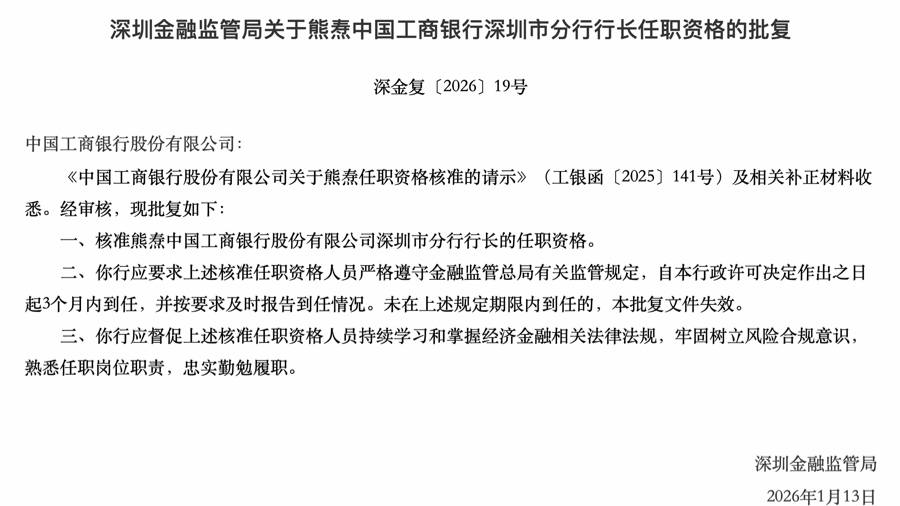
深圳工行新行长熊焘任职获批 原行长已调任总行
2 1 Shi Ji Jing Ji Bao Dao· 2026-01-19 12:43
Group 1 - The Shenzhen Financial Regulatory Bureau has approved the appointment of Xiong Tao as the president of the Industrial and Commercial Bank of China (ICBC) Shenzhen Branch, marking the formalization of this significant personnel change [1] - Xiong Tao previously served as the deputy president of the Guangdong Branch and the president of the Guangzhou Branch, indicating a trend of rotation among key positions within commercial banks [3] - The former president of ICBC Shenzhen Branch, Dong Jianjun, has been reassigned to the General Manager of the Strategic Management and Investor Relations Department at the head office after nearly five years in his previous role [3] Group 2 - Xiong Tao is considered an "old hand" at ICBC, having extensive experience in the banking sector, particularly in investment banking, and has held various positions since joining the bank in 2002 [3] - Under Xiong's leadership, the Guangdong Branch reported a loan balance of 2.6 trillion yuan by the end of 2025, with a net increase of over 1 trillion yuan during the 14th Five-Year Plan period [4] - Dong Jianjun's tenure saw significant achievements, including the Shenzhen Branch becoming the first city branch in the ICBC system to surpass 200 billion yuan in inclusive finance loans, highlighting the strategic importance of inclusive finance for the bank [4]
天益医疗:取得金融机构股票回购专项贷款承诺函
Ge Long Hui· 2026-01-19 12:32
Core Viewpoint - Tianyi Medical (301097.SZ) has obtained a loan commitment letter from the Ningbo branch of the Industrial and Commercial Bank of China, indicating a strategic move to repurchase its own shares [1] Group 1: Loan Details - Loan Amount: Up to 90 million RMB [1] - Loan Term: Not exceeding 3 years [1] - Loan Purpose: Specifically for the repurchase of the company's stock [1]
工行宁夏分行打造15分钟社保便民服务圈
Zhong Guo Jin Rong Xin Xi Wang· 2026-01-19 10:14
Core Viewpoint - The Industrial and Commercial Bank of China (ICBC) Ningxia Branch is actively exploring a "social security + banking" service model to enhance public welfare services in Ningxia Hui Autonomous Region, supported by the local Human Resources and Social Security Department [1][2]. Group 1 - ICBC Ningxia Branch has achieved full coverage of "social security banking outlets" across all counties in the region, addressing issues related to the distance and long wait times for social security services [1]. - The bank has upgraded some core outlets into "one-stop" social security service windows, significantly improving the efficiency of social security processing [1]. - The service philosophy of "data running for the people, convenience at your fingertips" is being implemented to enhance service experiences and integrate social security functions into banking services [1]. Group 2 - ICBC Ningxia Branch has introduced an "instant same-number card replacement" service for social security cards, allowing insured individuals to replace their cards conveniently at nearby branches without affecting their benefit payments [1]. - For clients with mobility issues, the bank offers home service for opening financial accounts linked to social security cards, ensuring accessibility to financial services [1]. - The bank is promoting the integration of social security cards with financial scenarios, aiming to make them a key medium for "one card for all" applications [2]. Group 3 - Over 30 ICBC branches in the region have launched services for applying for financial social security cards, which include high-frequency social security functions such as information inquiries and eligibility verification [2]. - The initiative aims to provide a seamless experience for the public, allowing them to handle multiple social security matters in one visit [2].
深圳工行正式“换将”,科技金融或是新行长熊焘的关键考卷
Nan Fang Du Shi Bao· 2026-01-19 09:49
按照公开履历,熊焘2002年加入工商银行广东省分行,职业履历路径也比较清晰。2007年前后,他从授 信审批部转岗至投资银行部,并逐步升任该部副总经理、总经理。他也有二级分行的历练,曾先后担任 河源分行行长、东莞分行行长等职。2023年,他出任工行广东省分行副行长,期间曾兼任广州分行行 长。 南都湾财社记者注意到,熊焘是一位从工行成长起来、拥有丰富的对公业务和分行管理经验,其任命成 为工行在关键区域进行的一次重要人事布局。 实际上,工行广东省分行是工行体系的一面旗帜。按照其官网描述,广东省分行是工行系统最大的省级 分行,个人客户接近8000万,对公客户为138万。 一纸批复,意味着"宇宙行"在深圳有了新动作。1月中旬,深圳金融监管局批复了"熊焘中国工商银行深 圳市分行行长任职资格",这意味着深圳工行"掌门人"正式落定。南都湾财社记者注意到,早在2025年 底,深圳工行已经"换将",原分行行长董建军调任总行战略管理与投资者关系部总经理,其职位由工行 广东省分行副行长熊焘接任。 截至2025年2月末,深圳工行科技企业投融资余额超1500亿元,累计为超15000家科技企业提供全方位金 融支持,聚焦机器人、人工智能等硬 ...
南通工行少先路支行打造适老服务阵地 让金融温情守护“夕阳红”
Yang Zi Wan Bao Wang· 2026-01-19 09:24
Core Viewpoint - The Industrial and Commercial Bank of China (ICBC) Nantong Shaoxian Road Branch is actively enhancing its services for elderly clients by creating age-friendly banking environments and optimizing service processes to address the specific needs of this demographic [1][2]. Group 1: Hardware Upgrades - The branch has made significant improvements to its hardware facilities, including the provision of reading glasses and magnifying glasses to assist elderly clients with vision impairments [1] - A designated area for mobility aids, such as canes, has been established to assist clients with mobility issues [1] - The layout of the branch has been optimized with non-slip flooring and handrails to ensure the safety of elderly customers throughout their banking experience [1] Group 2: Service Process Optimization - A dedicated "Love Window" has been set up to reduce waiting times for elderly clients, focusing on high-frequency services such as pension withdrawals and certificate transactions [2] - Staff members practice the "Three Slow Services" approach—speaking slowly, explaining in detail, and allowing longer wait times—to make the banking process more accessible for elderly clients [2] - For elderly clients who are homebound or have special needs, the branch offers a green channel for home service, ensuring that financial services are delivered directly to their homes [2] Group 3: Financial Education and Safety - The branch has established a financial education corner in the waiting area, featuring large-font posters and easy-to-read materials on topics such as fraud prevention and understanding pension financial products [2] - Staff members provide guidance on common scams and safety tips, enhancing the financial literacy and self-protection capabilities of elderly clients [2]
工行南通如东栟茶支行为客户追回输错卡号乌龙货款
Yang Zi Wan Bao Wang· 2026-01-19 09:19
为了打消王先生的顾虑,工作人员一边耐心解释钱款确实进入其休眠账户,只是因账户长期未用且无短 信提醒才未察觉;一边通过后台查询相关信息,意外发现王先生是网点代发单位的员工。顺着这条线 索,网点负责人联系上王先生所在单位的负责人,希望他们协助沟通,在单位负责人确认我们身份的真 实性后,王先生这才松口,答应到网点当面核实。 近日,工行南通如东栟茶支行的营业厅里,张女士手捧鲜花连连道谢的场景,成了冬日里暖心的画面。 而这束鲜花的背后,是一场因ATM转账输错卡号引发的乌龙,更是工行工作人员工用数通电话、数次 耐心沟通,为客户追回6000元的温情守护。 事情还要从2025年11月中旬说起,当时张女士急匆匆冲进工行南通如东栟茶支行的大堂,满脸焦急地求 助,原来她在ATM机转账时输错卡号,把6000元货款转到了陌生人账户,等发现时款项已经到账,银 行无法直接追回。这让想靠这笔货款周转的张女士慌了神,大堂经理和运营主管核实情况后,决定先尝 试联系收款方王先生,可系统里登记的王先生信息有限,几经周折才拨通了他的电话。 本以为找到收款人就能解决问题,没想到沟通刚起步就遇了挫。王先生接到电话后,第一反应是遇上了 诈骗,坚称自己早已不 ...
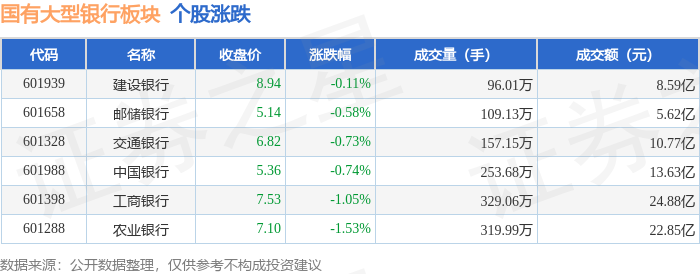
国有大型银行板块1月19日跌1.12%,农业银行领跌,主力资金净流出4.07亿元
Zheng Xing Xing Ye Ri Bao· 2026-01-19 08:58
Group 1 - The core viewpoint of the news is that the state-owned large bank sector experienced a decline of 1.12% on January 19, with Agricultural Bank leading the drop [1] - The Shanghai Composite Index closed at 4114.0, up 0.29%, while the Shenzhen Component Index closed at 14294.05, up 0.09% [1] - The trading performance of individual stocks in the state-owned large bank sector showed varied results, with Agricultural Bank down 1.53% and Industrial and Commercial Bank down 1.05% [1] Group 2 - The net outflow of main funds from the state-owned large bank sector was 407 million yuan, while retail investors saw a net inflow of 539 million yuan [1] - The detailed fund flow data indicates that the Agricultural Bank had a significant net outflow of 35.37 million yuan from main funds, but a net inflow of 73.72 million yuan from retail investors [2] - The overall trend shows that while main and speculative funds are withdrawing, retail investors are increasing their positions in certain banks [2]


今年仅半月减少超70家银行 “减量提质”持续推进
Xin Jing Bao· 2026-01-19 06:20
Core Viewpoint - The banking industry is undergoing a significant structural adjustment, with many rural banks being acquired and transformed into branches of larger state-owned banks, reflecting a trend towards consolidation and quality improvement in the financial sector [1][2][5]. Group 1: Bank Acquisitions - Several rural banks are being acquired by major state-owned banks, such as Chang'an Bank acquiring Shaanxi Taibai Changyin Rural Bank and Bank of Communications acquiring Zhejiang Anji Jiaoyin Rural Bank [1][3]. - In just the first half of this year, over 70 banks are set to be integrated, a stark increase from only 8 during the same period last year [1]. - The acquisitions are part of a broader strategy to enhance the quality of financial institutions by eliminating weaker competitors and optimizing regional financial supply [1][5]. Group 2: Structural Reforms - The central economic work conference has emphasized the need to "deeply promote the reduction and quality improvement of small and medium-sized financial institutions," indicating a shift towards a more efficient banking structure [11]. - The consolidation of smaller banks into larger entities is seen as a necessary step to mitigate regional financial risks and improve the management and operational standards of these institutions [5][11]. - The approach of merging smaller banks into larger ones is being recognized as a new model for enhancing the quality of financial services in rural areas [5]. Group 3: Governance and Quality Improvement - The focus on "reduction" is aimed at achieving "rebirth," with the ultimate goal being quality enhancement rather than merely reducing the number of institutions [10][11]. - The ongoing reforms are expected to lead to a decrease in the number of high-risk institutions, thereby laying a foundation for deeper reforms and risk management [11]. - The success of these reforms hinges on improving governance and ensuring that financial institutions can effectively meet the diverse financial needs of the real economy [11][12]. Group 4: Customer Impact - Bank customers' deposits will remain unaffected during the transition, as the assets and liabilities are typically assumed by the acquiring bank or newly established institution [12]. - The consolidation is expected to enhance the overall competitiveness of banks, thereby providing greater security for customer deposits [12].