
ICBC(601398)

Search documents
个贷不良资产进入“盲拍时代”?银行不再向公众披露部分信息,但AMC仍可见
Hua Xia Shi Bao· 2025-11-21 05:59
Core Viewpoint - Recent changes in the disclosure of personal loan non-performing asset (NPA) transfer information by banks indicate a shift towards less transparency, with key data no longer available to the public, reflecting a strong demand for rapid capital recovery by banks [2][4][5]. Disclosure Changes - Since November, banks have stopped disclosing auxiliary valuation information such as starting prices, average outstanding principal and interest balances, and write-off statuses in their NPA transfer announcements [3][4]. - The announcements now include a watermark stating "unauthorized reproduction prohibited," indicating a tightening of information access [3]. Impact on Asset Management Companies (AMCs) - Although some information is hidden from public view, AMCs can still access most data through corporate accounts, except for write-off statuses, which are crucial for assessing asset value [4][5]. - The write-off status is significant as it indicates the bank's assessment of the likelihood of recovering the asset, affecting the discount rates of asset packages [4]. Market Dynamics - The pilot program for bulk transfers of personal non-performing loans began in 2021, initially involving a limited number of banks, but has since expanded to include more institutions, leading to a more standardized process [5]. - The decision to limit public information is seen as a necessary step as the market stabilizes, reducing the risk of misinterpretation by non-participants [5]. Transaction Process Changes - The transaction process has accelerated, with banks significantly shortening payment deadlines in recent announcements compared to earlier in the year [6]. - For example, a state-owned bank reduced the payment and agreement signing periods from five working days to three and two days, respectively [6]. Market Growth - The scale of personal non-performing loan transfers is expanding, with over 100 projects announced, indicating a faster pace of asset disposal [7]. - As of the end of Q1 this year, the scale of personal non-performing loan bulk transfers reached 37.04 billion, a year-on-year increase of 761.4% [7]. - The banking sector has disposed of 1.5 trillion in non-performing assets in the first half of the year, contributing to a decrease in both the balance and rate of non-performing loans [7].



金融助力中国企业“走出去”报告
第一财经研究院· 2025-11-21 05:51
Investment Rating - The report indicates a positive investment outlook for Chinese enterprises going global, with a projected increase in foreign direct investment (FDI) to 1.16 trillion RMB in 2024, reflecting an 11.30% year-on-year growth [8]. Core Insights - Chinese enterprises are actively exploring new pathways for international expansion, adapting strategies in response to geopolitical challenges and evolving market conditions [4][8]. - The ASEAN region has emerged as a key destination for Chinese investment, with its share of China's outbound investment rising from 6.34% in 2014 to 17.88% in 2024 [8]. - The structure of China's outbound investment is shifting, with significant increases in the wholesale, retail, and manufacturing sectors, indicating a deeper integration into global value chains [8][52]. Summary by Sections Part A: Challenges and Pathways for Chinese Enterprises Going Global - The Chinese government is committed to high-quality outbound investment, emphasizing the importance of maintaining a stable international economic environment despite rising geopolitical tensions [18][19]. - The share of China's exports in global trade is projected to reach 14.64% in 2024, maintaining its position as the world's largest exporter [19][23]. - Chinese enterprises are increasingly focusing on the ASEAN region for investment, with a notable rise in direct investment since the implementation of the RCEP [44][52]. Part B: Financial Support for Outbound Expansion - Chinese financial institutions are enhancing their overseas presence, with major banks establishing branches in numerous countries to support outbound enterprises [9]. - There is a strong emphasis on integrating domestic and international resources, with banks providing cross-border credit and financing solutions for projects under the Belt and Road Initiative [9][11]. - Innovative financial products and services are being developed to support overseas investments, including specialized loans for infrastructure projects and comprehensive solutions for cross-border e-commerce [9][11]. Part C: Future Outlook and Recommendations - Recommendations include optimizing overseas network construction, enhancing multi-tiered financial service systems, and expanding the use of cross-border RMB [12][13]. - A comprehensive risk management system is suggested to help enterprises navigate geopolitical uncertainties and market volatility [12][13]. - Strengthening collaboration between financial institutions and industries is crucial for supporting enterprises in their global expansion efforts [12][13].




又一地新设黄金指定仓库,工行再落子
Huan Qiu Wang· 2025-11-21 05:02
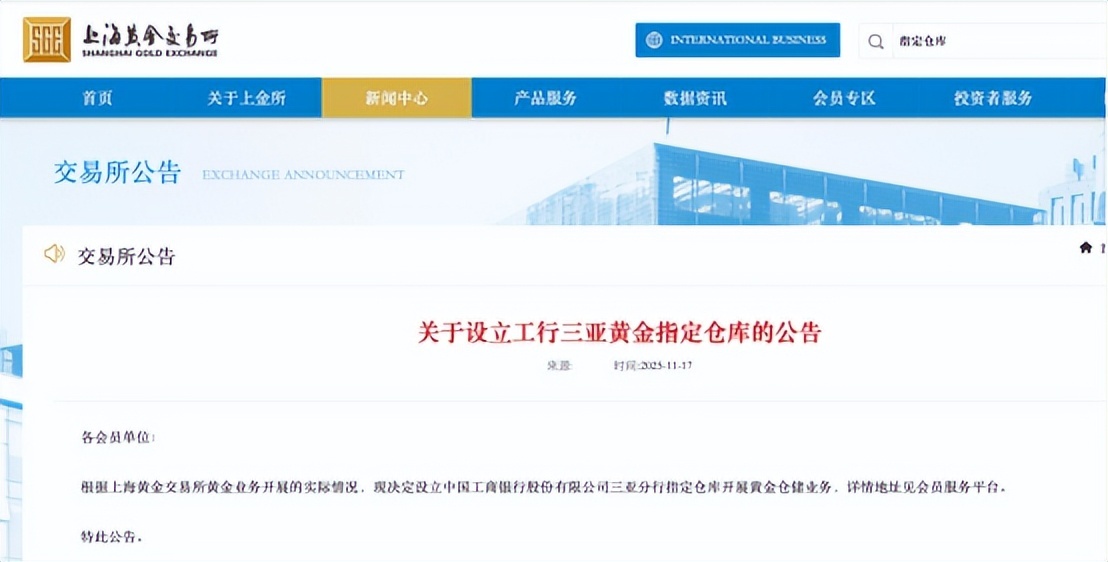
Core Insights - The establishment of the designated warehouse by the Shanghai Gold Exchange at the Industrial and Commercial Bank of China (ICBC) in Sanya reflects a strategic move to enhance the efficiency of physical gold circulation and reduce operational costs for enterprises, thereby reshaping the local gold industry ecosystem [1][4][5] Group 1: Strategic Importance - The new warehouse in Sanya is seen as a response to national financial reform and regional development strategies, leveraging Sanya's geographical and policy advantages as a key tourist city and free trade port [2][4] - This initiative is expected to improve liquidity and efficiency in the gold market, promoting the internationalization of the domestic gold market [4][6] Group 2: Infrastructure Development - Designated warehouses are considered essential infrastructure for the gold industry, facilitating the storage, delivery, and transportation of physical gold, allowing for local storage and real-time extraction of raw materials [4][6] - The establishment of the warehouse is part of a broader effort to develop Sanya's gold industry, including the construction of multiple gold and jewelry industrial parks [4][6] Group 3: Financial Implications - ICBC's expansion of designated warehouses strengthens its position in the full-service gold chain, enhancing its capabilities in gold pricing and risk management [6][7] - The warehouse in Hezhou, which was opened earlier, is expected to save local enterprises approximately 10 million yuan annually by addressing issues related to low delivery efficiency and high costs [6][8] Group 4: Regional Collaboration - The collaboration between ICBC and the Shanghai Gold Exchange is anticipated to deepen their partnership, increasing service capabilities and market share in the precious metals sector [7] - The establishment of offshore gold delivery warehouses in Hong Kong is also part of a strategy to enhance cooperation between Hong Kong and Shanghai in the gold market, providing diversified asset allocation options for investors [8][10]
银行直供房打折卖,能捡漏吗
21世纪经济报道· 2025-11-21 02:36
Core Viewpoint - The concept of "bank direct supply housing" is misleading as banks do not sell houses directly; they are promoting the disposal of non-performing assets, specifically properties acquired through loan defaults [1][2]. Group 1: Understanding "Bank Direct Supply Housing" - Banks are not licensed to sell real estate; their primary business is financial services such as deposits and loans [1]. - The term refers to banks promoting properties they have repossessed due to loan defaults, not direct sales by the banks themselves [1][2]. - The traditional method for banks to dispose of these properties involves bulk sales to asset management companies or public auctions on platforms like Alibaba and JD [2]. Group 2: Market Context and Trends - The popularity of "bank direct supply housing" has surged this year due to a low overall transaction rate of 13.1% for judicial auction properties in the first three quarters [2]. - The success rate for first-time auctions is only 39%, prompting banks to seek alternative methods to accelerate inventory turnover [2]. Group 3: Risks for Buyers - The property title typically remains under the original debtor's name, meaning buyers may inherit existing legal issues or disputes related to the property [2][3]. - Buyers should thoroughly investigate the property’s details, including any rights restrictions or potential eviction challenges post-purchase [3]. - The volume of "bank direct supply housing" is limited, with only a few hundred properties available, which is unlikely to impact the overall housing market significantly [3].
银行股再“逆袭”,走强并非偶然丨每日研选
Shang Hai Zheng Quan Bao· 2025-11-21 01:17
Core Viewpoint - The banking sector is experiencing a significant inflow of funds, indicating a potential new cycle of stable profitability, driven by a combination of favorable policies, improving performance, and changing market conditions [1][2][3]. Group 1: Market Performance - On November 20, the banking sector saw a net inflow of 2.16 billion yuan, leading all sectors in the Shenwan first-level industry classification [1]. - The overall trading volume for banking stocks reached 42.51 billion yuan, with main funds flowing in at 23.30 billion yuan and flowing out at 21.14 billion yuan [1]. - High dividend yields in the banking sector are attracting funds as a reliable "safe haven" amid market volatility [1]. Group 2: Policy Environment - The central bank aims to maintain relatively loose social financing conditions and strengthen the execution and transmission of monetary policy [2]. - There is an expectation of a reasonable slowdown in loan growth due to structural changes in social financing and economic development [2]. - Structural monetary policy tools are being implemented to support key areas of the economy, enhancing the banking sector's ability to operate steadily [2]. Group 3: Performance Improvement - By Q3 2025, commercial banks' net profit increased by 2% year-on-year, with large commercial banks and city commercial banks seeing profit growth of 4% and 9%, respectively [2]. - The optimization of credit structure and consumer policy support are expected to further improve banks' asset quality and profitability [2]. Group 4: Future Outlook - Analysts believe the banking sector is entering a new cycle of stable profitability, with long-term capital still actively entering the market [3]. - A favorable macro environment, including potential improvements in PPI and long-term interest rates, could enhance the banking sector's profitability [3]. - The strategy of combining leading banks with smaller banks is expected to elevate valuations, with specific banks like Industrial Bank and CITIC Bank showing potential for price elasticity [3]. Group 5: Valuation and Investment Appeal - The banking sector's valuation remains low historically, making it attractive for medium to long-term investments [4]. - High dividend assets represented by state-owned banks offer significant value compared to risk-free rates [4]. - Recommended stocks include CITIC Bank, Construction Bank, Agricultural Bank, and others, highlighting their investment appeal [4].

东方红汇裕债券型证券投资基金基金份额发售公告
Zhong Guo Zheng Quan Bao - Zhong Zheng Wang· 2025-11-21 00:33
Fund Overview - The fund is named "Oriental Red Huiyu Bond Fund" and is a contractual open-end bond fund [12] - The fund has two classes of shares: Class A (code: 026055) and Class C (code: 026056) [12] Fund Management and Custody - The fund is managed by Shanghai Oriental Securities Asset Management Co., Ltd. and the custodian is Industrial and Commercial Bank of China [4][50] Fund Offering Details - The fundraising period is from December 2, 2025, to December 22, 2025, with a minimum fundraising amount of 200 million RMB [5][18][16] - The fund may extend the fundraising period by up to three months based on actual conditions [5][18] Subscription Process - Investors can subscribe through the fund manager's direct sales center or online trading system, with a minimum subscription amount of 10 RMB [3][21] - Investors must use the company's open-end fund account for subscription [8][21] Fee Structure - Class A shares incur subscription fees, while Class C shares do not charge subscription fees but have service fees deducted from the fund's assets [10][25] - The subscription fee for Class A shares varies based on the type of investor, with specific rates for pension clients [23] Risk and Investment Strategy - The fund aims for long-term stable growth of net asset value while strictly controlling investment risks [14] - The fund can invest in various securities, including asset-backed securities, stocks listed on the Hong Kong Stock Exchange, and stocks on the Science and Technology Innovation Board [7][8][9] Investor Eligibility - The fund is open to individual investors, institutional investors, qualified foreign investors, and other investors permitted by law [15] Fund Contract and Effectiveness - The fund contract will become effective once the fundraising conditions are met, including a minimum of 200 million shares and 200 investors [46] - If the fundraising fails to meet the conditions, the fund manager must return the funds to investors with interest [48]

成都高速股东将股票由中国工商银行亚洲转入德意志银行 转仓市值1.04亿港元
Zhi Tong Cai Jing· 2025-11-21 00:28
智通财经APP获悉,香港联交所最新资料显示,11月20日,成都高速(01785)股东将股票由中国工商银行 亚洲转入德意志银行,转仓市值1.04亿港元,占比10.94%。 成都高速截至2025年9月30日止9个月的第三季度业绩显示,该集团期内取得营业收入21.95亿元,同比 增长1.73%;归母净利润4.67亿元,同比减少5.31%。 ...
成都高速(01785)股东将股票由中国工商银行亚洲转入德意志银行 转仓市值1.04亿港元
智通财经网· 2025-11-21 00:26
成都高速截至2025年9月30日止9个月的第三季度业绩显示,该集团期内取得营业收入21.95亿元,同比 增长1.73%;归母净利润4.67亿元,同比减少5.31%。 智通财经APP获悉,香港联交所最新资料显示,11月20日,成都高速(01785)股东将股票由中国工商银行 亚洲转入德意志银行,转仓市值1.04亿港元,占比10.94%。 ...
“银行直供房”打折卖,能捡漏吗?
2 1 Shi Ji Jing Ji Bao Dao· 2025-11-20 23:24
Core Insights - The concept of "bank direct supply housing" is misleading as banks do not sell houses directly but promote the disposal of non-performing assets [1][2] - The increase in popularity of "bank direct supply housing" this year is due to low auction success rates for foreclosed properties, prompting banks to seek faster inventory turnover [2][3] Summary by Sections - **Nature of "Bank Direct Supply Housing"** - Banks are not licensed to sell real estate; they primarily deal with financial services [1] - The properties promoted are actually non-performing assets that banks need to dispose of, not direct sales by banks [1][2] - **Market Context** - The overall transaction rate for foreclosed properties in the first three quarters of this year was only 13.1%, with a first auction success rate of 39% [2] - Banks are increasing the promotion of "bank direct supply housing" to accelerate inventory turnover due to these low success rates [2] - **Buyer Considerations** - The property title remains with the original debtor, and banks only have the authority to dispose of the property [4] - Potential buyers should be cautious of existing legal issues or encumbrances associated with the properties [4] - The volume of "bank direct supply housing" is limited, with only a few dozen to a few hundred properties available, which is unlikely to impact the overall housing market significantly [4]
“银行直供房”打折卖,能捡漏吗?|财经早察
2 1 Shi Ji Jing Ji Bao Dao· 2025-11-20 23:21
Core Viewpoint - The concept of "bank direct supply housing" is misleading as banks do not sell houses directly; instead, they promote properties they have repossessed due to loan defaults, aiming to recover losses through asset disposal [1][2]. Group 1: Nature of "Bank Direct Supply Housing" - Banks are licensed financial institutions primarily engaged in lending and deposit services, not in real estate sales [1]. - The term "bank direct supply housing" refers to banks promoting properties they have acquired as collateral, not selling them directly [1][2]. - The traditional method for banks to dispose of these properties involves bulk sales to asset management companies or public auctions on platforms like Alibaba and JD [2]. Group 2: Market Context and Trends - The popularity of "bank direct supply housing" has surged this year due to low transaction rates for judicial auction properties, with an overall success rate of only 13.1% in the first three quarters [2]. - Banks are under pressure to accelerate inventory turnover, leading to an increase in the promotion of "bank direct supply housing" to individual buyers [2][3]. Group 3: Considerations for Buyers - The ownership of the properties remains with the original debtors, and banks only have the authority to dispose of them, meaning potential legal issues may still exist [4]. - Buyers should thoroughly investigate the properties for any existing legal disputes or encumbrances, as well as potential challenges in vacating the property post-purchase [4]. - The overall volume of "bank direct supply housing" is limited, with only a few dozen to a few hundred properties available, which is unlikely to impact the broader housing market significantly [4].