
Guolian Minsheng Sec(601456)

Search documents
研报掘金丨国联民生:维持隆鑫通用“推荐”评级,多业务协同发力驱动增长
Ge Long Hui A P P· 2026-01-19 09:19
Core Viewpoint - Longxin General is expected to achieve significant growth in 2025, with a new phase for the Wujie brand starting in 2026, driven by steady growth in its motorcycle and general machinery sectors, as well as continuous optimization of the Wujie product structure [1] Group 1 - The company is experiencing robust growth in overall performance due to the scale of its main businesses in motorcycles and general machinery [1] - The implementation of the employee stock ownership plan has enhanced the stability of the core team [1] - The global expansion of the medium and large displacement motorcycle segment is primarily driven by the Wujie brand [1] Group 2 - The company is leveraging multi-business collaboration to drive growth, with dual expansion in both product and channel for the Wujie brand [1] - The resonance of volume and profit is accelerating growth [1] - The rating is maintained at "Recommended" [1]

“牛市旗手”业绩开花!国联民生去年利润大增超4倍,四季度加速明显
Guan Cha Zhe Wang· 2026-01-19 06:58
炒股就看金麒麟分析师研报,权威,专业,及时,全面,助您挖掘潜力主题机会! 【文/羽扇观金工作室】号称"牛市旗手"的券商板块,去年业绩陆续宣布。 此前中信证券于1月14日发布《2025年度业绩快报》。快报显示,2025年,中信证券实现营业收入 748.30亿元,同比(与前一年同期相较)增加28.75%;归属于母公司股东的净利润(下称"净利润") 300.51亿元,同比增加38.46%。这也是中信证券历史首次全年净利润突破300亿元。同时,截至2025年 末,中信证券总资产2.08万亿元,较上一年同期增加了21.79%。 此外,西南证券16日发布的业绩预告也显示,2025年度预计实现归属于母公司所有者的净利润10.28亿 元至10.98亿元,同比增幅达47%至57%。对于业绩预增的核心原因,西南证券称主要是财富管理业务、 证券投资业务、投资银行业务同比大幅增长。 本文系观察者网独家稿件,未经授权,不得转载。 昨日(1月18日),国联民生发布公告,宣布预计公司2025年实现归母净利润20.08亿元,同比大增约 406%;扣除非经常性损益的净利润人民币也将达到19.44亿元,同比增长410%左右。 MACD金叉信号形 ...
国联民生高开近5% 预期2025年度归母净利润同比增逾4倍
Zhi Tong Cai Jing· 2026-01-19 05:53
Core Viewpoint - Guolian Minsheng (601456) reported a significant increase in expected net profit for the fiscal year 2025, projecting a net profit of RMB 2.008 billion, which represents a year-on-year increase of approximately 406% [1] Financial Performance - The company anticipates a net profit attributable to shareholders of RMB 2.008 billion for 2025, an increase of RMB 1.611 billion compared to the previous year [1] - The expected net profit excluding non-recurring gains and losses is projected to be RMB 1.944 billion, reflecting a year-on-year growth of around 410% [1] Business Developments - The company successfully completed the acquisition of control over Minsheng Securities through the issuance of A-shares, facilitating the integration of its existing business with Minsheng Securities [1] - The company is actively exploring the deep integration of technology, finance, and industry, focusing on "synergistic empowerment" and "internal growth" to enhance its comprehensive financial service capabilities [1] Growth Drivers - Significant growth was observed in the business lines of securities investment, brokerage, and wealth management, contributing to the overall increase in operating performance [1] - The substantial year-on-year increase in operating results is partly attributed to a low comparative base from the previous year [1]
国联民生发盈喜 预期2025年度实现归母净利润20.08亿元 同比增加406%左右
Zhi Tong Cai Jing· 2026-01-19 05:53
Core Viewpoint - Guolian Minsheng (601456) expects a significant increase in net profit for the year 2025, driven by strategic acquisitions and business integration efforts [1] Financial Performance - The company anticipates a net profit attributable to shareholders of approximately RMB 2.008 billion for 2025, representing an increase of RMB 1.611 billion compared to the previous year, which is a growth of around 406% [1] - The expected net profit, excluding non-recurring gains and losses, is projected to be RMB 1.944 billion, reflecting an increase of RMB 1.563 billion year-on-year, equating to a growth of approximately 410% [1] Strategic Initiatives - The company successfully completed the acquisition of control over Minsheng Securities through the issuance of A-shares, facilitating the efficient integration of existing business with Minsheng Securities' operations [1] - The company is actively exploring the deep integration of technology, finance, and industry, focusing on "synergistic empowerment" and "internal growth" to enhance its comprehensive financial service capabilities [1] - Significant growth has been observed in business lines such as securities investment, brokerage, and wealth management, attributed to both market opportunities and a low comparative base from the previous year [1]
净利涨400%!券商业绩陆续出炉,“牛市旗手”迎业绩爆发
Nan Fang Du Shi Bao· 2026-01-19 04:07
Core Viewpoint - The performance reports of several securities firms for 2025 indicate significant growth, driven by a bullish market and strategic mergers and acquisitions [1][2]. Group 1: Company Performance - Guolian Minsheng Securities expects a net profit attributable to shareholders of 2.008 billion yuan for 2025, a year-on-year increase of approximately 406% [1]. - CITIC Securities anticipates a net profit exceeding 30 billion yuan, reflecting a year-on-year growth of 38.46% [2]. - Southwest Securities projects a net profit between 1.028 billion and 1.098 billion yuan, representing a year-on-year increase of 47% to 57% [3]. Group 2: Market Trends - The overall Chinese capital market is experiencing an upward trend in 2025, with active trading and major A-share indices showing gains [1][2]. - The integration of Guolian Securities and Minsheng Securities has contributed to the substantial increase in Guolian Minsheng's performance [2]. Group 3: Revenue Breakdown - CITIC Securities reported an operating income of 74.83 billion yuan for 2025, a year-on-year increase of 28.75% [2]. - Southwest Securities attributes its profit growth to significant increases in wealth management, securities investment, and investment banking businesses [3]. - Estimates suggest that the net profit of 43 listed securities firms could reach 216.7 billion yuan, a year-on-year increase of 55% [3]. Group 4: Business Segments - Expected revenue growth for brokerage and credit businesses is projected at 50% and 43% respectively for 2025 [4]. - Investment banking revenues are anticipated to grow by approximately 27% due to a significant increase in A-share IPOs and refinancing activities [4]. - Self-operated business revenues are expected to grow by 35%, despite challenges in bond trading [4].
国联民生(01456.HK)高开近5%
Mei Ri Jing Ji Xin Wen· 2026-01-19 01:47
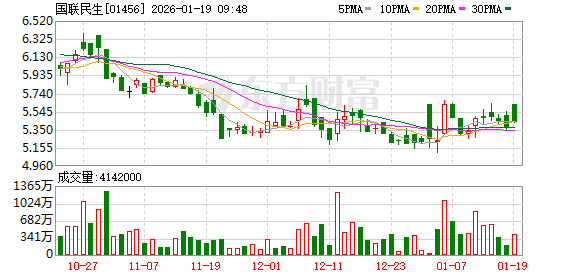
每经AI快讯,国联民生(01456.HK)高开近5%,截至发稿涨4.85%,报5.62港元,成交额419.25万港元。 (文章来源:每日经济新闻) ...

港股异动 | 国联民生(01456)高开近5% 预期2025年度归母净利润同比增逾4倍
智通财经网· 2026-01-19 01:27
报告期内,公司完成通过发行A股股份的方式收购民生证券控制权,平稳有序推进公司原有业务与民生 证券相关业务的高效整合,并将其纳入财务报表合并范围。公司主动把握市场机遇,积极探索科技、金 融与产业的深度融合,以"协同赋能"和"内生增长"为主线提升综合金融服务能力,证券投资、经纪及财 富管理等业务条线实现显著增长,同时由于上年同期比较基数较小,本期经营业绩同比大幅提升。 消息面上,国联民生发布公告称,经公司财务部门初步测算,预计2025年度实现归属于母公司所有者的 净利润人民币20.08亿元,与上年同期相比,将增加人民币16.11亿元,同比增长406%左右。预计2025年 度实现归属于母公司所有者的扣除非经常性损益的净利润人民币19.44亿元,同比增长410%左右。 智通财经APP获悉,国联民生(01456)高开近5%,截至发稿,涨4.85%,报5.62港元,成交额419.25万港 元。 ...
国联民生:预计2025年归母净利润20.08亿元,同比增长约406%;周钟山出任长城证券总裁 | 券商基金早参
Mei Ri Jing Ji Xin Wen· 2026-01-19 01:08
Group 1 - Guolian Minsheng expects a net profit attributable to shareholders of 2.008 billion yuan for 2025, representing a year-on-year increase of approximately 406% [1] - The significant profit increase is primarily due to the acquisition of Minsheng Securities and its consolidation into the financial statements, along with strong growth in securities investment, brokerage, and wealth management businesses [1] - The integration of Minsheng Securities exemplifies a "collaborative empowerment" model, which may enhance the competitive landscape of the brokerage industry and boost market confidence in the non-bank financial sector [1] Group 2 - Zhou Zhongshan has been appointed as the president and financial officer of Great Wall Securities, indicating a stable transition in management [2] - Zhou's extensive experience within the company is expected to optimize business operations and enhance market confidence in the company's future development [2] - The internal promotion trend within the brokerage sector supports long-term stability in the industry, contributing to the healthy functioning of the capital market [2] Group 3 - Several equity funds have initiated subscription limits to manage rapid growth in scale and maintain operational stability amid increasing market enthusiasm [3] - This limitation on large subscriptions is seen as a way to optimize the timing of market entry for new funds, enhancing the holding experience for investors during the market recovery [3] - The orderly inflow of funds is anticipated to support the spring market rally, reflecting a rational expectation from institutions regarding future market performance [3]

盘前公告淘金:国联民生预计去年净利润预增406%左右,民爆光电拟收购PCB标的企业
Jin Rong Jie· 2026-01-19 00:59
Important Matters - TCL Zhonghuan plans to invest in a new energy acceleration company to promote its moderate integration strategy [1] - Yanjiang Co. intends to acquire 98.54% equity of Yongqiang Technology, with stock resuming trading [1] - Minexplosion Optoelectronics is planning to acquire 100% of Xiazhi Precision and Jiangxi Maida, focusing on core consumables in PCB manufacturing, leading to stock suspension [1] Investment Operations - Baiwei Storage urges investors to continuously monitor the sustainability of AI investments and the cyclical changes in the storage industry, noting that current storage prices are at historical highs [1] - Trina Solar has made long-term comprehensive layouts in three areas related to space photovoltaic, including crystalline silicon batteries (HJT, etc.), perovskite stacked batteries, and III-V arsenide multi-junction batteries [1] Performance - Guolian Minsheng expects a net profit increase of approximately 406% year-on-year for 2025 [1] - Changxin Bochuang anticipates a net profit increase of 344%-413% year-on-year for 2025, driven by steady growth in data communication-related product revenue [1] - Shenghong Technology projects a net profit increase of 260%-295% year-on-year for 2025 [1] - Northern Rare Earth expects a net profit increase of 117%-135% year-on-year for 2025, with production and sales of rare metals and rare earth permanent magnet motors increasing year-on-year [1] - Cambridge Technology forecasts a net profit increase of 51%-67% year-on-year for 2025, with Q4 performance below expectations [1] - Lanke Technology anticipates a net profit increase of 52%-66% year-on-year for 2025, with a significant increase in the shipment volume of interconnect chips [1] - Ruiming Technology expects a net profit increase of 27.58%-37.92% year-on-year for 2025 [1]
金融界财经早餐:国常会部署促消费举措;证监会定调2026年工作!央行开年首次“定向降息”!国联民生2025年净利同比预增406%,容百科技被证监会立案(1月19日)
Jin Rong Jie· 2026-01-19 00:59
Capital Market Developments - The People's Bank of China announced a reduction in the re-lending and re-discount rates by 0.25 percentage points, with new rates set at 0.95%, 1.15%, and 1.25% for 3-month, 6-month, and 1-year re-lending respectively [3] - Hong Kong's equity financing market saw explosive growth in 2025, with total financing reaching HKD 612.2 billion, a year-on-year increase of 250.91%. The IPO market regained its global lead with 117 companies raising HKD 285.8 billion, up 224.24% year-on-year [3] - A-share market experienced a significant increase in institutional research, with 1,357 institutions conducting approximately 4,897 research sessions, focusing on information technology, industrial machinery, and healthcare sectors [3] Industry Insights - The storage market has seen DDR5 memory prices rise over 300% since September 2025, while DDR4 memory prices increased by over 150%. AI servers are consuming 53% of global memory production capacity, significantly impacting consumer-grade memory supply [6] - In semiconductor materials, a breakthrough was achieved by a team from Xi'an University of Electronic Science and Technology, enhancing chip cooling efficiency and device performance through innovative technology [6] - The commercial space sector marked a significant milestone with the successful verification of landing buffer technology for manned spacecraft, indicating progress in key technologies within the domestic commercial space industry [7] Company Developments - Guizhou Moutai issued a warning against fraudulent applications for its Flying Moutai product, emphasizing that sales contracts are being signed directly with verified corporate clients [8] - Guolian Minsheng expects a net profit of CNY 2.008 billion for 2025, an increase of CNY 1.611 billion, representing a growth of approximately 406% year-on-year [8] - Container technology company Longxin Storage plans a USD 4 billion stock issuance, aiming to compete with Micron Technology and leading Korean firms amid rising AI-driven demand for storage chips [10] - Alibaba is integrating its Qwen chatbot into its ecosystem, allowing users to perform tasks like ordering food and booking flights without navigating multiple applications [10]