
BANK OF CHANGSHA(601577)

Search documents
长沙银行(601577) - 长沙银行股份有限公司关于董事任职资格获得核准的公告
2025-09-30 08:46
证券代码:601577 证券简称:长沙银行 编号:2025-047 优先股代码:360038 优先股简称:长银优 1 郭子嘉、王宗润、曹虹剑、程青龙简历详见本行在上海证券交易 所网站(www.sse.com.cn)披露的《长沙银行股份有限公司第七届董 事会第十五次会议决议公告》。 特此公告。 长沙银行股份有限公司董事会 长沙银行股份有限公司 关于董事任职资格获得核准的公告 本行董事会及全体董事保证本公告内容不存在任何虚假记载、误导性陈述 或者重大遗漏,并对其内容的真实性、准确性和完整性承担法律责任。 近日,长沙银行股份有限公司(简称"本行")收到《湖南金融 监管局关于郭子嘉长沙银行股份有限公司董事任职资格的批复》(湘 金复〔2025〕220 号)、《湖南金融监管局关于王宗润长沙银行股份 有限公司独立董事任职资格的批复》(湘金复〔2025〕222 号)、《湖 南金融监管局关于曹虹剑长沙银行股份有限公司独立董事任职资格 的批复》(湘金复〔2025〕221 号)、《湖南金融监管局关于程青龙 长沙银行股份有限公司董事任职资格的批复》(湘金复〔2025〕224 号),分别核准郭子嘉、程青龙担任本行董事的任职资格,核准王 ...

上市银行获股东密集增持 年内机构调研超300次
2 1 Shi Ji Jing Ji Bao Dao· 2025-09-30 07:32
Group 1: Shareholding Increases - Recently, Nanjing Bank announced that BNP Paribas (QFII) increased its shareholding by 108 million shares, raising its total stake from 16.14% to 17.02% [1] - Since the beginning of the year, Nanjing Bank has seen multiple significant shareholders increase their stakes, with Zijin Trust raising its holding from 12.56% to 13.02% by acquiring 56.78 million shares [3] - Another major shareholder, Nanjing Gaoke, increased its stake from 8.94% to 9.00% by purchasing 7.51 million shares [3] Group 2: Bank Sector Trends - A total of 11 A-share listed banks have seen shareholding increases from shareholders or executives this year, indicating a trend where such plans are often announced when bank stock valuations are at historical lows [5] - The banking sector has been experiencing a "red envelope rain" with 17 banks announcing mid-term dividend plans for 2025, including significant contributions from the six major state-owned banks [6] - The six major state-owned banks have all provided dividend plans, with Industrial and Commercial Bank of China (ICBC) planning to distribute approximately 50.40 billion yuan in cash dividends [7][8] Group 3: Market Sentiment and Future Outlook - The banking sector is viewed favorably by institutions due to its low valuations and stable dividends, leading to increased interest from institutional investors [8] - As of September 29, over 300 investigations into listed banks have been conducted, with more than 2,000 institutional inquiries, highlighting the sector's attractiveness [8] - Analysts predict that the inflow of incremental funds will support the banking sector's performance, driven by the high dividend characteristics and significant index weight of bank stocks [8]




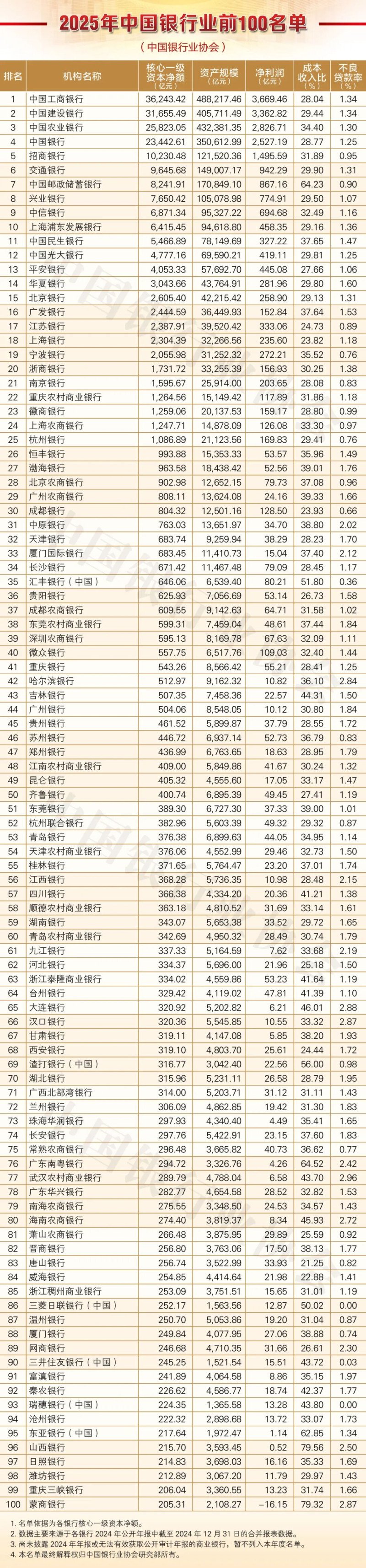
2025年中国银行业100强出炉 长沙银行、湖南银行排名提升至第34名、59名
Chang Sha Wan Bao· 2025-09-30 07:29
Core Insights - The "2025 China Banking Industry Top 100" list was released by the China Banking Association, ranking banks based on their core tier one capital and evaluating their operational scale, profitability, operational efficiency, and asset quality [1][4] - The total core tier one capital of the top 100 banks reached 23.37 trillion yuan, an increase of 8.10% year-on-year, accounting for 95.09% of the total commercial banks [1][2] - The total assets of these banks amounted to 342.15 trillion yuan, reflecting a year-on-year growth of 7.42% [1][2] Group 1: Major Banks - The top 100 list includes 6 large commercial banks, 12 nationwide joint-stock commercial banks, 56 city commercial banks, 18 rural commercial banks, 2 private banks, and 6 foreign banks [2] - The 6 large commercial banks hold a core tier one capital of 13.51 trillion yuan, representing 57.80% of the total for the top 100 banks [2] - The total assets of these large banks reached 199.68 trillion yuan, maintaining stable asset quality [2] Group 2: Performance of Other Banks - The 56 city commercial banks constitute the largest group in the list, with a core tier one capital share of 13.58% [3] - The 18 rural commercial banks showed a strong vitality with a core tier one capital growth of 9.67% [3] - Two private banks, including WeBank, have rapidly grown through financial technology, with WeBank's total assets reaching 651.78 billion yuan [3] Group 3: Regional Distribution - The banks from Guangdong, Beijing, Shanghai, Zhejiang, and Shandong are the most represented, with 14, 11, 10, 10, and 7 banks respectively [3] - The core tier one capital from these regions totaled 20.20 trillion yuan, accounting for 86.46% of the top 100 banks [3] Group 4: Local Bank Highlights - Changsha Bank ranked 34th, up 2 places from last year, with a core tier one capital of 67.14 billion yuan and an asset scale of 1,146.75 billion yuan [4][10] - Hunan Bank improved its ranking from 63rd to 59th, with a core tier one capital of 34.31 billion yuan and an asset scale of 565.34 billion yuan [4][10] - Both banks are focusing on innovation and serving the local economy, contributing positively to the financial landscape in Hunan [4][5]

上市银行不良出清与拨备压力观察
Guoxin Securities· 2025-09-29 02:04
Investment Rating - The industry is rated as "Outperform the Market" [2][3] Core Viewpoints - The stability of asset quality in the banking sector is attributed to the gradual clearing of non-performing loans across various sectors over the past 15 years, which has mitigated the impact on bank financial statements [1][2] - Banks have proactively adjusted their loan structures to reduce risk exposure, particularly by decreasing the proportion of loans to sectors experiencing rising non-performing loans [1][2] - The impact of non-performing loans on profit statements has been minimized due to banks' preemptive provisioning strategies, which have allowed for smoother profit reporting [1][2] - Non-credit areas of non-performing assets have also been cleared or are at a minimal level, contributing to the overall stability of bank risk profiles [1][2] Summary by Sections Non-Performing Loan Exposure and Clearing - The banking sector has experienced a 15-year process of risk resolution, with non-performing loans being gradually exposed and cleared [12] - The manufacturing and retail sectors have seen significant reductions in non-performing loans, achieving a return to levels similar to those seen in 2010 [26][30] Real Estate Sector - The real estate sector's non-performing loan ratio peaked in 2023 but has since shown signs of recovery, although it remains elevated [35][37] - The overall impact of real estate risks on bank loan portfolios is limited due to the relatively small proportion of real estate loans compared to total loans [37][38] City Investment Loans - The non-performing loan ratio for city investment loans has been declining since 2023, aided by debt reduction efforts [41][44] Retail Loans - Retail loan categories, including personal housing loans and credit card loans, are currently experiencing rising non-performing rates, indicating ongoing risk exposure [50][53] Other Loan Categories - Other loan categories, such as utilities and miscellaneous public loans, have minimal impact on overall bank risk due to their low non-performing rates [60][63] Loan Structure Adjustments - Banks have actively adjusted their loan structures in response to risk exposures, shifting focus towards lower-risk personal loans [66][68] Provisioning Strategies - Banks have utilized provisioning to smooth profit impacts from non-performing loans, with historical data indicating a capacity to release significant net profits from existing provisions [81][82] Investment Recommendations - The report suggests focusing on banks with strong asset quality and low provisioning pressure, such as Chengdu Bank and Changsha Bank, while also recommending cyclical stocks like Ningbo Bank and Changshu Bank for potential recovery [105]



上市银行“十四五回望”之资负结构与息差变迁
CMS· 2025-09-28 15:09
Investment Rating - The report maintains a recommendation for the banking industry [3] Core Insights - The report provides a comprehensive analysis of the asset-liability structure and interest margin changes of 42 A-share listed banks during the "14th Five-Year Plan" period, highlighting a shift towards corporate loans on the asset side and a stronger retail focus on the liability side [12][14] - The asset-liability structure indicates a significant increase in the proportion of corporate loans, rising from 57.02% to 63.22% from the end of 2020 to mid-2025, while the proportion of demand deposits decreased from 41.94% to 30% [12][14] - The report notes a decline in both asset yield and interest margin, with the yield on interest-earning assets dropping from 4.43% to 3.32% and the net interest margin decreasing from 2.23% to 1.53% during the same period [14][15] Summary by Sections Overall Asset-Liability Structure and Interest Margin Changes - The asset-liability structure shows an increase in loan-to-earning asset ratio from 54.19% to 56.49%, with corporate loans making up a larger share of total loans [14][15] - The average yield on interest-earning assets decreased significantly, with the loan yield falling from 5.34% to 3.82% [15] - The net interest margin for listed banks remains higher than that of commercial banks, despite a decline [14][15] Changes in Each Banking Sector's Asset-Liability Structure and Interest Margin - City commercial banks experienced a more significant increase in the proportion of corporate loans, with their interest margin narrowing less compared to other banks [18] - The report highlights that the proportion of deposits in interest-bearing liabilities for state-owned banks decreased, while it increased for rural commercial banks [18] - The decline in interest-bearing liabilities' cost rate was most pronounced in city commercial banks, leading to a smaller reduction in their interest margin [18]



友阿股份、通程控股相关公司新增一项120.00万元的招标项目
Xin Lang Cai Jing· 2025-09-28 13:27
Group 1 - The core point of the article is the announcement of a public tender by Changsha Bank for the project named "Changsha Bank Asset Custody Multi-layer Penetration Investment Supervision System" with a budget of 1.2 million yuan [1] - The project is associated with Youa Co., Ltd. and Tongcheng Holdings, which hold shares in the bank at 5.69% and 3.07% respectively [1]



队伍扩充!又有2家上市银行中期分红落地,六大行派发超2000亿
Xin Lang Cai Jing· 2025-09-28 00:38
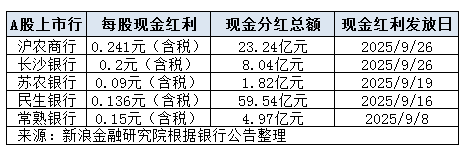
Core Viewpoint - A-share listed banks are actively implementing their 2025 interim dividend distribution plans, with significant cash dividends being announced and distributed by multiple banks in September 2023 [1][4]. Summary by Category Dividend Distribution - As of now, 17 A-share listed banks have announced their 2025 interim profit distribution plans, with six major state-owned banks collectively distributing a total of 204.657 billion yuan in cash dividends [1][4]. - Bank of Communications leads with a cash dividend of 50.396 billion yuan, followed by Agricultural Bank of China with 41.823 billion yuan, and China Construction Bank with 48.605 billion yuan [4]. Specific Bank Announcements - Shanghai Rural Commercial Bank announced a cash dividend of 0.241 yuan per share, totaling 2.324 billion yuan, distributed on September 26, 2025 [2][3]. - Changsha Bank declared a cash dividend of 0.20 yuan per share, amounting to 804 million yuan, also distributed on September 26, 2025 [2][3]. - Other banks such as Suzhou Rural Commercial Bank, Minsheng Bank, and Changshu Bank have also completed their 2025 interim dividend distributions [1][2]. New Dividend Policies - Several banks, including China Merchants Bank, Changshu Bank, and Ningbo Bank, have confirmed the implementation of interim dividends for the first time [6][7]. - Jiangyin Bank's board has approved its 2025 interim dividend plan, while other banks like Wuxi Bank and Xiamen Bank are considering their dividend distribution methods [7]. Non-Dividend Announcements - Some banks, such as Zhengzhou Bank, have explicitly stated they will not distribute cash dividends for the first half of 2025 [8]. - The trend of increasing dividend frequency is seen as beneficial for investor confidence and stock price stability [8]. Market Context - The overall dividend distribution in 2024 exceeded 630 billion yuan, with major banks like ICBC and CCB leading the way with over 100 billion yuan each [9][10]. - Regulatory changes have encouraged companies to enhance their dividend policies, aiming for more frequent and higher dividend payouts [10].

固收深度报告20250927:从42家上市银行半年报解读银行债券投资“攻守道”





Soochow Securities· 2025-09-27 14:32
1. Report Industry Investment Rating No information about the report industry investment rating is provided in the given content. 2. Core Viewpoints of the Report - External environment factors such as interest rate fluctuations, bond supply - demand, and policy orientation jointly impact bond investment returns. In H1 2025, the bond investment of 42 listed banks showed certain characteristics in scale, structure, and profit and loss, but there are still challenges in maintaining stable returns in the future [1]. - The overall bond investment scale of 42 listed banks expanded steadily in H1 2025. There were differences in the investment structure among different types of banks, with state - owned banks and city commercial banks having stable growth in the bond allocation portfolio, while joint - stock banks and rural commercial banks increased their efforts in the bond trading portfolio. The bond investment portfolio generally presented a pattern of "stable foundation and flexible gain" [1]. - The coupon income of 42 listed banks was generally stable in H1 2025 but showed a slight year - on - year decline. The fair value change loss was significant, and the investment income increased. However, the bond investment of the banking industry still faces pressure to maintain stable returns [1]. 3. Summary According to the Table of Contents 3.1 42 Listed Banks' Bond Investment Volume - **Overall Bond Investment Scale: Steady Expansion**: In H1 2025, the total scale of the three types of bond - type financial assets of 42 listed banks showed a steady expansion trend. The growth of debt investment - type financial assets measured at amortized cost was relatively slow, while the growth of trading financial assets measured at fair value and included in current profits and losses was relatively large, indicating that banks increased the proportion of trading positions [9]. - **Differentiated Bond Investment Distribution Structures among Different Bank Types**: In H1 2025, state - owned banks and city commercial banks showed stable growth in the bond allocation portfolio, which may be related to their participation in the primary - market issuance of important national and regional bond varieties. Joint - stock banks and rural commercial banks slightly weakened their bond allocation power but significantly increased their efforts in the bond trading portfolio, showing a differentiated feature of "stable allocation by large banks and prominent trading flexibility by small and medium - sized banks" [13]. - **Bond Investment Allocation Tilted towards Government - Related Bonds**: In H1 2025, commercial banks increased their allocation of government - related bonds, with an average month - on - month increase of about 10% for state - owned banks, joint - stock banks, and city commercial banks, and a slightly smaller increase for rural commercial banks. The allocation of financial bonds and other bonds was differentiated. All banks held a relatively large scale of government - related bonds, followed by financial bonds and credit - related bonds [18]. - **Correlation between Financial Asset Types and Bond Variety Structures**: The banking industry maintained a stable growth of interest - rate bonds in the bond allocation portfolio and increased the allocation of credit bonds, while the allocation of financial bonds was relatively weak. In the bond trading portfolio, interest - rate bonds and financial bonds were the core varieties, with a more significant increase than credit bonds, showing a "stable foundation and flexible gain" pattern [22]. 3.2 42 Listed Banks' Bond Investment Profit and Loss - **Coupon Income: Generally Stable and Still the Main Source of Income**: In H1 2025, the total coupon income of 42 listed banks decreased slightly year - on - year. Although the scale of held - to - maturity bonds increased, the decline in the coupon rate of newly issued bonds led to a decrease in coupon income. In the future, coupon income is still expected to be the main source of bond investment income for commercial banks [26]. - **Fair Value Change Loss: Losses in the Trading Level**: In H1 2025, the total fair value change loss of 42 listed banks decreased significantly year - on - year, indicating that it was difficult to obtain capital gains through short - term trading in the volatile bond market, and there were floating losses in bond trading [28]. - **Investment Income: Growth in All Bank Types**: In H1 2025, the actual investment income of 42 listed banks in the bond field increased significantly year - on - year. Although the book value appreciation of bond - type trading financial assets and other debt investment - type financial assets was not as good as that of the previous year, banks could still increase their investment income by selling floating - profit old bonds and waiting for the maturity of high - coupon bonds [31]. 3.3 Attribution and Summary - **External Environment Driving Factors: Interest Rate Fluctuations, Bond Supply - Demand, and Policy Orientation Jointly Impact Bond Investment Returns**: In H1 2025, the "more adjustments and fewer opportunities" bond market environment led to a general decline in the prices of existing bonds, resulting in a significant year - on - year decline in the fair value change loss of listed banks' bond investment. The supply of national bonds, local government bonds, and policy - based financial bonds increased, but the coupon rate of newly issued bonds decreased, leading to a decline in coupon income. Regulatory policies indirectly affected bond investment performance [35]. - **Banking Industry's Bond Investment Pressure and Future Outlook** - Overall Income Shows a Positive Trend but There Are Still Hidden Concerns: In H1 2025, the actual bond investment income of 42 listed banks increased slightly year - on - year, but the coupon income faced downward pressure in the interest - rate downward cycle, and it was more difficult to obtain spread income through band trading. Since H2 2025, the "stock - strong and bond - weak" pattern has emerged, and the loss caused by fair value change will be more obvious [3]. - Different Bank Types Show Differentiated Performance, and State - owned Banks' Pressure Is Relatively Controllable: State - owned banks can maintain a certain profit - making ability in the low - interest - rate volatile bond market due to their advantages in bond allocation and trading portfolios. Joint - stock banks, city commercial banks, and rural commercial banks are more vulnerable, and they may increase their capital allocation in the equity market, commodity market, and related structured fixed - income products in the future [3].
友阿股份:关于收到参股公司长沙银行股份有限公司利润分红款的公告
Zheng Quan Ri Bao Zhi Sheng· 2025-09-26 13:16
Core Viewpoint - The announcement from Youa Co., Ltd. regarding its stake in Changsha Bank and the approval of the 2025 interim profit distribution plan highlights the company's financial benefits from its investment in the bank [1] Group 1: Company Announcement - Youa Co., Ltd. announced that it holds 228,636,220 shares in Changsha Bank [1] - The board of Changsha Bank approved the 2025 interim profit distribution plan [1] - Youa Co., Ltd. is set to receive cash dividends amounting to 45,727,244.00 RMB [1] Group 2: Financial Impact - The cash dividends received by Youa Co., Ltd. are a direct result of its shareholding in Changsha Bank [1] - The dividend payment was received shortly after the approval of the profit distribution plan [1]
友阿股份(002277.SZ):收到参股公司长沙银行利润分红款4572.7万元
Ge Long Hui A P P· 2025-09-26 11:40
Core Points - Youa Co., Ltd. announced that its equity investment in Changsha Bank has resulted in a cash dividend of 45,727,244.00 RMB based on the bank's 2025 interim profit distribution plan [1] - The company holds 228,636,220 shares of Changsha Bank, and the dividend will be distributed on the equity registration date of September 25, 2025 [1] - The cash dividend received will not impact the company's consolidated net profit for the 2025 fiscal year due to the use of the equity method for accounting [1]