CPIC(601601)

Search documents
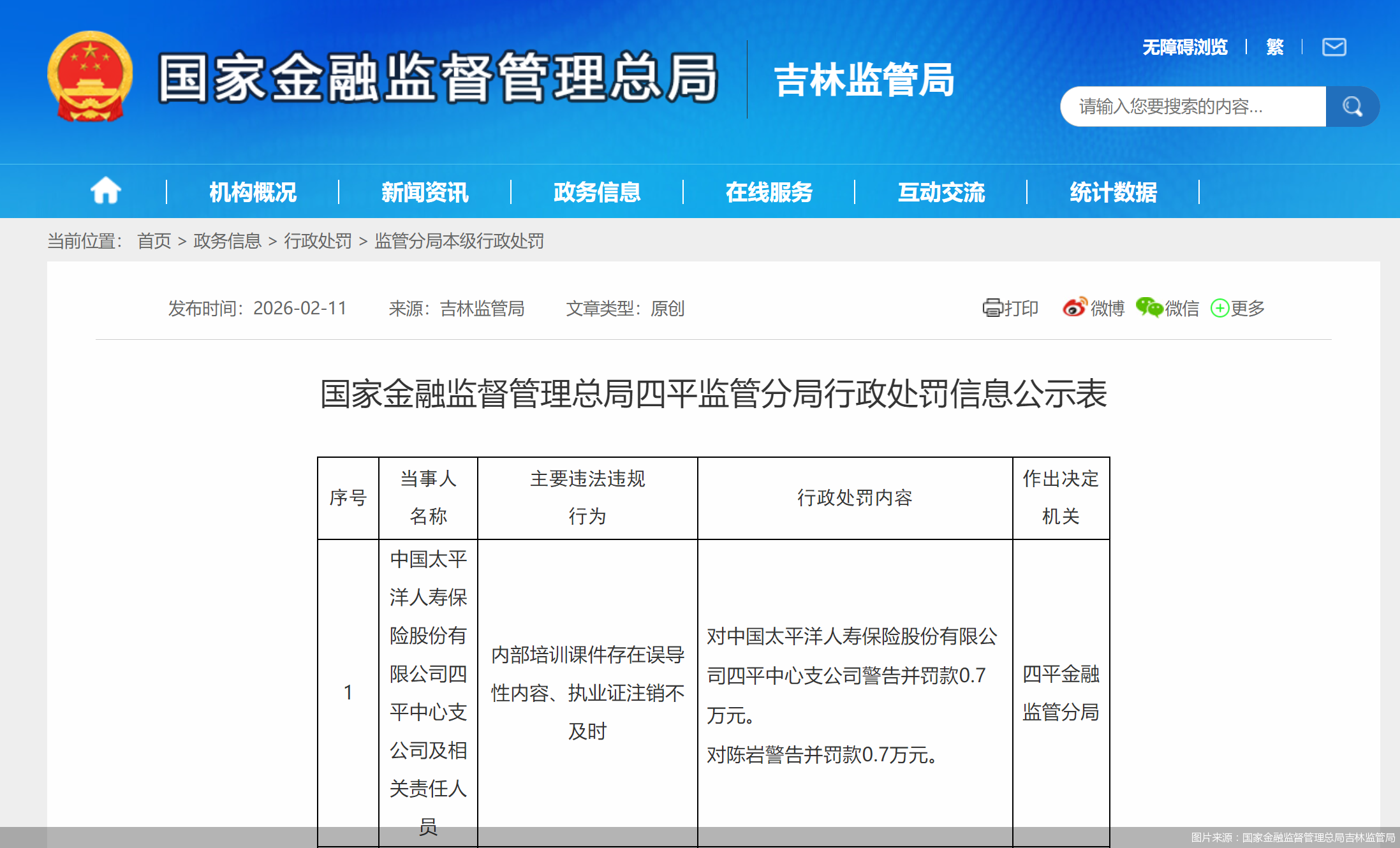
因内部培训课件存在误导性内容等,太保寿险四平中支合计被罚1.4万元
Bei Jing Shang Bao· 2026-02-11 11:20
Group 1 - The core viewpoint of the article highlights that China Pacific Life Insurance Co., Ltd. was penalized for misleading content in internal training materials and delayed cancellation of professional licenses [1] - The regulatory authority, the National Financial Supervision Administration, issued a warning and imposed a fine of 0.07 million yuan (0.7万元) on the company [1] - Individual responsibility was also addressed, with a fine of 0.07 million yuan (0.7万元) imposed on an individual named Chen Yan [1]


申万宏源:预计险企NBV增速亮眼 市场波动阶段性影响4Q25业绩表现
智通财经网· 2026-02-11 06:23
Group 1 - The core viewpoint is that the strong performance in the first three quarters lays a solid foundation for the annual results, with a high growth trend in NBV expected to continue into 2025 [1][2] - It is projected that the net profit attributable to shareholders of A-share insurance companies will increase by 22.7% year-on-year to 426.4 billion yuan in 2025, with a decrease in growth rate of 10.9 percentage points compared to the first three quarters of 2025 [1] - Specific companies are expected to show significant growth in net profit, including China Taiping (215%-225%), China Life (45.8%), and New China Life (43.0%) [1] Group 2 - The liability side of life insurance is expected to maintain a high growth trend, with projected NBV growth rates for various companies such as PICC Life (60.2%) and Sunshine Insurance (49.9%) [2] - The property insurance sector is expected to see a year-on-year premium income increase of 3.9% to 1.76 trillion yuan in 2025, with claims expenses rising by 1.6% to 1.17 trillion yuan [3] - The impact of Typhoon "Maitai" in October 2025 is expected to cause a temporary effect on the combined ratio (COR) performance, with significant economic losses reported [3] Group 3 - The strategy for insurance capital entering the market is continuously advancing, with the scale and proportion of investments in the secondary market increasing significantly [4] - By the end of September 2025, the balance of insurance funds in the secondary market reached 5.59 trillion yuan, accounting for 14.9% of total investments, an increase of 1.49 trillion yuan and 2.6 percentage points from the end of 2024 [4] - Market fluctuations are anticipated to exert pressure on investment performance in the fourth quarter of 2025, with various indices showing mixed performance [4]




聊城监管分局同意太保寿险聊城市东昌府支公司变更营业场所
Jin Tou Wang· 2026-02-11 03:49
Core Viewpoint - The National Financial Supervision Administration of Liaocheng has approved the change of business location for China Pacific Life Insurance Co., Ltd. Liaocheng Dongchangfu Branch to a new address [1] Group 1 - The new business location will be at 100 Xinhua East Road, 4th Floor, Dongchangfu District, Liaocheng City, Shandong Province [1] - The company is required to handle the change and obtain the necessary permits in accordance with relevant regulations [1]
险资购金试点一周年:配置克制 显“耐心资本”本色
Bei Jing Shang Bao· 2026-02-11 01:55
Core Insights - The insurance funds have cautiously entered the gold market, contrary to expectations of aggressive investment, reflecting a prudent approach amid market volatility [1][3][5] - The pilot program for insurance funds to invest in gold has been operational for a year, with ten insurance companies approved, but only six have completed membership with the Shanghai Gold Exchange [1][2][3] Group 1: Pilot Program Overview - The pilot program was officially launched on February 7, 2025, allowing ten insurance companies, including major players like China Life and PICC, to invest in gold [2][4] - By March 2025, several insurance companies completed their first transactions, indicating initial engagement with the gold market [2][3] Group 2: Investment Strategy and Caution - Despite the theoretical investment limit of nearly 200 billion yuan, actual investments remain low, with many companies still in a trial phase [3][5] - The cautious approach is attributed to the volatile nature of gold prices and the lack of experience among insurance companies in gold investment [5][7] Group 3: Challenges and Professional Barriers - Insurance companies face challenges due to the complex nature of gold as an asset, which requires sophisticated analysis and risk management capabilities [5][6] - Regulatory requirements mandate that insurance companies maintain strict internal controls and reporting mechanisms, adding to the operational complexity [6] Group 4: Long-term Perspectives - Long-term, gold is being recognized for its strategic value in diversifying portfolios and mitigating risks, especially in uncertain market conditions [7][8] - The shift towards gold investment is seen as a response to the limitations of traditional fixed-income assets, prompting insurance companies to explore new avenues for asset growth [7][9]

机器人“上岗”谁来兜底? 保险业加速布局机器人保障
Jin Rong Shi Bao· 2026-02-11 01:32
Core Insights - The emergence of "robot insurance" is crucial for addressing the risks associated with the deployment of intelligent robots in real-world scenarios, alleviating concerns from both suppliers and users [1][2] Group 1: Market Demand and Supply - The Chinese humanoid robot market is projected to reach 8.239 billion yuan by 2025, accounting for approximately 50% of the global market [3] - The complexity of robots leads to high repair costs, ranging from 30,000 to 300,000 yuan per incident, and introduces new risks such as network attacks and data breaches [3] - Real-world incidents have highlighted the necessity of insurance for robots, as accidents can lead to significant damages and liabilities [3][4] Group 2: Insurance Product Development - The first "lifetime liability insurance for elderly care robots" has been launched, addressing the concerns of both robot manufacturers and care institutions [2] - Insurance products are evolving to cover both self-protection and third-party liabilities, with comprehensive coverage for various risks including natural disasters and algorithm failures [4] - Innovative insurance solutions are being developed, integrating technology and capital to create a robust ecosystem for the robot industry [4] Group 3: Challenges and Solutions - The rapid technological advancements in robotics present challenges for insurance product design and pricing, as traditional data-driven models may not apply [5][6] - Collaboration among insurance companies, industry players, and academic institutions is essential for building a risk database and establishing industry standards [7] - Government policies and subsidies are being implemented to stimulate market demand and support the development of insurance products for robots [7] Group 4: Future Market Potential - The humanoid robot market is expected to grow significantly, with projections estimating a market size of 20 to 50 billion yuan by 2028 and potentially reaching 10 trillion yuan by 2045 [8] - The establishment of a comprehensive insurance system is vital for the sustainable development of the robotics industry, addressing various risk scenarios from operational errors to cybersecurity threats [8]

购金试点周年 险资克制入场
Bei Jing Shang Bao· 2026-02-10 16:54
Core Viewpoint - The cautious approach of insurance funds in the gold market reflects a combination of risk awareness and a lack of professional capability, despite the theoretical potential for significant investment [1][5][7]. Group 1: Policy and Market Entry - The pilot program for insurance funds to invest in gold was officially launched on February 7, 2025, with ten insurance companies approved to participate [1][4]. - By March 2025, several major insurance companies, including China Life and PICC Property and Casualty, completed their first gold transactions, marking a significant step in the integration of gold into their investment strategies [2][3]. Group 2: Investment Strategy and Caution - Despite the opening of the investment channel, insurance companies have been cautious, with many reporting low gold investment ratios, indicating a trial phase rather than aggressive investment [3][5]. - The theoretical investment cap for the ten pilot companies is nearly 200 billion, but actual allocations remain low, reflecting a careful approach amid market volatility [5][8]. Group 3: Challenges and Professional Barriers - The complexity of gold as an asset, including its price volatility and the need for sophisticated analysis, poses significant challenges for insurance companies lacking experience in precious metals investment [5][6]. - Regulatory requirements mandate that insurance companies maintain strict internal controls and risk management practices, adding to the operational challenges [6]. Group 4: Long-term Perspectives - From a long-term perspective, gold is being recognized for its strategic value in diversifying risk and enhancing portfolio resilience, especially in uncertain global market conditions [7][8]. - The shift towards including gold in investment portfolios is seen as a response to the limitations of traditional fixed-income assets, which have been under pressure due to low interest rates [7][8].
招商证券:保险行业2025年稳健收官 2026年开门红值得期待
Zhi Tong Cai Jing· 2026-02-10 06:08
Core Viewpoint - The insurance industry maintains a recommended rating, supported by a "slow bull" market trend that benefits both asset returns for insurance companies and sales of floating income-type dividend insurance [1] Group 1: Life Insurance Companies - In 2023, life insurance companies achieved a cumulative premium income of 43,624 billion, with a year-on-year growth of 8.9%, slightly down from 9.1% [3] - December's premium income for life insurance companies was 2,152 billion, showing a year-on-year increase of 6.0%, with life insurance premiums at 1,683 billion, up 10.1% [3] - The strong performance in life insurance is expected to continue into 2026, particularly in the bancassurance channel, where new single premiums are anticipated to double [3] Group 2: Property Insurance Companies - Property insurance companies reported a cumulative premium income of 17,570 billion in 2023, with a stable year-on-year growth of 3.9% [4] - December's premium income for property insurance was 1,413 billion, with a year-on-year increase of 4.4%, and auto insurance premiums at 977 billion, up 2.2% [4] - Non-auto insurance premiums in December reached 437 billion, showing a significant year-on-year growth of 9.6%, driven by low base effects from the previous year [4] Group 3: Overall Industry Performance - The total premium income for the insurance industry in 2023 was 61,194 billion, reflecting a year-on-year growth of 7.4% [5] - By the end of December, the total assets of the insurance industry reached 413,145 billion, a 15.1% increase from the beginning of the year, while net assets grew by 10.2% to 36,640 billion [5] - Investment recommendations include China Ping An, New China Life, China Life, and China Taiping, with a focus on the long-term investment value of China Property Insurance [5]

中国太保20260209
2026-02-10 03:24
Summary of the Conference Call for China Pacific Insurance (CPIC) Company Overview - The conference call focused on China Pacific Insurance (CPIC), a prominent player in the insurance sector in China, discussing its operational updates and market conditions. Key Points and Arguments Opening Remarks - The call was initiated by Sun Ting, an analyst from Dongwu Securities, who highlighted the increased market attention on insurance stocks recently and set the stage for discussing CPIC's performance and expectations for the upcoming year [1]. Performance Update - CPIC's management, led by Chen, provided an update on the "first quarter red" (开门红) performance, indicating that the results from January were slightly better than expected for the agent channel, while the bancassurance channel met expectations [1][2]. - The growth in the agent channel was attributed to several factors, including external demand and a shift in consumer behavior towards insurance products as a more stable wealth management option compared to traditional bank deposits [2][3]. Market Dynamics - The phenomenon of "deposit migration" was discussed, where consumers are increasingly moving their funds from traditional bank deposits to insurance products, which are perceived as less risky [2][3]. - The management noted that while the growth in the agent channel was encouraging, the third quarter might face challenges due to high base effects from previous years [3][5]. Product Mix and Strategy - The management indicated that the proportion of participating insurance products in new business was expected to remain similar to the previous year, with a focus on increasing the share of floating income products [6][7]. - The value rate of participating insurance products was discussed, revealing that it is lower than traditional insurance products, but the difference is not as significant as perceived [9][10]. Sales Channels - The differences between the individual insurance (个险) and bancassurance (银保) channels were highlighted, with the agent channel being more uniform in product offerings compared to the diverse strategies employed by different banks in the bancassurance channel [14][16]. - The management emphasized the importance of gradually increasing the proportion of premium payment products in the bancassurance channel, moving away from simple one-time payment products [19][21]. Future Outlook - CPIC's management expressed optimism about the overall growth targets for 2026, indicating that the adjustments would likely be slightly higher than previous estimates [21]. - The management also addressed the potential impact of regulatory changes on the industry, particularly concerning the new accounting standards expected to be implemented in 2026, which may increase pressure on smaller insurance companies [42][44]. Investment Strategy - The investment strategy was discussed, with a focus on maintaining a stable asset allocation while being responsive to market changes. The management highlighted a continued emphasis on high-dividend strategies and long-term bonds [50][51]. - The current allocation to equities and funds was noted to be slightly below industry averages, with a focus on improving this aspect in the future [56]. International Expansion - CPIC's international strategy, particularly in Hong Kong and Southeast Asia, was mentioned as a key area of focus, with plans for further investment and support for international business development [68][70]. Additional Important Information - The management acknowledged the challenges faced by smaller insurance companies in the current regulatory environment and emphasized the need for a long-term perspective on industry stability and growth [42][43]. - The call concluded with a commitment to continue enhancing the product offerings and improving the sales strategies across different channels to better meet market demands [37][70].
2026险资入市规模或达0.9万亿
HTSC· 2026-02-10 02:35
Investment Rating - The report recommends a "Buy" rating for several insurance companies, including China Pacific Insurance, China Life Insurance, and China Property & Casualty Insurance [5]. Core Insights - The insurance industry is expected to see significant growth in investable funds, with estimates of 3.1 trillion yuan in 2026, driven by strong premium growth and a balanced allocation between equities and bonds [6][31]. - The secondary equity investment is projected to reach 0.9 trillion yuan in 2026, slightly lower than the previous year, while bond investments are expected to increase significantly [6][30]. - The report emphasizes the importance of dividend stocks as a key investment strategy for insurance companies, aiming to secure cash dividends to offset declining interest income [7][48]. Summary by Sections Investment Scale and Growth - In 2025, the insurance sector is estimated to have an additional investable fund of 2.3 trillion yuan, with secondary equity investments around 1 trillion yuan, marking a significant increase from previous years [12][36]. - By 2026, the total investment scale in the insurance industry is projected to reach 42 trillion yuan, with a secondary equity allocation expected to rise to 18% [30][35]. Premium and Fund Sources - The total premium for the insurance industry is expected to reach 6.9 trillion yuan in 2026, with a year-on-year growth of approximately 13% [31][34]. - New single premiums are projected to be 2 trillion yuan, reflecting a 25% increase, while renewal premiums are expected to grow by 11% to 3 trillion yuan [31][34]. Asset Allocation and Strategy - The report indicates a shift in asset allocation, with a decrease in non-standard, deposit, and alternative assets, while equities and bonds are expected to see increased investment [30][41]. - The focus on dividend stocks is highlighted as a strategy to stabilize cash flow and reduce profit volatility, with an anticipated annual increase in high-dividend stock allocations of 300 to 500 billion yuan [7][55]. Market Dynamics - The report notes that the insurance sector's secondary equity position reached a historical high of 16% by the end of 2025, driven by favorable market conditions and policy support [12][20]. - The anticipated regulatory changes in asset-liability management are expected to further influence investment strategies within the insurance industry [6][30].

苏州金融监管分局同意撤销太平洋产险苏州市高新技术开发区支公司枫桥营销服务部
Jin Tou Wang· 2026-02-09 08:32
Group 1 - The Suzhou Financial Regulatory Bureau approved the request for the cancellation of the Fengqiao Marketing Service Department of China Pacific Property Insurance Co., Ltd. Suzhou High-tech Zone Branch [1] - The company is required to ensure a smooth transition of business operations following the cancellation to prevent any adverse effects [1] - Upon receiving the approval document, the company must immediately cease all business activities of the mentioned institution and return the license to the Suzhou Financial Regulatory Bureau within 15 working days, along with completing relevant legal procedures [1]