
CPIC(601601)

Search documents
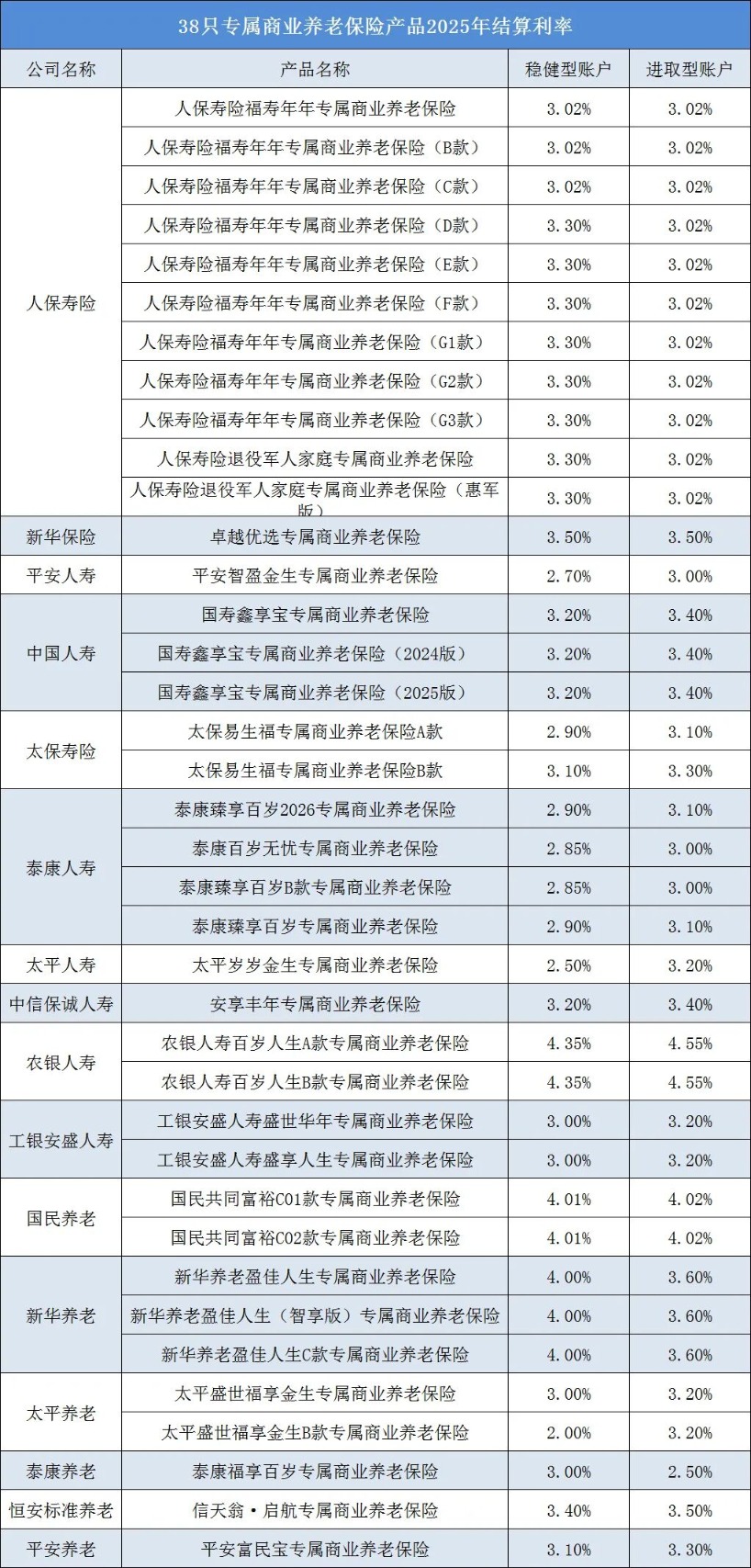
最高4.55%!专属商业养老保险2025年结算利率出炉
Guo Ji Jin Rong Bao· 2026-01-14 14:44
Core Viewpoint - The exclusive commercial pension insurance products have shown promising settlement interest rates for 2025, with a significant portion exceeding 3% and several surpassing 4% [1][3]. Group 1: Settlement Rates - A total of 67 accounts have settlement rates of 3% or higher, accounting for nearly 90% of the total [1]. - Among 38 exclusive commercial pension insurance products, the settlement rates for stable accounts range from 2% to 4.35%, while for aggressive accounts, they range from 2.5% to 4.55% [3]. - Three insurance companies have products with settlement rates of 4% or higher, with the highest rates being 4.35% for stable accounts and 4.55% for aggressive accounts from Agricultural Bank Life Insurance [4]. Group 2: Product Design and Strategy - Exclusive commercial pension insurance is designed with two phases: accumulation and payout, featuring a "guarantee + floating" yield model [3]. - The stable accounts are tailored for risk-averse clients, focusing more on fixed-income assets, while aggressive accounts have a higher allocation to equity assets [3][5]. - The dual-account structure allows for risk diversification and improved overall returns, leveraging long-term capital attributes for cross-cycle asset allocation [5]. Group 3: Market Development and Policy Support - The pilot program for exclusive commercial pension insurance began in June 2021 and expanded nationwide by March 2022, transitioning to a regular business model by October 2023 [6]. - Recent policies have emphasized the development of the third pillar of pension insurance, encouraging the creation of new products and enhancing the market for exclusive commercial pension insurance [6]. - To enhance competitiveness, insurance companies are encouraged to shift from a single financial product model to a comprehensive ecosystem solution, integrating health management and community services [7][8].




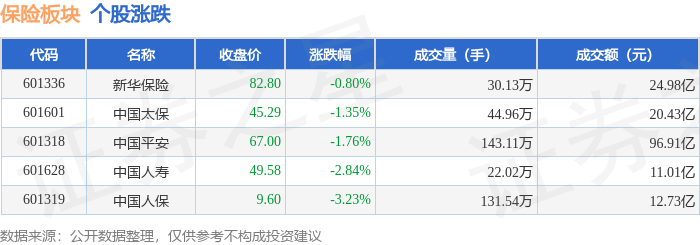
保险板块1月14日跌2.28%,中国人保领跌,主力资金净流出9.6亿元
Zheng Xing Xing Ye Ri Bao· 2026-01-14 08:58
证券之星消息,1月14日保险板块较上一交易日下跌2.28%,中国人保领跌。当日上证指数报收于 4126.09,下跌0.31%。深证成指报收于14248.6,上涨0.56%。保险板块个股涨跌见下表: 以上内容为证券之星据公开信息整理,由AI算法生成(网信算备310104345710301240019号),不构成投资建议。 从资金流向上来看,当日保险板块主力资金净流出9.6亿元,游资资金净流入7.4亿元,散户资金净流入 2.2亿元。保险板块个股资金流向见下表: | 代码 | 名称 | 主力净流入(元) | 主力净占比 游资净流入 (元) | | 游资净占比 散户净流入(元) | | 散户净占比 | | --- | --- | --- | --- | --- | --- | --- | --- | | 601336 新华保险 | | 1.75亿 | 7.01% | 5562.73万 | 2.23% | -2.31 Z | -9.23% | | 601628 中国人寿 | | -1319.10万 | -1.20% | 236.32万 | 0.21% | 1082.78万 | 0.98% | | 601319 中国人保 ...


A股保险股午后跳水,中国人保跌3%
Ge Long Hui· 2026-01-14 05:18
格隆汇1月14日|A股市场保险股午后跳水,其中,中国人保跌3%,中国人寿跌超2%,中国太保跌超 1%。 ...
太平洋人寿商丘中支及两责任人多项违规被罚 合计罚没47万元
Jing Ji Guan Cha Wang· 2026-01-14 03:42
Core Viewpoint - The China Pacific Life Insurance Company, Shangqiu Branch, and two responsible individuals have been fined a total of 470,000 yuan for multiple violations of regulations [1] Group 1: Penalties on Individuals - Wang Jinghua, the Deputy General Manager of the Shangqiu Branch, was fined 40,000 yuan and received a warning for not using the approved insurance premium rates as required [1] - Tian Junzhou, the Deputy General Manager and Supervisor, was also fined 40,000 yuan and received a warning for providing benefits to policyholders beyond what was stipulated in the insurance contract [1] Group 2: Penalties on the Company - The Shangqiu Branch of China Pacific Life Insurance was fined 390,000 yuan for three violations, including providing benefits to policyholders outside of the insurance contract, not using the approved insurance premium rates, and inadequate management of employee behavior [1]

ETF资金榜 | 半导体设备ETF 广发(560780):净流入2.23亿元,居可比基金前二-20260113
Xin Lang Cai Jing· 2026-01-14 01:37
2026年1月13日,半导体设备ETF 广发(560780.SH)收跌3.43%,成交2.52亿元。净流入2.23亿元(净申购 份额*单位净值),居可比基金前二。 拉长时间看,该基金连续5天资金净流入,合计吸金10.66亿元,居可比基金前三。 资金流入也助力了份额的提升,该基金最新份额较前一日增加1.15亿份,突破13.00亿份,居可比基金前 二。与此同时,该基金最新规模突破27.00亿元,创历史新高。 半导体设备ETF 广发(560780.SH),场外联接(A:020639;C:020640)。 ...
ETF主力榜 | 通用航空ETF(563320)主力资金净流出1074.54万元,居可比基金前2-20260113
Xin Lang Cai Jing· 2026-01-13 11:33
Group 1 - The General Aviation ETF (563320.SH) experienced a decline of 8.10% on January 13, 2026 [1] - The net outflow of main funds (transactions over 1 million yuan) amounted to 10.74 million yuan, ranking it among the top two in comparable funds [1] - The latest trading volume for the fund was 70.20 million shares, with a total transaction value of 96.24 million yuan, placing it among the bottom two in comparable funds [1]
ETF主力榜 | 稀土ETF(159713)主力资金净流出2932.33万元,居可比基金前2-20260113
Xin Lang Cai Jing· 2026-01-13 11:33
Group 1 - The Rare Earth ETF (159713.SZ) closed down by 3.40% on January 13, 2026 [1] - The net outflow of main funds (single transaction amount over 1 million yuan) was 29.32 million yuan, ranking it among the top two in comparable funds [1] - The latest trading volume of the fund was 152 million shares, with the latest transaction amount falling below 230 million yuan, ranking it among the bottom two in comparable funds [1]
Mhy20260113生猪晚评:春节消费驱动猪价坚挺
Xin Lang Cai Jing· 2026-01-13 10:52
Market Overview - As of January 9, the profit from self-bred and raised pigs is a loss of 11.54 yuan per head, improving from a loss of 34.59 yuan per head the previous week. The profit from purchased piglets is a loss of 2.31 yuan per head, compared to a loss of 48.35 yuan per head the prior week [1] - The National Development and Reform Commission's price monitoring center reports that as of January 7, 2026, the price of live pigs is 12.67 yuan per kilogram, corn is 2.30 yuan per kilogram, and the pig-to-grain price ratio is 5.51. Compared to December 31, 2025, the price of live pigs has increased by 2.10%, corn prices remain stable, and the pig-to-grain price ratio has risen by 2.04% [1] Daily Market Prices and Forecast - The daily prices for live pigs across various regions show a range from 11.70 yuan per kilogram in Xinjiang to 13.38 yuan per kilogram in Guangdong, with most regions experiencing stability in prices [2] - Year-on-year comparisons indicate a significant decline in prices, with reductions ranging from 13.58% in Guangdong to 21.35% in Xinjiang [2] - The forecast for the next day indicates stability in prices across most regions, with some areas showing slight upward trends [2]

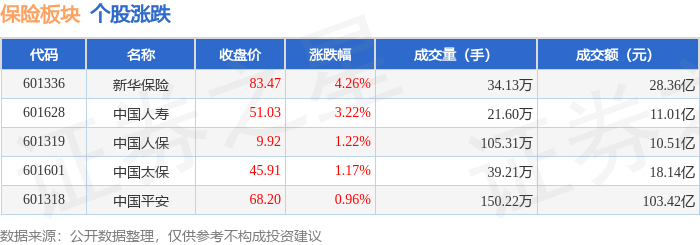
保险板块1月13日涨2.14%,新华保险领涨,主力资金净流出4.67亿元
Zheng Xing Xing Ye Ri Bao· 2026-01-13 09:06
Core Viewpoint - The insurance sector experienced a rise of 2.14% on January 13, with New China Life leading the gains, while the overall market indices saw declines [1] Group 1: Market Performance - The Shanghai Composite Index closed at 4138.76, down 0.64% [1] - The Shenzhen Component Index closed at 14169.4, down 1.37% [1] Group 2: Individual Stock Performance - New China Life (601336) closed at 83.47, up 4.26% with a trading volume of 341,300 shares and a turnover of 2.836 billion [1] - China Life (601628) closed at 51.03, up 3.22% with a trading volume of 216,000 shares and a turnover of 1.101 billion [1] - China Pacific Insurance (601601) closed at 45.91, up 1.17% with a trading volume of 392,100 shares and a turnover of 1.814 billion [1] - China Ping An (601318) closed at 68.20, up 0.96% with a trading volume of 1,502,200 shares and a turnover of 10.342 billion [1] - China Re (601319) closed at 9.92, up 1.22% with a trading volume of 1,053,100 shares and a turnover of 1.051 billion [1] Group 3: Fund Flow Analysis - The insurance sector saw a net outflow of 467 million from institutional investors, while retail investors contributed a net inflow of 418 million [1] - New China Life had a net inflow of 212 million from institutional investors, while retail investors had a net outflow of 171 million [2] - China Life experienced a net inflow of 104 million from institutional investors, with retail investors seeing a net outflow of 8.424 million [2] - China Pacific Insurance had a net outflow of 23.39 million from institutional investors, while retail investors had a net inflow of 61.86 million [2] - China Ping An faced a significant net outflow of 718 million from institutional investors, while retail investors had a net inflow of 597 million [2]
中国太保入选“2025中国企业ESG百强”榜单
Xin Lang Cai Jing· 2026-01-13 05:38
Group 1 - The core viewpoint of the article emphasizes the growing importance of ESG (Environmental, Social, and Governance) as a key measure of high-quality corporate development and a vital link between corporate value and social value [1][2] - The "2025 China ESG Top 100" list was released by Sina Finance, evaluating over 5,000 A-share listed companies and mainland companies listed in Hong Kong using 18 industry ESG evaluation models and over 150 ESG indicators [1][2] - The list serves as a benchmark for industry development and provides valuable decision-making references for investors [1][2] Group 2 - China Pacific Insurance (China Taibao) was recognized for its outstanding ESG performance, ranking 70th on the "2025 China ESG Top 100" list [2][8] - The publication of the list is seen as an authoritative recognition of the sustainable development practices of the listed companies and promotes the core values of ESG across the industry [2][8] - The article calls for more companies to prioritize ESG system construction and innovative practices, integrating ESG concepts into strategic planning and operations to achieve a symbiotic relationship between commercial and social value [2][8] Group 3 - The "2025 China ESG Top 100" list includes notable companies such as China Construction Bank, China Mobile, Agricultural Bank of China, Tencent, and others, all receiving a five-star rating in their respective industries [4][5][6] - The list highlights the diverse sectors represented, including finance, telecommunications, information technology, and renewable energy, showcasing the broad commitment to ESG principles across various industries [4][5][6] Group 4 - The Sina Finance ESG Rating Center is the first Chinese professional platform for ESG information and ratings, aiming to promote sustainable development and responsible investment [11] - The center is focused on establishing ESG evaluation standards suitable for China's characteristics and advancing the development of ESG investment in the asset management industry [11]
