CPIC(601601)

Search documents
Mhy20260115油脂晚评:印尼B50计划取消,市场仍在消化
Xin Lang Cai Jing· 2026-01-15 09:32
Market Focus - Indonesia has canceled its plan to increase the mandatory biodiesel blend ratio to 50% this year, maintaining the current mix of 40% palm oil-based fuel and 60% diesel [1] - Indonesia will raise the export levy on crude palm oil (CPO) from 10% to 12.5% starting March 1, with a similar increase of 2.5 percentage points for refined products [1] - Malaysia has lowered the reference price for crude palm oil for February, resulting in an export tax reduction to 9%, with the reference price set at 3,846.84 ringgit per ton, down from 3,946.17 ringgit in January [1] Soybean Processing Data - The National Oilseed Processors Association (NOPA) is expected to report a soybean crush of 224.809 million bushels for December, reflecting a month-over-month increase of 4.1% and a year-over-year increase of 8.8%, marking the second-highest monthly crush in history [2] - December's soybean oil inventory is projected to reach 1.686 billion pounds, an increase of 11.4% month-over-month and 36.4% year-over-year [2] Palm Oil Export Data - Malaysia's palm oil exports from January 1-15 amounted to 727,440 tons, an increase of 18.64% compared to 613,172 tons in the same period last month [2] Market Sentiment - The cancellation of Indonesia's B50 plan represents a significant adjustment in demand-side expectations, establishing a neutral to bearish market tone [4] - Despite strong short-term export performance and policy negotiations among exporting countries, it is challenging to reverse the weakening sentiment caused by long-term changes in consumption growth trends [4]

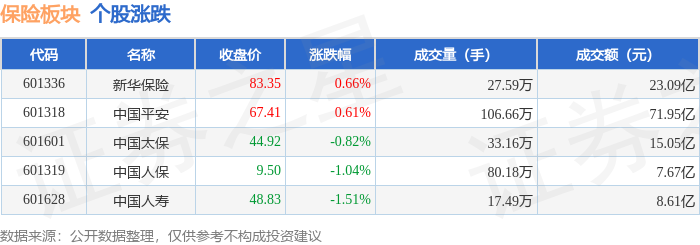
保险板块1月15日跌0.63%,中国人寿领跌,主力资金净流出1.65亿元
Zheng Xing Xing Ye Ri Bao· 2026-01-15 08:58
证券之星消息,1月15日保险板块较上一交易日下跌0.63%,中国人寿领跌。当日上证指数报收于 4112.6,下跌0.33%。深证成指报收于14306.73,上涨0.41%。保险板块个股涨跌见下表: 从资金流向上来看,当日保险板块主力资金净流出1.65亿元,游资资金净流出3.33亿元,散户资金净流入 4.98亿元。保险板块个股资金流向见下表: | 代码 | 名称 | 主力净流入 (元) | 主力净占比 游资净流入 (元) | | 游资净占比 散户净流入 (元) | | 散户净占比 | | --- | --- | --- | --- | --- | --- | --- | --- | | 601601 中国太保 | | 1.08亿 | 7.15% | -1.19/Z | -7.93% | 1172.46万 | 0.78% | | 601628 中国人寿 | | 1513.53万 | 1.76% | 515.82万 | 0.60% | -2029.36万 | -2.36% | | 601336 新华保险 | | 606.86万 | 0.26% | -4536.59万 | -1.96% | 3929.73万 | 1. ...




2025中国企业ESG“金责奖”责任投资最佳资产管理机构奖揭晓
Xin Lang Cai Jing· 2026-01-15 07:43
Core Viewpoint - The 2025 China Enterprise ESG "Golden Responsibility Award" recognizes companies that excel in environmental, social, and governance (ESG) practices, promoting sustainable development in China [1][4]. Group 1: Award Overview - The award aims to honor enterprises and institutions that have made significant contributions to the ESG cause in China, emphasizing the importance of responsibility in sustainable development [1][4]. - The award selection process began in November 2025, attracting over 5,000 participating companies, and involved a rigorous evaluation based on ESG performance, professional scoring, and online voting [5]. Group 2: Award Winners - The winners of the "Best Responsible Investment Asset Management Institution" category include Guoshou Asset, Huaxia Wealth, Xingyin Wealth, Taikang Asset, Taibao Asset, and Galaxy Investment [2][5]. - The award committee congratulated the winning companies and expressed hope that they would lead by example, enhancing their ESG capabilities and contributing to high-quality development in China [2][5]. Group 3: ESG Rating Center - The Sina Finance ESG Rating Center is the first Chinese platform dedicated to ESG information and ratings, promoting sustainable development and responsible investment [3][6]. - The center aims to establish ESG evaluation standards suitable for China's characteristics and enhance the ESG investment development in the asset management industry [3][6].

2025中国企业ESG“金责奖”责任投资最佳保险公司奖揭晓
Xin Lang Cai Jing· 2026-01-15 07:43
Core Viewpoint - The 2025 China Enterprise ESG "Golden Responsibility Award" aims to recognize companies that excel in environmental, social, and governance (ESG) practices, promoting sustainable development in China [1][4]. Group 1: ESG Award Overview - The award selection process began in November 2025, attracting over 5,000 companies to participate [5]. - The evaluation criteria included comprehensive ESG performance, professional scoring, and online voting results [5]. - The award is intended to encourage more companies to enhance their ESG capabilities and contribute to high-quality development in China [2][5]. Group 2: Award Recipients - The "Best Responsible Investment Insurance Company" award was given to China Life Insurance, China Pacific Insurance, China Reinsurance, Sunshine Insurance, China People's Insurance, and China Ping An [2][5]. - The award committee congratulated the winning companies and expressed hope for them to lead by example in improving ESG performance [2][5]. Group 3: ESG Rating Center Introduction - The Sina Finance ESG Rating Center is the first Chinese platform dedicated to ESG information and ratings, promoting sustainable development and responsible investment [3][6]. - The center aims to establish ESG evaluation standards suitable for China's characteristics and enhance corporate ratings [3][6]. - It also publishes multiple ESG innovation indices to provide investors with more options regarding corporate ESG performance [3][6].
张掖监管分局同意太平洋产险山丹支公司变更营业场所
Jin Tou Wang· 2026-01-15 03:21
Core Viewpoint - The National Financial Supervision Administration's Zhangye Regulatory Bureau has approved the change of business location for China Pacific Property Insurance Co., Ltd.'s Shandan Branch to a new address in Zhangye City, Gansu Province [1] Group 1 - The new business location for China Pacific Property Insurance Co., Ltd.'s Shandan Branch is specified as: South Shop, 2nd Floor, Segment C, Harmony Community, Aili Road, Shandan County, Zhangye City, Gansu Province [1] - The company is required to present the approval document and related materials to the National Financial Supervision Administration's Zhangye Regulatory Bureau within 10 days to exchange for the insurance license [1] - The company must also handle the announcement matters in accordance with relevant regulations in a timely manner [1]

2025中国企业ESG“金责奖”评选结果揭晓 共筑可持续发展新生态
Xin Lang Cai Jing· 2026-01-15 02:38
Core Viewpoint - The 2025 China Enterprise ESG "Golden Responsibility Award" aims to recognize companies and institutions that have made significant contributions to ESG initiatives in China, reflecting a shift from voluntary practices to compliance requirements in ESG performance [1][18]. Group 1: Award Categories and Winners - The award includes ten categories: Best Environmental Responsibility Award, Best Social Responsibility Award, Best Corporate Governance Responsibility Award, Best Responsibility Initiative Award, Annual Sustainable Development Award, Best Responsible Investment Bank Award, Best Responsible Investment Securities Company Award, Best Responsible Investment Insurance Company Award, Best Responsible Investment Fund Company Award, and Best Responsible Investment Asset Management Institution Award [1][18]. - The Best Environmental Responsibility Award winners include: Sungrow Power Supply, Industrial Fulian, Kweichow Moutai, Geely Automobile, Haier Smart Home, Hisense Visual Technology, Linyang Electronics, Tongwei Co., Weichai Power, and Luxshare Precision [10][28]. - The Best Social Responsibility Award winners include: China Shenhua, China General Nuclear Power, China Resources Sanjiu, Sinopec, Shougang, Wuliangye, Yangtze Power, China Telecom, China Oilfield Services, and LONGi Green Energy [10][28]. - The Best Corporate Governance Responsibility Award winners include: Zijin Mining, SF Holding, ZTE Corporation, Industrial Fulian, JA Solar, Sany Heavy Industry, Nanjing Steel, Bright Dairy, TCL Zhonghuan, and Fuyao Glass [10][28]. - The Best Responsibility Initiative Award winners include: FiberHome Technologies, Wens Foodstuff Group, Haitian Flavoring and Food, Aier Eye Hospital, Yunnan Baiyao, Anker Innovations, Kingfa Sci. & Tech., Huatai Securities, Silex, and Hainengda [11][28]. - The Annual Sustainable Development Award winners include: China General Nuclear Power, Sungrow Power Supply, Kweichow Moutai, Contemporary Amperex Technology, Zijin Mining, Hikvision, Yili, Baosteel, Chint Electric, and China Mobile [11][28]. Group 2: Responsible Investment Awards - The Best Responsible Investment Bank Award winners include: Agricultural Bank of China, Industrial and Commercial Bank of China, China Construction Bank, China Merchants Bank, Industrial Bank, and Bank of China [11][28]. - The Best Responsible Investment Securities Company Award winners include: Guotai Junan, Everbright Securities, CITIC Securities, Huatai Securities, and CICC [12][28]. - The Best Responsible Investment Insurance Company Award winners include: China Life Insurance, China Ping An, China Pacific Insurance, China Re, Sunshine Insurance, and China Life [13][28]. - The Best Responsible Investment Fund Company Award winners include: Bosera Funds, Southern Fund, China Asset Management, Penghua Fund, Huitianfu Fund, and E Fund [14][28]. - The Best Responsible Investment Asset Management Institution Award winners include: China Life Asset Management, Huaxia Wealth Management, Xingyin Wealth Management, Taikang Asset, Taikang Asset, and Galaxy Investment [15][28]. Group 3: ESG Development Context - By 2025, China's ESG development has transitioned from "setting standards" to "strengthening regulations," with a comprehensive disclosure standard system being established [1][18]. - The ESG performance of enterprises is now a compliance requirement, linking commercial value with social value [1][18]. - The ESG rating center aims to promote sustainable development and responsible investment, enhancing the ESG performance of listed companies [17][34].


ETF融资榜 | 科创人工智能ETF 广发(588760)融资净买入1581.59万元,居可比基金首位-20260114
Xin Lang Cai Jing· 2026-01-15 02:04
拉长时间看,该基金近4天杠杆资金加速流入,合计流入4740.52万元,居可比基金第一。(数据来源: Wind) 科创人工智能ETF 广发(588760.SH),场外联接(A类:024245;C类:024246)。 2026年1月14日,科创人工智能ETF 广发(588760.SH)收涨2.57%,成交6.01亿元。获融资买入5734.69 万元,融资偿还4153.10万元,融资净买入1581.59万元,居可比基金首位。(数据来源:Wind) ...
ETF融资榜 | 半导体设备ETF 广发(560780)融资净买入996.58万元,居可比基金第一-20260114
Xin Lang Cai Jing· 2026-01-15 02:04
Group 1 - The semiconductor equipment ETF, Guangfa (560780.SH), experienced a rise of 2.31% on January 14, 2026, with a trading volume of 224 million yuan [1] - The fund received a net financing purchase of 9.97 million yuan, ranking first among comparable funds, with 20.83 million yuan in financing purchases and 10.86 million yuan in financing repayments [1] - Over the past five trading days, the fund has seen net financing inflows on four occasions, totaling 19.50 million yuan, also ranking first among comparable funds [1] Group 2 - The fund has both onshore and offshore connection classes, with Class A (020639) and Class C (020640) available [1]
横琴人寿注册资本增59%至49.9亿,64岁董事长钱仲华曾因年龄原因离任中国太保
Sou Hu Cai Jing· 2026-01-15 01:45
Core Viewpoint - Hengqin Life Insurance Co., Ltd. has increased its registered capital from approximately 3.137 billion to about 4.989 billion yuan, marking a 59% increase [1] Group 1: Company Overview - Hengqin Life was established in December 2016 and its main business includes life insurance, health insurance, accident insurance, and related reinsurance and investment operations [1] - The shareholders of Hengqin Life include Hengtong Group Co., Ltd., Zhongzhi Enterprise Group Co., Ltd., Zhuhai Huachuang Investment Management Co., Ltd., Suzhou Anyuan Industrial Co., Ltd., and Shenzhen Pearl Red Trading Co., Ltd. [1] - The chairman of Hengqin Life is Qian Zhonghua, who has a background in public service and has held various positions in the insurance industry since 1995 [1] Group 2: Financial Performance - For the first half of 2025, Hengqin Life reported insurance revenue of 4.39 billion yuan and a net loss of 838 million yuan, with a return on equity of -99.09%, indicating ongoing financial difficulties [2] - From 2022 to 2024, Hengqin Life's cumulative net loss reached 1.515 billion yuan [2]
险资出手,今年首次举牌
券商中国· 2026-01-14 23:18
Core Viewpoint - The article highlights the ongoing trend of insurance capital actively increasing their equity investments, with significant recent activities including the acquisition of shares in Shanghai Airport by Taibao Life Insurance, indicating a robust wave of insurance capital entering the market in 2026 [2][3][5]. Group 1: Recent Acquisitions - On January 9, Taibao Life Insurance increased its stake in Shanghai Airport by acquiring 72.424 million shares, raising its total holdings to 124 million shares, which constitutes approximately 5.00% of the company's A-share capital [2][3]. - Prior to this acquisition, Taibao Life Insurance and its asset management subsidiary held 51.9917 million shares, representing a 2.09% stake [3]. - The total value of Taibao Life Insurance's holdings in Shanghai Airport is approximately 4.067 billion yuan, accounting for 0.15% of the company's total assets as of Q3 2025 [3][4]. Group 2: Insurance Capital Trends - In December 2025, Ping An Life Insurance also made significant acquisitions, reaching a 20% stake in Agricultural Bank of China and China Merchants Bank, triggering mandatory disclosure [5]. - The frequency of insurance capital triggering the 5% disclosure threshold has become a notable trend in 2025, with a total of 36 instances recorded, surpassing previous highs [5][6]. Group 3: Equity Asset Allocation - As of Q3 2025, the total equity asset allocation by life and property insurance companies reached 5.59 trillion yuan, marking a 35.92% increase year-on-year [7]. - The equity asset allocation ratio for insurance companies has reached a historical high, with stock allocations accounting for 10% of total assets and combined stock and fund allocations exceeding 15% [7]. - Ping An Life Insurance reported an equity asset balance of 1.5 trillion yuan, which is 27.00% of its total assets, up from 19.81% in the previous year [7]. Group 4: Market Outlook and Investment Sentiment - The article notes that insurance capital is motivated by a low interest rate environment and new accounting standards, leading to a greater need for equity asset allocation [8]. - A survey of insurance investment officers indicates a prevailing sentiment that opportunities in the market outweigh risks, with over 70% planning to continue increasing equity allocations [8][9]. - The trend of reallocating assets in a declining interest rate environment is expected to further drive insurance capital towards equity investments, fostering a positive cycle of market recovery [9].