CPIC(601601)

Search documents
保险板块大幅上涨,新华保险涨超7%创历史新高
Xin Lang Cai Jing· 2026-01-05 03:29
1月5日金融一线消息,A股保险板块大幅上涨,新华保险涨超7%创历史新高,中国太保、中国平安、 中国人寿涨超5%。 责任编辑:李琳琳 1月5日金融一线消息,A股保险板块大幅上涨,新华保险涨超7%创历史新高,中国太保、中国平安、 中国人寿涨超5%。 责任编辑:李琳琳 ...



新年如何布局?1月金股出炉!这只股票人气最高
券商中国· 2026-01-05 03:07
2026年1月金股陆续披露。 整体来看,有色板块在1月获得券商一致青睐,紫金矿业被10家券商扎堆推荐,是当之无愧的"人气王"。此外,电子、机械、非银板块也有不俗人气。 展望1月市场行情,券商普遍认为,"春季躁动"正徐徐展开,中期大盘趋势依然向上。 1月金股出炉,紫金矿业人气最高 回顾2025年全年,券商金股在波澜壮阔的A股行情中收益亮眼。根据每市APP数据,国元证券月度金股组合在2025年以超80%的收益率居于第一,东北证券、开源证 券去年收益率也近70%,东兴证券、华鑫证券、招商证券等收益率超60%。 进入2026年,1月金股陆续披露。 在众多推荐标的中,紫金矿业获得中泰证券、光大证券等10家机构的一致推荐,是当之无愧的最热金股。推荐券商普遍认为,公司兼具"金+铜"双轮驱动逻辑,在 降息周期与供需格局优化的背景下,金价与铜价有望同步上行,公司业绩弹性与资源成长性突出。 中际旭创则被开源证券、招商证券等7家券商推荐,人气排名第二。推荐理由上,券商认为,作为光模块龙头,公司受益于AI算力建设加速,1.6T等高端产品有望放 量,业绩增长确定性较强。 保险板块也获得券商高度关注,例如中国平安获得国联民生证券、申万宏 ...




基本面向好叠加估值双击保险行情,保险证券ETF(515630)涨超2.5%
Xin Lang Cai Jing· 2026-01-05 03:01
Group 1 - The core viewpoint of the news highlights a strong performance in the insurance sector, with the CSI 800 Securities Insurance Index rising by 2.61% and key stocks like New China Life and Ping An experiencing significant gains of 7.98% and 5.54% respectively [1] - The strategic cooperation agreement signed between Ping An Property & Casualty, Shanghai Electric Leasing Co., and Shanghai Electric Insurance Brokerage marks a breakthrough in the integrated financial service of "insurance + financing leasing" for embodied intelligent robots, representing the first successful case in the industry [1] - The individual insurance new business premium growth rates for major insurers such as China Life, Ping An, Taikang, and New China Life are reported to be between 40-60% as of January 1, 2026, indicating a strong start to the year [2] Group 2 - The stable performance of the equity market, with the Shanghai Composite Index showing a nine-day rise, is expected to provide favorable investment returns for insurance companies, while the 2.25% yield on 30-year bonds covers new business liability costs [2] - The valuation of major insurance companies remains attractive, with a projected Price-Embedded Value (PEV) range of 0.55-0.75, which is around the 40th percentile of the past decade [2] - As of December 31, 2025, the top ten weighted stocks in the CSI 800 Securities Insurance Index account for 64.71% of the index, with major players including Ping An, East Money, and CITIC Securities [3]


内险股集体走高 险企开门红备战充分 中长期看险企利差有望逐步向好
Zhi Tong Cai Jing· 2026-01-05 02:56
Core Viewpoint - The insurance stocks have collectively risen, with notable increases in share prices for major companies such as Xinhua Insurance, China Pacific Insurance, China Ping An, and China Life Insurance, indicating positive market sentiment towards the insurance sector [1] Group 1: Stock Performance - Xinhua Insurance shares increased by 4.45%, reaching HKD 58.7 [1] - China Pacific Insurance shares rose by 3.04%, reaching HKD 37.3 [1] - China Ping An shares grew by 2.17%, reaching HKD 68.25 [1] - China Life Insurance shares climbed by 1.8%, reaching HKD 29.36 [1] Group 2: Liability Side Analysis - The individual insurance channel is expected to face pressure in 2025 due to factors such as the transformation of dividend insurance and the integration of individual insurance reporting [1] - Preparations for the 2026 "opening red" period are expected to improve the individual insurance channel marginally [1] - The bank insurance channel is anticipated to maintain high growth due to the trend of residents moving deposits [1] - Health insurance is expected to improve under policy guidance, with a positive outlook for the liability side growth rate of insurance companies in 2026 [1] Group 3: Asset Side Analysis - Stabilization of long-term interest rates and a favorable equity market are expected to benefit net assets and profitability of insurance companies [1] - Marginal improvement in liability costs is anticipated, leading to a gradual enhancement of insurance companies' interest spreads in the medium to long term [1] - With the stabilization and recovery of long-term interest rates, insurance company valuations are expected to approach 1x PEV, with recommendations for China Pacific Insurance, China Ping An, and China Life Insurance H shares [1]
A股三大指数上涨,沪指重回4000点创2025年11月以来新高!保险板块领涨,新华保险涨近8%创新高,中国平安冲高
Ge Long Hui· 2026-01-05 02:45
格隆汇1月5日|沪指重回4000点,日内涨0.78%,股价创2025年11月以来新高。脑机接口、保险、贵金 属等板块涨幅居前,新华保险(601336)涨近8%股价创历史新高,中国平安(601318)、中国太保 (601601)、中国人寿(601628)、中国人保(601319)纷纷冲高。 ...
沪指重回4000点 保险板块领涨
Bei Ke Cai Jing· 2026-01-05 02:41
新京报贝壳财经讯 沪指重回4000点,日内涨0.78%,股价创2025年11月以来新高。脑机接口、保险、贵 金属等板块涨幅居前,新华保险涨近8%股价创历史新高,中国平安、中国太保、中国人寿、中国人保 纷纷冲高。 ...
2026年首个交易日,A股保险板块集体飘红
Bei Jing Shang Bao· 2026-01-05 02:29
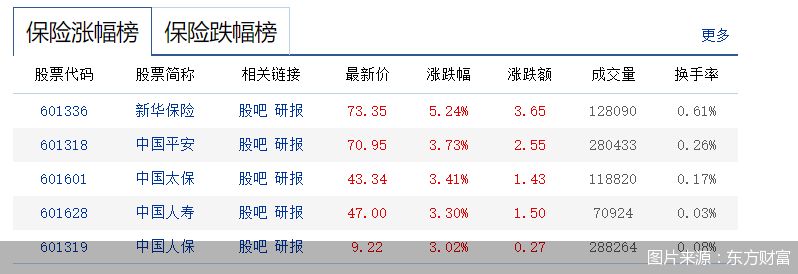
| 保险涨幅榜 | | 保险跌幅榜 | | | | | 題多 | | --- | --- | --- | --- | --- | --- | --- | --- | | 股票代码 | 股票简称 | 相关链接 | 最新价 | 涨跌幅 | 涨跌额 | 成交量 | 换手率 | | 601336 | 新华保险 | 股吧 研报 | 73. 35 | 5.24% | 3.65 | 128090 | 0.61% | | 601318 | 中国平安 | 股吧 研报 | 70. 95 | 3.73% | 2. 55 | 280433 | 0. 26% | | 601601 | 中国太保 | 股吧 研报 | 43. 34 | 3.41% | 1.43 | 118820 | 0.17% | | 601628 | 中国人寿 | 股吧 研报 | 47.00 | 3.30% | 1.50 | 70924 | 0.03% | | 601319 | 中国人保 | 股吧 研报 | 9.22 | 3.02% | 0.27 | | 288264 图片来源:东方财富 | 北京商报讯(记者 李秀梅)1月5日,2026年A股首个交易日,保险板块集体飘红 ...

非银金融行业周报:公募费率改革收官,非银板块向上突破动能充盈-20260105
Shenwan Hongyuan Securities· 2026-01-05 02:05
Investment Rating - The report maintains a "Positive" outlook on the non-bank financial sector for 2026, indicating strong upward momentum for the industry [3][4]. Core Insights - The brokerage sector is expected to experience a significant upward breakthrough in 2026, driven by improved chip structure, reduced turnover rates, and a favorable valuation environment. The sector is currently undervalued compared to its earnings potential [4]. - The insurance sector shows signs of stabilization post the interest rate switch, with premium growth expected to improve in 2026, particularly in the life insurance segment [4]. - Regulatory changes, including the completion of public fund fee reforms, are anticipated to benefit the non-bank financial sector by reducing costs for investors and enhancing market participation [4][22]. Summary by Sections Market Review - The Shanghai Composite Index closed at 4,629.94 with a decline of 0.59% over the week. The non-bank index fell by 1.84%, with brokerages and insurance indices declining by 1.37% and 3.33%, respectively [8][10]. Non-Bank Financial Insights - The brokerage sector's index underperformed the Shanghai Composite Index by 0.78 percentage points in 2025, with a total decline of 2.05% for the year. In contrast, major A-share indices saw significant gains [4]. - The insurance sector's original premium income reached 5.76 trillion yuan from January to November 2025, reflecting a year-on-year growth of 7.6%. The life insurance segment grew by 9.2% during the same period [4][31]. Investment Analysis - For brokerages, the report recommends focusing on leading firms with strong competitive advantages, such as Guotai Junan and CITIC Securities, as well as those with high earnings elasticity like Huatai Securities [4]. - In the insurance sector, companies like China Life and Ping An are highlighted for their potential in the upcoming market revaluation, with a focus on the growth of new business premiums [4]. Regulatory Developments - The China Securities Regulatory Commission (CSRC) has implemented new rules for public real estate investment trusts (REITs), expanding financing options for commercial properties [21]. - The completion of the public fund fee reform is expected to lower overall fund costs by approximately 20%, saving investors around 51 billion yuan annually [22].



如何为“小电驴”买保险?
Jin Rong Shi Bao· 2026-01-05 01:13
Core Viewpoint - The article discusses the rising concern among electric bicycle owners regarding insurance coverage after a significant traffic accident resulted in a 630,000 yuan compensation due to lack of insurance [1] Group 1: Insurance Market Overview - Currently, electric bicycles are not included in the mandatory insurance regulations, making commercial insurance essential for risk management [2] - Main types of insurance products available for electric bicycles include liability insurance, personal accident insurance, and vehicle damage insurance, with premiums ranging from 50 yuan to 200 yuan annually for liability insurance [2][5] - Major insurance companies offering electric bicycle insurance include China Pacific Insurance, PICC, and China Life Insurance, with various purchasing channels available [2][3] Group 2: Purchasing Channels - Online channels allow consumers to purchase insurance through official websites, apps, or third-party platforms like Alipay and WeChat [3][4] - Offline options include visiting insurance company branches or vehicle management service windows for assistance [3] - Some electric bicycle sales outlets offer bundled insurance services, although consumers should be cautious of high-priced packages [3] Group 3: Government Initiatives - Local governments have partnered with insurance companies to provide affordable insurance products, such as the "Riding Insurance" in Nanning, which offers plans starting at 68 yuan per year [5] - The "Shanghai Riding Insurance" provides comprehensive coverage for various risks associated with electric bicycle use, including emergency services [6] Group 4: Regulatory Considerations - Electric bicycles must adhere to safety standards, including a maximum speed of 25 km/h; exceeding this limit may classify them as motor vehicles, requiring mandatory insurance [7]


券商推荐212只首月金股
Zheng Quan Ri Bao· 2026-01-04 16:51
Group 1 - Investors are focusing on potential investment opportunities and market dynamics as the new year begins, with brokerages recommending a total of 212 stocks for January [1] - The "spring market rally" is anticipated, supported by policy initiatives and capital inflows, leading analysts to have an optimistic outlook for the A-share market in January [3][4] Group 2 - Among the recommended stocks, Zijin Mining received the highest attention with 8 joint recommendations from brokerages, while Zhongji Xuchuang received 7, and China Duty Free, Sanhua Intelligent Control, and China Pacific Insurance each received 4 [2] - The bullish outlook for Zijin Mining is based on the rising copper cycle driven by demand in new energy and the significant investment value of gold [2] Group 3 - Analysts predict that the "spring market rally" will be supported by ongoing policy efforts and a favorable economic environment, with expectations of a sustained upward trend in the market [3] - The macroeconomic environment is in a marginal recovery phase, with a neutral to loose financial environment, and the technology sector is expected to continue strengthening [3] Group 4 - New investment themes are emerging, with four key allocation directions identified: AI investments aligned with global manufacturing recovery, Chinese equipment exports, consumer recovery driven by inbound tourism and income growth, and non-bank financials benefiting from market expansion [4] Group 5 - In 2025, the performance of stocks recommended by brokerages was notable, with some stocks seeing monthly gains exceeding 150%, indicating strong market interest in these recommendations [5][6] - The number of recommended stocks remained stable, with a significant percentage of them achieving price increases in several months, particularly in August where 82% of recommended stocks rose [6] Group 6 - The performance of brokerage stock indices in 2025 was positive, with all 34 brokerage indices showing increases, and the Guoyuan Securities index leading with a 106% gain [7]