China Life(601628)

Search documents
保险业 2025 年三季报综述:资负共振,利润高增
Guoxin Securities· 2025-11-04 13:16
Investment Rating - The report maintains an "Outperform the Market" rating for the insurance industry [4][5][40]. Core Views - The insurance industry has shown strong performance in the first three quarters of 2025, driven by a recovery in the capital market and improvements in both asset and liability sides [3][40]. - The investment business remains a key factor for valuation recovery, with a focus on optimizing product structures and enhancing operational efficiency [3][40]. - The industry is preparing for the 2026 "New Year" with strategies to adapt to changes in interest rates and regulatory updates [3][40]. Summary by Sections Performance Overview - As of the end of Q3 2025, five listed insurance companies in A-shares achieved a total net profit of CNY 426.04 billion, a year-on-year increase of 33.5% [1][11]. - Major companies like China Life and New China Life reported net profit growth of 60.5% and 58.9%, respectively [1][11]. Life Insurance Sector - The new business value for life insurance companies continued to grow rapidly, with increases of 41.8% for China Life and 76.6% for New China Life [1][12]. - The adjustment of preset interest rates and the establishment of a dynamic adjustment mechanism have led to improved asset-liability coordination [1][18]. Property and Casualty Insurance - The property and casualty insurance sector saw a steady increase in premium income, with a total of CNY 859.64 billion, reflecting a year-on-year growth of 3.8% [2][26]. - The combined ratio (COR) for major companies improved, with China Life's COR at 96.1%, down 2.1 percentage points year-on-year [2][33]. Investment Performance - Investment returns have significantly recovered, with total investment yields for major companies reaching 8.6% for New China Life and 6.42% for China Life, marking increases of 1.8 and 1.04 percentage points, respectively [2][38]. - The allocation of assets has been optimized, with a focus on long-term bonds and equity investments, capitalizing on market opportunities [2][38]. Future Outlook - The insurance industry is expected to continue benefiting from a stable recovery in the capital market, with a focus on enhancing the proportion of floating yield products to mitigate risks [3][40]. - Companies are advised to pay attention to China Life, China Ping An, and China Property Insurance as potential investment opportunities [3][40].


沧州监管分局同意中国人寿财险海兴县支公司变更营业场所
Jin Tou Wang· 2025-11-04 11:30
一、同意中国人寿财产保险股份有限公司海兴县支公司将营业场所变更为:河北省沧州市海兴县海信路 南兴融街东0002381号。 二、中国人寿财产保险股份有限公司应按照有关规定及时办理变更及许可证换领事宜。 2025年10月30日,国家金融监督管理总局沧州监管分局发布批复称,《关于中国人寿财产保险股份有限 公司海兴县支公司变更营业场所的请示》(国寿财险冀发〔2025〕122号)收悉。经审核,现批复如 下: ...
险资“炒股”业绩爆发:五大险企投资日赚15亿元,新华保险收益增687%领跑
Sou Hu Cai Jing· 2025-11-04 10:35
Core Insights - The five major listed insurance companies in China reported a combined net profit of approximately 426 billion yuan for the first three quarters of 2025, averaging about 17.5 billion yuan per day, with China Life leading at 167.8 billion yuan, a year-on-year increase of 60.5% [2][3][6] Financial Performance - China Life achieved a net profit of 167.8 billion yuan, followed by Ping An with 132.86 billion yuan, which represents a year-on-year growth of 11.5% [3][6] - Other companies, including China Pacific Insurance, China Property & Casualty Insurance, and New China Life, reported net profits of 46.82 billion yuan, 45.7 billion yuan, and 32.86 billion yuan respectively, with New China Life showing a notable growth rate of 58.9% [6][7] Investment Performance - The total investment income for the five companies reached 357.12 billion yuan, with all companies experiencing more than double growth in investment net income [6][7] - China Life led with an investment net income of 137.075 billion yuan, a year-on-year increase of 453.75%, while New China Life had the highest growth rate at 687.16% with an investment net income of 40.413 billion yuan [7][8] Asset Allocation - The total investment assets of the five insurance companies exceeded 20 trillion yuan by the end of the third quarter, with China Life's assets at 7.28 trillion yuan, an increase of 10.2% from the beginning of the year [8][9] - The insurance companies maintained a strong focus on bank stocks, holding seven out of the top ten positions in their major stock holdings, with significant increases in positions for Postal Savings Bank [9][12] Stock Holdings - Postal Savings Bank saw a substantial increase of over 213 million shares, valued at approximately 12.556 billion yuan, making it the most favored stock among insurers in the third quarter [12][14] - Other notable increases included Nanjing Bank and Hualing Steel, with significant share increases and multiple insurance institutions participating in the investments [12][15]





新进270家上市公司十大流通股名单,险资前三季度加大权益投资
Hua Xia Shi Bao· 2025-11-04 09:58
Core Viewpoint - The A-share market has shown a strong upward trend in Q3 2023, driven by favorable policies and capital inflows, with insurance funds playing a crucial role in market dynamics [2] Group 1: Insurance Fund Investment Strategies - Insurance funds have maintained a strong preference for traditional "anchor" bank stocks, demonstrating a commitment to stable returns and high dividend assets [2][4] - There has been a significant increase in the allocation towards technology growth sectors such as electronics and computers, indicating a strategic shift towards economic transformation and industrial upgrading [2][8] - The "cash flow and growth" strategy reflects the asset allocation wisdom of insurance funds in the current market environment, potentially revealing future capital flows and market style preferences [2] Group 2: Performance and Holdings of Insurance Companies - Major insurance companies like China Life, China Ping An, and China Pacific have reported an increase in total investment returns, ranging from 5.2% to 8.6% year-on-year [4] - By the end of Q3, insurance funds were among the top ten shareholders in 633 A-share listed companies, with a total holding value exceeding 650 billion yuan, marking a growth of over 6% from mid-2023 [4][5] - The overall number of shares held by insurance funds in bank stocks increased significantly by 8.36 billion shares, with a market value growth of over 6.4 billion yuan despite a decline in the bank sector index [5][6] Group 3: Specific Stock Movements - Postal Savings Bank emerged as a standout stock for insurance funds in Q3, with a notable increase of 2.189 billion shares held by Ping An Life, making it one of the top ten shareholders [5][6] - Other banks like Industrial and Commercial Bank of China and Nanjing Bank also saw increased holdings from insurance funds, reflecting a trend of deepening investment in the banking sector [5][6] - Insurance funds are not only increasing their stakes but also seeking deeper involvement in governance, as seen with Hongkang Life's nomination of a director candidate at Su Nong Bank [6] Group 4: Focus on Technology Growth Stocks - The electronics sector saw the largest increase in holdings by insurance funds, with a rise of nearly 11.8 billion yuan and an increase of 15.6 million shares [8] - The number of computer industry companies in which insurance funds are among the top ten shareholders rose from 17 to 23, with a market value increase of over 1.2 billion yuan [9] - The investment in technology stocks is seen as a response to the macroeconomic environment and a strategic move to capture future growth potential, particularly in the context of the AI wave [9][10] Group 5: Adjustments in Other Sectors - Insurance funds have significantly reduced their holdings in sectors such as public utilities, construction materials, and transportation, indicating a reassessment of traditional cyclical industries [10] - This reduction reflects insurance funds' judgment on the economic outlook and policy impacts on certain sectors, showcasing their role as long-term investors and value discoverers in the capital market [10]

保险板块11月4日涨0.75%,中国平安领涨,主力资金净流入4.74亿元
Zheng Xing Xing Ye Ri Bao· 2025-11-04 08:48
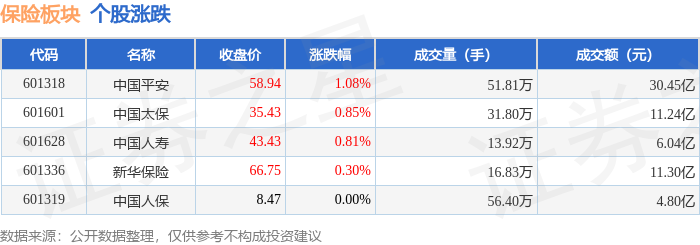
Core Insights - The insurance sector experienced a rise of 0.75% on November 4, with China Ping An leading the gains [1] - The Shanghai Composite Index closed at 3960.19, down 0.41%, while the Shenzhen Component Index closed at 13175.22, down 1.71% [1] Insurance Sector Performance - China Ping An (601318) closed at 58.94, up 1.08% with a trading volume of 518,100 shares and a transaction value of 30.45 billion yuan [1] - China Pacific Insurance (601601) closed at 35.43, up 0.85% with a trading volume of 318,000 shares and a transaction value of 11.24 billion yuan [1] - China Life Insurance (601628) closed at 43.43, up 0.81% with a trading volume of 139,200 shares and a transaction value of 6.04 billion yuan [1] - New China Life Insurance (601336) closed at 66.75, up 0.30% with a trading volume of 168,300 shares and a transaction value of 11.30 billion yuan [1] - China Reinsurance (601319) closed at 8.47, unchanged with a trading volume of 564,000 shares and a transaction value of 4.80 billion yuan [1] Capital Flow Analysis - The insurance sector saw a net inflow of 474 million yuan from institutional investors, while retail investors experienced a net outflow of 394 million yuan [1] - China Ping An had a net inflow of 363 million yuan from institutional investors, while retail investors had a net outflow of 196 million yuan [2] - New China Life Insurance recorded a net inflow of 62 million yuan from institutional investors, with retail investors experiencing a net outflow of 67 million yuan [2] - China Life Insurance had a net inflow of 541,940 yuan from institutional investors, while retail investors faced a net outflow of 5.41 million yuan [2] - China Pacific Insurance had a net outflow of 344,110 yuan from institutional investors, with retail investors seeing a net inflow of 59 million yuan [2]
A股上市险企财报“说”了什么?解码4260亿元净利润背后的周期与突围
Jing Ji Guan Cha Wang· 2025-11-04 08:41
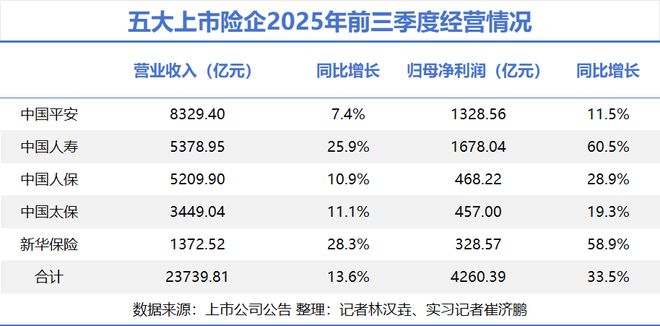
Core Viewpoint - The insurance industry in China has shown significant profit growth in the first three quarters of 2025, with a total net profit of 426.04 billion yuan, reflecting a year-on-year increase of 33.5% and a quarterly increase of 68.3%. However, this strong performance does not guarantee stock price increases, as evidenced by the mixed market reactions to the earnings reports of major listed insurance companies [2][4]. Financial Performance - The five major listed insurance companies reported a combined net profit of 426.04 billion yuan, averaging about 15 billion yuan per day [2]. - China Life's net profit increased by 60.5%, while its new business value (NBV) grew by 41.8%. New China Life's net profit rose by 58.9%, with an NBV increase of 50.8% [6]. - China Ping An and China Pacific Life exhibited a negative SG (Scissors Gap), indicating that their NBV growth outpaced profit growth, with Ping An's NBV increasing by 46.2% and net profit by 11.5% [5][6]. Investment and Profit Drivers - The investment sector has been identified as the main driver of profit growth for listed insurance companies, with significant increases in total investment returns. For instance, China Life's total investment return was 368.55 billion yuan, up 41% year-on-year [9]. - The companies are increasingly relying on equity investments to mitigate pressure from low interest rates on their liabilities [7]. Channel Strategies - The insurance companies are shifting their channel strategies from merely increasing manpower to enhancing productivity and value. For example, China Ping An's NBV from the bancassurance channel grew by 170.9%, contributing approximately 35% to its performance [8]. - The focus is on improving customer retention and value through better management of individual insurance sales forces, rather than relying solely on expanding the number of agents [7][8]. Future Outlook - The insurance industry is expected to benefit from a recovery in the economy, which may lead to simultaneous improvements in both the liability and investment sides. Current industry valuations remain low compared to historical levels, suggesting potential for growth [12]. - The companies are preparing for new opportunities and challenges in 2026, with strategic adjustments in response to regulatory changes and market conditions [12].

中国人寿黔西南分公司和兴义支公司被罚 误导投保人等
Zhong Guo Jing Ji Wang· 2025-11-04 06:54
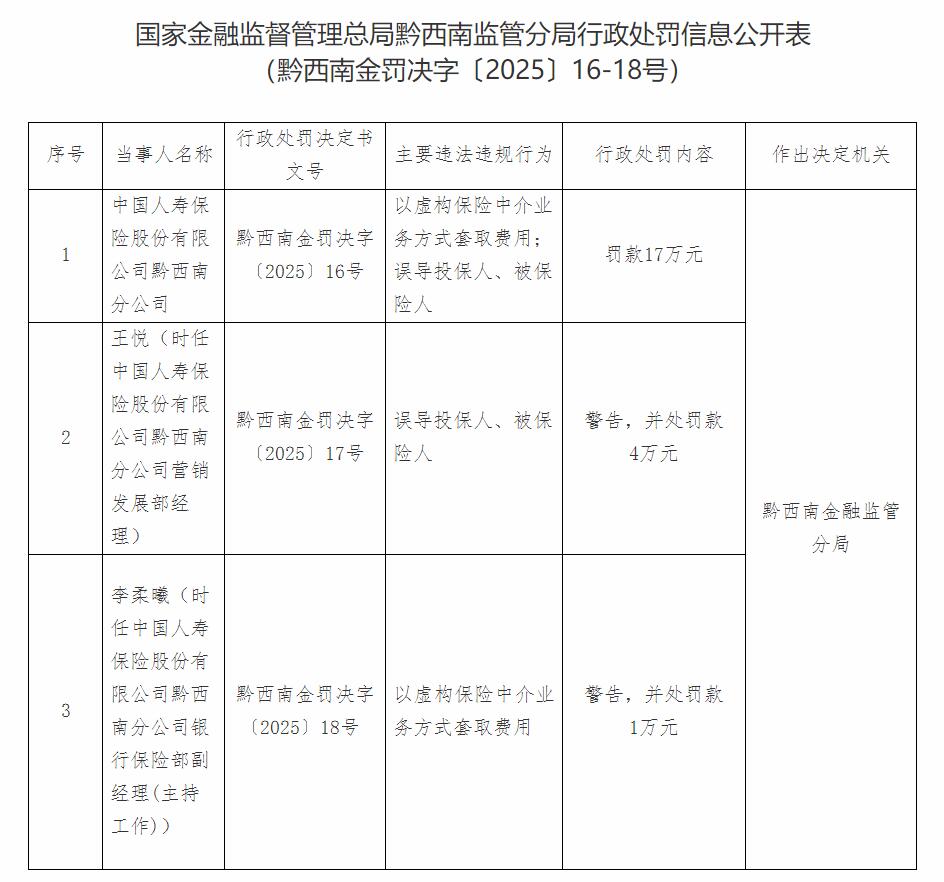
中国经济网北京11月4日讯 国家金融监督管理总局黔西南监管分局近日发布行政处罚信息公开表(黔西南金罚决字〔2025〕16-21号)。 黔西南金罚决字〔2025〕16号显示,中国人寿保险股份有限公司黔西南分公司以虚构保险中介业务方式套取费用;误导投保人、被保险 人。黔西南金融监管分局对中国人寿保险股份有限公司黔西南分公司罚款17万元。 黔西南金罚决字〔2025〕17号显示,王悦(时任中国人寿保险股份有限公司黔西南分公司营销发展部经理)误导投保人、被保险人。黔 西南金融监管分局对王悦警告,并处罚款4万元。黔西南金罚决字〔2025〕18号显示,李柔曦(时任中国人寿保险股份有限公司黔西南分公 司银行保险部副经理(主持工作))以虚构保险中介业务方式套取费用。黔西南金融监管分局对李柔曦警告,并处罚款1万元。 黔西南金罚决字〔2025〕19号显示,中国人寿保险股份有限公司兴义支公司个人代理人给予投保人保险合同约定以外的利益。黔西南金 融监管分局对中国人寿保险股份有限公司兴义支公司警告,并处罚款0.5万元。 国家金融监督管理总局黔西南监管分局行政处罚信息公开表 (黔西南金罚决字〔2025〕16-18号) | 序号 | 当事人 ...
大基金三期投资南通晶体!中国人寿、钜泉科技等超20亿加码半导体
Sou Hu Cai Jing· 2025-11-04 06:13
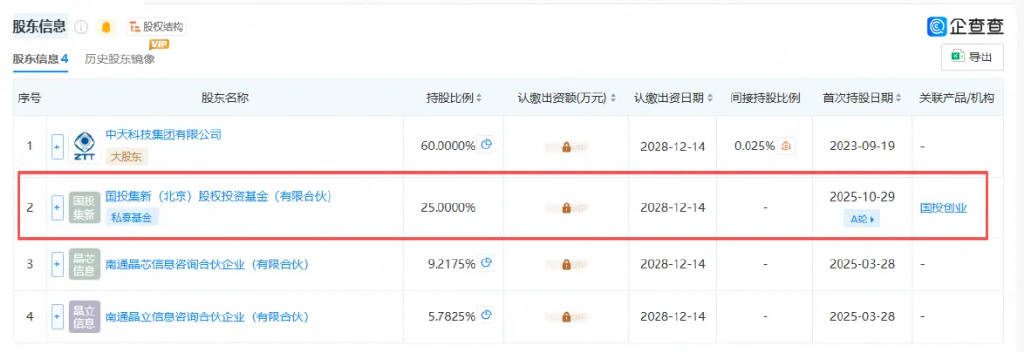
Core Insights - The article highlights the increasing importance of capital in driving technological breakthroughs and upgrading the semiconductor supply chain amid intensifying global competition and accelerated domestic production processes [1] Group 1: Major Investments - The National Big Fund Phase III has invested 100 million RMB in Nantong Crystal, increasing its registered capital from 300 million RMB to 400 million RMB, with a 25% stake [2] - China Life Insurance has announced a 2 billion RMB investment in a new fund focusing on semiconductors and smart electric vehicles, reflecting a strategic shift towards high-tech sectors [5][6] - Juyuan Technology plans to invest 150 million RMB through its wholly-owned subsidiary in a fund targeting the semiconductor and integrated circuit sectors [8][12] - Fulede Technology is participating in a private investment fund focused on the semiconductor industry, contributing 30 million RMB, which represents about 2.4% of the fund's total size [13][15] Group 2: Industry Focus - Nantong Crystal specializes in high-performance synthetic quartz materials, essential for semiconductor manufacturing, particularly in producing photomask substrates [4] - The investments from China Life Insurance are part of a broader strategy to support key emerging industries, including semiconductors, digital energy, and smart electric vehicles [6][7] - Juyuan Technology aims to enhance its influence in the upstream materials and technology sectors of semiconductors through its investment [12] - Fulede Technology's investment strategy includes targeting upstream materials and chip design, as well as emerging hard-tech fields like artificial intelligence and robotics [15] Group 3: Strategic Implications - The investments from the National Big Fund, China Life, Juyuan Technology, and Fulede Technology demonstrate a strong confidence and long-term strategy in the semiconductor sector, focusing on critical pain points such as materials and design [16] - The establishment and operation of these funds are expected to facilitate breakthroughs in the domestic production of key materials like photomasks, contributing to a more complete ecosystem for chip design, manufacturing, and packaging [16]

险资三季度继续扫货银行股!银行AH优选ETF(517900)涨近2%,机构:银行股投资进入季节性“顺风期”
2 1 Shi Ji Jing Ji Bao Dao· 2025-11-04 03:31
Core Viewpoint - The banking sector is experiencing a strong performance, with several banks seeing significant stock price increases, indicating a seasonal "tailwind" for bank stocks as they enter a favorable investment period from November to January [1][4]. Group 1: Market Performance - On November 4, various banks such as Xiamen Bank and CITIC Bank saw stock price increases of over 4% and 2% respectively, with the Bank AH Preferred ETF also rising nearly 2% [1]. - Historical data shows that from November to December, the banking sector has a 70% probability of generating absolute returns, which increases to 80% in January [4]. Group 2: Investment Trends - Insurance funds have been increasing their holdings in bank stocks since the third quarter, with a notable shift in strategy towards A-share state-owned banks like Agricultural Bank and Postal Savings Bank [4][5]. - Major insurance companies, such as Ping An Life and China Life, are adjusting their investment focus, with Ping An Life increasing its stake in Agricultural Bank and Postal Savings Bank [5][6]. Group 3: Market Conditions - The banking sector's strong performance is attributed to limited market information at the beginning of the year and the traditional "credit opening red" practice in January, which provides more certainty for bank operations [4]. - The current low-interest-rate environment has made high-dividend assets more attractive, enhancing the appeal of bank stocks for long-term investors [9].



五大险企大赚4260亿,此类保单收益或提高
2 1 Shi Ji Jing Ji Bao Dao· 2025-11-04 02:21
Core Viewpoint - The five major A-share listed insurance companies in China reported strong performance for the first three quarters of 2025, with total operating revenue reaching 23,739.81 billion yuan, a year-on-year increase of 13.6%, and net profit attributable to shareholders reaching 4,260.39 billion yuan, up 33.5% year-on-year [1][5]. Group 1: Financial Performance - China Life led the net profit with 1,678.04 billion yuan, showing a significant year-on-year growth of 60.5% [2][5]. - New China Life reported a net profit of 328.57 billion yuan, up 58.9% year-on-year, while China Property & Casualty Insurance achieved a net profit of 468.22 billion yuan, growing by 28.9% [2][5]. - The total net profit for the third quarter alone was 2,478.47 billion yuan, reflecting a remarkable year-on-year increase of 68.34% [5]. Group 2: Investment Income - Investment income was a key driver of profit growth, with China Life achieving total investment income of 3,685.51 billion yuan, a 41.0% increase year-on-year [8]. - The average total investment income growth for the five listed insurance companies exceeded 35% in the first three quarters, with a nearly 67% increase in the third quarter [8][9]. - The implementation of new accounting standards has amplified the impact of capital market fluctuations on insurance companies' profits [8][9]. Group 3: Business Transformation - In response to long-term interest rate pressures, the five major insurance companies are collectively shifting towards dividend insurance, with new business proportion reaching a high level [1][11]. - China Life reported that the proportion of dividend insurance in new individual business channels reached 70% in the second and third quarters [11]. - The companies are focusing on dynamic adjustment mechanisms for guaranteed interest rates, enhancing the development of floating income-type businesses [11][12]. Group 4: Customer Benefits from Performance - The significant increase in net profits may lead to higher dividends for policyholders, as companies are required to distribute no less than 70% of the distributable surplus to dividend insurance policyholders [11][12]. - Analysts suggest that while the net profit growth is likely, the actual benefits to dividend insurance policyholders may vary based on each company's surplus and dividend realization rates [12][13].