
GWMOTOR(601633)

Search documents
10月9日晚间重要公告一览
Xi Niu Cai Jing· 2025-10-09 10:19
Group 1 - Changyuan Power reported a power generation of 2.742 billion kWh in September, a year-on-year decrease of 41.88% [1] - The cumulative power generation from January to September was 27.332 billion kWh, down 8.24% year-on-year [1] - Huanyu Electronics achieved a consolidated revenue of 5.96 billion yuan in September, a year-on-year increase of 0.1% [1][2] Group 2 - Zhonghuan Environmental announced a change in controlling shareholder, with 27.5% of shares being transferred for a total consideration of 598 million yuan [2] - *ST Songfa's subsidiary signed contracts for the construction of 6 VLCCs, with a total contract value of approximately 600-900 million USD [1][3] - Suzhou Xinchen Technology's subsidiary plans to acquire 55% of Kunyu Lancheng for 74.25 million yuan [3] Group 3 - Guiguan Power reported a cumulative power generation of 31.848 billion kWh for the first three quarters, a year-on-year increase of 14.89% [4] - Jincheng Pharmaceutical's subsidiary received approval for the market launch of a raw material drug [4] - Shandong Steel expects a net profit of approximately 140 million yuan for the first three quarters, an increase of about 21.96 million yuan year-on-year [4][5] Group 4 - Xiangjia Co. reported sales revenue of 96.6186 million yuan from live poultry in September, with a sales price of 12.10 yuan/kg [6] - Aonong Bio's pig sales volume in September increased by 12.2% year-on-year, with a total of 164,400 pigs sold [7] - Mingtai Aluminum's aluminum plate and foil sales reached 1.1747 million tons in the first three quarters [8] Group 5 - Guangzhou Port expects to complete a container throughput of 2.051 million TEUs in September, a year-on-year decrease of 0.8% [11] - Jiangsu Sop plans to conduct a month-long maintenance on several production units starting October 10 [12] - Baike Bio received approval for a clinical trial of a combined vaccine for infants [13] Group 6 - Yutong Bus reported a 25.55% year-on-year increase in bus sales in September, totaling 4,756 units [16] - Shanghai Rural Commercial Bank's vice chairman and president's qualifications were approved [19] - Huayu Pharmaceutical's product received market approval in four countries [20] Group 7 - Longan Automobile reported a 24.92% year-on-year increase in vehicle sales in September, totaling 266,300 units [38] - Chip Origin expects a third-quarter revenue of 1.284 billion yuan, a year-on-year increase of 78.77% [39] - Bomaike signed a contract for an offshore floating production storage and offloading vessel project, with a contract value of approximately 190-240 million USD [40]


长城汽车(601633) - 长城汽车股份有限公司关于可转换公司债券转股及2023年股票期权激励计划自主行权结果暨股份变动公告
2025-10-09 09:16
| 证券代码:601633 | 证券简称:长城汽车 | 公告编号:2025-121 | | --- | --- | --- | | 转债代码:113049 | 转债简称:长汽转债 | | 长城汽车股份有限公司 关于可转换公司债券转股及 2023 年股票期权激励计划 自主行权结果暨股份变动公告 本公司董事会及全体董事保证本公告内容不存在任何虚假记载、误导性陈述或者重 大遗漏,并对其内容的真实性、准确性和完整性承担法律责任。 重要内容提示: 一、可转债转股情况 (一)可转债发行上市概况 经中国证券监督管理委员会《关于核准长城汽车股份有限公司公开发行可转换公司 债券的批复》(证监许可[2021]1353号)核准,长城汽车股份有限公司(以下简称"公 司"或"本公司")于2021年6月10日公开发行3,500万张可转换公司债券,每张面值100 元,发行总额35亿元。 可转债转股情况:2025年9月1日至2025年9月30日期间,共有42,000元"长汽转 债"已转换成公司股票,转股数为1,072股。自2021年12月17日至2025年9月30 日,累计共有4,942,000元"长汽转债"已转换为公司股票,累计转股数为1 ...
长城汽车(02333) - 海外监管公告
2025-10-09 08:55
此海外監管公告是根據香港聯合交易所有限公司證券上市規則第13.10B條發出。以下為長城汽 車股份有限公司於上海證券交易所網站(www.sse.com.cn)所刊發之「長城汽車股份有限公 司關於可轉換公司債券轉股及2023年股票期權激勵計劃自主行權結果暨股份變動公告」。 香港交易及結算所有限公司及香港聯合交易所有限公司對本公告的內容概不負責,對其準確性或完整性亦不發表任 何聲明,並明確表示,概不對因本公告全部或任何部份內容而產生或因倚賴該等內容而引致的任何損失承擔任何責任 。 長 城 汽 車 股 份 有 限 公 司 GREAT WALL MOTOR COMPANY LIMITED* (於中華人民共和國註冊成立的股份有限公司) 股份代號:2333(港幣櫃檯)及82333(人民幣櫃檯) 承董事會命 長城汽車股份有限公司 公司秘書 ,2025 10 9 於本公告日期,董事會成員如下: 執行董事:魏建軍先生、趙國慶先生及李紅栓女士。 職工董事:盧彩娟女士。 非執行董事:何平先生。 獨立非執行董事:樂英女士、范輝先生及鄒兆麟先生。 * 僅供識別 海外監管公告 李紅栓 | 证券代码:601633 | 证券简称:长城汽车 | ...
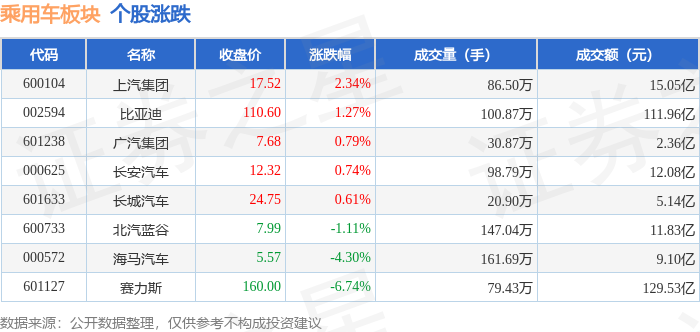
乘用车板块10月9日跌0.56%,赛力斯领跌,主力资金净流出18.23亿元
Zheng Xing Xing Ye Ri Bao· 2025-10-09 08:54
Core Viewpoint - The passenger car sector experienced a decline of 0.56% on October 9, with Seres leading the drop, while the Shanghai Composite Index rose by 1.32% and the Shenzhen Component Index increased by 1.47% [1] Group 1: Market Performance - The closing price of SAIC Motor was 17.52, up by 2.34%, with a trading volume of 865,000 shares and a transaction value of 1.505 billion [1] - BYD closed at 110.60, up by 1.27%, with a trading volume of 1,008,700 shares and a transaction value of 11.196 billion [1] - GAC Group closed at 7.68, up by 0.79%, with a trading volume of 308,700 shares and a transaction value of 236 million [1] - Changan Automobile closed at 12.32, up by 0.74%, with a trading volume of 987,900 shares and a transaction value of 1.208 billion [1] - Great Wall Motors closed at 24.75, up by 0.61%, with a trading volume of 209,000 shares and a transaction value of 514 million [1] - BAIC Blue Valley closed at 7.99, down by 1.11%, with a trading volume of 1,470,400 shares and a transaction value of 1.183 billion [1] - Haima Automobile closed at 5.57, down by 4.30%, with a trading volume of 1,616,900 shares and a transaction value of 910 million [1] - Seres closed at 160.00, down by 6.74%, with a trading volume of 794,300 shares and a transaction value of 12.953 billion [1] Group 2: Fund Flow Analysis - The passenger car sector saw a net outflow of 1.823 billion from main funds, while retail funds had a net inflow of 1.066 billion [1] - BYD had a main fund net inflow of 894 million, but a net outflow of 631 million from speculative funds and 263 million from retail investors [2] - SAIC Motor experienced a main fund net inflow of 64.31 million, with a net outflow of 66.76 million from retail investors [2] - GAC Group had a main fund net inflow of 31.38 million, but a net outflow of 2.466 million from retail investors [2] - Changan Automobile faced a main fund net outflow of 56.85 million, while retail investors contributed a net inflow of 41.02 million [2] - BAIC Blue Valley had a significant main fund net outflow of 142 million, but a net inflow of 114 million from retail investors [2] - Seres saw a main fund net outflow of 25.20 million, with retail investors contributing a net inflow of 11.80 million [2]






长城汽车9月销量达13.36万台,同比增长23.29%
Ju Chao Zi Xun· 2025-10-09 04:03
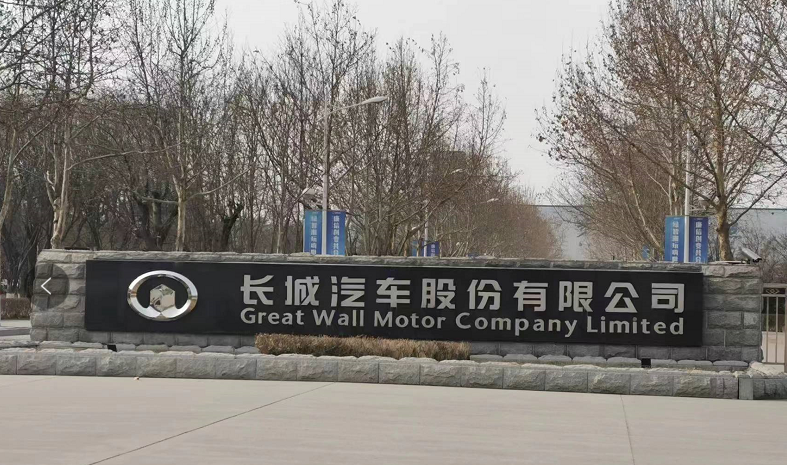
Sales Performance - In September, Great Wall Motors sold 133,639 vehicles, representing a year-on-year increase of 23.29% [3] - Cumulative sales for the year reached 923,358 units, showing an 8.15% year-on-year growth [3] Production Performance - The company produced 134,404 vehicles in September, which is a 25.38% increase compared to the same month last year [3] - Year-to-date production totaled 919,816 units, reflecting an 8.03% year-on-year increase [3] Brand-Specific Performance - Haval brand sold 81,923 units in September, up 30.24% year-on-year, with cumulative sales of 528,483 units, a 12.03% increase [1][2] - WEY brand achieved sales of 11,026 units in September, a significant 63.23% increase, with year-to-date sales of 63,593 units, up 96.35% [2] - The sales of Great Wall Pickup decreased by 10.76% in September to 12,901 units, but cumulative sales increased by 3.11% to 136,223 units [2] - Ora brand's September sales were 6,255 units, a 14.02% increase, but cumulative sales fell by 37.06% to 29,686 units [2] - Tank brand sold 21,441 units in September, a 14.41% increase, while year-to-date sales decreased by 2.75% to 165,143 units [2] New Energy and Overseas Sales - In September, Great Wall Motors sold 45,961 new energy vehicles, with cumulative sales of 278,463 units for the year [2] - The company recorded 50,269 units in overseas sales for September, totaling 334,181 units in cumulative overseas sales for the year [2]
国内外市场成绩亮眼 长城汽车9月刷新历史同期最好成绩售新车13.36万
Zhong Guo Jing Ying Bao· 2025-10-09 02:32
Group 1 - Great Wall Motors achieved record sales in September, selling 133,600 vehicles, a year-on-year increase of 23.29% [2] - From January to September, Great Wall Motors sold 923,400 vehicles, reflecting a year-on-year growth of 8.15% [2] - In September, sales of Great Wall's new energy vehicles reached 46,000 units, up 52.55% year-on-year, setting a new record [2] Group 2 - The company sold 36,200 vehicles priced above 200,000 yuan in September, marking a year-on-year increase of 28.80% [2] - Great Wall's overseas sales reached 50,300 units in September, a year-on-year increase of 13.98%, surpassing 50,000 units for the first time [2] - The sales of the "Boxy" models reached 63,400 units in September, up 37.31% year-on-year, leading the boxy vehicle market [2] Group 3 - Great Wall Motors is actively pursuing a global strategy, recently hosting the "GWM TECH DAY" in Australia to showcase its technology [3] - The event highlighted the Hi4 hybrid four-wheel drive platform and the launch of the Tank 500 Hi4-T in Australia [3] - As of August 2025, Great Wall Motors sold 34,398 vehicles in Australia, a year-on-year increase of 23%, achieving a market share of 4.2% [3]
长城汽车申请前保险杠安装结构和车辆专利,满足整车安全碰撞性能要求
Jin Rong Jie· 2025-10-09 01:33
天眼查资料显示,长城汽车股份有限公司,成立于2001年,位于保定市,是一家以从事汽车制造业为主 的企业。企业注册资本855894.5933万人民币。通过天眼查大数据分析,长城汽车股份有限公司共对外 投资了74家企业,参与招投标项目2667次,财产线索方面有商标信息5000条,专利信息5000条,此外企 业还拥有行政许可640个。 声明:市场有风险,投资需谨慎。本文为AI基于第三方数据生成,仅供参考,不构成个人投资建议。 责任编辑:栎树 国家知识产权局信息显示,长城汽车股份有限公司申请一项名为"前保险杠安装结构和车辆"的专利,公 开号CN120716622A,申请日期为2024年03月。 专利摘要显示,本发明公开了一种前保险杠安装结构和车辆,前保险杠安装结构包括:中支架,所述中 支架的前侧与前保险杠的下段中部连接且后侧与所述散热器下横梁的中部连接,所述前保险杠的后侧安 装有前保险杠下格栅;至少两个侧支架,至少两个所述侧支架分别位于所述中支架的两侧,所述侧支架 的前侧与前保险杠卡接且后侧与所述散热器下横梁连接;连接支架,所述连接支架的前侧与所述前保险 杠下格栅相连接且后侧与所述中支架的前侧相卡接。其中,前保险杠的 ...
9月第4周乘用车环比+26.7%,继续看好汽车板块 | 投研报告
Zhong Guo Neng Yuan Wang· 2025-10-09 01:08
Core Insights - The automotive industry is experiencing a shift with electric vehicle (EV) adoption nearing its peak while the focus is now on automotive intelligence and robotics innovation [5] Group 1: Market Performance - In September, the top 15 domestic new energy vehicle companies delivered 877,000 units, a year-on-year increase of 15% [4][5] - Xpeng, Xiaomi, and Great Wall's new energy vehicles each surpassed 40,000 units for the first time, while Hongmeng exceeded 50,000 units [4][5] - Li Auto's deliveries returned to over 30,000 units, and NIO set a new delivery record of 34,700 units [4][5] Group 2: Segment Performance - The performance of automotive segments for the week showed: SW commercial trucks (+3.8%) > SW passenger cars (+2.8%) > SW automotive (+1.7%) = SW automotive parts (+1.7%) > SW commercial passenger vehicles (-1.7%) [2][4] - The insurance premium for compulsory traffic insurance reached 644,000 units, with a week-on-week increase of 26.7% and a month-on-month increase of 25% [2] Group 3: Key Developments - Tesla released the FSD V14 version, expanding the model scale by ten times and increasing context length by three times [3] - Xpeng's deliveries in September reached 42,000 units, a year-on-year increase of 95% and a month-on-month increase of 10% [3] - Ideal Auto delivered 34,000 units in September, a year-on-year decrease of 37% but a month-on-month increase of 19% [3] Group 4: Investment Opportunities - The automotive sector is entering a new phase with three main investment opportunities: electric vehicle benefits nearing an end, the dawn of automotive intelligence, and innovations in robotics [5][6] - Key investment areas include Robotaxi and Robovan applications, with major players like Tesla, Xpeng, and various technology providers [6]


汽车早报|特斯拉推出新款Model 3及Model Y 保时捷赛车项目战略调整
Xin Lang Cai Jing· 2025-10-09 01:07
Group 1: BYD and Competitors' Sales Performance - BYD's new energy vehicle sales in September decreased by 5.52% year-on-year, totaling 396,300 units, with exports reaching 71,256 units [1] - Changan Automobile reported a 87.03% year-on-year increase in new energy vehicle sales for September, totaling 103,582 units, with a cumulative sales of 724,249 units for the year, reflecting a 59.72% growth [1] - Great Wall Motors achieved a total sales volume of 133,639 units in September, marking a 23.29% year-on-year increase [1] - BAIC Blue Valley's subsidiary sold 20,539 units in September, a 30.15% increase year-on-year, with cumulative sales of 111,501 units for the year, up 64.34% [2] - Seres reported a 19.44% year-on-year increase in new energy vehicle sales for September, reaching 44,700 units [3] Group 2: Corporate Changes and Strategic Adjustments - Dongfeng Hongtai Holdings has changed its name to Dongfeng Automotive Group Leap Technology, with a registered capital increase from approximately 502 million RMB to about 702 million RMB [4] - Porsche announced a strategic shift to focus on electric formula racing and North American IMSA events, discontinuing participation in the FIA World Endurance Championship after the current season [5] - Tesla launched new versions of Model 3 and Model Y priced below $40,000 to counter the impact of the cancellation of U.S. electric vehicle subsidies [6] - The European Automobile Manufacturers Association warned that the EU's proposed reduction of steel import quotas could exacerbate inflation by increasing product prices [7] - Stellantis Group announced leadership changes, appointing Grégoire Olivier as the head of China and Asia-Pacific, and Francesco Ciancia as the global manufacturing head [7][8]

长城汽车申请车辆天窗保养提醒相关专利,提高天窗保养提醒的准确性和及时性
Jin Rong Jie· 2025-10-09 00:56
Group 1 - The core point of the article is that Great Wall Motors Co., Ltd. has applied for a patent for a vehicle sunroof maintenance reminder method, device, vehicle, and storage medium, with the publication number CN120716609A and an application date of March 2024 [1] Group 2 - The patent application provides a method for maintaining vehicle sunroofs, which includes obtaining vehicle environmental information during different states (stationary and driving) over a statistical period [1] - The environmental information includes the vehicle's current location, particulate matter in the air, and debris information, which are used to determine the maintenance value of the sunroof [1] - Based on the maintenance values over the statistical period, the method establishes a target maintenance level for the sunroof and outputs a corresponding maintenance reminder strategy [1] Group 3 - Great Wall Motors Co., Ltd. was established in 2001 and is located in Baoding City, primarily engaged in the automotive manufacturing industry [1] - The company has a registered capital of 85,589.45933 million RMB and has invested in 74 enterprises, participated in 2,667 bidding projects, and holds 5,000 trademark and patent information records [1] - Additionally, the company possesses 640 administrative licenses [1]