
PSBC(601658)

Search documents
绿色信贷增速超24%,县域金融覆盖超千镇!看广东金融如何协同赋能高质量发展
Nan Fang Nong Cun Bao· 2026-01-16 10:31
Core Viewpoint - Guangdong's green loans have maintained a rapid growth rate of 24.2% year-on-year by the end of 2025, significantly outpacing the growth of other types of loans, indicating a strong focus on green finance in the region [3][21][31]. Financial Growth and Support - By the end of 2025, the balance of green loans in Guangdong reached 533.9 billion yuan, with an annual increase of 81.9 billion yuan, showcasing the effectiveness of financial institutions in supporting green initiatives [27][31]. - The People's Bank of China Guangdong Branch has implemented structural monetary policy tools to guide financial resources towards green projects, resulting in a cumulative investment of 612 billion yuan, which has stimulated local banks to increase credit in related fields by 333.9 billion yuan [15][16]. Collaborative Financial Ecosystem - Financial institutions in Guangdong, including Agricultural Bank and Postal Savings Bank, have established a collaborative network to enhance support for green and rural revitalization projects, with a focus on integrating resources and providing comprehensive services [20][21][56]. - The establishment of "Green Guangdong Financial Service Centers" by Agricultural Bank aims to provide tailored financing and advisory services for urban and rural development projects [23][25]. Innovation in Financial Services - Financial institutions have introduced innovative financial products and services to address the unique challenges faced by green industries, such as customized credit assessments and financing solutions for environmentally friendly projects [38][40]. - The Postal Savings Bank has developed a credit assessment model to support green technology enterprises, addressing their financing difficulties [30]. Environmental and Social Governance - Financial institutions are increasingly focusing on environmental and social risk management, conducting extensive ESG assessments to ensure the quality of green assets [86][89]. - The shift towards "ecological value finance" reflects a broader commitment to not only support green industries but also to directly contribute to ecological restoration and protection efforts [82][83]. Rural and Community Development - Financial services have been extended to rural areas through a comprehensive network, with Agricultural Bank covering 1,127 towns and villages, facilitating access to financial resources for local communities [56][57]. - Innovative rural financial products, such as "Rural Housing Credit Loans," have been introduced to help farmers overcome collateral challenges, demonstrating a commitment to rural revitalization [68]. Future Outlook - The financial sector in Guangdong is expected to continue deepening its collaborative efforts, enhancing policy guidance, and innovating financial products to support green development and rural revitalization in the upcoming "15th Five-Year Plan" [102][104].




银行业“10万亿俱乐部”扩容至10家,陈国汪详解大中小银行划分标准
Jin Rong Jie· 2026-01-16 09:09
Group 1 - The core viewpoint of the articles highlights that both Pudong Development Bank and CITIC Bank have successfully surpassed the 10 trillion yuan asset threshold, expanding the "10 trillion asset club" in China's banking industry to 10 members, which includes six major state-owned banks and four national joint-stock banks [1] - The total asset scale of the 10 banks now accounts for 60% of the entire banking industry, indicating a growing concentration of resources among leading institutions [1] - Chen Guowang, director of the Financial Industry Research Institute, noted that the significant changes in asset scale among banks have created a clear disparity with the classification standards established in 2015, which need to be updated to better reflect the current industry landscape [2] Group 2 - The classification standards for banks, established in 2015, categorize institutions based on asset size, but the threshold for large banks is no longer applicable as multiple institutions have surpassed the 10 trillion yuan mark [2] - The current classification includes various types of banks, such as policy banks, state-owned commercial banks, joint-stock banks, urban commercial banks, rural small banks, and private banks, indicating a diverse banking landscape [2] - Chen Guowang suggests that the asset scale classification standards should be revised to adapt to the new developments in the banking industry [2]



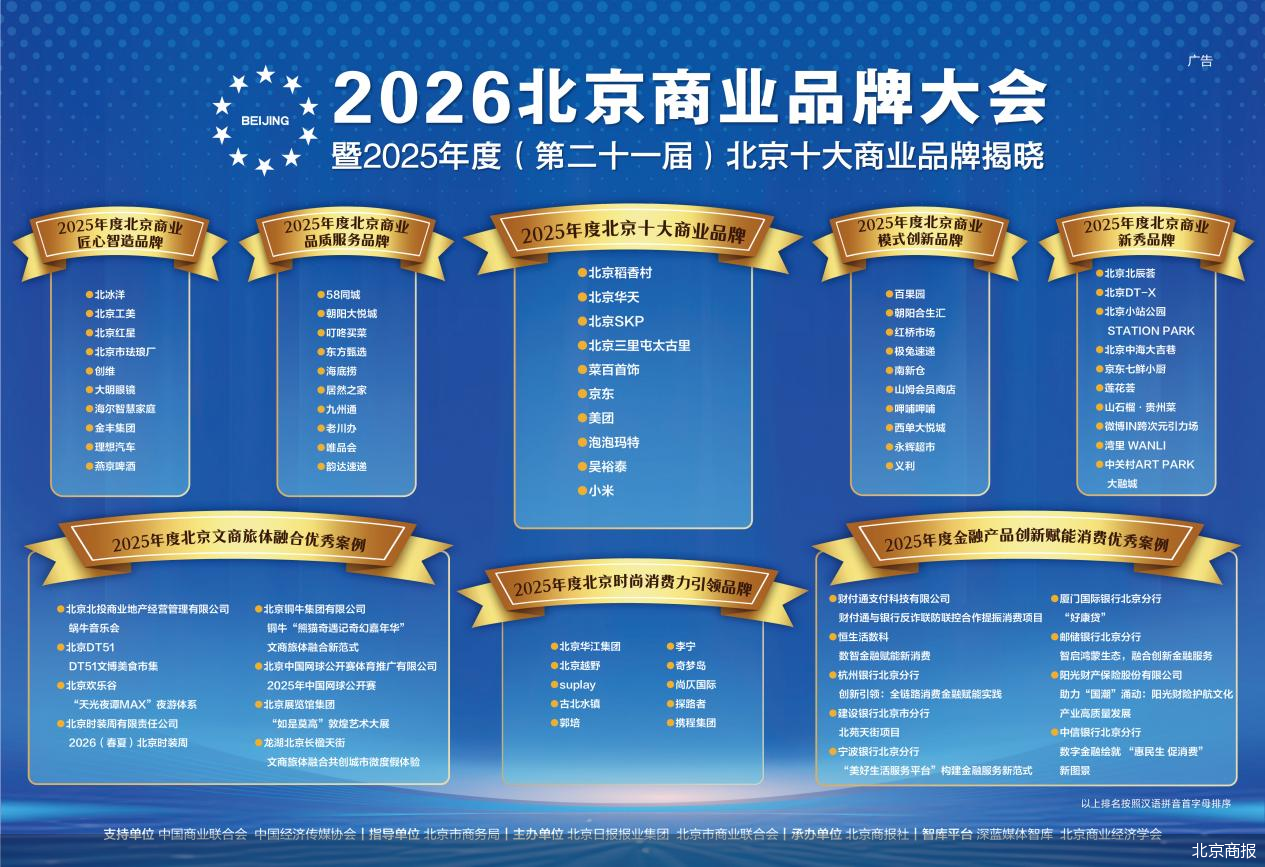
2025年度金融产品创新赋能消费优秀案例揭晓
Bei Jing Shang Bao· 2026-01-16 08:58
Group 1 - The 2026 Beijing Commercial Brand Conference and the announcement of the 2025 Top Ten Commercial Brands took place in Beijing, focusing on the theme "New Demand, New Supply" [1] - The event was guided by the Beijing Municipal Bureau of Commerce and co-hosted by the Beijing Daily Media Group and the Beijing Commercial Association, highlighting the highest level of commercial brands in Beijing [1] Group 2 - The consumer market is undergoing continuous transformation and upgrading, with finance playing a crucial role by innovating products and service models to meet new consumer demands [3] - Financial innovations are effectively releasing consumption potential, enhancing payment convenience, and expanding consumer credit scenarios, thereby injecting strong momentum into the real economy [3] Group 3 - The annual special list "Outstanding Cases of Financial Product Innovation Empowering Consumption" was revealed, featuring various financial institutions and their innovative projects aimed at boosting consumption [5] - Notable projects include: - WeChat Pay's collaboration with banks on fraud prevention to boost consumption - Hangzhou Bank's full-chain consumer finance empowerment - Construction Bank's North Garden Street project - Ningbo Bank's "Beautiful Life Service Platform" - Xiamen International Bank's "Good Loan" - Postal Savings Bank's innovative financial services - Sunshine Property Insurance's support for the cultural industry - Citic Bank's digital finance initiatives [5][7]



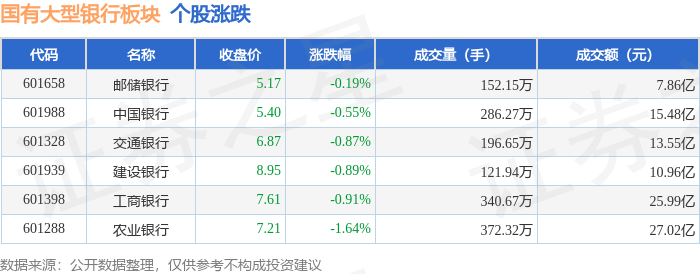
国有大型银行板块1月16日跌1.08%,农业银行领跌,主力资金净流入1.46亿元
Zheng Xing Xing Ye Ri Bao· 2026-01-16 08:55
Market Performance - The state-owned large bank sector declined by 1.08% compared to the previous trading day, with Agricultural Bank leading the decline [1] - The Shanghai Composite Index closed at 4101.91, down 0.26%, while the Shenzhen Component Index closed at 14281.08, down 0.18% [1] Individual Bank Performance - Postal Savings Bank closed at 5.17, down 0.19% with a trading volume of 1.52 million shares and a transaction value of 7.86 billion [1] - Bank of China closed at 5.40, down 0.55% with a trading volume of 2.86 million shares and a transaction value of 15.48 billion [1] - Bank of Communications closed at 6.87, down 0.87% with a trading volume of 1.97 million shares and a transaction value of 13.55 billion [1] - China Construction Bank closed at 8.95, down 0.89% with a trading volume of 1.22 million shares and a transaction value of 10.96 billion [1] - Industrial and Commercial Bank closed at 7.61, down 0.91% with a trading volume of 3.41 million shares and a transaction value of 25.99 billion [1] - Agricultural Bank closed at 7.21, down 1.64% with a trading volume of 3.72 million shares and a transaction value of 27.02 billion [1] Fund Flow Analysis - The state-owned large bank sector saw a net inflow of 146 million from institutional investors, while retail investors contributed a net inflow of 123 million [1] - The sector experienced a net outflow of 269 million from speculative funds [1] Detailed Fund Flow for Individual Banks - Bank of Communications had a net inflow of 172 million from institutional investors, while speculative funds saw a net outflow of 67.34 million [2] - Industrial and Commercial Bank had a net inflow of 73.01 million from institutional investors, with a significant net outflow of 363 million from speculative funds [2] - Postal Savings Bank had a net inflow of 65.23 million from institutional investors, while speculative funds had a net inflow of 37.30 million [2] - Bank of China had a net inflow of 6.76 million from institutional investors, with speculative funds contributing a net inflow of 43.81 million [2] - China Construction Bank experienced a net outflow of 18.52 million from institutional investors, while speculative funds had a net inflow of 66.99 million [2] - Agricultural Bank had a net outflow of 153 million from institutional investors, with a small net inflow of 13.28 million from speculative funds [2]


银行行业:2025年12月金融数据点评:企业中长贷边际修复,关注政策成效释放
Yin He Zheng Quan· 2026-01-16 03:11
Investment Rating - The report maintains a "Recommended" rating for the banking industry [1] Core Insights - The banking sector is experiencing a marginal recovery in medium to long-term loans, with a focus on the effectiveness of policy measures being released [1] - Social financing (社融) has shown a year-on-year decrease, with a month-on-month decline in growth rate. In December, new social financing amounted to 2.21 trillion yuan, a year-on-year decrease of 645.7 billion yuan [5] - The growth of RMB loans and corporate bonds has made a significant positive contribution to social financing increment, with RMB loans increasing by 975.7 billion yuan in December, a year-on-year increase of 135.5 billion yuan [5] - Corporate loans have shown a notable increase, with a total increase of 1.1 trillion yuan in December, a year-on-year increase of 580 billion yuan, indicating a marginal recovery in financing demand from the real economy [5] - The M2 growth rate has risen, with M1 and M2 increasing by 3.8% and 8.5% year-on-year, respectively [5] - The report suggests that the government bond's contribution to social financing has weakened towards the end of the year, while RMB credit shows signs of marginal improvement, primarily supported by corporate loans [5] Summary by Sections Social Financing - In December, the total social financing stock increased by 8.3% year-on-year, with a month-on-month decline of 0.2 percentage points [5] - The structure of corporate loans has improved, with medium to long-term loans increasing by 330 billion yuan and short-term loans by 370 billion yuan [5] Loan Data - As of the end of December, the balance of RMB loans from financial institutions increased by 6.4% year-on-year, remaining stable compared to the previous month [5] - The demand for loans from the household sector remains weak, with a decrease of 916 billion yuan in December, a year-on-year decrease of 4.416 trillion yuan [5] Investment Recommendations - The report emphasizes the continued attractiveness of the banking sector's dividend value, recommending specific banks such as Industrial and Commercial Bank of China, Agricultural Bank of China, and others [5]


并购票据机制优化月余 多家银行助力业务落地
Zhong Guo Zheng Quan Bao· 2026-01-15 21:11
Core Viewpoint - The optimization of the merger note mechanism enhances market attractiveness and serves as a catalyst for structural adjustments in the real economy, with banks actively facilitating merger note projects following the new regulations [1][2]. Group 1: Mechanism Optimization - The highlights of the merger note mechanism optimization include expanded scope and improved efficiency, allowing funds to be used more flexibly for transaction payments and replacing bridge financing, significantly reducing liquidity pressure on enterprises [2]. - The notification prioritizes support for traditional advantageous industries' transformation, strategic emerging industries, and future industrial layout mergers, aligning with the macro guidance for resource allocation optimization [2]. - The optimization of the registration mechanism significantly shortens the cycle from project initiation to fund availability, addressing the previous issue of slow fund availability compared to transaction pace [2]. Group 2: Bank Involvement - Since the notification was released, multiple banks have facilitated the successful issuance of merger notes, including a record financing scale of 5 billion yuan for China Minmetals Corporation's mid-term notes [3]. - Banks play a crucial role in the issuance process, acting as underwriters and book managers, leveraging interbank market mechanisms to provide information disclosure, organize transactions, and support liquidity [3][4]. - The involvement in merger note projects allows banks to enhance their income structure through underwriting fees, deepen client relationships, and promote their investment banking transformation [4]. Group 3: Comprehensive Service for Mergers - In addition to merger notes, merger loans are also vital tools for banks in providing merger financing services, with larger state-owned enterprises preferring merger notes to reduce financial costs [5]. - Merger loans are favored by small and medium-sized enterprises for their flexibility, while merger notes require higher information transparency due to public disclosure [5]. - A combination of merger loans and merger notes can improve the accessibility and matching of financing for enterprises, addressing both short-term bridge funding needs and long-term cost reduction [5].

中国邮政储蓄银行股份有限公司关于董事任职资格获国家金融监督管理总局核准的公告
Shang Hai Zheng Quan Bao· 2026-01-15 19:14
证券代码:601658 证券简称:邮储银行 公告编号:临2026-002 中国邮政储蓄银行股份有限公司 本行董事会对浦永灏先生的加入表示欢迎。 特此公告。 中国邮政储蓄银行股份有限公司董事会 二〇二六年一月十五日 中国邮政储蓄银行股份有限公司董事会及全体董事保证本公告内容不存在任何虚假记载、误导性陈述或 者重大遗漏,并对其内容的真实性、准确性和完整性承担法律责任。 中国邮政储蓄银行股份有限公司(以下简称本行)2024年年度股东大会审议通过了选举浦永灏先生为本 行独立非执行董事的议案。近日,本行收到《国家金融监督管理总局关于浦永灏邮储银行独立董事任职 资格的批复》(金复〔2026〕27号),国家金融监督管理总局已核准浦永灏先生的任职资格。 根据相关规定,浦永灏先生自2026年1月13日起就任本行独立非执行董事,任期三年。同时,浦永灏先 生担任本行董事会战略规划委员会委员、董事会风险管理委员会委员、董事会社会责任与消费者权益保 护委员会委员。 浦永灏先生的简历请见本行刊载于上海证券交易所网站(www.sse.com.cn)的《中国邮政储蓄银行股份 有限公司2024年年度股东大会会议资料》。截至本公告日,除浦永灏先 ...
银行今十条:央行明确2026年降准降息仍有空间;梁衍波拟任青岛农商行董事长;凌晨点外卖触发银行卡风控,四川农商行回应...
Jin Rong Jie· 2026-01-15 12:35
Monetary Policy - The People's Bank of China (PBOC) confirmed that there is still room for interest rate cuts and reserve requirement ratio (RRR) reductions in 2026, maintaining a moderately accommodative monetary policy [1] - On January 19, 2026, the PBOC will lower the re-lending and re-discount rates by 0.25 percentage points, with new rates set at 0.95%, 1.15%, and 1.25% for 3-month, 6-month, and 1-year re-lending respectively [1] Liquidity Injection - The PBOC conducted a 900 billion yuan reverse repo operation on January 15, 2026, resulting in a net injection of 300 billion yuan, marking the fifth consecutive month of increased reverse repo operations [2] - This action is part of an ongoing effort to maintain adequate liquidity in the market ahead of the Spring Festival [2] Housing Loan Rates - Starting January 1, 2026, the national housing provident fund loan rates were adjusted to 2.6% for first homes and 3.075% for second homes, nearing historical lows [3] - Future adjustments to these rates will depend on the macroeconomic environment and the recovery of the real estate market [3] Deposit Market Trends - Short-term large-denomination time deposit rates have declined, with some banks offering rates that have entered the "0" range, reducing their attractiveness compared to regular fixed deposits [4] - This trend reflects the ongoing marketization of deposit rates and is influenced by the overall monetary policy environment [4] Wealth Management Industry - As of December 2025, 14 leading wealth management companies reported a combined scale of 25.41 trillion yuan, showing a year-on-year growth of approximately 13.3% despite a slight decline from the peak in November [5] - The overall wealth management industry reached a peak of nearly 34 trillion yuan in November 2025, marking a significant increase of over 4 trillion yuan since the beginning of the year [5] Bank Dividends - In early 2026, three banks distributed nearly 300 billion yuan in dividends, indicating a faster pace of dividend distribution compared to previous years [6] - This trend reflects the banks' operational stability and provides tangible returns to shareholders, boosting market confidence [6] Payment Services - Visa announced that Chinese cardholders can now link their Visa cards to Apple Pay, with eight banks initially supporting this service [7] - This development enhances the convenience of cross-border payments for domestic cardholders and aligns with the global trend of contactless transactions [7] Leadership Changes - Liang Yanbo has been nominated as the candidate for the chairman of Qingdao Rural Commercial Bank, pending approval from the shareholders' meeting [9] - Liang has extensive experience within the Shandong rural credit system, having held various leadership positions [9] Banking Operations - Sichuan Rural Commercial Bank addressed concerns regarding card transaction limits that triggered risk controls, clarifying that users can adjust these limits through mobile banking or at bank counters [10] - This response aims to alleviate customer concerns and streamline the process for adjusting transaction limits [10] Global Economic Outlook - The World Bank reported that global economic resilience has exceeded expectations, but the income gap between rich and poor countries continues to widen [11] - The projected growth rate for per capita income in developing economies is 3% for 2026, which is lower than the average growth rate from 2000 to 2019 [11]

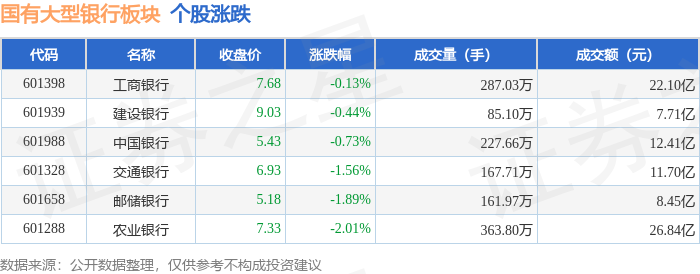
国有大型银行板块1月15日跌1.11%,农业银行领跌,主力资金净流出1.59亿元
Zheng Xing Xing Ye Ri Bao· 2026-01-15 08:59
Group 1 - The core viewpoint of the news is that the state-owned large bank sector experienced a decline of 1.11% on January 15, with Agricultural Bank leading the drop [1] - The Shanghai Composite Index closed at 4112.6, down 0.33%, while the Shenzhen Component Index rose by 0.41% to 14306.73 [1] - The trading performance of individual state-owned banks showed varying results, with Agricultural Bank falling by 2.01% to a closing price of 7.33 [1] Group 2 - The net outflow of main funds from the state-owned large bank sector was 159 million yuan, while retail investors saw a net inflow of 242 million yuan [1] - The detailed fund flow data indicated that Industrial and Commercial Bank had a main fund net inflow of 346 million yuan, while Agricultural Bank had a significant main fund net outflow of 462 million yuan [2] - The retail investor net inflow for Agricultural Bank was 302 million yuan, indicating strong retail interest despite the overall sector decline [2]
邮储银行(01658):浦永灏担任独立非执行董事的任职资格获核准
智通财经网· 2026-01-15 08:57
Core Viewpoint - Postal Savings Bank of China (01658) has received approval from the National Financial Regulatory Administration for the appointment of Mr. Pu Yonghao as an independent non-executive director, effective January 13, 2026, for a term of three years [1] Group 1 - Mr. Pu Yonghao will also serve as a member of the bank's Board Strategic Planning Committee [1] - He will be a member of the Board Risk Management Committee [1] - Additionally, he will be part of the Board Social Responsibility and Consumer Rights Protection Committee [1]