QILU BANK(601665)

Search documents
银行业周报:银行板块整体下行-20250922
Bank of China Securities· 2025-09-22 08:40
Investment Rating - The report assigns an "Outperform" rating to the banking sector [1] Core Insights - The banking sector experienced a decline of 4.21% this week, marking the lowest performance across all industries [1][14] - Year-to-date, the banking sector has seen a growth of 3.30%, ranking 26th among all industries [1] - The report highlights investment opportunities in China Merchants Bank, Agricultural Bank of China, and Jiangsu Bank [1] Summary by Sections Banking Sector and Stock Performance - The A-share banking index fell by 4.09%, underperforming the Wind All A index by 3.91 percentage points [13] - Among 42 listed banks, only Qilu Bank saw an increase in stock price this week [2][17] - The average price-to-book (P/B) ratios for different types of banks are as follows: state-owned banks at 0.70X, joint-stock banks at 0.54X, city commercial banks at 0.63X, and rural commercial banks at 0.59X [2][17] Funding Price Situation - The People's Bank of China conducted a significant reverse repo operation, injecting 18,268 billion yuan into the market [3][29] - The overnight SHIBOR rate increased to 1.46%, up by 9 basis points from last week [3][32] - The average issuance rate for interbank certificates of deposit rose to 1.64%, an increase of 1 basis point [6][40] Bond Market Situation - Total bond market financing reached 23,465.1 billion yuan, with net financing of 8,512.8 billion yuan, an increase of 7,050.0 billion yuan from the previous week [4][45] - The issuance of financial bonds increased by 1,031.0 billion yuan, while the issuance of government bonds decreased [4][46] - The yield on 10-year government bonds rose to 1.88%, while the 1-year yield fell to 1.39% [5][50] Interbank Market Review - The interbank repo overnight rate (R001) increased to 1.50%, up by 10 basis points [3][32] - The trading volume for the week was 31.39 trillion yuan, a decrease of 1.74 trillion yuan from the previous week [3][32] Important News and Announcements - The report includes various charts and data visualizations that illustrate the performance of the banking sector and market conditions [12][18]


银行业周报:14天逆回购操作调整,促消费政策再加码-20250922
Yin He Zheng Quan· 2025-09-22 06:14
Investment Rating - The report maintains a "Recommended" rating for the banking sector [1][39]. Core Insights - The banking sector underperformed the market, with a decline of 4.21% compared to a 0.44% drop in the CSI 300 index. State-owned banks, joint-stock banks, city commercial banks, and rural commercial banks saw declines of 4.43%, 4.48%, 3.61%, and 3.54% respectively [3][13]. - The People's Bank of China (PBOC) adjusted the 14-day reverse repurchase operation to a fixed quantity and interest rate bidding, enhancing liquidity management and emphasizing the 7-day OMO rate as the core policy rate. This change is expected to benefit larger state-owned banks more than smaller banks [3][5][6]. - A new set of policies aimed at boosting consumption has been introduced, focusing on enhancing service consumption platforms, improving service quality, and increasing financial support for consumption-related sectors. This is expected to stimulate retail credit growth [11][12]. Summary by Sections Latest Research Insights - The PBOC's adjustment of the 14-day reverse repurchase operation aims to optimize liquidity management and reinforce the 7-day OMO policy rate [5][6]. Weekly Market Performance - The banking sector's performance was notably weaker than the broader market, with significant declines across various types of banks [3][13]. Valuation of the Sector and Listed Companies - As of September 19, 2025, the banking sector's price-to-book (PB) ratio stands at 0.67, indicating a 37.43% discount compared to the overall A-share market [29][35]. Investment Recommendations - The report suggests that the adjustments in reverse repurchase operations and the new consumption policies will lead to improved fundamentals for banks, with a potential turning point in mid-term performance. Specific banks recommended for investment include Industrial and Commercial Bank of China, Agricultural Bank of China, Postal Savings Bank of China, Jiangsu Bank, Hangzhou Bank, and China Merchants Bank [39][40].

浙商早知道-20250922





ZHESHANG SECURITIES· 2025-09-21 23:30
Group 1: Key Recommendations - The report highlights Jiangbolong (301308) as a leading player in the full matrix storage industry, driven by "main control expansion + enterprise-level breakthroughs" [3] - The recommendation logic emphasizes the company's continuous breakthroughs and growth in the enterprise storage segment, with expected revenue growth rates of 41.09%, 26.39%, and 23.65% from 2025 to 2027 [3] - The report also identifies Stik (300806) as a leader in functional coating composite materials, with a growth inflection point approaching, supported by a significant increase in electronic-grade adhesive material demand [4] Group 2: Financial Projections - Jiangbolong's projected revenues for 2025-2027 are 24,639.91 million, 31,141.96 million, and 38,506.08 million yuan, with net profits expected to reach 843.17 million, 1,491.97 million, and 2,166.77 million yuan respectively [3] - Stik's projected revenues for the same period are 3,405.54 million, 4,540.38 million, and 5,834.50 million yuan, with net profits forecasted at 102.45 million, 287.35 million, and 464.63 million yuan [4] Group 3: Market Insights - The banking sector report indicates that the recent decline in bank stocks, down 7.3% from July 1 to September 19, 2025, is primarily due to increased risk appetite and liquidity withdrawal [5] - The report suggests that as risk-free interest rates decline and risk appetite stabilizes, the pressure on bank stock outflows is expected to ease, potentially opening up absolute return opportunities [5] Group 4: Catalysts and Drivers - For Jiangbolong, the key catalyst is the increase in storage prices, which is expected to drive revenue growth [3] - For Stik, the demand surge for OCA (Optically Clear Adhesive) in end products is identified as a significant growth driver [4] - In the banking sector, the anticipated decline in risk-free interest rates and stabilization of risk appetite are seen as crucial factors for recovery [5]
银行业周度追踪2025年第37周:银行股调整后股东增持加速-20250922
Changjiang Securities· 2025-09-21 23:30
Investment Rating - The report maintains a "Positive" investment rating for the banking sector [11] Core Insights - Recent adjustments in bank stocks have led to accelerated share buybacks by state-owned shareholders and management, indicating strong recognition of investment value [2][6] - The systematic increase in holdings by state-owned shareholders reflects a demand to optimize financial equity layouts amid asset scarcity, highlighting the core advantages of low valuations, stable profits, and dividends in bank stocks [7][41] - The report emphasizes the long-term investment value of regional leading city commercial banks, particularly after two rounds of debt restructuring [7][41] Summary by Sections Shareholder Activity - In the past week, banks such as Qingdao Bank, Nanjing Bank, and Chengdu Bank have disclosed progress in share buybacks by state-owned shareholders, showcasing their confidence in investment value [2][6] - Nanjing Bank has seen its state-owned shareholder, Nanjing High-tech, increase its stake by 1.05%, bringing its total holding to 9.99% [6][41] - Other banks, including Suzhou Bank and Qingdao Bank, have also reported significant buyback plans, with Suzhou Bank's shareholders increasing their holdings by 856 million yuan earlier this year [6][41] Market Performance - The banking index has experienced a cumulative decline of 4.1% this week, underperforming the CSI 300 index by 3.6% and the ChiNext index by 6.4% [9][20] - Despite the recent downturn, the long-term investment logic remains solid, with individual stocks like Qilu Bank showing resilience due to management buybacks [9][20] Dividend and Earnings Outlook - The report notes that the expected dividend yield for leading city commercial banks has risen to around 5%, with specific banks like Jiangsu Bank and Chengdu Bank reaching yields of 5.5% [7][8] - The stability of the banking sector's fundamentals is highlighted, with expectations for net interest income to maintain stable growth despite market fluctuations [8][40] - Mid-term dividends are set to commence, with several banks planning to distribute dividends in the fourth quarter, creating an attractive entry point for absolute return funds [8][40] Valuation and Investment Opportunities - The report suggests that the recent valuation adjustments have created significant investment opportunities in bank stocks, particularly for those focusing on dividend yields [7][44] - The ongoing adjustments in the bond market and the anticipated stabilization of loan interest rates are expected to support the banks' revenue streams [8][44]
银行“二永债”赎回潮来袭
Bei Jing Shang Bao· 2025-09-21 16:03
Core Viewpoint - The recent trend of banks redeeming perpetual bonds and subordinated debt is driven by the need to optimize capital structure, reduce financing costs, and comply with regulatory requirements during a declining interest rate environment [1][3][4]. Group 1: Redemption Activities - Multiple banks, including China Construction Bank, CITIC Bank, and Ningbo Bank, have announced full redemptions of their 2020-issued perpetual bonds, with amounts ranging from tens of billions to hundreds of billions [1][3]. - As of September 21, 2023, the total redemption scale of bank perpetual bonds has reached 729.28 billion yuan this year, with a year-on-year increase of over 180% compared to last year's total of 1.11 trillion yuan [3][4]. Group 2: Drivers Behind Redemption - The primary drivers for the redemption of old bonds include the current macroeconomic environment of declining interest rates, allowing banks to replace high-cost debt with lower-cost alternatives [4][6]. - Regulatory requirements, particularly for globally systemically important banks, necessitate maintaining a total loss-absorbing capacity (TLAC) risk-weighted ratio of no less than 16%, prompting banks to optimize their capital structure through debt replacement [4][7]. Group 3: Capital Structure Optimization - New subordinated debt has a higher proportion counted towards capital, which can quickly enhance banks' Tier 2 capital and improve key regulatory indicators like capital adequacy ratios [6][7]. - The efficiency of old subordinated debt diminishes after five years, leading banks to redeem these bonds to maintain adequate capital buffers and comply with new regulatory standards [6][7]. Group 4: Future Outlook - As more existing capital instruments approach their redemption windows, the pace of replacing perpetual bonds is expected to accelerate, driven by stricter counter-cyclical capital regulations [7]. - If the macroeconomic interest rate trend remains downward, banks will likely continue to benefit from cost advantages in issuing new bonds, further incentivizing the redemption of old debt [7].



本周聚焦:三阶段视角:银行资产质量及拨备计提力度如何?
GOLDEN SUN SECURITIES· 2025-09-21 10:34
Investment Rating - The report maintains a positive outlook on the banking sector, suggesting potential investment opportunities due to favorable policy catalysts and improving fundamentals in certain banks [12]. Core Insights - The report highlights the adequacy of loan loss provisions among listed banks, with a provision coverage ratio of 70.8% for Stage 3 loans, indicating limited future impact on profits [2][12]. - It emphasizes the improvement in asset quality, particularly in Stage 3 loans, with notable reductions in the proportion of such loans for several banks compared to the end of Q4 2024 [1][2]. - The report suggests a focus on banks with positive fundamental changes and continuous improvement in financial statements, recommending specific banks for investment [12]. Summary by Sections 1. Loan Quality and Provisioning - The proportion of Stage 3 loans is relatively low for banks like Chengdu Bank (0.66%) and Ningbo Bank (0.76) [1]. - Significant improvements in Stage 3 loan ratios were observed for Chongqing Bank (-61bp) and Guiyang Bank (-48bp) compared to Q4 2024 [1]. - The provision coverage for Stage 3 loans is high, with leading banks like Qingnong Bank (4.35%) and Yunan Bank (4.16%) showing strong provisioning ratios [2]. 2. Financial Assets - The proportion of Stage 3 financial assets is low, with most banks not exceeding 0.05%, indicating manageable asset quality pressure [4]. - The report notes that the provision coverage for financial investments is also robust, with Zhejiang Bank (3.16%) and Qingdao Bank (2.85%) leading in provisioning ratios [8]. 3. Sector Outlook - The report anticipates that expansionary policies aimed at stabilizing the economy will benefit the banking sector, with a focus on banks like Ningbo Bank and Jiangsu Bank for potential investment [12]. - It highlights the ongoing economic recovery and the potential for interest rate cuts, suggesting a sustained dividend strategy for certain banks [12].





城商行板块9月19日涨0.39%,齐鲁银行领涨,主力资金净流入2.68亿元
Zheng Xing Xing Ye Ri Bao· 2025-09-19 08:54
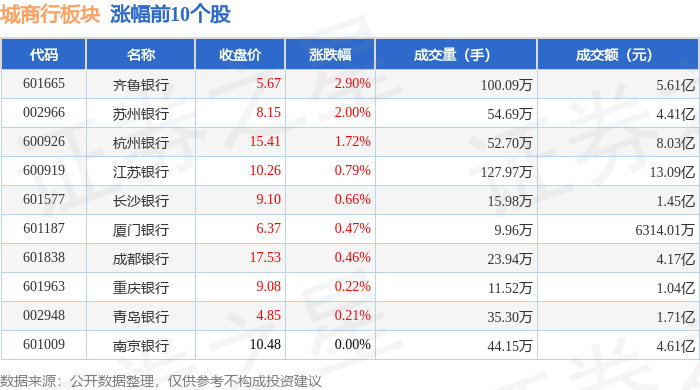
Market Performance - The city commercial bank sector increased by 0.39% on September 19, with Qilu Bank leading the gains [1] - The Shanghai Composite Index closed at 3820.09, down 0.3%, while the Shenzhen Component Index closed at 13070.86, down 0.04% [1] Individual Stock Performance - Qilu Bank's closing price was 5.67, up 2.90%, with a trading volume of 1,000,900 shares and a transaction value of 561 million [1] - Suzhou Bank closed at 8.15, up 2.00%, with a trading volume of 546,900 shares and a transaction value of 441 million [1] - Hangzhou Bank closed at 15.41, up 1.72%, with a trading volume of 527,000 shares and a transaction value of 803 million [1] - Jiangsu Bank closed at 10.26, up 0.79%, with a trading volume of 1,279,700 shares and a transaction value of 1.309 billion [1] - Other notable performances include: - Changsha Bank: 9.10, up 0.66% - Xiamen Bank: 6.37, up 0.47% - Chengdu Bank: 17.53, up 0.46% - Chongqing Bank: 9.08, up 0.22% - Qingdao Bank: 4.85, up 0.21% - Nanjing Bank: 10.48, unchanged [1] Capital Flow Analysis - The city commercial bank sector saw a net inflow of 268 million from institutional investors, while retail investors contributed a net inflow of 122 million [2] - The sector experienced a net outflow of 390 million from speculative funds [2] Individual Stock Capital Flow - Qilu Bank had a net inflow of 87.58 million from institutional investors, while it faced a net outflow of 69.65 million from speculative funds [3] - Ningbo Bank saw a net inflow of 65.53 million from institutional investors, with a net outflow of 71.36 million from speculative funds [3] - Suzhou Bank experienced a net inflow of 54.95 million from institutional investors, alongside a net outflow of 49.77 million from speculative funds [3] - Jiangsu Bank had a net inflow of 39.48 million from institutional investors, with a significant net outflow of 118 million from speculative funds [3]

多家银行被“加仓”,透露什么信号?
Jin Rong Shi Bao· 2025-09-19 02:19
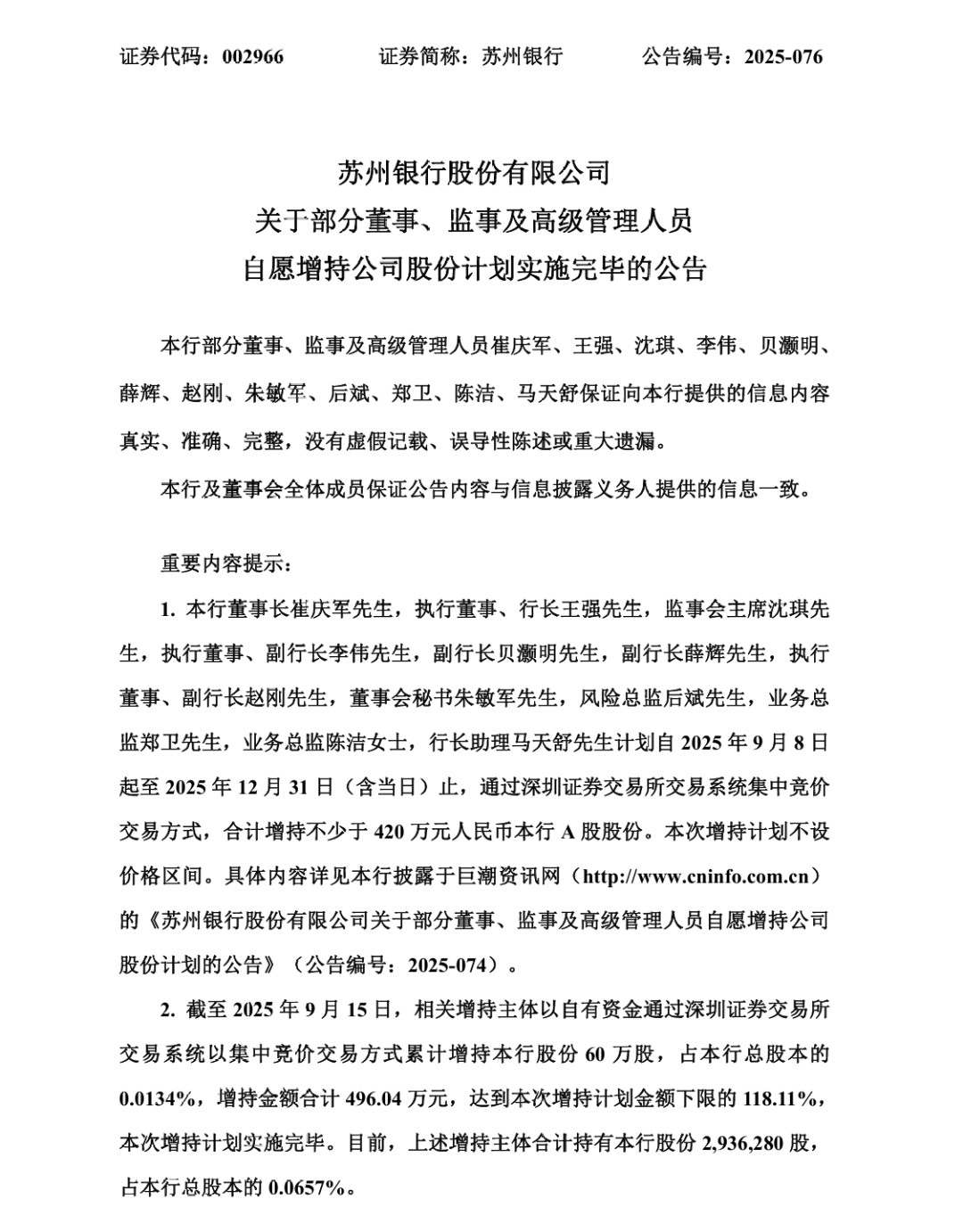
Core Viewpoint - Recent surge in bank stock purchases by executives and major shareholders indicates strong confidence in the banks' future value and strategic direction [1][8] Group 1: Executive and Major Shareholder Purchases - Suzhou Bank's executives, including the chairman and president, collectively purchased 600,000 shares, amounting to approximately 4.96 million yuan, representing 0.0134% of the total shares [2] - Qilu Bank announced a plan for its executives to voluntarily purchase at least 3.5 million yuan worth of shares between September 16, 2025, and December 31, 2025 [3] - Huaxia Bank's executives purchased 4.23 million shares for about 31.9 million yuan, reflecting a proactive approach to bolster confidence in the bank's value [4] Group 2: Major Shareholder Support - Everbright Bank's major shareholder increased its stake by 13.97 million shares, worth approximately 51.66 million yuan, representing 0.02% of the total shares [9] - Nanjing Bank's major shareholder's subsidiary acquired 56.78 million shares, increasing the total holding from 12.56% to 13.02% [9] - Chengdu Bank's major shareholders purchased a total of 9.66 million shares, with investments of approximately 87 million yuan and 79.59 million yuan respectively [9] Group 3: Market Implications - The concentrated buying activity from bank executives and major shareholders signals a positive outlook for the banking sector, potentially alleviating investor concerns regarding business models and asset quality [10] - The current low price-to-book ratios and high dividend yields of bank stocks make them attractive for long-term investment [10] - Analysts suggest that the shift from defensive to proactive market management reflects expectations of economic recovery and stable interest margins, enhancing the banks' valuation [10]
积极布局服务民营新路径,齐鲁银行多元塑造新优势
Qi Lu Wan Bao· 2025-09-18 07:11
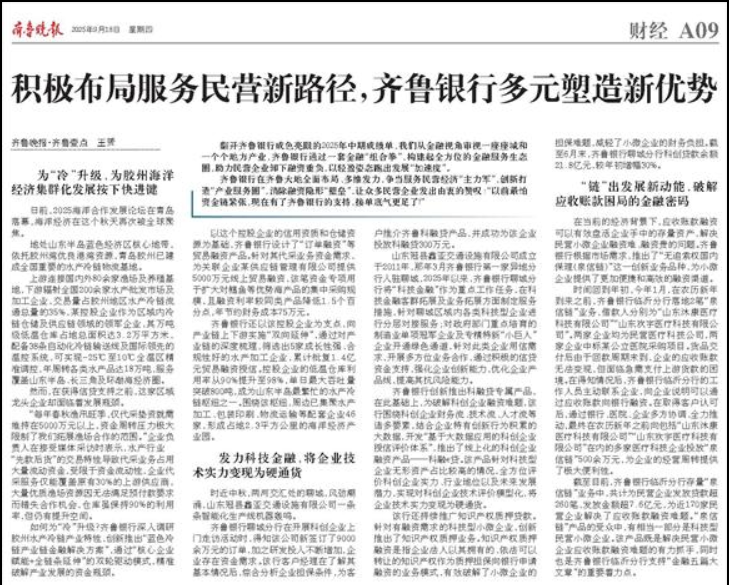
Group 1 - Qilu Bank has achieved impressive mid-year results for 2025, establishing a comprehensive financial service ecosystem to support private enterprises in overcoming financing burdens and accelerating development [1] - The bank aims to be a key player in serving the private economy by innovatively creating an "industrial service circle" to eliminate invisible financing barriers [1] - Many private enterprises express gratitude for Qilu Bank's support, stating that it has strengthened their confidence in securing orders [1] Group 2 - The 2025 Marine Cooperation Development Forum highlighted the focus on marine economy, with Jiaozhou Bay becoming a significant cold chain logistics base for aquatic products [3] - A leading cold chain enterprise in the region has a cold storage area of 32,000 square meters and can handle 180,000 tons of aquatic products annually, covering a wide market [3][4] - Before receiving credit support, this enterprise faced development bottlenecks due to high capital turnover pressure, which limited its ability to expand supplier relationships [4] Group 3 - Qilu Bank has introduced a "blue cold chain industry chain financial solution" to address funding bottlenecks in the cold chain industry, utilizing the creditworthiness of a leading enterprise [4] - The bank provided 50 million yuan in online trade financing to a supply chain management company, reducing financing costs by 750,000 yuan annually [4][5] - The utilization rate of the cold storage facility increased from 90% to 98%, and the maximum daily throughput exceeded 800 tons, establishing it as a busy cold chain hub [5] Group 4 - Qilu Bank is focusing on technology finance, having successfully provided 3 million yuan in financing to a transportation facility company that signed orders worth over 90 million yuan [6][7] - The bank has developed a credit evaluation system based on big data for technology enterprises, allowing for the monetization of their technological strengths [7] - As of June, the bank's technology loans balance reached 2.18 billion yuan, reflecting a 30% increase since the beginning of the year [7] Group 5 - Qilu Bank launched an innovative "non-recourse domestic factoring" product to help small and micro enterprises address financing challenges related to accounts receivable [8][9] - The bank facilitated over 76 million yuan in loans through the "泉信链" product, assisting nearly 170 private enterprises in overcoming accounts receivable financing difficulties [9]
齐鲁银行参加“金号角·金融集市”金融教育宣传活动
Qi Lu Wan Bao· 2025-09-18 06:40
Core Viewpoint - The event "Golden Horn · Financial Market" organized by Shandong financial regulatory authorities aims to enhance financial literacy and consumer protection among the public through various interactive activities and exhibitions [1][3]. Group 1: Consumer Protection Initiatives - Qilu Bank has integrated its "泉心消保" brand with local cultural elements to create a unique exhibition area, attracting widespread public participation [3]. - The exhibition features a theme board titled "Investment and Future," emphasizing the importance of rational investment and listing key points such as "Investment has risks" and "Choose legitimate channels" [5]. - A list of anti-money laundering reminders is provided, highlighting the need for public participation in combating money laundering [5]. Group 2: Financial Services for the Public - The bank showcases various measures aimed at assisting the elderly, including the establishment of a financial education base in collaboration with 41 senior universities, offering over 20 courses [9]. - Qilu Bank has launched more than 80 specialized products in inclusive finance, maintaining the leading position in the province for three consecutive years in terms of inclusive loan scale [9]. - The bank has introduced convenient social security services, including the first "same number card replacement" service in the province, significantly easing residents' daily lives [9]. Group 3: Financial Education and Engagement - An interactive game called "泉城寻'保'战" is designed to educate the public on financial rights, anti-money laundering, and other financial knowledge through an immersive experience [11]. - The bank combines financial education with fun activities, effectively enhancing the financial literacy of citizens while engaging them in enjoyable ways [11]. Group 4: Commitment to Community Service - Since its establishment 29 years ago, Qilu Bank has focused on serving urban and rural residents, small and medium-sized enterprises, and the local economy, continuously optimizing resource allocation [13]. - The bank is committed to enhancing consumer protection mechanisms and improving financial service levels, aiming to meet diverse financial needs of the public [13].