
CSCEC(601668)

Search documents
中国建筑材料 - 2025 年第三季度预览:更多价格企稳迹象,市场份额持续整合-China Construction_ Building Materials_ 3Q25 Preview_ More evidence of price stabilization, with continued market share consolidation
2025-10-15 03:14
Summary of Key Points from the Conference Call Industry Overview - The report focuses on the **Chinese building materials industry**, particularly companies like **Oriental Yuhong**, **Beijing New Building Materials (BNBM)**, **Vasen**, and **Skshu Paint** [1][5][43][47]. Core Insights - **Market Conditions**: Underlying demand remains weak, with a year-over-year decline in new builds and secondary property transactions. However, there is no significant sequential deterioration from the previous quarter [5][12]. - **Price Stabilization**: Pricing has stabilized across most product categories, with some sectors like waterproofing and gypsum board seeing mild price restoration. A 1-2% price increase was noted in the project channel and a 3-5% increase in the retail channel for waterproofing materials [5][9]. - **Competitive Landscape**: Competition remains intense, particularly in gypsum board and plastic pipes. However, top players are becoming more price disciplined, which has led to some price restoration efforts [5][9]. Company-Specific Highlights Oriental Yuhong - **Earnings Outlook**: Anticipated positive earnings inflection in 3Q25, with expected growth in membrane volume and overall volume growth. Projected earnings growth of +5% year-over-year [9][43]. - **Market Position**: As the largest producer of waterproofing materials in China, Yuhong is well-positioned to expand market share due to cost competitiveness and strong channel capabilities [43][44]. Beijing New Building Materials (BNBM) - **Revenue and Profitability**: Expected slight decline in revenue for 3Q25, but the company is optimistic about new product expansions in waterproofing and coatings, which are expected to drive earnings growth [47]. - **Market Leadership**: BNBM is the world's largest producer of gypsum boards, benefiting from rising renovation demand [47]. Vasen - **Growth Challenges**: Despite being a leading producer of plastic piping systems, Vasen faces earnings downside risks due to the property completion downcycle and competition. The company is rated as a "Sell" due to unfavorable risk-reward dynamics [51][54]. - **Market Strategy**: Focus on expanding market share and cross-selling new products, but concerns remain about profitability and competition [51][54]. Skshu Paint - **Performance Expectations**: Expected to deliver +5% year-over-year top-line growth in 3Q25, driven by better pricing and expansion in new retail channels [9][54]. - **Market Position**: As the largest local supplier of architectural paint, Skshu Paint is in a fragmented market but faces competition from stronger brands like Nippon Paint [54]. Financial Metrics and Projections - **EPS Revisions**: Minor revisions in EPS forecasts for Vasen and BNBM, with downward revisions for Yuhong and Skshu due to impairment losses. However, 2026E-27E EPS estimates for Yuhong and Skshu have been raised due to expected pricing restoration [7][10]. - **Target Prices**: Target prices for Yuhong, BNBM, Vasen, and Skshu have been adjusted based on the latest financial metrics and market conditions [8][39][45][52]. Risks and Considerations - **General Risks**: Key risks include weaker-than-expected construction activities, unexpected increases in raw material prices, and potential impairment losses related to receivables from developers [40][46][50]. - **Company-Specific Risks**: Each company faces unique risks, such as BNBM's reliance on paper prices and Vasen's exposure to the property market downturn [46][51]. Conclusion - The Chinese building materials industry is navigating a challenging environment with weak demand and competitive pressures. However, companies like Oriental Yuhong and BNBM are positioned to leverage their market leadership and product expansions to drive future growth, while Vasen and Skshu Paint face more significant challenges in maintaining profitability amidst competition and market conditions [1][5][43][47].



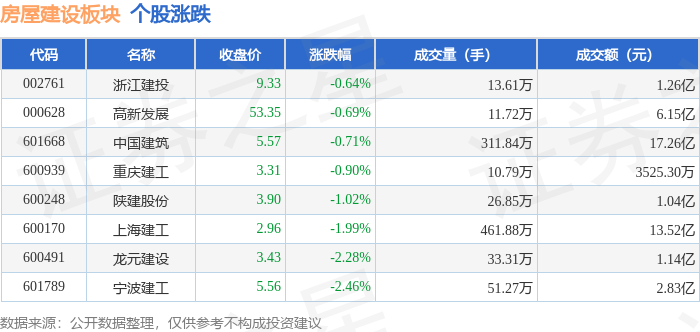
房屋建设板块10月13日跌0.9%,宁波建工领跌,主力资金净流出1.82亿元
Zheng Xing Xing Ye Ri Bao· 2025-10-13 12:45
Core Insights - The housing construction sector experienced a decline of 0.9% on October 13, with Ningbo Construction leading the drop [1] - The Shanghai Composite Index closed at 3889.5, down 0.19%, while the Shenzhen Component Index closed at 13231.47, down 0.93% [1] Sector Performance - The housing construction sector stocks showed mixed performance, with notable declines in several key companies: - Zhejiang Construction: closed at 9.33, down 0.64% - China State Construction: closed at 5.57, down 0.71% - Chongqing Construction: closed at 3.31, down 0.90% - Ningbo Construction: closed at 5.56, down 2.46% [1] - The total net outflow of funds in the housing construction sector was 1.82 billion yuan, with retail investors showing a net inflow of 2.09 billion yuan [1] Fund Flow Analysis - Major fund flows indicated: - Ningbo Construction: net inflow of 866.46 million yuan from major funds, but a net outflow of 2270.16 million yuan from retail investors [2] - China State Construction: net inflow of 777.58 million yuan from major funds, with a net outflow of 532.60 million yuan from retail investors [2] - High New Development: significant net outflow of 4788.17 million yuan from major funds, while retail investors had a net inflow of 2317.52 million yuan [2]


中美关税博弈再起,看好自主可控、内需基建及高景气细分方向
East Money Securities· 2025-10-13 08:37
Investment Rating - The report maintains a "stronger than the market" investment rating for the construction decoration industry [3]. Core Viewpoints - The report highlights the renewed US-China tariff conflict, emphasizing the potential benefits for domestic infrastructure and high-demand segments [14]. - It notes an increase in special bond net financing, with significant rapid deployment of special treasury funds, which supports investment stability [15]. Summary by Sections Investment Recommendations - Three main investment lines are recommended for the second half of 2025: 1. **Main Line One**: Focus on state-owned enterprises benefiting from national key projects, including low-valuation central enterprises and high-demand local state-owned enterprises. Recommended companies include China Railway Construction, China Railway, China Chemical, China Energy Engineering, China Communications Construction, and China State Construction. Attention is also drawn to China Power Construction and China Metallurgical Group [2]. 2. **Main Line Two**: Target high-demand segments driven by major strategic projects, with recommendations for companies like Gaozheng Minexplosion, Tiejian Heavy Industry, China Railway Industry, Yipuli, and Zhongyan Dadi, while keeping an eye on Tibet Tianlu and Wuxin Tunnel Equipment [2]. 3. **Main Line Three**: Invest in sectors empowered by AI, robotics, and semiconductors, recommending companies such as Roman Co., Hongrun Construction, Zhi Te New Materials, Honglu Steel Structure, and Metro Design [2][18]. Market Performance - The construction decoration index rose by 3.62% in the last week, outperforming the overall A-share index by 2.73 percentage points. Notable performers included Guan Zhong Ecological (+96.1%), Xinjiang Jiaojian (+28.9%), and Huajian Group (+25.4%) [13][26]. Financing and Policy Support - As of October 11, 2025, special bonds had a cumulative net financing of 3.19 trillion yuan, surpassing the same period in 2022 and significantly higher than 2023 and 2024. The issuance of special bonds has reached 84% of the annual target [15][17]. - The report indicates that the government is likely to enhance domestic demand stabilization policies in response to external demand fluctuations, benefiting infrastructure and water conservancy sectors [14]. Company Dynamics - Key company updates include significant project wins for China Railway Construction and China State Construction, with total contract values of 630 billion yuan and 62.2 billion yuan, respectively [34].





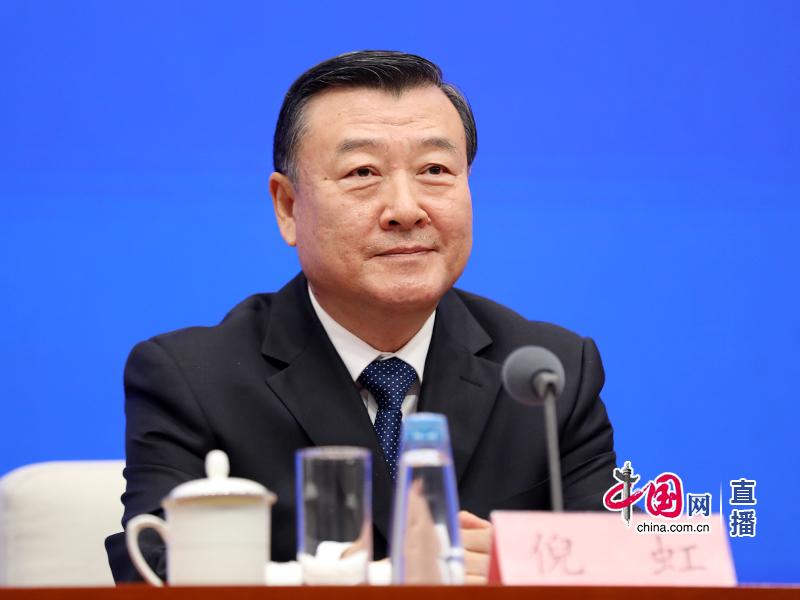
住建部部长倪虹答一财:“好房子”建设重点抓五个“好”
第一财经· 2025-10-11 08:38
Core Viewpoint - The article emphasizes the importance of "good houses" in the government's work report, highlighting the focus on building safe, comfortable, green, and smart housing as a priority for the housing and urban-rural development work in 2023 [3]. Group 1: Government Initiatives - The Ministry of Housing and Urban-Rural Development is focusing on five key areas: good standards, good design, good materials, good construction, and good maintenance to promote the concept of "good houses" during the 14th Five-Year Plan period [3][4]. - The "Residential Project Standards" implemented on May 1, 2023, set mandatory requirements for residential construction, including a minimum ceiling height of 3 meters and the installation of elevators in buildings with four or more floors [3]. Group 2: Industry Response - Various architectural firms and design units are actively researching housing needs, with nearly 3,000 proposals submitted for a national residential design competition, addressing both new constructions and renovations of old houses [4]. - The construction industry is shifting focus from speed and quantity to high quality, new technologies, and better services, with "good houses" becoming a key area of emphasis [5]. Group 3: Pilot Projects and Implementation - China State Construction Engineering Corporation has initiated the first batch of "good house" construction system pilot projects, with 88 projects included, covering a total construction area of 12.87 million square meters and involving over 65,000 households across 20 provinces [6]. - The "good house" construction system aims to ensure traceability and assessability at every stage, with a focus on customer satisfaction as the ultimate measure of success [6].

住建部部长倪虹答一财:“好房子”建设重点抓五个“好”
Di Yi Cai Jing· 2025-10-11 04:07
Core Viewpoint - The concept of "Good Houses" has been officially included in the government work report for the first time, emphasizing the importance of safety, comfort, sustainability, and intelligence in housing construction this year [1]. Group 1: Government Initiatives - The Ministry of Housing and Urban-Rural Development is focusing on five key areas: good standards, good design, good materials, good construction, and good maintenance to promote the construction of "Good Houses" during the 14th Five-Year Plan period [1]. - The "Residential Project Specification" implemented on May 1, 2023, sets mandatory requirements for residential construction, including a minimum ceiling height of 3 meters and the installation of elevators in buildings with four or more floors [1]. Group 2: Industry Response - Many construction companies and design units are actively researching housing needs, with over 30,000 survey responses collected to create a manual covering 16 categories and 262 key points for the construction of "Good Houses" [2]. - The China State Construction Engineering Corporation has launched the "Good House" branding and has initiated a pilot program with 88 projects, covering a total construction area of 12.87 million square meters, involving 1052 residential buildings and over 65,000 households across 20 provinces [6]. Group 3: Local Government Actions - Local governments are accelerating the exploration of practices related to "Good Houses" through standards, policies, demonstrations, and regulations, with Shanghai's recent guidelines focusing on various aspects of residential quality improvement [4][5].
东莞证券2025年四季度股票组合
Dongguan Securities· 2025-10-10 10:59
Investment Themes - Recommended stocks include Huaxin Cement, China State Construction, and Ningde Times in the cyclical sector[2] - In the consumer sector, recommended stocks include Hengrui Medicine and Shanxi Fenjiu[2] - In the power equipment and new energy vehicle sector, recommended stocks include Ningde Times and Goldwind Technology[2] - In the TMT sector, recommended stocks include Longi Green Energy and Luxshare Precision[2] Market Performance - As of September 30, 2025, the Shanghai Composite Index rose by 12.73%, the Shenzhen Component Index by 29.25%, and the ChiNext Index by 50.40%[4] - The average gain of the recommended stock portfolio was 33.11%, significantly outperforming the CSI 300 Index's gain of 17.90%[4] - Key outperformers included Huaxin Cement and Ningde Times, with quarterly gains exceeding 50%[4] Economic Outlook - The macroeconomic environment remains stable, with a focus on "appropriate easing" in monetary policy to support growth[4] - The manufacturing PMI showed signs of recovery but remained in contraction territory as of September[4] - The report anticipates continued inflow of foreign capital due to the Federal Reserve's interest rate cuts, enhancing the attractiveness of equity assets[4] Company Highlights - Huaxin Cement's projected EPS for 2025 is 1.30, with a PE ratio of 14.27[6] - China State Construction's projected EPS for 2025 is 1.16, with a PE ratio of 4.68[12] - China Rare Earth's projected EPS for 2025 is 0.34, with a PE ratio of 150.92[25] - Hengrui Medicine's projected EPS for 2025 is 1.26, with a PE ratio of 56.90[33]





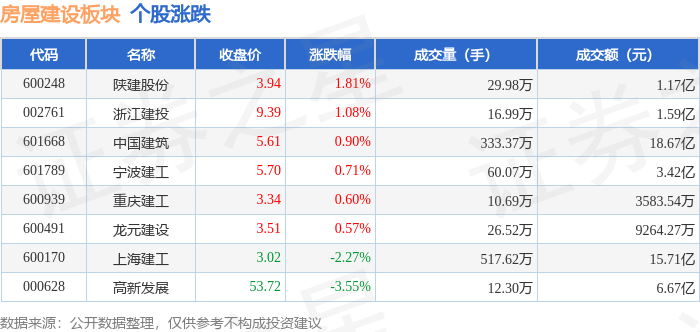
房屋建设板块10月10日涨0.5%,陕建股份领涨,主力资金净流出4209.77万元
Zheng Xing Xing Ye Ri Bao· 2025-10-10 08:51
Core Insights - The housing construction sector experienced a 0.5% increase on October 10, with Shaanxi Construction leading the gains [1] - The Shanghai Composite Index closed at 3897.03, down 0.94%, while the Shenzhen Component Index closed at 13355.42, down 2.7% [1] Sector Performance - Shaanxi Construction (600248) closed at 3.94, up 1.81% with a trading volume of 299,800 shares and a turnover of 117 million yuan [1] - Zhejiang Construction Investment (002761) closed at 68.6, up 1.08% with a trading volume of 169,900 shares and a turnover of 159 million yuan [1] - China State Construction (601668) closed at 5.61, up 0.90% with a trading volume of 3,333,700 shares and a turnover of 1.867 billion yuan [1] - Ningbo Construction (601789) closed at 5.70, up 0.71% with a trading volume of 600,700 shares and a turnover of 342 million yuan [1] - Other notable performances include Chongqing Construction (600939) up 0.60%, Longyuan Construction (600491) up 0.57%, while Shanghai Construction (600170) and Gaoxin Development (000628) saw declines of 2.27% and 3.55% respectively [1] Capital Flow Analysis - The housing construction sector saw a net outflow of 42.1 million yuan from institutional investors and a net outflow of 106 million yuan from speculative funds, while retail investors contributed a net inflow of 149 million yuan [1] - China State Construction had a net inflow of 12.9 million yuan from institutional investors, while experiencing a net outflow of 83.6 million yuan from speculative funds [2] - Shaanxi Construction saw a net inflow of 19.8 million yuan from institutional investors, but a net outflow of 15.5 million yuan from speculative funds [2] - High New Development (000628) experienced a significant net outflow of 55.4 million yuan from institutional investors, while retail investors contributed a net inflow of 49.6 million yuan [2]
驻中国建筑纪检监察组以能力提升促工作落实 深化研讨聚众智
Zhong Yang Ji Wei Guo Jia Jian Wei Wang Zhan· 2025-10-10 00:02
Core Insights - The article highlights the significant issues related to supply chain management within state-owned enterprises, particularly focusing on corruption and integrity risks in the construction industry [2][3]. Group 1: Supply Chain Management Challenges - A high percentage (80%) of cases handled in the first half of the year were related to supply chain issues, indicating a concentrated risk area for corruption [2]. - Supply chain management encompasses critical processes such as bidding, procurement, performance, and settlement, making it a focal point for integrity risks [2]. - Current supervision efforts are primarily reactive, with insufficient proactive measures to prevent issues before they arise [2][3]. Group 2: Recommendations for Improvement - There is a call for enhanced supervision of key personnel and a clear delineation of power boundaries to prevent corrupt practices [3]. - The establishment of a cross-departmental collaborative mechanism is suggested to create a comprehensive oversight framework for supply chain management [3]. - Emphasis is placed on integrating data analytics to improve the detection of issues within supply chain processes, addressing the challenge of information silos [2][3]. Group 3: Enhancing Oversight and Accountability - The need for a systematic approach to address corruption and misconduct is emphasized, with a focus on linking case investigations to broader systemic reforms [3][4]. - Strengthening the three-tiered supervision system (company discipline inspection committee, discipline inspectors, and grassroots supervisors) is proposed to enhance oversight capabilities [5]. - Continuous training and sharing of best practices among personnel involved in case handling are recommended to improve the quality of investigations [6].
大A的荣耀不再属于“性价比”投资者
虎嗅APP· 2025-10-09 23:56
Core Viewpoint - The article discusses the performance of deep value fund managers during different market conditions, highlighting their underperformance in the current bull market compared to growth-style fund managers, particularly in sectors like technology and innovation [4][20]. Group 1: Performance Comparison - In the past three years of bear markets, deep value fund managers performed relatively well, with many managing over 10 billion in assets [5]. - As of September 24, 2023, mainstream deep value fund managers like Xu Yan and Jiang Cheng had annual returns below 20%, while the average return of the CSI Active Equity Fund Index reached 34.11% [6][12]. - The article notes that deep value fund managers typically focus on low-valuation, stable companies, which leads to lower returns in bull markets but better performance in bear markets [14][19]. Group 2: Investment Philosophy - Deep value fund managers invest from an owner's perspective, focusing on long-term intrinsic value rather than short-term market fluctuations [16]. - They emphasize "quality and price," seeking high-quality companies that are undervalued due to market sentiment [17]. - Safety margins are crucial in their investment decisions, as they aim to protect against errors and downside risks [17][18]. Group 3: Market Trends and Strategies - The current bull market has favored growth-style funds, particularly those heavily invested in technology, with some achieving over 200% annual returns [7]. - Deep value fund managers often hold significant positions in traditional sectors like finance and real estate, which have underperformed in the current market [14][19]. - The article suggests that deep value funds should be considered for core portfolio allocations, especially for conservative investors [23][24]. Group 4: Selection Criteria - Not all low-valuation stocks represent deep value; some may belong to contrarian or cyclical strategies [29]. - Investors should focus on the stability of deep value fund managers' styles, as many have shifted towards growth or other strategies over time [36][38]. - The article advises that deep value funds can serve as a bottom-layer allocation in a diversified portfolio, balancing risk and return [24][26].






南昌北二环两大关键工程加速冲刺 “1 小时都市圈” 交通骨架构筑城市发展新格局
Zhong Guo Fa Zhan Wang· 2025-10-09 10:53
Core Insights - Nanchang is rapidly transforming under the national strategy for the rise of central China and the Poyang Lake ecological economic zone, with significant transportation infrastructure projects underway to enhance urban connectivity and alleviate traffic pressure [1][3]. Group 1: Strategic Importance - The North Second Ring Road project is a crucial component of Nanchang's urban transportation planning, aimed at addressing increasing traffic congestion due to population growth and vehicle ownership [2][3]. - The project will facilitate the formation of a "1-hour urban circle," enhancing regional connectivity and supporting the coordinated development of various districts [3]. Group 2: Project Overview - The North Second Ring project includes two major core projects with a total investment exceeding 2.3 billion yuan, covering various construction aspects such as roads, bridges, drainage, landscaping, lighting, and intelligent monitoring [4]. - The North Second Ring Phase II and the Xiaozhuang Lake Bridge are essential links in completing the second ring road, connecting key highways and improving traffic flow [5][6]. Group 3: Construction Progress - Multiple construction zones are advancing simultaneously, with significant milestones achieved in various sections, including the completion of foundational work and the initiation of structural construction [8][9][11][12][13]. - The project has adopted innovative construction techniques to enhance efficiency and minimize disruption to existing traffic [16][18]. Group 4: Collaborative Efforts - The successful advancement of the North Second Ring project relies on the collaboration of various stakeholders, including construction, design, and supervision teams, ensuring high standards and effective resource management [20]. Group 5: Future Prospects - Upon completion, the North Second Ring project is expected to significantly alleviate traffic congestion, promote urban expansion, and enhance the quality of life for residents through improved infrastructure and services [21].
