
CHINA TELECOM(601728)

Search documents
通信行业2025年三季报业绩前瞻:算力景气,红利稳健,战力将起
ZHESHANG SECURITIES· 2025-10-11 07:44
Investment Rating - The industry investment rating is "Positive" [4][19] Core Views - The telecommunications industry is benefiting from the ongoing Digital China strategy, leading to stable growth in overall business for operators, with innovative services experiencing higher growth rates and increasing proportions [2] - The AI computing power sector continues to thrive globally, with significant investments from major companies, indicating a rapid growth period for domestic computing power targets [4] - New growth drivers such as satellite internet are injecting new momentum into the industry, providing additional performance elasticity [4] Summary by Relevant Sections Telecom Operators - China Mobile is expected to report Q3 revenue of CNY 245.1 billion to CNY 246 billion, a year-on-year growth of 0.2% to 0.5%, with net profit of CNY 32.1 billion to CNY 32.4 billion, a growth of 4.6% to 5.6% [2][16] - China Telecom is projected to achieve Q3 revenue of CNY 127.2 billion to CNY 128.5 billion, a growth of 1% to 2%, with net profit of CNY 7.75 billion to CNY 8.05 billion, a growth of 3.5% to 7.5% [2][16] - China Unicom's Q3 revenue is expected to be CNY 93.7 billion to CNY 94.6 billion, with a growth of 1% to 2%, and net profit of CNY 2.41 billion to CNY 2.49 billion, a growth of 4.8% to 8.3% [3][16] - China Tower is anticipated to report Q3 revenue of CNY 24.9 billion to CNY 25.2 billion, a growth of 2.9% to 4.1%, with net profit of CNY 2.97 billion to CNY 3.05 billion, a growth of 5.2% to 8% [3][16] AI and Network Connectivity - The AI optical module sector is experiencing significant growth, with companies like Zhongji Xuchuang expected to report Q3 revenue of CNY 8.9 billion to CNY 9.6 billion, a growth of 37% to 47%, and net profit of CNY 2.9 billion to CNY 3.2 billion, a growth of 108% to 130% [4][16] - Tianfu Communication is projected to achieve Q3 revenue of CNY 1.8 billion to CNY 2.1 billion, a growth of 115% to 150%, with net profit of CNY 650 million to CNY 750 million, a growth of 102% to 133% [5][16] AI Applications and Data Centers - AI server demand is rapidly increasing, with ZTE expected to report Q3 revenue of CNY 31 billion to CNY 32 billion, a growth of 12% to 16%, and net profit of CNY 1.95 billion to CNY 2.1 billion, a decrease of 3% to 10% [7][16] - The AIDC sector is also growing, with Keda Data expected to report Q3 revenue of CNY 24 billion to CNY 27 billion, a growth of 44% to 62%, and net profit of CNY 180 million to CNY 230 million, a growth of 1347% to 1748% [8][16] Satellite Internet and Military Communication - The military communication sector is expected to see increased investment due to regional tensions, with companies like Zhenlei Technology projected to report Q3 revenue of CNY 150 million to CNY 160 million, a growth of 125% to 141%, and net profit of CNY 45 million to CNY 50 million, a growth of 409% to 466% [10][16]



限时免费!中国电信TeleStudio平台上线并即将举办全民AI视频创作大赛
Cai Fu Zai Xian· 2025-10-11 07:34
Core Viewpoint - China Telecom has launched the "TeleStudio" all-link AI video creation platform, offering a one-stop service from creative input to high-definition video output, currently available for free to the public [1][22]. Group 1: Platform Features - TeleStudio is developed by China Telecom's AI Research Institute (TeleAI) and Tianyi AI, focusing on democratizing professional capabilities, standardizing creative processes, and ensuring controllable output effects [3]. - The platform supports the generation of 2K resolution videos, with options for various resolutions (1080p, 720p, 480p) and aspect ratios (16:9, 9:16, etc.), allowing users to create tailored content for different scenarios [7]. - TeleStudio can produce videos longer than 20 seconds while maintaining coherent actions and consistent characters, catering to the needs of both advertising and professional film production [9]. Group 2: User Accessibility - The platform is designed for a diverse user base, including professional video creators in film post-production, advertising, and game animation, as well as casual users like short video bloggers and creative enthusiasts [6]. - TeleStudio features a user-friendly interface that simplifies the video creation process, enabling users to easily configure parameters, select styles, and generate content without requiring advanced skills [6][22]. Group 3: Advanced Functionalities - TeleStudio excels in generating complex movements, such as martial arts and dance, with smooth and natural transitions, addressing common issues faced in traditional filming [11]. - The platform incorporates audio-driven features, allowing for precise synchronization of character lip movements and actions with voiceovers and music, enhancing the overall video quality [17][21]. Group 4: Community Engagement - An AI video creation competition will be launched, encouraging public participation and rewarding innovative ideas, further promoting the platform's accessibility and creative potential [4][22].


通信行业双周报(2025、9、26-2025、10、9):全球电信设备市场止跌复苏-20251010
Dongguan Securities· 2025-10-10 09:31
Investment Rating - The report maintains an "Overweight" rating for the telecommunications industry, expecting the industry index to outperform the market index by over 10% in the next six months [2][40]. Core Insights - The global telecommunications equipment market has shown signs of recovery in the first half of 2025 after two years of investment decline, with significant growth in mobile core networks, optical transmission, and service provider routers and switches [3][15]. - Huawei has maintained its position as the leading telecommunications equipment supplier, capturing 31% of the market share and continuing to expand its market advantage [3][36]. - The telecommunications industry is currently in a phase of technological iteration and policy benefits, with new growth drivers emerging from AI, quantum communication, and low-altitude economy sectors [3][36]. - The report suggests focusing on companies that align with the themes of "technology commercialization + policy catalysis + earnings certainty" [3][36]. Summary by Sections 1. Industry Market Review - The Shenyuan telecommunications sector index fell by 2.70% over the past two weeks (9/26-10/9), underperforming the CSI 300 index by 5.22 percentage points, ranking 29th among 31 sectors [11][12]. - Year-to-date, the telecommunications sector has risen by 63.39%, outperforming the CSI 300 index by 43.70 percentage points [11][12]. 2. Industry News - Dell'Oro Group reported a 4% year-on-year increase in global telecommunications equipment revenue in the first half of 2025, driven by various factors including a lower year-on-year base and stable inventory levels [15]. - LightCounting indicated that AI is taking a dominant role in the market [16]. - The 2025 World Intelligent Connected Vehicle Conference will be held in Beijing, focusing on AI and telecommunications applications in the automotive industry [20]. - The number of AI companies in China has exceeded 5,300, with the industry scale surpassing 900 billion yuan, growing by 24% year-on-year [21]. - The Ministry of Industry and Information Technology has granted China Mobile a license for satellite mobile communication services, enhancing communication capabilities in various scenarios [22]. 3. Company Announcements - Guanghe Communication has approved the global issuance and listing of H shares [23]. - Tianyi Co. signed a procurement framework agreement with China Telecom for dual-band broadband integrated terminals [24]. - Hainengda announced a share transfer agreement involving 5% of its equity [25]. 4. Industry Data Updates 4.1 Telecommunications User Scale Data - As of August 2025, the mobile phone user base reached approximately 1.819 billion, a year-on-year increase of 2.67% [26]. - The internet broadband access user base reached about 689 million, up 4.97% year-on-year [26]. 4.2 Optical Fiber and Cable Data - The length of optical cable lines reached approximately 73.77 million kilometers in Q2 2025, a year-on-year increase of 9.91% [28]. - The optical cable production in August 2025 was 20.44 million core kilometers, a decrease of 10.70% year-on-year [29]. 4.3 5G Development Status - By August 2025, the total number of 5G base stations reached 4.646 million, with a net increase of 395,000 from the end of the previous year [33]. 5. Investment Recommendations - The report recommends focusing on companies such as China Mobile, China Telecom, FiberHome, Yangtze Optical Fibre, and Weisheng Information, which are well-positioned to benefit from the current market dynamics [36].



运营商还在博弈?采用eSIM的最薄iPhone内地上市仍无时间表
Guan Cha Zhe Wang· 2025-10-10 05:57
Core Viewpoint - The launch of the "thinnest iPhone," the iPhone Air, in mainland China is delayed due to issues with eSIM support from local telecom operators, despite its global release in nearly 100 countries [1][3]. Group 1: Product Details - The iPhone Air, released on September 10, features a thickness of only 5.6 mm and eliminates the physical SIM card slot, adopting eSIM technology instead [1]. - Apple announced that the iPhone Air would be available in China on September 19, with support from over 500 global operators, including China Unicom [1]. Group 2: Telecom Operators' Issues - The delay in the iPhone Air's launch in mainland China is attributed to conflicts among telecom operators, with China Unicom prepared but China Mobile and China Telecom facing issues [3]. - China Mobile and China Telecom have indicated readiness for eSIM services, but have not yet launched them, leading to uncertainty regarding the iPhone Air's availability [3]. Group 3: Market Competition - The competition in the Chinese smartphone market is intensifying, with Apple facing challenges from domestic brands. From January to July, Apple's market share in the 4000 to 6000 yuan price segment dropped from 23.4% to 17%, while Huawei, Xiaomi, Vivo, OPPO, and Honor gained shares [6]. - The future pricing strategies of the three major telecom operators regarding eSIM services will significantly influence user migration and market dynamics [6].



中国电信拟10月21日举行董事会会议批准季度业绩
Ge Long Hui· 2025-10-09 09:07
格隆汇10月9日丨中国电信(00728.HK)宣布,董事会将于2025年10月21日(星期二)举行本公司董事会 会议,藉以批准(其中包括)本公司及其附属公司截至2025年9月30日止九个月期间的财务业绩。 ...
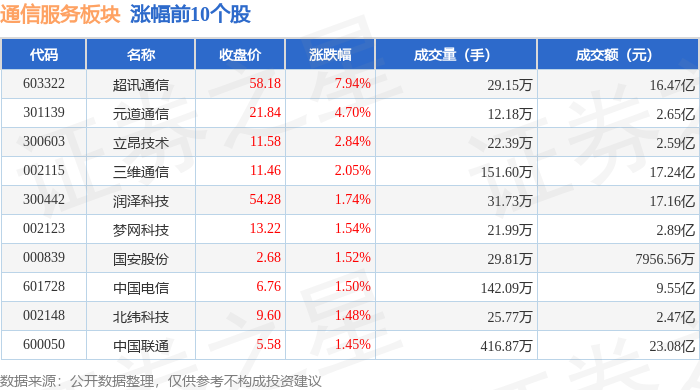
通信服务板块10月9日涨1.1%,超讯通信领涨,主力资金净流出3.76亿元
Zheng Xing Xing Ye Ri Bao· 2025-10-09 09:00
Core Insights - The communication services sector experienced a 1.1% increase on October 9, with Chaoxun Communication leading the gains [1] - The Shanghai Composite Index closed at 3933.97, up 1.32%, while the Shenzhen Component Index closed at 13725.56, up 1.47% [1] Sector Performance - Chaoxun Communication (603322) closed at 58.18, with a rise of 7.94% and a trading volume of 291,500 shares, totaling a transaction value of 1.647 billion yuan [1] - Yuandao Communication (301139) saw a 4.70% increase, closing at 21.84 with a trading volume of 121,800 shares, amounting to 265 million yuan [1] - Lian Technology (300603) increased by 2.84%, closing at 11.58 with a trading volume of 223,900 shares, totaling 259 million yuan [1] - Other notable performers include Sanwei Communication (002115) with a 2.05% increase and a transaction value of 1.724 billion yuan, and Runhua Branch (300442) with a 1.74% increase and a transaction value of 1.716 billion yuan [1] Fund Flow Analysis - The communication services sector saw a net outflow of 376 million yuan from institutional investors, while retail investors contributed a net inflow of 264 million yuan [2] - Notable net inflows from retail investors were observed in Dream Network Technology (002123) with 20.17 million yuan and China Mobile (600941) with 19.20 million yuan [3] - Conversely, China Unicom (600050) experienced a net outflow of 73.05 million yuan from institutional investors [3]


中国电信(00728.HK)拟10月21日举行董事会会议批准季度业绩
Ge Long Hui· 2025-10-09 08:45
格隆汇10月9日丨中国电信(00728.HK)宣布,董事会将于2025年10月21日(星期二)举行本公司董事会 会议,藉以批准(其中包括)本公司及其附属公司截至2025年9月30日止九个月期间的财务业绩。 ...
平治信息(300571.SZ)子公司预中标中国电信天翼网关4.0(2023年-2025年)集中采购项目
智通财经网· 2025-10-09 08:35
Core Viewpoint - Pingzhi Information (300571.SZ) announced that its subsidiary, Shenzhen Zhaoneng Xuntong Technology Co., Ltd., has been shortlisted as a candidate for the China Telecom Tianyi Gateway 4.0 (2023-2025) centralized procurement project [1] Group 1 - The announcement was made following the publication of the candidate list on the China Telecom Sunshine Procurement Network external portal [1] - Shenzhen Zhaoneng is one of the candidates for the second inquiry of the procurement project [1]

平治信息子公司预中标中国电信天翼网关4.0(2023年-2025年)集中采购项目
Zhi Tong Cai Jing· 2025-10-09 08:34
Core Viewpoint - Pingzhi Information (300571.SZ) announced that its subsidiary, Shenzhen Zhaoneng Xuntong Technology Co., Ltd., has been shortlisted as a candidate for the China Telecom Tianyi Gateway 4.0 (2023-2025) centralized procurement project [1] Group 1 - The announcement was made following the publication of the candidate list on the China Telecom Sunshine Procurement Network external portal [1] - Shenzhen Zhaoneng is one of the candidates for the second inquiry of the procurement project [1]
中国电信(00728) - 董事会会议召开日期
2025-10-09 08:31
香港交易及結算所有限公司及香港聯合交易所有限公司對本公告的內容概不負責,對其準確性或完整性亦不發表任何聲 明,並明確表示概不對因本公告全部或任何部份內容而產生或因倚賴該等內容而引致的任何損失承擔任何責任。 China Telecom Corporation Limited 中国电信股份有限公司 (於中華人民共和國註冊成立之股份有限公司) (股份編號:728) 董事會會議召開日期 中國北京,2025 年 10 月 9 日 於本公告刊發之日的本公司董事會包括柯瑞文(董事長兼首席執行官);劉桂清(總裁兼首席 運營官);唐珂、李英輝(財務總監)(皆為執行副總裁);呂永鐘(非執行董事);吳嘉寧、 楊志威、陳東琪、呂薇(皆為獨立非執行董事)。 中國電信股份有限公司(「本公司」)董事會(「董事會」)宣佈將於 2025 年 10 月 21 日(星 期二)舉行本公司董事會會議,藉以批准(其中包括)本公司及其附屬公司截至 2025 年 9 月 30 日止九個月期間的財務業績。 承董事會命 中國電信股份有限公司 公司秘書 黄玉霞 ...