CEB BANK(601818)

Search documents
不足3个月,光大银行旗下村镇银行全部“清空”
Xin Lang Cai Jing· 2026-02-05 01:31
Core Viewpoint - Everbright Bank has completely exited the village bank sector, with three of its village banks shutting down within three months, marking a significant shift in its banking strategy [1][10]. Group 1: Everbright Bank's Village Bank Exits - Everbright Bank's Jiangxi Ruijin Village Bank officially exited on January 23, 2025, following the exit of its Jiangsu Huai'an Village Bank on January 20, 2025, and Shaoshan Village Bank on November 11, 2024 [1][6][10]. - The Jiangxi Ruijin Village Bank was established in November 2018, with a registered capital of 150 million yuan, and had total assets of 819 million yuan and net assets of 191 million yuan as of June 2024 [6][10]. - The exit of these banks has resulted in Everbright Bank having no remaining village banks under its management [1][10]. Group 2: Other Banks' Village Bank Exits - Other banks, including Pudong Development Bank, Huaxia Bank, Hengfeng Bank, and Minsheng Bank, have also seen village banks exit, with Pudong Development Bank having the highest number at 13 exits from July 2024 to January 2025 [1][12][15]. - As of February 2, 2025, Huaxia Bank and Hengfeng Bank each had three village banks exit, while Minsheng Bank had two [12][16]. Group 3: Industry Trends - Since 2025, a total of 335 village banks have exited the market, accounting for 75% of all exits, indicating a significant trend in the restructuring of the village banking sector [19]. - The regulatory focus has shifted towards accelerating the reform and risk management of small financial institutions, with a clear directive from the central government to promote the orderly reform and restructuring of village banks [19].


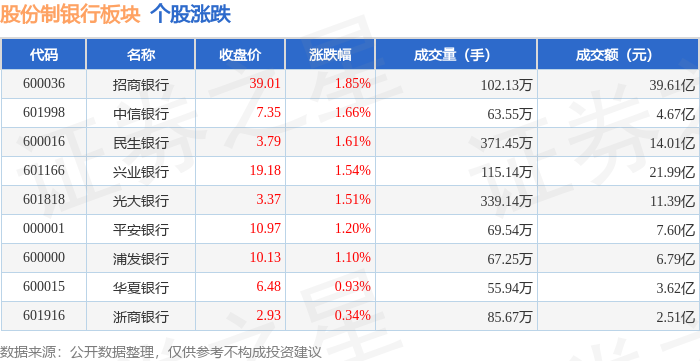
股份制银行板块2月4日涨1.51%,招商银行领涨,主力资金净流入11.33亿元
Zheng Xing Xing Ye Ri Bao· 2026-02-04 08:56
Group 1 - The banking sector saw an increase of 1.51% on February 4, with China Merchants Bank leading the gains [1] - The Shanghai Composite Index closed at 4102.2, up 0.85%, while the Shenzhen Component Index closed at 14156.27, up 0.21% [1] - Key stocks in the banking sector showed various performance metrics, with China Merchants Bank closing at 39.01, up 1.85%, and CITIC Bank at 7.35, up 1.66% [1] Group 2 - The banking sector experienced a net inflow of 1.133 billion yuan from main funds, while retail and speculative funds saw net outflows of 0.351 billion yuan and 0.782 billion yuan, respectively [1] - Major banks like China Merchants Bank and Industrial Bank had significant net inflows of 1.642 billion yuan and 0.322 billion yuan, respectively, indicating strong institutional interest [1] - In contrast, banks like Everbright Bank and CITIC Bank faced net outflows of 0.549 billion yuan and 0.239 million yuan, reflecting weaker retail sentiment [1]




赋能“后冬奥”时代,光大银行“冰雪去嗨节”助力“京”彩消费
Jin Rong Jie· 2026-02-04 03:20
近日,中国人民银行北京市分行等12部门印发《金融支持北京市提振和扩大消费的实施方案》,鼓励金 融机构围绕"赛事+"、冰雪经济等消费场景丰富金融产品,支持和引导金融机构与文旅住宿餐饮经营主 体联合开展消费满减、折扣优惠、信用卡积分抵扣、消费立减金等多样化优惠活动,不断扩大金融消费 优惠场景覆盖面。 北京冬奥会的成功举办,带动三亿人参与冰雪运动,点燃了经济增长新引擎。光大银行依托"双奥之 城"资源禀赋,聚焦五大板块,打造全场景消费闭环,构建起"冰雪运动+文旅消费"的双重价值生态。 从冬奥场馆的活力焕发到冰雪产业的蓬勃发展,从政策红利的精准落地到消费市场的全面激活,光大银 行"冰雪去嗨节"以金融之力撬动冰雪经济,书写了后冬奥时代"冷资源"变身"热经济"的生动篇章。 冰雪畅玩板块,光大银行聚焦北京15大核心滑雪场,联合携程平台推出门票满30立减5元的优惠,切实 降低参与门槛;响应北京市政府"快乐冰雪季"推广号召,用户可通过"北京健身汇"微信小程序,领取光 大银联信用卡"5折封顶10元"立减优惠券,该优惠可与政府补贴消费券、银联优惠券叠加使用,单笔支 付最高享40元优惠,进一步丰富冰雪消费优惠选择。 银行频道更多独家策 ...
“约惠光大”焕新而来:五大活动赋能消费提质扩容
Jin Rong Jie· 2026-02-04 02:17
Core Viewpoint - The article emphasizes the importance of expanding domestic demand as a strategic foundation, highlighting the role of credit cards in facilitating consumer spending and supporting financial development in line with the upgrading of resident consumption patterns [1] Group 1: Online Platform Collaboration - Everbright Credit Card has launched the "Yuehui Everbright" campaign in collaboration with Meituan, offering discounts for consumers who pay with their Everbright Credit Card on the platform, with a minimum discount of 1 yuan and a maximum of 10 yuan for orders over 30 yuan [2] - The partnership with JD.com allows customers to receive a discount of 10 yuan for orders over 200 yuan, while Platinum cardholders can enjoy a 50 yuan discount for orders over 1000 yuan, and JD co-branded cardholders can receive a 50 yuan discount for orders over 500 yuan [2] - Everbright Credit Card has also partnered with Taobao and Tmall to provide ongoing discounts, where customers can enjoy a 10 yuan discount on orders over 200 yuan when paying with their Everbright Credit Card through Alipay [2] Group 2: Offline Store Empowerment - In response to the growing consumer demand, Everbright Credit Card has extended its discount offerings to offline leisure consumption, collaborating with well-known stores to stimulate the real economy [3] - A partnership with Starbucks allows customers to receive a 15 yuan discount on purchases over 40 yuan when paying with Everbright Credit Card at Starbucks locations [3] - Additionally, a collaboration with KFC offers a 10 yuan discount for purchases over 30 yuan when using Everbright Credit Card at KFC outlets [3] - The company aims to continue building a consumption ecosystem by collaborating with various e-commerce platforms and entertainment enterprises to enhance consumer experiences and promote market prosperity [3]
泰山榜|山东银行版图透视:法人机构219家,一二级分行总数达420家
Xin Lang Cai Jing· 2026-02-03 23:55
Core Viewpoint - Shandong Province aims to reform and restructure rural commercial banks and village banks while deepening internal control and risk management actions in urban commercial banks, highlighting the importance of a well-distributed financial service network for regional economic vitality and development potential [2]. Financial Institutions Overview - As of now, Shandong Province has a total of 219 banking legal entities, including 170 first-level branches and 250 second-level branches, with a total of 639 headquarters and branches, supported by 14,700 other outlets [2]. - The core components of Shandong's banking industry include joint-stock banks, urban commercial banks, and rural commercial banks, which work collaboratively to outline a clear regional banking landscape [2]. Joint-Stock Banks - Joint-stock banks play a pivotal role in Shandong's banking sector, characterized by a "leading head, focused core, and precise efforts" strategy, connecting national financial markets with local economies [3][4]. - As of September 2025, Hengfeng Bank, the only national joint-stock commercial bank with independent legal status in Shandong, has total assets of 1.568726 trillion yuan, nearing the 1.6 trillion yuan mark [4]. - National joint-stock banks have established 25 first-level branches and 119 second-level branches in Shandong, with a notable presence in Jinan, Qingdao, and Yantai [4]. Urban Commercial Banks - Urban commercial banks are essential local financial institutions in Shandong, leveraging geographical and service advantages to empower local economies and improve livelihoods [5][6]. - Shandong has 14 local urban commercial banks, including Qilu Bank and Qingdao Bank, along with branches from three non-local urban commercial banks, forming a comprehensive service matrix across the province [5]. Rural Commercial Banks - Rural commercial banks are the most numerous banking entities in Shandong, with 110 institutions focused on serving rural areas and supporting agricultural development [7][8]. - These banks provide a full range of financial services, effectively addressing issues of financing difficulties in rural regions [7]. - Additionally, 91 village banks complement rural commercial banks by extending financial services to remote areas, creating a multi-layered and comprehensive rural financial service system [8]. Future Outlook - Despite facing challenges such as smaller scales and weaker risk resistance, rural commercial banks in Shandong are deepening reforms and enhancing service capabilities, with asset quality steadily improving [8]. - Experts suggest that the three banking groups—joint-stock banks, urban commercial banks, and rural commercial banks—should continue to leverage their strengths and address development challenges to support high-quality economic growth and rural revitalization in Shandong [8].


丈量地方性银行(2):浙江163家区域性银行全梳理-20260203
GF SECURITIES· 2026-02-03 13:31
Investment Rating - The industry investment rating is "Buy" [2] Core Insights - The report provides a comprehensive analysis of 163 regional banks in Zhejiang Province, highlighting their asset and liability structures, profitability, and asset quality [6][20] - The asset growth rate for major city commercial banks in Zhejiang is 9.4%, which is lower than the 14.2% growth rate of listed city commercial banks, while major rural commercial banks show an asset growth rate of 8.0%, exceeding the 6.7% growth rate of listed rural commercial banks [6][25] - The report indicates that the loan-to-asset ratio for city commercial banks is projected to reach 55.5% in 2024, an increase of 95 basis points year-on-year, while rural commercial banks will see a decrease to 59.3%, down 19 basis points [31] - Profitability metrics show that the average Return on Assets (ROA) for city commercial banks in Zhejiang is 0.78%, slightly above the average of listed city commercial banks, while rural commercial banks have an average ROA of 0.82%, which is below the average of listed rural commercial banks [6][31] - The asset quality of regional banks in Zhejiang is reported to be better than that of listed banks, with non-performing loan ratios lower by 16 basis points for city commercial banks and 9 basis points for rural commercial banks compared to their listed counterparts [6][31] Summary by Sections Section 1: Economic Structure of Zhejiang Province - Zhejiang Province is focused on high-quality development and aims to become a model for common prosperity [13] - The province's GDP is heavily concentrated in cities like Hangzhou, Ningbo, and Wenzhou, with Hangzhou accounting for 24.3% of the total GDP in 2025 [15] Section 2: Overview of 163 Regional Banks - The report categorizes the banks into city commercial banks, rural banks, and others, with a total of 163 banks in the region [20] - The distribution of registered capital among these banks is relatively balanced, with 63 banks having over 500 million yuan in registered capital [22] Section 3: Asset and Liability Structure - The asset growth of major city and rural commercial banks has been declining since 2019, with city banks showing a growth rate of 9.4% in the first half of 2025 [25] - The liability structure indicates that customer deposits account for 77.5% of liabilities for city commercial banks, which is higher than the 66.2% for listed city banks [44] Section 4: Profitability and Asset Quality - The average ROE for city commercial banks in Zhejiang is 11.98%, slightly lower than the average of listed city banks [6][31] - The report highlights that the non-performing loan ratio for city commercial banks is lower than that of listed banks, indicating better asset quality [6][31]



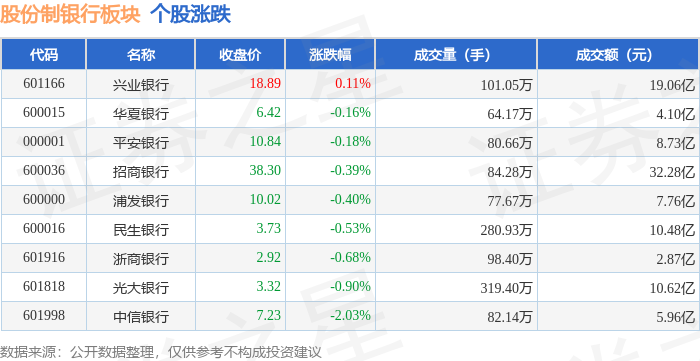
股份制银行板块2月3日跌0.53%,中信银行领跌,主力资金净流出2.88亿元
Zheng Xing Xing Ye Ri Bao· 2026-02-03 09:03
Group 1 - The banking sector experienced a decline of 0.53% on February 3, with CITIC Bank leading the drop [1] - The Shanghai Composite Index closed at 4067.74, up 1.29%, while the Shenzhen Component Index closed at 14127.1, up 2.19% [1] - Individual stock performance in the banking sector showed mixed results, with Industrial Bank slightly up by 0.11% and CITIC Bank down by 2.03% [1] Group 2 - The banking sector saw a net outflow of 288 million yuan from institutional investors, while retail investors contributed a net inflow of 353 million yuan [2] - Specific stock flows indicated that Industrial Bank had a net inflow of 20.39 million yuan from institutional investors, while CITIC Bank had a net outflow of 29.66 million yuan [2] - Retail investors showed significant interest in several banks, with Minsheng Bank receiving a net inflow of 51.32 million yuan [2]

与“圳”同行 光大银行亮出科技金融的“特”色答卷
2 1 Shi Ji Jing Ji Bao Dao· 2026-02-03 08:54
Core Insights - The article highlights the successful collaboration between Everbright Bank's Shenzhen branch and Pudutech, showcasing how financial support has enabled the company to overcome production bottlenecks and enhance its manufacturing capabilities for humanoid robots [1][3]. Financial Support and Innovation - Everbright Bank Shenzhen branch approved a comprehensive credit of 60 million yuan within a week to support Pudutech, which led to a rapid increase in production capacity [1]. - The bank's technology finance loans exceed 30 billion yuan, serving over 2,000 tech companies, with a leading position in loans for strategic emerging industries [2][3]. Structural Innovation - The establishment of the Technology Finance Center in June 2025 marked a significant structural innovation, breaking down traditional business barriers and enhancing service efficiency [2]. - The bank emphasizes the importance of industry judgment, comprehensive operations, and risk management to support high-quality development in technology finance [2]. Business Performance - The bank's technology finance loan scale ranks among the top two in the system, with strategic emerging industry loans leading the system [3]. - Pudutech's partnership with the bank exemplifies the effectiveness of structural innovation, as the bank provided timely financial support during a crisis, allowing the company to stabilize and grow [3][9]. Full-Cycle Support - Everbright Bank Shenzhen branch has developed a full-cycle service system to support tech companies from startup to maturity, addressing different financial needs at each stage [6][8]. - The bank has successfully launched various financial products tailored to the needs of startups, growth-stage companies, and mature enterprises, facilitating their development [6][8]. Market Adaptation - The bank has introduced customized financial products like "Tengfei Loan" and "Technological Transformation Re-loan" to meet the capital expansion needs of growing companies [7]. - The bank's proactive approach in identifying and supporting companies in emerging sectors, such as AI and low-altitude economy, has led to significant business growth for its clients [7][11]. Future Outlook - The bank plans to continue optimizing its technology finance layout, aligning with Shenzhen's "20+8" industrial strategy to provide tailored financial solutions for emerging industries [13]. - The focus will be on enhancing service efficiency and expanding ecological cooperation to support more companies in their growth journey [13].
与“圳”同行 光大银行亮出科技金融的“特”色答卷
21世纪经济报道· 2026-02-03 08:46
Core Viewpoint - The article highlights the transformative role of financial support in fostering technological innovation and growth in Shenzhen, exemplified by the collaboration between Everbright Bank Shenzhen Branch and Pudutech, which has led to significant advancements in production capacity and product development [1]. Financial Innovation and Structural Reform - Everbright Bank Shenzhen Branch has initiated a structural reform to enhance its technology finance services, establishing a dedicated Technology Finance Center to streamline operations and improve service efficiency [3][4]. - The bank's comprehensive strategy includes strengthening industry judgment, risk management, and customer cultivation to support high-quality development in technology finance [4]. Case Studies of Successful Collaboration - Pudutech's journey illustrates the effectiveness of the bank's structural reforms, receiving substantial credit support during challenging times, which enabled the company to stabilize and expand its operations [5]. - The bank has also provided tailored financial solutions to other tech companies, such as providing 1 billion yuan in credit to support Pudutech's IPO preparations and various financing needs [5]. Full-Cycle Support for Tech Enterprises - Everbright Bank Shenzhen Branch has developed a full-cycle service system to cater to the diverse financial needs of tech enterprises at different growth stages, from startup to maturity [9]. - The bank has successfully implemented online loan products like "Tech e-loan" and "Specialized and Innovative Enterprise Loan," facilitating over 20 billion yuan in funding for startups [9][10]. Focus on Emerging Industries - The bank is actively engaging in emerging sectors such as low-altitude economy and digital finance, providing innovative financial products and services to meet the specific needs of these industries [14][15]. - By establishing partnerships with various stakeholders, including government and industry players, the bank aims to create a supportive ecosystem for tech innovation [15]. Future Outlook - As Shenzhen celebrates its 45th anniversary, Everbright Bank Shenzhen Branch plans to further optimize its financial offerings and expand its collaborative ecosystem to support the city's strategic industrial development [16].

光大银行旗下村镇银行清零!开年以来村镇银行减量提质持续
Nan Fang Du Shi Bao· 2026-02-03 08:20
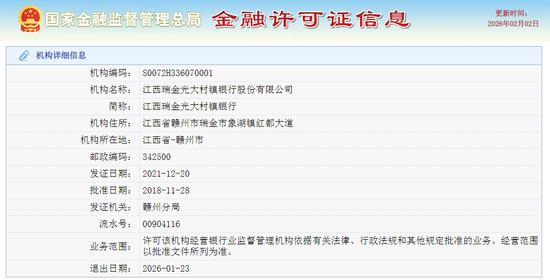
我国村镇银行退出再添一例。国家金融监督管理总局官网信息显示,由光大银行发起设立的江西瑞金光 大村镇银行已于近期退出。而2026年开年以来,我国已经有25家村镇银行"离场",行业"减量提质"步伐 持续。 光大银行旗下三家村镇银行均退出 国家金融监督管理总局"金融许可证信息"栏目显示,江西瑞金光大村镇银行已于近期退出,成为今年以 来退出市场的25家村镇银行之一。 光大银行财报信息显示,2025年6月末,该行旗下尚有3家村镇银行,分别为韶山光大村镇银行、江苏淮 安光大村镇银行和江西瑞金光大村镇银行,光大银行持股比例均为70%。 其中,韶山光大村镇银行成立于2009年9月,注册资本1.5亿元,去年上半年亏损116.88 万元;江苏淮安 光大村镇银行成立于2013年2月,注册资本1亿元,去年上半年实现净利润273.01万元;江西瑞金光大村 镇银行成立于2018年11月,注册资本1.5亿元,去年上半年实现净利润479.52万元。 不过,在江西瑞金光大村镇银行退出之前,另两家也已经退出。国家金融监督管理总局官网信息显示, 2025年10月,江苏淮安光大村镇银行和韶山光大村镇银行解散均获当地监管部门批复同意,两家银行全 部资 ...