
CEB BANK(601818)

Search documents
金价高位震荡叠加政策合规要求 银行收紧个人贵金属投资通道
Shen Zhen Shang Bao· 2025-12-23 23:03
Core Insights - The international gold and silver prices have reached historical highs in 2023, with COMEX gold surpassing $4500 per ounce and a year-to-date increase of 71%, while COMEX silver has surged by 138% [1] - Banks are tightening their personal precious metal investment channels by closing speculative leveraged businesses and raising margin requirements [1][4] Group 1: Market Performance - As of December 23, 2023, COMEX gold hit a record high of $4530.80 per ounce, while COMEX silver peaked at $70.155 per ounce [1] - The current spot gold price reached $4473 per ounce before consolidating, indicating strong market sentiment [1] Group 2: Bank Policies - Banks are actively closing "zombie accounts" and halting speculative leveraged business, with institutions like Hengfeng Bank and ICBC announcing the cessation of services for accounts with no positions or inventory [2][3] - The China Banking sector is shifting from high-risk speculative products to more stable offerings, such as physical gold bars and ETFs, to protect investors [3][6] Group 3: Investment Thresholds - Banks are increasing margin requirements for gold investments, with institutions like Everbright Bank raising standard margin ratios for various contracts [4] - The entry barriers for gold ETFs are high, requiring investors to have significant assets or income, which aims to deter less risk-tolerant investors [4] Group 4: Investment Strategy - Analysts suggest that individual investors should avoid blindly following market trends and focus on value-based investment strategies in precious metals [5][6] - The current market volatility necessitates a cautious approach, with recommendations for investors to limit gold investments to 10%-20% of their total assets for long-term strategies [4][6]

中国光大银行成功发行60亿元科技创新债券
Jin Rong Shi Bao· 2025-12-23 17:16
光大银行表示,该行将继续提升支持科技创新的力度、增强服务科技型企业的能力水平,在赋能新质生 产力发展上精准发力、协同发力、持续发力,为金融强国建设与中国式现代化作出新的更大贡献。责任 编辑:韩胜杰 据悉,本期科创债吸引了各类型投资机构参与认购,最终获配投资机构涵盖国有大型银行、股份制银 行、城商行、农商行、基金、券商等各类投资机构,获得了市场高度关注和积极反响。 本期债券的募集资金将投向《金融"五篇大文章"总体统计制度(试行)》中规定的科创领域,包括发放 科技贷款、投资科技创新企业发行的债券等,专项支持科技创新领域业务。 12月16日,光大银行在全国银行间债券市场簿记发行2025年科技创新浮息债券,发行规模60亿元,债券 期限3年,首期票面利率确定为1.85%,全场认购倍数达2.3倍。 ...

光大银行发行60亿元科技创新债券
Xin Hua Cai Jing· 2025-12-23 02:36
本期债券的募集资金将投向《金融"五篇大文章"总体统计制度(试行)》中规定的科创领域,包括发放 科技贷款、投资科技创新企业发行的债券等,专项支持科技创新领域业务。 新华财经北京12月23日电(记者吴丛司)记者23日从光大银行获悉,该行日前在全国银行间债券市场簿 记发行2025年科技创新浮息债券,发行规模60亿元,债券期限3年,首期票面利率确定为1.85%,全场 认购倍数达2.3倍。 据悉,本期科创债最终获配投资机构涵盖国有大型银行、股份制银行、城商行、农商行、基金、券商等 各类投资机构。 编辑:刘润榕 光大银行有关负责人表示,将继续提升支持科技创新的力度、增强服务科技型企业的能力水平,在赋能 新质生产力发展上精准发力、协同发力、持续发力。 ...
市场或将迎来第四家股份行AIC
中国基金报· 2025-12-22 16:04
Core Viewpoint - Everbright Bank is actively planning the establishment of an Asset Investment Company (AIC) in response to investor inquiries, emphasizing ongoing communication with regulatory bodies and strategic alignment with national financial policies [2][4]. Group 1: AIC Establishment Plans - Everbright Bank confirmed its intention to establish an AIC, aligning with the regulatory framework set by the National Financial Regulatory Administration, which supports qualified commercial banks in launching AICs [4]. - The bank aims to enhance its service capabilities in the technology finance sector, focusing on equity investment and credit services for technology-driven enterprises [4]. Group 2: Strategic Focus Areas - The bank's future strategy will concentrate on "hard technology" sectors, including artificial intelligence, biomanufacturing, new materials, high-end equipment, new energy, and semiconductors, as part of its comprehensive financial service offerings [4]. - Everbright Bank has established 16 "Innovation Finance Centers" across its branches, with a loan balance for technology enterprises reaching 417 billion yuan, reflecting a 9.9% increase from the previous year [6]. Group 3: Industry Context - As of now, eight bank-affiliated AICs are operational, with several banks, including Industrial Bank, CITIC Bank, and China Merchants Bank, having launched their AICs recently [6]. - The inclusion of joint-stock banks in the AIC framework is expected to enhance market responsiveness and flexibility, indicating a shift from the exploratory phase to an expansion phase for the AIC model [7].


市场或将迎来第四家股份行AIC
Zhong Guo Ji Jin Bao· 2025-12-22 16:02
Core Viewpoint - Everbright Bank is actively planning to establish a Financial Asset Investment Company (AIC) and is enhancing communication with regulatory authorities to meet the necessary conditions for this initiative [4][6]. Group 1: Company Strategy and Operations - Everbright Bank is focusing on the strategic deployment of its "Five Major Articles" and aims to leverage its strengths in technological finance for product innovation and comprehensive service capabilities [4]. - The bank plans to enhance its service quality and efficiency in supporting the real economy by promoting the linkage between equity investment and credit for technology-based enterprises [4]. - The bank's future strategy will concentrate on "hard technology" sectors such as artificial intelligence, biomanufacturing, new materials, high-end equipment, new energy, and semiconductors, aiming to provide comprehensive financial services throughout the lifecycle from startup investment to industrial integration [4][6]. Group 2: Industry Context and Developments - As of now, eight bank-affiliated AICs are officially operational, with several banks, including Industrial Bank, CITIC Bank, and China Merchants Bank, having launched their AICs since November [6][7]. - The regulatory framework has been evolving, with the National Financial Regulatory Administration issuing a notice in March 2025 to support qualified commercial banks in establishing AICs, thereby laying the groundwork for the expansion of bank-affiliated AICs [7]. - If Everbright Bank successfully establishes its AIC, it will become the fourth bank in the shareholding system to do so, aligning its strategic focus with other banks on the "hard technology" sector [6][7].
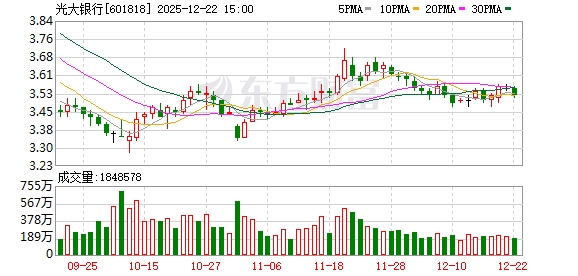
光大银行:截至2025年10月31日A股股东共计19.16万户
Zheng Quan Ri Bao· 2025-12-22 13:42
证券日报网讯 12月22日,光大银行在互动平台回答投资者提问时表示,截至2025年10月31日,本行A股 股东共计19.16万户。 (文章来源:证券日报) ...
或冲刺第四家股份行AIC!光大银行称稳步筹划相关申设工作
2 1 Shi Ji Jing Ji Bao Dao· 2025-12-22 10:46
Core Viewpoint - Everbright Bank is planning to establish a financial asset investment company (AIC) in response to regulatory support for qualified commercial banks to set up AICs, with a focus on enhancing communication with regulatory bodies and advancing related preparations [2][4]. Group 1: Regulatory Context - In March 2025, the National Financial Regulatory Administration issued a notice supporting qualified commercial banks in establishing AICs, which aligns with Everbright Bank's strategic plans [2][4]. - The policy framework for AICs has been expanding, with the regulatory body announcing in May that the scope for establishing AICs would include qualified national commercial banks, thereby laying a foundation for the expansion of bank-affiliated AICs [4]. Group 2: Strategic Focus - Everbright Bank aims to leverage its strengths in technological finance and product innovation to enhance the quality and efficiency of services to the real economy, focusing on sectors such as artificial intelligence, biomanufacturing, new materials, high-end equipment, new energy, and semiconductors [4]. - The bank's strategy includes a comprehensive financial service solution that spans from initial investment to industrial integration, supported by a robust framework of five strengths: strong services, strong products, strong ecosystems, strong research and development, and strong digital intelligence [4]. Group 3: Industry Developments - As of December, the establishment of AICs by joint-stock banks has accelerated, with several banks, including China Merchants Bank and CITIC Bank, launching their AICs, indicating a growing trend in the sector [5]. - A total of nine AICs have been approved nationwide, including those under major state-owned banks and joint-stock banks, with Everbright Bank potentially becoming the fourth joint-stock bank to establish an AIC if its application is successful [5]. - Since the initiation of market-oriented debt-to-equity swaps in 2016, AICs have evolved from a singular risk mitigation tool to a key player in supporting technological innovation and industrial upgrades, especially following the regulatory expansion of AIC equity investment trials in 2024 [5].
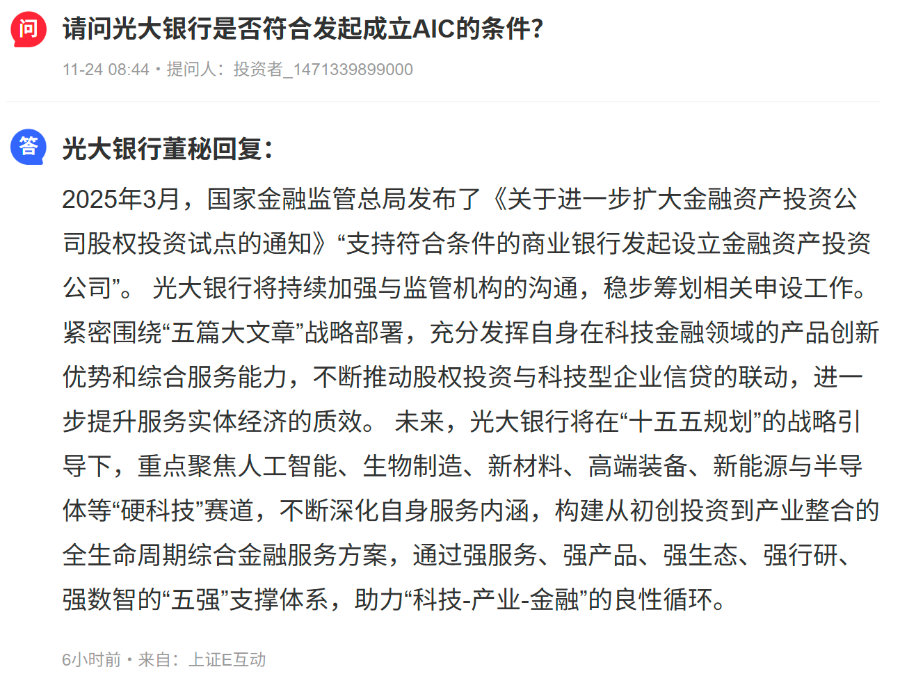
光大银行:稳步筹划金融资产投资有限公司相关申设工作
Bei Jing Shang Bao· 2025-12-22 10:14
Core Viewpoint - Everbright Bank is preparing to establish an Asset Investment Company (AIC) in response to regulatory support for qualified commercial banks to set up such entities by March 2025 [1] Group 1 - The China Banking and Insurance Regulatory Commission issued a notice on March 2025 to expand the pilot program for financial asset investment companies [1] - Everbright Bank is committed to enhancing communication with regulatory authorities regarding the establishment of the AIC [1] - The bank is steadily planning the relevant application and establishment work for the AIC [1]
股份制银行板块12月22日跌0.62%,光大银行领跌,主力资金净流出3994.56万元
Zheng Xing Xing Ye Ri Bao· 2025-12-22 09:10
从资金流向上来看,当日股份制银行板块主力资金净流出3994.56万元,游资资金净流入1.81亿元,散户 资金净流出1.41亿元。股份制银行板块个股资金流向见下表: 以上内容为证券之星据公开信息整理,由AI算法生成(网信算备310104345710301240019号),不构成投资建议。 证券之星消息,12月22日股份制银行板块较上一交易日下跌0.62%,光大银行领跌。当日上证指数报收 于3917.36,上涨0.69%。深证成指报收于13332.73,上涨1.47%。股份制银行板块个股涨跌见下表: ...

光大银行举办“走进长三角”综合金融服务研讨会
Xin Hua She· 2025-12-22 08:51
Core Viewpoint - China Everbright Bank is actively integrating and supporting national regional development strategies, focusing on the artificial intelligence sector as part of its "Going into the Yangtze River Delta" initiative [1][2]. Group 1: Financial Services Initiative - The "Yangtze River Delta Comprehensive Financial Service Plan" was launched by China Everbright Bank, aligning with the national "14th Five-Year Plan" and regional development strategies [1]. - The plan aims to provide tailored financial services that leverage the unique characteristics of the Yangtze River Delta, which is known for its concentration and circulation of various production factors [1]. Group 2: Focus on Artificial Intelligence - The event highlighted the importance of artificial intelligence as one of the three leading industries for Shanghai's goal of becoming a world-class innovation center [2]. - China Everbright Bank plans to enhance support across the entire artificial intelligence industry chain, including key areas such as chips, large models, and application scenarios [2]. Group 3: Collaboration and Innovation - Representatives from participating companies expressed appreciation for the workshop's content and format, emphasizing the need for more platforms for collaboration among industry, academia, and finance [3]. - The bank aims to build a collaborative platform to drive technological and industrial innovation, enhancing the integration of finance and technology [3].