Bank of Chengdu(601838)

Search documents
银行股,走强
第一财经· 2025-10-13 05:49
Group 1 - The banking sector experienced a strong rebound on October 13, with notable gains in several banks, including a more than 5% increase in Shanghai Pudong Development Bank and over 4% in Nanjing Bank [1] - The Shanghai Composite Index saw a narrowing decline, currently down by 0.47% [1] Group 2 - Specific stock performance includes: - Shanghai Pudong Development Bank at 12.52 with a rise of 5.74% - Nanjing Bank at 11.33 with an increase of 4.81% - Chongqing Rural Commercial Bank at 6.74 with a gain of 3.85% - Qilu Bank at 6.08 with a rise of 3.23% - Shanghai Bank at 9.45 with an increase of 2.83% - Chongqing Bank at 9.27 with a gain of 2.77% - Chengdu Bank at 17.97 with a rise of 2.74% [2]





成都银行涨2.00%,成交额3.43亿元,主力资金净流入1252.19万元
Xin Lang Zheng Quan· 2025-10-13 02:54
Core Viewpoint - Chengdu Bank's stock price has shown a year-to-date increase of 9.99%, with a recent rise of 2.00% on October 13, 2023, indicating positive market sentiment towards the bank's performance and potential growth [1]. Financial Performance - As of June 30, 2025, Chengdu Bank reported a net profit attributable to shareholders of 6.617 billion yuan, reflecting a year-on-year growth of 7.29% [1][2]. - The bank has cumulatively distributed dividends amounting to 17.856 billion yuan since its A-share listing, with 10.126 billion yuan distributed over the past three years [2]. Stock Market Activity - On October 13, 2023, Chengdu Bank's stock traded at 17.84 yuan per share, with a total market capitalization of 75.614 billion yuan [1]. - The stock experienced a trading volume of 343 million yuan, with a turnover rate of 0.46% [1]. - The net inflow of main funds was 12.5219 million yuan, with significant buying activity from large orders [1]. Shareholder Structure - As of June 30, 2025, the number of shareholders decreased by 1.83% to 44,600, while the average circulating shares per person increased by 1.87% to 94,868 shares [1]. - Hong Kong Central Clearing Limited is the third-largest circulating shareholder, holding 247 million shares, an increase of 4.3963 million shares from the previous period [2].
本周聚焦:银行股中期分红阵营扩大,国有大行分红超2000亿元
GOLDEN SUN SECURITIES· 2025-10-12 09:43
Investment Rating - The report indicates a positive outlook for the banking sector, particularly highlighting the increased mid-term dividend distributions from listed banks, with state-owned banks leading the way with over 200 billion yuan in dividends [2][3]. Core Insights - The report emphasizes that the mid-term dividend plans from listed banks reflect their stable profitability and capital adequacy, which is crucial in the current low-interest-rate environment. High dividend policies are expected to boost market confidence and enhance the defensive value of bank stocks for long-term investment [3][4]. - The report suggests that while short-term export impacts may arise from tariff policies, long-term domestic policies aimed at stabilizing the real estate market, promoting consumption, and enhancing social welfare are likely to support economic growth. The banking sector is expected to benefit from these policy catalysts [4]. Summary by Sections Dividend Distribution - Several banks have completed their mid-term dividend plans, with notable distributions including: - Industrial and Commercial Bank of China: 0.1414 yuan per share, totaling 50.396 billion yuan - China Construction Bank: 0.1858 yuan per share, totaling 48.605 billion yuan - Agricultural Bank of China: 0.1195 yuan per share, totaling 41.823 billion yuan - Bank of China: 0.1094 yuan per share, totaling 35.250 billion yuan - Bank of Communications: 0.1563 yuan per share, totaling 13.811 billion yuan - Postal Savings Bank: 0.1230 yuan per share, totaling 14.772 billion yuan [2][3][14]. Sector Performance - The report notes that the banking sector is expected to see a positive performance due to policy support and economic recovery, with specific banks like Ningbo Bank, Jiangsu Bank, Chengdu Bank, Shanghai Bank, and Hu'nong Commercial Bank recommended for investment based on their improving fundamentals [4][8]. Key Data Tracking - The average daily trading volume for stocks reached 26,032.76 billion yuan, an increase of 4,154.20 billion yuan from the previous week [8]. - The balance of margin financing increased by 0.70% to 2.44 trillion yuan [8]. - The issuance of non-monetary funds decreased significantly, with a total of 11.30 billion yuan issued this week, down 56.07 billion yuan from the previous week [8].




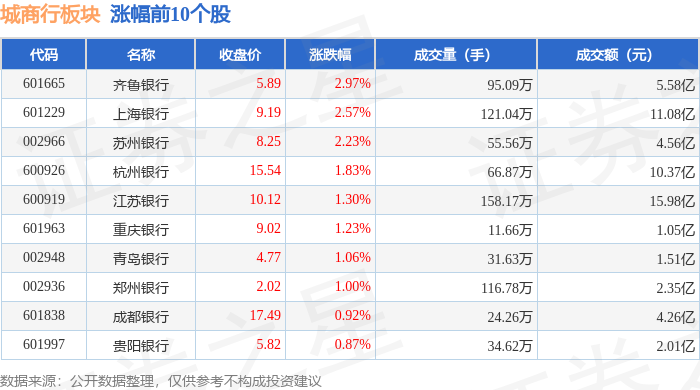
城商行板块10月10日涨1.16%,齐鲁银行领涨,主力资金净流出4.17亿元
Zheng Xing Xing Ye Ri Bao· 2025-10-10 08:46
Core Insights - The city commercial bank sector experienced a rise of 1.16% on October 10, with Qilu Bank leading the gains [1] - The Shanghai Composite Index closed at 3897.03, down 0.94%, while the Shenzhen Component Index closed at 13355.42, down 2.7% [1] Stock Performance - Qilu Bank (601665) closed at 5.89, up 2.97% with a trading volume of 950,900 shares and a transaction value of 558 million yuan [1] - Shanghai Bank (601229) closed at 9.19, up 2.57% with a trading volume of 1,210,400 shares and a transaction value of 1.108 billion yuan [1] - Suzhou Bank (002966) closed at 8.25, up 2.23% with a trading volume of 555,600 shares and a transaction value of 456 million yuan [1] - Hangzhou Bank (600926) closed at 15.54, up 1.83% with a trading volume of 668,700 shares and a transaction value of 1.037 billion yuan [1] - Jiangsu Bank (616009) closed at 10.12, up 1.30% with a trading volume of 1,581,700 shares and a transaction value of 1.598 billion yuan [1] Capital Flow - The city commercial bank sector saw a net outflow of 417 million yuan from institutional investors, while retail investors contributed a net inflow of 176 million yuan [2] - Shanghai Bank had a net inflow of 101 million yuan from institutional investors, but a net outflow of 51.32 million yuan from speculative funds [3] - Jiangsu Bank experienced a net inflow of 59.37 million yuan from institutional investors, with a net outflow of 68.54 million yuan from speculative funds [3]




城商行板块9月30日跌1%,苏州银行领跌,主力资金净流出4.62亿元
Zheng Xing Xing Ye Ri Bao· 2025-09-30 08:51
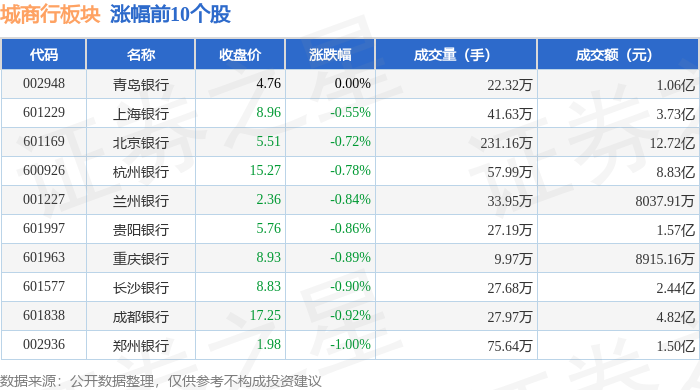
Core Insights - The city commercial bank sector experienced a decline of 1.0% on September 30, with Suzhou Bank leading the drop [1] - The Shanghai Composite Index closed at 3882.78, up 0.52%, while the Shenzhen Component Index closed at 13526.51, up 0.35% [1] Stock Performance Summary - Qingdao Bank: Closed at 4.76, unchanged; trading volume of 223,200 shares, turnover of 106 million [1] - Shanghai Bank: Closed at 8.96, down 0.55%; trading volume of 416,300 shares, turnover of 373 million [1] - Beijing Bank: Closed at 5.51, down 0.72%; trading volume of 2,311,600 shares, turnover of 1.272 billion [1] - Hangzhou Bank: Closed at 15.27, down 0.78%; trading volume of 157,990 shares, turnover of 883 million [1] - Lanzhou Bank: Closed at 2.36, down 0.84%; trading volume of 339,500 shares, turnover of 80.379 million [1] - Guiyang Bank: Closed at 5.76, down 0.86%; trading volume of 271,900 shares, turnover of 157 million [1] - Chongqing Bank: Closed at 8.93, down 0.89%; trading volume of 99,700 shares, turnover of 89.151 million [1] - Changsha Bank: Closed at 8.83, down 0.90%; trading volume of 276,800 shares, turnover of 244 million [1] - Chengdu Bank: Closed at 17.25, down 0.92%; trading volume of 279,700 shares, turnover of 482 million [1] - Zhengzhou Bank: Closed at 1.98, down 1.00%; trading volume of 756,400 shares, turnover of 150 million [1] Capital Flow Analysis - The city commercial bank sector saw a net outflow of 462 million from main funds, while speculative funds had a net inflow of 331 million, and retail investors had a net inflow of 131 million [2] - Suzhou Bank: Main fund net inflow of 55.9396 million, speculative fund net outflow of 11.5337 million, retail net outflow of 44.4059 million [3] - Changsha Bank: Main fund net inflow of 33.8793 million, speculative fund net outflow of 13.6525 million, retail net outflow of 20.2268 million [3] - Qilu Bank: Main fund net inflow of 8.6825 million, speculative fund net outflow of 2.7980 million, retail net outflow of 5.8846 million [3] - Hangzhou Bank: Main fund net inflow of 7.6881 million, speculative fund net inflow of 44.2474 million, retail net outflow of 51.9354 million [3] - Guiyang Bank: Main fund net inflow of 4.8665 million, speculative fund net outflow of 1.6412 million, retail net outflow of 3.2254 million [3]
精准赋能企业发展 郫都高新技术产业园创新“园区+国有平台公司+银行”模式
Mei Ri Jing Ji Xin Wen· 2025-09-29 15:41
Core Insights - The "Huiyuan Loan" product launch event took place on September 29 in Chengdu's Pidu District, with a signed amount of 20 million yuan, marking a significant step in the collaboration between Pidu High-tech Industrial Park, Juecheng Financial Holdings, and Chengdu Bank [1][2] - This innovative model targets technology-oriented, innovative, and growth-oriented small and micro enterprises within the park, establishing a whitelist of companies to enhance creditworthiness and reduce traditional lending barriers [1] Group 1 - The first batch of 40 "whitelist" companies was announced, selected through self-declaration, committee recommendations, expert reviews, and Chengdu Bank's comprehensive evaluation [1] - A representative from Chengdu Rongtong Technology Co., Ltd. expressed gratitude for the timely financial support, highlighting the company's growth from 5 million yuan in revenue last year to an expected 28 million yuan this year, with projections exceeding 50 million yuan next year [1] - The park aims to deepen this innovative model and attract more financial institutions to create a diversified financial service system, positioning itself as a benchmark for "government-enterprise-bank cooperation" in the region and nationwide [2]
重视优质银行配置性机会
HTSC· 2025-09-29 02:41
Investment Rating - The report maintains an "Overweight" rating for the banking sector [2] Core Views - The cost-effectiveness of bank allocations has improved, with a significant number of quality banks offering dividend yields exceeding 5% for 2025 [5][10] - The banking sector is expected to see a recovery in market allocation demand in Q4, driven by calendar effects and a potential shift towards safer investments [5][10] - Core business profitability is improving under supportive policies, with a narrowing decline in net interest income for listed banks [6][10] Summary by Sections Investment Rating - The banking sector is rated as "Buy" for several key banks, including Industrial and Commercial Bank of China (ICBC) with a target price of 7.88 HKD, Chengdu Bank at 23.33 CNY, and Shanghai Bank at 12.02 CNY [4] Market Trends - The banking index has experienced a maximum drawdown of approximately 15% since July, with the PB ratio falling to 0.62x, indicating a favorable valuation compared to historical levels [5][11] - The report highlights that 37 A-share banks have fallen below their six-month moving average, with 14 below their annual moving average, suggesting a potential buying opportunity [5] Performance Outlook - The report anticipates that insurance capital, industrial capital, and foreign investment will become significant incremental allocation sources for the banking sector [7] - The report notes that the banking sector's dividend payout capabilities are stable, making them attractive to long-term investors [7] Economic Indicators - The report discusses the impact of interest rate increases on bank performance, suggesting that banks may buffer non-interest income pressures through realized gains [8][10] - It emphasizes that if the economy enters an upward cycle, rising interest rates could positively impact net interest income and overall bank profitability [8][10]
上市银行不良出清与拨备压力观察
Guoxin Securities· 2025-09-29 02:04
Investment Rating - The industry is rated as "Outperform the Market" [2][3] Core Viewpoints - The stability of asset quality in the banking sector is attributed to the gradual clearing of non-performing loans across various sectors over the past 15 years, which has mitigated the impact on bank financial statements [1][2] - Banks have proactively adjusted their loan structures to reduce risk exposure, particularly by decreasing the proportion of loans to sectors experiencing rising non-performing loans [1][2] - The impact of non-performing loans on profit statements has been minimized due to banks' preemptive provisioning strategies, which have allowed for smoother profit reporting [1][2] - Non-credit areas of non-performing assets have also been cleared or are at a minimal level, contributing to the overall stability of bank risk profiles [1][2] Summary by Sections Non-Performing Loan Exposure and Clearing - The banking sector has experienced a 15-year process of risk resolution, with non-performing loans being gradually exposed and cleared [12] - The manufacturing and retail sectors have seen significant reductions in non-performing loans, achieving a return to levels similar to those seen in 2010 [26][30] Real Estate Sector - The real estate sector's non-performing loan ratio peaked in 2023 but has since shown signs of recovery, although it remains elevated [35][37] - The overall impact of real estate risks on bank loan portfolios is limited due to the relatively small proportion of real estate loans compared to total loans [37][38] City Investment Loans - The non-performing loan ratio for city investment loans has been declining since 2023, aided by debt reduction efforts [41][44] Retail Loans - Retail loan categories, including personal housing loans and credit card loans, are currently experiencing rising non-performing rates, indicating ongoing risk exposure [50][53] Other Loan Categories - Other loan categories, such as utilities and miscellaneous public loans, have minimal impact on overall bank risk due to their low non-performing rates [60][63] Loan Structure Adjustments - Banks have actively adjusted their loan structures in response to risk exposures, shifting focus towards lower-risk personal loans [66][68] Provisioning Strategies - Banks have utilized provisioning to smooth profit impacts from non-performing loans, with historical data indicating a capacity to release significant net profits from existing provisions [81][82] Investment Recommendations - The report suggests focusing on banks with strong asset quality and low provisioning pressure, such as Chengdu Bank and Changsha Bank, while also recommending cyclical stocks like Ningbo Bank and Changshu Bank for potential recovery [105]

上市银行“十四五回望”之资负结构与息差变迁
CMS· 2025-09-28 15:09
Investment Rating - The report maintains a recommendation for the banking industry [3] Core Insights - The report provides a comprehensive analysis of the asset-liability structure and interest margin changes of 42 A-share listed banks during the "14th Five-Year Plan" period, highlighting a shift towards corporate loans on the asset side and a stronger retail focus on the liability side [12][14] - The asset-liability structure indicates a significant increase in the proportion of corporate loans, rising from 57.02% to 63.22% from the end of 2020 to mid-2025, while the proportion of demand deposits decreased from 41.94% to 30% [12][14] - The report notes a decline in both asset yield and interest margin, with the yield on interest-earning assets dropping from 4.43% to 3.32% and the net interest margin decreasing from 2.23% to 1.53% during the same period [14][15] Summary by Sections Overall Asset-Liability Structure and Interest Margin Changes - The asset-liability structure shows an increase in loan-to-earning asset ratio from 54.19% to 56.49%, with corporate loans making up a larger share of total loans [14][15] - The average yield on interest-earning assets decreased significantly, with the loan yield falling from 5.34% to 3.82% [15] - The net interest margin for listed banks remains higher than that of commercial banks, despite a decline [14][15] Changes in Each Banking Sector's Asset-Liability Structure and Interest Margin - City commercial banks experienced a more significant increase in the proportion of corporate loans, with their interest margin narrowing less compared to other banks [18] - The report highlights that the proportion of deposits in interest-bearing liabilities for state-owned banks decreased, while it increased for rural commercial banks [18] - The decline in interest-bearing liabilities' cost rate was most pronounced in city commercial banks, leading to a smaller reduction in their interest margin [18]




城商行板块9月25日跌0.94%,重庆银行领跌,主力资金净流出2.78亿元
Zheng Xing Xing Ye Ri Bao· 2025-09-25 08:37
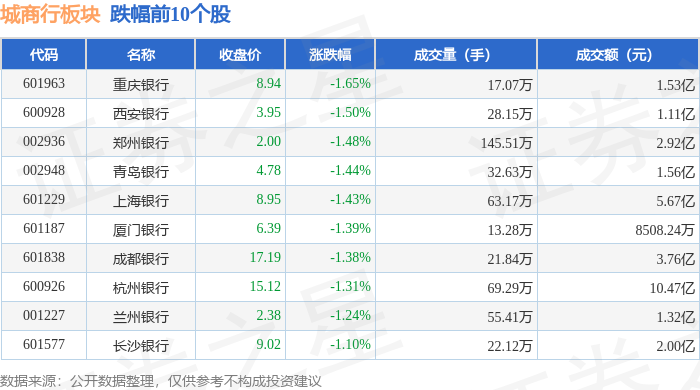
Market Performance - The city commercial bank sector declined by 0.94% on September 25, with Chongqing Bank leading the decline [1] - The Shanghai Composite Index closed at 3853.3, down 0.01%, while the Shenzhen Component Index closed at 13445.9, up 0.67% [1] Individual Stock Performance - Chongqing Bank closed at 8.94, down 1.65% with a trading volume of 170,700 shares and a transaction value of 153 million [1] - Other notable declines include Xi'an Bank down 1.50% to 3.95, Zhengzhou Bank down 1.48% to 2.00, and Qingdao Bank down 1.44% to 4.78 [1] - Shanghai Bank and Xiamen Bank also saw declines of 1.43% and 1.39%, respectively [1] Capital Flow Analysis - The city commercial bank sector experienced a net outflow of 278 million from institutional investors, while retail investors saw a net inflow of 152 million [1] - The table indicates that Suzhou Bank had a significant net outflow from institutional investors of 48.08 million, while Qilu Bank had a net inflow of 25.86 million [2] - Chongqing Bank specifically had a net outflow of 5.68 million from institutional investors but a net inflow of 10.91 million from retail investors [2]