Bank of Chengdu(601838)

Search documents
中国银行业:2025 年宏观、金融与房地产调研要点-China Banks_ Takeaways from 2025 macro, financial and property tour
2025-09-15 01:49
Summary of Key Points from the Conference Call Industry Overview - **Industry**: Chinese Banking Sector - **Date of Conference**: September 3-5, 2025 - **Location**: Hangzhou and Beijing Core Insights 1. **Economic Support and Government Policies**: The Chinese government has prioritized economic support through various policies since September 2024, including rate cuts and consumption stimuli, leading to a recovering capital market and alleviation of local government financing vehicle (LGFV) debt issues [2][3][4] 2. **GDP Growth Outlook**: Despite recent weakening economic data, experts believe China is on track to meet its approximately 5% GDP growth target for 2025, aided by a favorable base effect in the second half of the year. However, 2026 presents heightened risks [3][12] 3. **Monetary and Fiscal Policies**: Further policy rate cuts are deemed unlikely for the remainder of 2025, with a preference for targeted fiscal subsidies. The potential introduction of a consumption tax reform in 2025 is also noted [3][4][12] 4. **Inflation and Economic Structure**: Weak inflation persists, attributed to structural issues and overcapacity in the investment-driven growth model, particularly in manufacturing. Experts emphasize the need for long-term structural reforms [11][13] 5. **Capital Market Recovery**: The capital market is showing signs of recovery, supported by easing US-China tensions and improved global liquidity. The upward momentum is expected to continue [15] Banking Sector Insights 1. **Net Interest Margin (NIM) Outlook**: Banks are less negative about NIM outlooks, with many indicating that NIM is near its bottom and may stabilize soon. However, loan demand remains lackluster, particularly from non-government corporates and retail sectors [5][24] 2. **Dividend Preferences**: In light of macroeconomic uncertainties, banks with higher dividend yields, such as ICBC, CCB, CITIC, and regional banks like BOCD and BOHZ, are preferred [5][24] 3. **Individual Bank Performance**: - **ICBC**: Expects improved earnings in H2 2025, driven by fee income growth and trading gains, despite a slight decline in NIM [25] - **CCB**: Anticipates NIM stabilization, with potential downward pressure from previous LPR cuts [26] - **BOC**: Expects NIM to bottom out and aims to prioritize wealth management and consumer finance [27] - **CITIC**: Predicts stable NIM and improvement in retail asset quality by early next year [28] - **SPDB**: Noted revenue and NPAT growth in H1, with a focus on technology finance and inclusive finance [30] Additional Considerations 1. **Consumption Trends**: Retail consumer goods sales growth has slowed, with services consumption becoming increasingly significant, accounting for approximately 46% of total consumption in 2024. Policies to boost consumption are expected to be emphasized [16][17] 2. **Property Market Dynamics**: The residential property market remains weak, but there is high demand for quality homes. Experts express skepticism about new property policies due to limited room for easing [22][18] 3. **Tariff and Trade Outlook**: Tariffs are expected to remain stable, with potential RMB appreciation driven by trade dynamics. The relationship between China and the US is characterized as tight, with full decoupling seen as unlikely [19][22] Conclusion The conference highlighted a cautious yet optimistic outlook for the Chinese banking sector, with a focus on stabilizing NIMs, improving asset quality, and navigating macroeconomic challenges. The emphasis on structural reforms and consumption growth indicates a strategic shift in policy direction moving forward.




8月金融数据点评:存款非银化延续,贷款投放或“价在量先”
KAIYUAN SECURITIES· 2025-09-14 08:06
Investment Rating - The industry investment rating is "Overweight" (maintained) [1] Core Viewpoints - The report indicates that the financial management scale is expected to benefit, and there may be changes in investment fund preferences due to new regulations on fund sales [3] - The trend of deposit non-bankization continues, with loan issuance potentially prioritizing price over volume [4] - The report highlights a decrease in both corporate and personal loans in August, with a notable decline in short-term and medium-to-long-term loans [5][6] Summary by Sections Financial Data - In August, M1 and M2 year-on-year growth rates were 6.00% (up 0.4 percentage points month-on-month) and 8.80% (unchanged month-on-month), respectively [4] - The total social financing (社融) increased by 2.57 trillion yuan in August, a year-on-year decrease of 463 billion yuan, with a stock growth rate of 8.8% (down 0.2 percentage points month-on-month) [4] - The new RMB loans amounted to 590 billion yuan in August, a year-on-year decrease of 310 billion yuan [5] Loan Analysis - Corporate loans showed a decline, with medium-to-long-term loans decreasing by 20 billion yuan year-on-year, while short-term loans increased by 70 billion yuan, marking the first positive growth in five years for corporate short-term loans [6] - Residential loans also decreased, with medium-to-long-term loans adding only 20 billion yuan, a year-on-year decrease of 100 billion yuan [6] Investment Recommendations - The report anticipates a recovery in credit rhythm in September, with potential short-term loan growth for enterprises [7] - Recommended bank stocks include Agricultural Bank of China, China Merchants Bank, CITIC Bank, Industrial Bank, Beijing Bank, Jiangsu Bank, Hangzhou Bank, Chengdu Bank, and Chongqing Rural Commercial Bank [7]


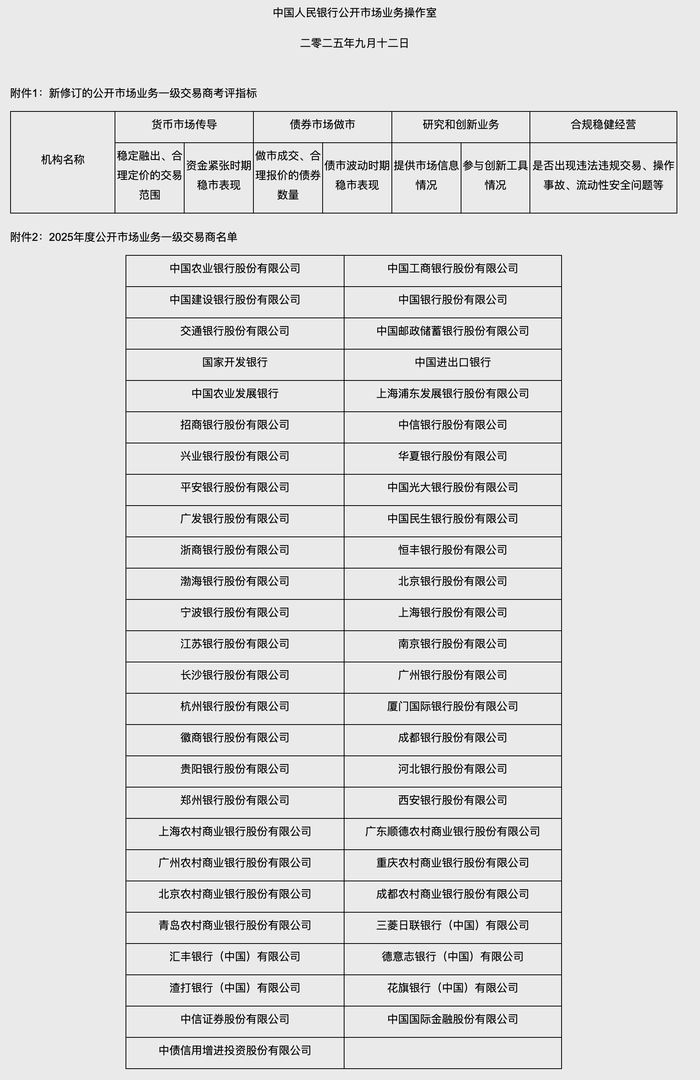
央行:调整后的一级交易商考评办法将从2025年启用,考评期内行为不当的一级交易商将被暂停参与公开市场操作
Sou Hu Cai Jing· 2025-09-12 10:45
Core Viewpoint - The People's Bank of China (PBOC) has established a new evaluation mechanism for primary dealers in the open market, which will be implemented in 2025, aiming to enhance the transmission of monetary policy and adapt to the evolving financial market [1]. Group 1: Evaluation Mechanism - The PBOC's evaluation mechanism for primary dealers was first established in 2004 and adjusted in 2018 to support smooth open market operations [1]. - The new evaluation method will focus on optimizing and simplifying assessment indicators, categorizing institutions for evaluation, and strengthening the linkage with bond market makers [1]. - The list of primary dealers for the year 2025 will remain unchanged, and any dealer exhibiting inappropriate behavior during the evaluation period may be suspended from participating in open market operations [1]. Group 2: Institutions Involved - A comprehensive list of institutions that will be evaluated includes major banks such as Agricultural Bank of China, Industrial and Commercial Bank of China, China Construction Bank, and Bank of China, among others [3][4]. - The evaluation will consider factors such as stable lending, reasonable pricing, market performance during tight funding periods, and compliance with operational standards [3].






成都银行跌2.10%,成交额3.09亿元,主力资金净流出2340.97万元
Xin Lang Zheng Quan· 2025-09-12 07:32
Core Viewpoint - Chengdu Bank's stock price has experienced fluctuations, with a current decline of 2.10% and a year-to-date increase of 12.34% [1] Group 1: Stock Performance - As of September 12, Chengdu Bank's stock price is 18.22 CNY per share, with a trading volume of 3.09 billion CNY and a turnover rate of 0.40%, resulting in a total market capitalization of 772.24 billion CNY [1] - The stock has seen a 0.66% increase over the last five trading days, a 0.05% increase over the last twenty days, and a 5.00% decrease over the last sixty days [1] Group 2: Financial Performance - For the first half of 2025, Chengdu Bank reported a net profit of 6.617 billion CNY, representing a year-on-year growth of 7.29% [1] - The bank has cumulatively distributed dividends of 17.856 billion CNY since its A-share listing, with 10.126 billion CNY distributed over the past three years [2] Group 3: Shareholder Information - As of June 30, 2025, the number of shareholders for Chengdu Bank is 44,600, a decrease of 1.83% from the previous period, with an average of 94,868 circulating shares per shareholder, an increase of 1.87% [1] - The top ten circulating shareholders include Hong Kong Central Clearing Limited, holding 247 million shares, an increase of 43.986 million shares from the previous period [2]
A股银行股走弱,浦发银行跌超3%
Ge Long Hui A P P· 2025-09-12 05:51
Group 1 - A-shares of bank stocks weakened, with notable declines in several banks including Shanghai Pudong Development Bank, which fell over 3% [1] - Qilu Bank experienced a decline of 2%, while other banks such as Chongqing Rural Commercial Bank, Chengdu Bank, and others saw drops exceeding 1% [1] - The overall market performance for these banks indicates a bearish trend in the banking sector [1] Group 2 - Shanghai Pudong Development Bank reported a decline of 3.68%, with a total market capitalization of 414.8 billion [2] - Qilu Bank's stock decreased by 2.07%, with a market value of 35 billion [2] - Other banks like Chongqing Rural Commercial Bank and Chengdu Bank also reported declines of 1.81% and 1.67% respectively, with market capitalizations of 73.8 billion and 77.6 billion [2]



银行股震荡回调,多家上市银行股东、董监高“趁机”增持
Sou Hu Cai Jing· 2025-09-11 10:19
Core Viewpoint - Several major shareholders and executives of listed banks have taken the opportunity to increase their holdings during the recent stock price fluctuations, reflecting confidence in the banks' fundamentals and future prospects, as well as highlighting the long-term investment value of bank stocks at current valuations, particularly their high dividend yields [2][5]. Group 1: Shareholder Actions - Since August, multiple listed banks, including Huaxia Bank, Chengdu Bank, Suzhou Bank, Nanjing Bank, Qingdao Bank, and Shanghai Bank, have announced plans or progress regarding share buybacks by major shareholders or executives [2][5]. - For instance, Nanjing Bank's major shareholder, Zijin Group's subsidiary, increased its holdings by 56.78 million shares, accounting for 0.46% of the total share capital, between July 18 and September 10 [2]. - Huaxia Bank completed its buyback plan by acquiring 4.23 million shares for a total of 31.9 million yuan, after initially announcing a plan to buy back at least 30 million yuan worth of shares [3][4]. Group 2: Market Context - The banking sector index has experienced a significant decline since reaching a peak around July 10, with smaller banks facing even larger drops [3][4]. - The stock price of Huaxia Bank fell from a high of 8.72 yuan per share on July 10 to 7.28 yuan per share by September 9 [4]. - Chengdu Bank's buyback plan was delayed due to its stock price exceeding the set upper limit, but it resumed with a total investment of 170 million yuan over a short period [4]. Group 3: Investment Sentiment - Analysts suggest that the recent buybacks by major shareholders and executives signal their recognition of the banks' long-term investment value and confidence in future operations, which can help stabilize stock price expectations [5][6]. - The banking sector is viewed as a defensive investment during market downturns due to its low valuations and high dividend characteristics, providing relatively stable returns [6]. - The banking sector index has seen a 64% increase from December 2023 to July 2025, with a maximum drawdown of over 10% in 2023 [7]. Group 4: Institutional Investment Trends - Insurance funds have increasingly targeted undervalued, large-cap, low-volatility banks, with several banks experiencing multiple stake increases from these funds [7]. - Public funds have also shown a rising interest in bank stocks, with the proportion of active public funds in bank stocks reaching 4.9% by the end of Q2, the highest since Q2 2021 [8]. - Despite the inflow of funds, there are concerns regarding net interest margin pressures and potential asset quality issues due to the real estate downturn, leading to some portfolio adjustments [8].



17年“桥梁”使命完成,成都银行外籍副董事长何维忠退休
Nan Fang Du Shi Bao· 2025-09-08 11:57
Core Viewpoint - The recent announcements from Chengdu Bank regarding the retirement of Vice Chairman Ho Wai Choong and the significant shareholding increase by state-owned enterprises indicate a new phase in the bank's collaboration with strategic investor Hong Leong Bank, reflecting local government confidence in the bank's long-term value [2][5]. Group 1: Management Changes - Ho Wai Choong, who served as Vice Chairman for 17 years, has officially retired and will no longer hold any positions within the company starting September 4, 2025 [3]. - His tenure is noted for facilitating the transformation of Chengdu Bank from attracting foreign investment to internalizing governance experiences, marking a shift towards self-optimization [4]. Group 2: State-Owned Enterprises' Shareholding Increase - On September 4, Chengdu Bank announced that state-owned shareholders, Chengdu Industrial Capital Holding Group and Chengdu Xintianyi Investment, have collectively increased their holdings by over 160 million yuan [5]. - Following this increase, Chengdu Industrial Capital's shareholding rose to 5.84%, while Chengdu Xintianyi's shareholding reached 3.90%, with both committing to not reduce their holdings within the legal timeframe [5]. Group 3: Business Development Potential - The combination of management changes and state-owned capital increases is expected to open new development opportunities for Chengdu Bank [6]. - The bank has achieved record performance in 2024, with total assets, deposits, and loans reaching 1.25 trillion yuan, 880 billion yuan, and 740 billion yuan respectively, marking a continuous growth trend [6]. - Chengdu Bank's non-performing loan ratio has decreased to a historical low of 0.66%, significantly better than the industry average, supported by a robust risk management system developed during Ho's tenure [6]. Group 4: Historical Context and Future Outlook - Chengdu Bank and Hong Leong Bank began their strategic partnership in 2007, with Hong Leong Bank becoming a significant shareholder in 2008 [7]. - The upcoming board seat replacements following Ho's retirement are anticipated to attract new international business collaborations, enhancing the bank's resource acquisition capabilities in areas like local infrastructure and green finance [8].
重要股东增持排行榜:9股增持金额超亿元
Zheng Quan Shi Bao Wang· 2025-09-08 01:37
Summary of Key Points Core Viewpoint - In the recent trading period from September 1 to September 5, a total of 33 companies experienced significant shareholder increases, with a cumulative increase of 393 million shares and a total investment of 6.151 billion yuan. Conversely, 160 companies saw shareholder reductions totaling 9.951 billion yuan [1]. Group 1: Shareholder Activity - The top three companies with the highest increase in shareholder investment were Gree Electric Appliances, with an increase of 41.86 million shares and an investment of 1.897 billion yuan; Yangtze Power, with 41.15 million shares and 1.164 billion yuan; and Chongqing Bank, with 55.6 million yuan [1]. - Three companies had shareholders increase their stakes more than twice in the past five days: Chengdu Bank, Xue Tian Salt Industry, and Jiaoda Sino [1]. - The distribution of shareholder increases showed that 2 companies were from the ChiNext board, 27 from the main board, and 4 from the Sci-Tech Innovation board, with the main board accounting for the majority of the investment [1]. Group 2: Market Performance - The average stock price of companies with shareholder increases fell by 1.80% over the past five days, underperforming the Shanghai Composite Index [2]. - Notable gainers included Nanfang Network Energy, Xue Tian Salt Industry, and Sailun Tire, with increases of 7.38%, 5.42%, and 4.94%, respectively [2]. - The companies with the largest net outflows included Gree Electric Appliances and Kweichow Moutai, with outflows of 1.010 billion yuan and 474 million yuan, respectively [2]. Group 3: Detailed Company Data - A detailed list of companies with shareholder increases included Gree Electric Appliances (41.86 million shares, 1.897 billion yuan, -2.91%), Yangtze Power (41.15 million shares, 1.164 billion yuan, -0.07%), and Chongqing Bank (52 million shares, 556.4 million yuan, -2.44%) [2][3]. - Other companies with significant shareholder increases included Chengdu Bank, Xue Tian Salt Industry, and Nanfang Network Energy, with respective increases and performance metrics detailed [3][4].



本周聚焦:2025上半年银行确认了多少金融资产处置收益?OCI浮盈有多少?
GOLDEN SUN SECURITIES· 2025-09-07 08:20
Investment Rating - The report maintains an "Increase" rating for the banking sector, indicating a positive outlook for the industry [1]. Core Insights - In the first half of 2025, the contribution of financial asset disposal gains from AC and OCI accounts to revenue reached 5.2%, an increase of 2.9 percentage points compared to 2024 [1][2]. - The investment income growth rate for 42 listed banks was 23.6%, with AC, OCI, and TPL gains showing year-on-year growth rates of 134.7%, 79.0%, and -8.4% respectively [1]. - The report highlights that the increase in disposal gains does not necessarily indicate a significant increase in asset disposal scale, as market conditions and strategies vary among banks [2]. Financial Asset Disposal Gains - The contribution of AC and OCI financial asset disposal gains to revenue was 5.2%, up 2.9 percentage points from 2024, with AC asset disposal gains contributing 2.6% [2]. - Among different types of banks, rural commercial banks had the highest contribution from AC and OCI disposal gains, reaching 11.0%, an increase of 6.2 percentage points from 2024 [2]. - Specific banks such as Jiangyin Bank, Sunong Bank, and Zijin Bank had high disposal gain ratios relative to their revenue, at 28.9%, 26.7%, and 22.7% respectively [2]. OCI Floating Profit Situation - The overall OCI floating profit decreased compared to the end of the previous year, accounting for 12.6% of the estimated profit for 2025 [3]. - Major state-owned banks like CCB and ABC reported significant OCI floating profits, with balances exceeding 30 billion [3]. - The average contribution of OCI floating profits to profits for city and rural commercial banks was notably high, with Ningbo Bank's ratio reaching 35% [3][6]. Sector Trends - The banking sector is expected to benefit from expansionary policies aimed at stabilizing the economy, with a focus on real estate and consumer spending [7]. - The report suggests a focus on banks with improving fundamentals, such as Ningbo Bank, and those with dividend strategies like Jiangsu Bank and Chengdu Bank [7]. - Attention is also drawn to banks with potential convertible bond conversion expectations, including Shanghai Bank and Industrial Bank [7].
成都银行上半年财报:盈利、风险、资本、监管四重挑战
Zheng Quan Zhi Xing· 2025-09-07 07:50
Group 1: Profitability and Business Performance - Chengdu Bank reported a revenue of 12.27 billion yuan, a year-on-year increase of 5.91%, and a net profit of 6.62 billion yuan, up 7.29% year-on-year, indicating positive growth but a significant slowdown compared to previous years [4][5] - The net profit growth rate of 7.29% is notably lower than the double-digit growth seen in some peer banks, reflecting insufficient momentum in profitability [4][5] - The bank's net income from fees and commissions dropped sharply by 45% year-on-year to 250 million yuan, primarily due to a decrease in wealth management fees, highlighting challenges in its intermediary business [4][5] Group 2: Asset Quality and Risk Exposure - Chengdu Bank's non-performing loan (NPL) ratio remained stable at 0.66%, but the provision coverage ratio fell by 26.64 percentage points to 452.65%, indicating increased asset quality pressure [7][9] - The NPL rates in specific sectors such as real estate and wholesale retail have risen, with the real estate NPL rate at 2.44%, up 29 basis points, and the wholesale retail NPL rate at 2.09%, up 32 basis points [7][8] - The total overdue loans increased significantly to 6.40 billion yuan from 5.22 billion yuan at the end of the previous year, with various overdue categories showing growth, indicating escalating credit risk [9][12] Group 3: Capital Adequacy and Regulatory Challenges - The core tier one capital adequacy ratio decreased to 8.61%, down 0.45 percentage points from the end of 2024, while the overall capital adequacy ratio fell to 13.13%, down 0.75 percentage points [13][14] - Despite meeting regulatory minimum requirements, the declining trend in capital adequacy ratios raises concerns, especially in a challenging risk management environment [13][14] - Chengdu Bank received a regulatory warning in January 2025 for deficiencies in its fund sales business, reflecting weaknesses in internal controls and compliance management [14][15]