CCB(601939)

Search documents
金融赋能激发消费活力 “贷”来美好生活新图景
Ren Min Wang· 2025-11-13 11:11
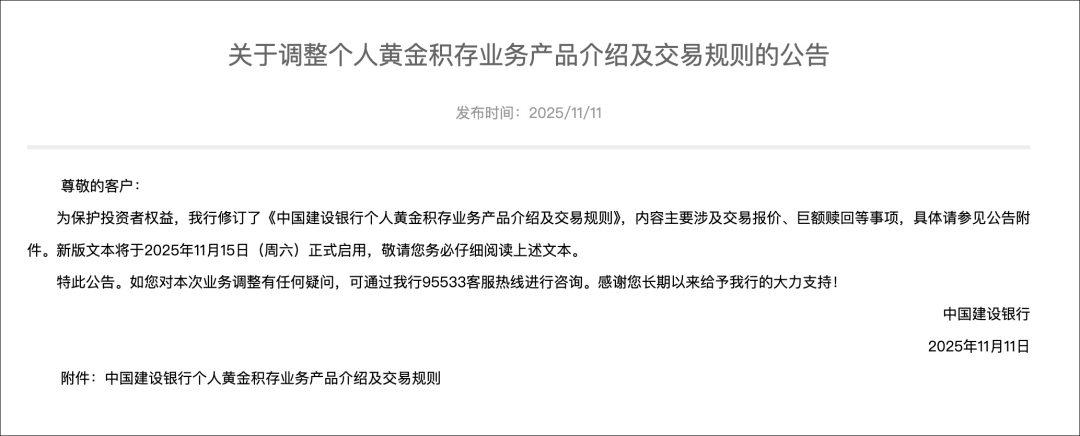
Core Viewpoint - The article discusses the importance of financial support in boosting consumer spending and enhancing the overall economy in China, as outlined in the "Guiding Opinions on Financial Support for Boosting and Expanding Consumption" issued by the People's Bank of China and other departments [1][4]. Financial Service Expansion - Financial services are being integrated with consumer scenarios to create a diversified consumption ecosystem, with a focus on enhancing service capabilities and meeting new consumer demands [1][3]. - The "One Mobile Phone to Explore Business Circle" platform launched by China Construction Bank in collaboration with the Yunnan Provincial Department of Commerce has attracted over 27,000 merchants and created 493 new "15-minute convenient living circles" [3][4]. Credit Support for Key Sectors - China Construction Bank has initiated a special action for consumer finance, aiming for a full-chain integration of credit, scenarios, payments, and derivative services by early 2025 [4]. - The bank has issued over 20.9 billion yuan in government consumption subsidies, stimulating consumption transactions exceeding 151.1 billion yuan, with personal consumer loans reaching 652.7 billion yuan [4][6]. Service Consumption Focus - The bank emphasizes the importance of service consumption in improving people's livelihoods, with a focus on sectors like tourism, culture, sports, health, education, and elderly care, which have seen loan growth exceeding 60% since the end of 2022 [6][10]. - Financial institutions are encouraged to innovate products and expand customer bases in the service consumption sector, which is seen as a significant opportunity for economic growth [6][10]. Infrastructure Financial Support - Financial support for infrastructure is crucial for enhancing consumption supply efficiency, with significant investments in agricultural projects like the blueberry cultivation initiative in Yunnan [7][10]. - China Construction Bank has provided 1.7 billion yuan in loans for infrastructure projects, covering irrigation for over 91,200 acres and benefiting nearly 20,000 ordinary farmers [10][11].



银行2025年三季报综述:息差筑底,手续费改善,国有行全部营利双增
China Post Securities· 2025-11-13 10:57
Industry Investment Rating - The industry investment rating is maintained at "Outperform" [2] Core Viewpoints - The overall operating income, pre-provision profit, and net profit growth rates for listed banks in the first three quarters of 2025 are 0.91%, 0.56%, and 1.48% respectively, indicating a recovery in performance driven by scale and an ongoing improvement in fee income [4][12] - The growth rate of interest-earning assets for listed banks is 9.40% year-on-year, with loans and debt investments increasing by 7.83% and 13.94% respectively [4][5] - The net interest margin for listed banks is stable at 1.35%, with a slight decline in state-owned banks, while other types of banks have stabilized [5] - Non-interest income has increased by 5.02% year-on-year, although it has seen a quarter-on-quarter decline due to adjustments in the bond market [5] - The asset quality is improving, with the non-performing loan ratio at 1.23%, showing a slight decrease from the previous half-year [5] Summary by Sections 1. Performance Recovery Driven by Scale and Fee Improvement - In the first three quarters of 2025, listed banks showed a growth in operating income, pre-provision profit, and net profit, with respective growth rates of 0.91%, 0.56%, and 1.48% [12] - City commercial banks outperformed other types of banks, while state-owned banks also showed positive growth [12] 2. Growth of Interest-Earning Assets and Slower Expansion of Liabilities - The year-on-year growth rate of interest-earning assets for listed banks is 9.40%, with loans and debt investments increasing by 7.83% and 13.94% respectively [4][5] 3. Stabilization of Net Interest Margin - The net interest margin for listed banks is stable at 1.35%, with a slight decline in state-owned banks [5] 4. Non-Interest Income Performance Affected by Bond Market Adjustments - Non-interest income increased by 5.02% year-on-year, but saw a quarter-on-quarter decline due to bond market adjustments [5] 5. Improvement in Asset Quality and Declining Credit Costs - The non-performing loan ratio for listed banks is 1.23%, showing a slight decrease from the previous half-year, with a significant decline in credit costs [5][12] 6. Investment Recommendations - Focus on banks with significant deposit maturities and potential for interest margin improvement, such as Chongqing Bank, China Merchants Bank, and Bank of Communications [6] - Attention to city commercial banks that will benefit from improvements in fixed asset investment, such as Jiangsu Bank, Qilu Bank, and Qingdao Bank [6]




中信、建行等多家银行宣布,上调积存金起购门槛
Xin Lang Cai Jing· 2025-11-13 10:56
Core Viewpoint - Several banks in China, including CITIC Bank and China Construction Bank, have announced an increase in the minimum investment threshold for gold accumulation products due to rising gold prices [1] Group 1: Bank Announcements - CITIC Bank will raise the minimum investment amount for its gold accumulation plan from 1,000 yuan to 1,500 yuan starting November 15, 2025 [1] - China Construction Bank will increase its minimum investment amount from 1,000 yuan to 1,200 yuan, effective the same date [1] - Other banks, such as Bank of China, Industrial and Commercial Bank of China, and Ningbo Bank, have also raised their minimum thresholds for gold accumulation products, surpassing the 1,000 yuan mark [1] Group 2: Changes in Investment Structure - Some banks are shifting their gold accumulation product structure from a fixed amount to a model that fluctuates with gold prices [1]

“银行直供房,不计成本卖”有的半价出售流拍,有的加价100万元抢拍
Mei Ri Jing Ji Xin Wen· 2025-11-13 10:03
Core Viewpoint - The emergence of a "bank direct supply housing" market is noted, where banks are selling properties at significantly lower prices than the market rate, yet many properties are failing to attract bids, indicating a potential mismatch between supply and demand [2][4][20]. Group 1: Market Dynamics - On November 10, the Lanzhou Rural Commercial Bank auctioned over a hundred residential units at prices as low as half the market rate, but all units received zero bids, leading to a failed auction [2][4]. - Major banks, including Agricultural Bank and various city commercial banks, are actively listing thousands of properties for direct sale, with Agricultural Bank listing 3,436 properties and Guangdong Rural Credit System exceeding 12,000 [3][10]. - The properties being sold are primarily non-performing assets, often resulting from loans that borrowers could not repay, and banks are under pressure to liquidate these assets within two years [4][16]. Group 2: Pricing and Demand - The starting prices for bank-supplied properties can be as low as 2,000 yuan per square meter, significantly below the market average of around 5,000 yuan per square meter, yet this has not translated into sales [4][20]. - Despite the attractive pricing, properties like those from the "育才壹品" project have not seen any successful bids, highlighting a potential lack of buyer interest or confidence in these offerings [20]. - In contrast, properties previously used as bank offices are in high demand, with some selling for prices significantly above their starting bids, indicating a differentiated market response based on property type [2][16]. Group 3: Asset Liquidation Process - The increase in bank direct supply housing is closely tied to the disposal of non-performing loans, with banks utilizing both judicial and non-judicial methods to recover debts [16][17]. - The judicial auction process typically starts at 70% of the appraised value, with subsequent rounds reducing the price further, leading to properties being sold at approximately 56% of their original appraised value after multiple rounds [17]. - The case of Lanzhou Rural Commercial Bank illustrates this process, where properties were acquired through court enforcement after the original borrower defaulted on a significant loan [17].




黄金,4连涨
Zhong Guo Xin Wen Wang· 2025-11-13 09:33
Core Insights - International gold prices have experienced a significant increase, marking a fourth consecutive day of gains, with prices surpassing $4200 per ounce [1][3]. Gold Market Dynamics - On November 12, COMEX gold rose by 2.07% to $4201.4 per ounce, while London spot gold closed at $4194.605 per ounce, up 1.68% [1]. - Domestic gold jewelry prices have adjusted accordingly, with notable increases in prices from major retailers such as Chow Tai Fook and Chow Sang Sang [3]. - The recent rise in gold prices is influenced by a decline in U.S. Treasury yields and expectations of a potential interest rate cut by the Federal Reserve in December [3][4]. Economic Factors - The U.S. government shutdown has created economic pressures, leading to a reliance on private indicators for economic assessment [3]. - The labor market in the U.S. remains weak, as indicated by data from ADP, contributing to the demand for gold as a safe-haven asset [3][4]. Central Bank Actions - The trend of monetary easing continues, with expectations of a cumulative 25 basis points rate cut by the Federal Reserve this year, supporting the value of gold [4]. - Global central banks have maintained a strong demand for gold, with an average net purchase of over 1000 tons per year since 2022, significantly above previous averages [4]. Investor Behavior - The demand for gold as a hedge against uncertainty remains robust, driven by various geopolitical risks [4]. - Investors are advised to monitor market changes closely and manage their gold investments based on personal risk tolerance and investment needs [4]. Banking Adjustments - Recent adjustments in gold accumulation business by domestic banks, such as Citic Bank and China Construction Bank, reflect changing market conditions [4][6]. - China Construction Bank has introduced new rules regarding large redemptions, which may affect liquidity for investors [6].

“银行直供房,不计成本卖!”有的半价出售,众多刚需还不知道!银行用过的房很抢手,有人加价100万元抢拍
Mei Ri Jing Ji Xin Wen· 2025-11-13 09:25
Core Insights - The article highlights the emergence of a "bank direct supply housing" market, where banks are selling properties at significantly discounted prices, often around half of the market value, but facing challenges in attracting buyers [2][6][24]. Group 1: Bank Direct Supply Housing - The "Yucai Yipin" residential units listed by Lanzhou Rural Commercial Bank on JD Asset Platform were auctioned at prices as low as 7,000 to 11,000 yuan, translating to approximately 2,000 yuan per square meter, which is significantly lower than the market price of around 5,000 yuan per square meter [6][24]. - Major banks, including state-owned and city commercial banks, are increasingly engaging in direct sales of properties to quickly liquidate non-performing assets, with thousands of properties listed for sale [6][14]. - As of November 10, 2023, JD Asset Platform had 414 residential and 957 commercial properties listed by banks, indicating a substantial increase compared to the previous year [9]. Group 2: Non-Performing Asset Disposal - The rise in bank direct supply housing is closely linked to the disposal of non-performing assets, primarily properties that serve as collateral for loans that borrowers have defaulted on [20][21]. - Traditional methods of disposing of non-performing loans, such as selling debt to third parties or through judicial auctions, have become increasingly slow and inefficient, prompting banks to explore direct sales [33][36]. - The process of judicial auctions often results in properties being sold at a significant discount, with average starting prices around 70% of the appraised value, leading to further price reductions if properties do not sell [21][36]. Group 3: Market Reception and Challenges - Despite the attractive pricing of bank direct supply housing, the sales performance has been disappointing, with many properties, including those at over 50% discounts, failing to attract bids [27][42]. - Certain types of properties, such as former bank office buildings, have seen higher demand and successful sales, indicating a market preference for specific asset types [28]. - The disconnect between the marketing of these properties and the actual demand from potential buyers, particularly in lower-tier cities, poses a significant challenge for banks in effectively liquidating these assets [41][42].

国有大型银行板块11月13日跌0.19%,邮储银行领跌,主力资金净流出2.97亿元
Zheng Xing Xing Ye Ri Bao· 2025-11-13 08:45
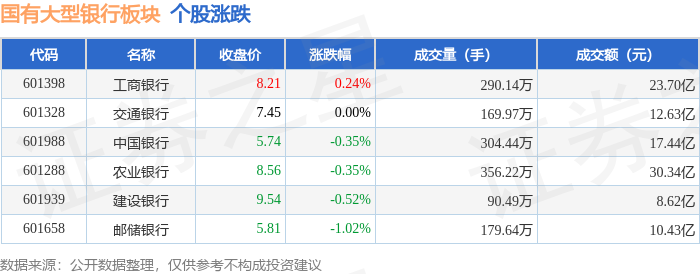
Core Insights - The state-owned large bank sector experienced a decline of 0.19% on November 13, with Postal Savings Bank leading the drop [1] - The Shanghai Composite Index closed at 4029.5, up 0.73%, while the Shenzhen Component Index closed at 13476.52, up 1.78% [1] Bank Performance Summary - Industrial and Commercial Bank of China (ICBC) closed at 8.21, with a slight increase of 0.24% and a trading volume of 2.9014 million shares [1] - Bank of Communications remained unchanged at 7.45, with a trading volume of 1.6997 million shares [1] - China Bank closed at 5.74, down 0.35%, with a trading volume of 3.0444 million shares [1] - Agricultural Bank of China closed at 8.56, down 0.35%, with a trading volume of 3.5622 million shares [1] - China Construction Bank closed at 9.54, down 0.52%, with a trading volume of 904,900 shares [1] - Postal Savings Bank closed at 5.81, down 1.02%, with a trading volume of 1.7964 million shares [1] Fund Flow Analysis - The state-owned large bank sector saw a net outflow of 297 million yuan from main funds, while speculative funds had a net inflow of 355 million yuan [1] - Retail investors experienced a net outflow of 58.1835 million yuan [1] Individual Bank Fund Flow - Bank of Communications had a main fund net inflow of 30.3628 million yuan, while retail investors saw a net outflow of 33.0669 million yuan [2] - ICBC experienced a main fund net outflow of 6.8361 million yuan, with speculative funds seeing a net inflow of 30.1024 million yuan [2] - China Construction Bank had a main fund net outflow of 18.4073 million yuan, with speculative funds seeing a net inflow of 25.9620 million yuan [2] - China Bank faced a significant main fund net outflow of 89.5407 million yuan, while speculative funds had a net inflow of 55.9172 million yuan [2] - Agricultural Bank of China had a main fund net outflow of 104 million yuan, with speculative funds seeing a net inflow of 125 million yuan [2] - Postal Savings Bank experienced a main fund net outflow of 109 million yuan, while speculative funds had a net inflow of 115 million yuan [2]
中电建设完成建行数据中心高压送电 项目建设取得阶段性进展
Xin Hua Cai Jing· 2025-11-13 07:40
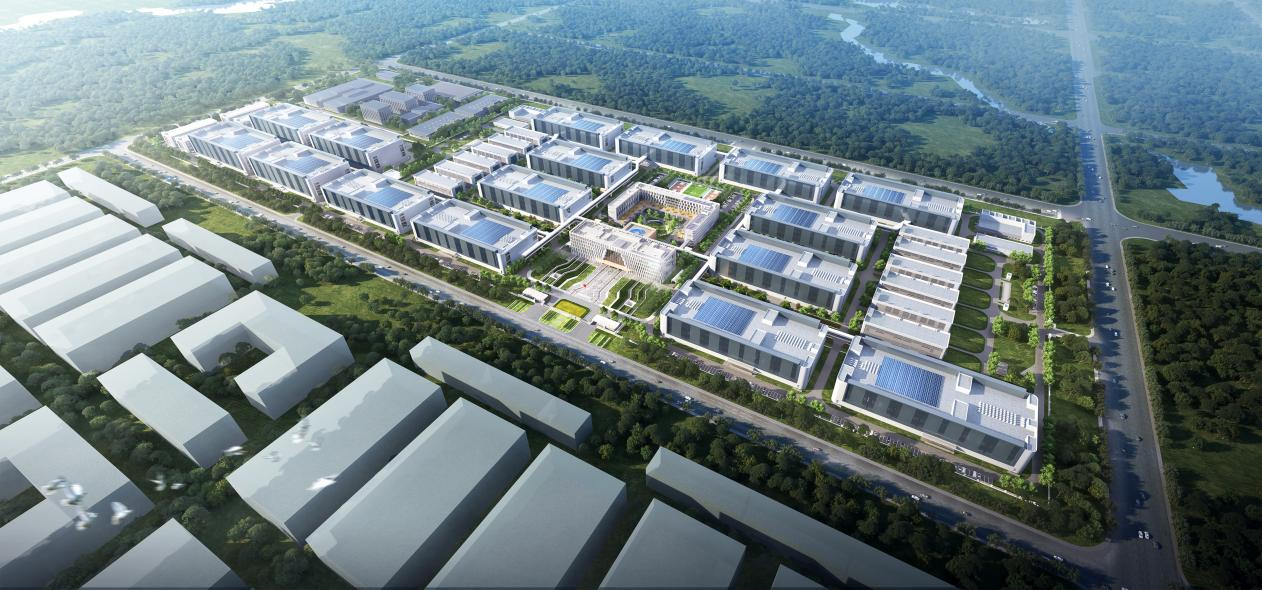
Core Insights - The China Construction Bank's data center project in Inner Mongolia has made significant progress, transitioning from the construction phase to the operational preparation phase after successfully completing the 10KV high-voltage power supply task [1][3] - The data center, covering an area of approximately 190,600 square meters, is designed to house no fewer than 9,560 server cabinets and adheres to the A-level standards of the "Data Center Design Specification" [1] - The project aims to be a green and low-carbon demonstration project in the financial sector, with an expected Power Usage Effectiveness (PUE) value of below 1.188, providing secure and reliable computing and storage services for "Bank of China Cloud" [1] Project Development - The successful completion of the high-voltage power supply is a critical milestone that significantly advances the overall project timeline, allowing for valuable time savings in subsequent equipment debugging and system deployment [3] - The project team from China Electric Construction has demonstrated technical expertise in data center construction, ensuring a successful first-time power supply [3] - The project is expected to enhance the information technology level of the financial industry in China and provide important support for the development of the digital economy [3] Sustainability and Innovation - The project incorporates advanced energy-saving technologies and aims to serve as a beneficial reference for sustainable development in the industry [3]
黄金大消息!银行收紧淘金路,多家银行门槛提至千元!
Sou Hu Cai Jing· 2025-11-13 07:09
Core Viewpoint - Several banks are adjusting their gold accumulation business rules in response to fluctuating gold prices, aiming to protect investors and manage market risks [1][3][4]. Group 1: Bank Adjustments - China Construction Bank revised its gold accumulation business rules, effective November 15, 2025, including changes to transaction pricing and large redemptions [1][4]. - The minimum monthly accumulation amount for individual clients at China Construction Bank has been raised to 1,200 yuan, with increments of 10 yuan [1][4]. - CITIC Bank announced an increase in the minimum investment amount for its gold accumulation plan from 1,000 yuan to 1,500 yuan, effective the same date [1][7]. Group 2: Market Conditions - As of November 11, international gold prices reached 4,140 USD per ounce, while domestic prices were at 948.23 yuan per gram [3][9]. - The adjustments by banks reflect increased volatility in gold prices and heightened investment risks, with banks aiming to curb irrational investments by raising thresholds and revising rules [3][8]. Group 3: Pricing Mechanism - China Construction Bank's pricing for gold accumulation includes proactive accumulation price, regular accumulation price, and redemption price, with the latter being based on the active accumulation price at 10:30 AM [5][4]. - The bank reserves the right to adjust the pricing based on market conditions, and the buy-sell spread may vary, impacting transaction costs for clients [5][4]. Group 4: Investor Implications - The increase in thresholds directly limits participation from small investors, while rule optimizations and redemption restrictions may affect liquidity [8]. - The potential risks in gold accumulation business include market liquidity risk, operational risk, and credit risk, especially during periods of price volatility [8][9].
银行掀起房产直售潮,低价背后双重市场逻辑与购房新变
Sou Hu Cai Jing· 2025-11-13 07:01
Core Insights - The banking sector in China is experiencing an unprecedented wave of direct property sales, with institutions like Lanzhou Bank and Agricultural Bank selling properties at prices up to 25% below market value, reflecting a unique financial market ecology and providing rare opportunities for buyers [1][4] Group 1: Scale of Direct Property Sales - Lanzhou Rural Commercial Bank has listed nearly 200 properties in late October, with a total of 720 properties on the JD platform, including 630 newly added this year [3] - Other banks are also participating significantly, with Jilin Bank listing 2,099 properties, Tianjin Bank 1,227, and Zhongyuan Bank 521 [3] - The scale of asset disposal in the rural credit system is even more remarkable, with Guangdong Rural Credit listing 12,386 properties and Sichuan Rural Credit reaching 24,821 [3] Group 2: Source of Properties - Most properties are acquired by banks through "debt-for-assets" arrangements, such as Lanzhou Rural Commercial Bank obtaining over 250 residential units from a developer unable to repay a loan totaling 460 million yuan [3] - Similar cases are reported nationwide, with banks acquiring properties and land in various regions due to borrowers' defaults [3] Group 3: Price Advantages and Market Conditions - Bank direct sales offer significant price advantages, with properties in Lanzhou selling for 151 million yuan, 30-70 million yuan below market prices [4] - Despite attractive pricing, actual transaction rates are low, with some properties experiencing multiple failed sales [4] - The urgency for banks to recover funds quickly and the prolonged traditional asset disposal cycle are driving this trend, as personal loan default rates rise significantly [4] Group 4: Implications for Buyers and Market Dynamics - Buyers should approach bank direct sales with caution, as while properties have clear titles and avoid common issues associated with auctioned properties, some may have location or amenity drawbacks [5] - The ongoing direct sales trend will be influenced by macroeconomic conditions, real estate market regulations, and banks' strategies for handling non-performing assets [5] - This wave of asset disposal represents a significant risk clearing for banks and poses a challenge to their asset management capabilities, while also potentially exerting downward pressure on local property prices [5]