
CCB(601939)

Search documents
财政部等四部门发布关于优化实施设备更新贷款财政贴息政策的通知
Xin Lang Cai Jing· 2026-01-20 04:32
Core Viewpoint - The Ministry of Finance and other departments have issued a notice to optimize the implementation of the equipment renewal loan interest subsidy policy, aimed at supporting enterprises in equipment updates and technological transformation, reducing financing costs, and promoting effective investment [1] Group 1: Support Scope and Areas - The central government will subsidize 1.5% of the principal on fixed asset loans for equipment renewal projects, applicable for a maximum of 2 years from the loan issuance date [1] - The policy will include new technology innovation loans issued by banks starting in 2026, expanding the support to various sectors including construction, aviation, and artificial intelligence, among others [1] Group 2: Implementation and Management - A total of 26 banks will handle the interest subsidy loans, including major state-owned and commercial banks [2] - The subsidy process will be optimized through a "pre-allocation + settlement" method, with specific timelines for fund requests and approvals [3] - The Ministry of Finance and other regulatory bodies will oversee the implementation, ensuring compliance and monitoring of fund usage [4][5] Group 3: Supervision and Reporting - Joint inspections will be conducted to ensure compliance, with penalties for serious violations by enterprises or banks involved in the subsidy process [5] - Banks are required to report on the execution of the policy, including loan issuance and subsidy usage, within specified timeframes [6]






五部门发布实施中小微企业贷款贴息政策通知 支持以人工智能等为代表的新兴领域
智通财经网· 2026-01-20 04:27
Core Viewpoint - The Chinese government has announced a loan interest subsidy policy aimed at supporting small and micro enterprises in key industries, effective from January 1, 2026, with a subsidy rate of 1.5% for loans up to 50 million yuan per enterprise [1][4]. Group 1: Policy Content - The policy targets small and micro private enterprises involved in key industrial chains and their upstream and downstream sectors [3]. - Eligible industries include new energy vehicles, industrial mother machines, pharmaceuticals, medical equipment, software, civil aircraft, servers, mobile communication devices, new displays, industrial robots, and agricultural machinery [4]. - The subsidy will be provided for fixed asset loans and new policy financial tools used by small and micro enterprises [4]. Group 2: Subsidy Standards - The central government will provide a 1.5% annual interest subsidy for eligible loans, with a maximum loan amount of 50 million yuan per enterprise and a term not exceeding 2 years [4]. - The policy is initially set to last for one year, with the possibility of extension based on future evaluations [4]. Group 3: Implementation Mechanism - The policy will be executed through a "total-to-total" model, where financial departments will coordinate directly with banks [5][6]. - Banks will be responsible for loan approvals based on market principles and will manage the disbursement of funds [7]. - Monthly reporting on loan issuance and subsidy usage will be required from banks to ensure compliance and oversight [9]. Group 4: Supervision and Management - The Ministry of Finance will oversee the implementation and conduct audits to ensure proper use of subsidy funds [10]. - Banks are required to monitor the flow of loan funds to prevent misuse, such as investment in speculative activities [10].
盘中,涨停!A股,突然异动!
Zhong Guo Ji Jin Bao· 2026-01-20 04:23
Market Overview - A-shares opened high but closed lower, with the Shanghai Composite Index down 0.3% at 4101.62 points, Shenzhen Component down 1.22%, and ChiNext Index down 1.83% [1] - The total trading volume in the Shanghai and Shenzhen markets reached 1.85 trillion yuan, an increase of 568 billion yuan compared to the previous trading day [2] Sector Performance - The communication equipment, aerospace military, electronic components, basic metals, and energy equipment sectors experienced significant declines [2] - The banking and insurance sectors saw a notable rise, with food and beverage, real estate, and semiconductor sectors also performing well [2] Banking and Insurance Sector - The banking and insurance sector showed resilience, with major insurance stocks like China Life and Ping An rising over 1% [3] - Key banking stocks such as CITIC Bank increased by over 2%, while other banks like China Construction Bank and Bank of China rose by over 1% [5] - A report from China Galaxy Securities indicated that structural monetary policy tools and a marginal improvement in RMB credit could support bank lending [5] Food and Beverage Sector - The food and beverage sector was active, with food processing stocks leading the gains, including Hongmian Co., Jingji Zhino, and Weizhi Xiang, all hitting the daily limit [6] - Notable performers included Hongmian Co. with a 10.13% increase and Jingji Zhino with a 10.01% increase [7] Real Estate Sector - The real estate sector showed a rebound, with stocks like Dayue City and Chengtou Holdings hitting the daily limit, and others like China Merchants Shekou and Binjiang Group rising over 5% [8] - Recent data from the National Bureau of Statistics indicated a slight decrease in new residential sales prices in first-tier cities, which may influence market sentiment [10] Aerospace and Military Sector - The aerospace and military sector faced significant declines, with stocks like Tongyu Communication and Aerospace Power hitting the daily limit down, and Aerospace Hongtu dropping 13% [11] - Other companies in the sector, such as China Satellite and China Aerospace, also saw declines exceeding 6% [12]



建设银行盐城分行以金融之力服务发展大局
Sou Hu Cai Jing· 2026-01-20 03:59
Group 1 - The core objective of the bank is to promote "qualitative effective enhancement and reasonable quantitative growth" in the economy, aligning with the central economic work conference's directives [1] - The bank aims to provide precise financial services to support national strategies and key sectors of the real economy, focusing on domestic market development and the dual emphasis on consumption and investment [1] - The bank is committed to supporting technological innovation and modern industrial systems, with a specific initiative to assist local aquaculture businesses in transforming through live-streaming e-commerce [1] Group 2 - The bank is implementing measures to reduce financing costs for small and micro enterprises and is actively promoting green development in line with the "dual carbon" strategy, with green loan balances growing at a rate of 34.15% [1] - The bank is focused on risk management by adhering to city-specific policies to support housing demand and by collaborating with local governments to mitigate existing debt risks, ensuring no systemic risks arise [2] - The bank emphasizes strengthening its comprehensive risk management system and internal compliance to maintain asset quality and achieve sustainable development [2]
商业银行赋能“冷资源”变“热经济”
Zheng Quan Ri Bao· 2026-01-19 16:44
Core Insights - The winter ice and snow economy is becoming a significant driver for consumption upgrades, regional development, and industrial integration, supported by innovative financial services from banks [1] Group 1: Financial Support for the Ice and Snow Economy - Banks are embedding services throughout the entire ice and snow economy chain, providing differentiated financial support tailored to various segments such as infrastructure, equipment manufacturing, and tourism [2] - Construction Bank's Heilongjiang branch has provided billions in loans for major infrastructure projects to enhance tourism connectivity between key ice and snow attractions [2] - Agricultural Bank of China quickly issued a 2.73 million yuan loan to a local beverage company facing cash flow issues during peak tourism season, demonstrating the banks' responsiveness to small and micro enterprises [2][3] Group 2: Support for Small and Micro Enterprises - Small and micro enterprises are crucial to the ice and snow economy, with Construction Bank providing over 100 million yuan in credit support to more than 130 hotels and restaurants in Heilongjiang since 2025 [3] - Financial institutions are actively identifying and addressing the funding needs of local businesses, ensuring they can upgrade facilities and meet increased demand during the winter season [3] Group 3: Consumer Experience and Payment Solutions - Banks are enhancing consumer experiences by integrating financial services into consumption scenarios, such as the "Love Ice and Snow Carnival" campaign by Industrial and Commercial Bank of China, which offers discounts to stimulate spending [4] - Agricultural Bank and Construction Bank have established "Ice and Snow Stations" to provide free services like hot drinks and luggage storage, improving visitor satisfaction [5][6] - The introduction of comprehensive payment solutions, including support for international card payments, aims to accommodate diverse consumer payment preferences [5] Group 4: Future Projections and Strategic Directions - The "China Ice and Snow Tourism Development Report (2026)" predicts that ice and snow tourism will attract 360 million visitors and generate 450 billion yuan in revenue during the 2025-2026 winter season [6] - Financial institutions are encouraged to leverage technology and green finance to support high-tech equipment production and eco-tourism projects, enhancing the overall ice and snow industry [6]

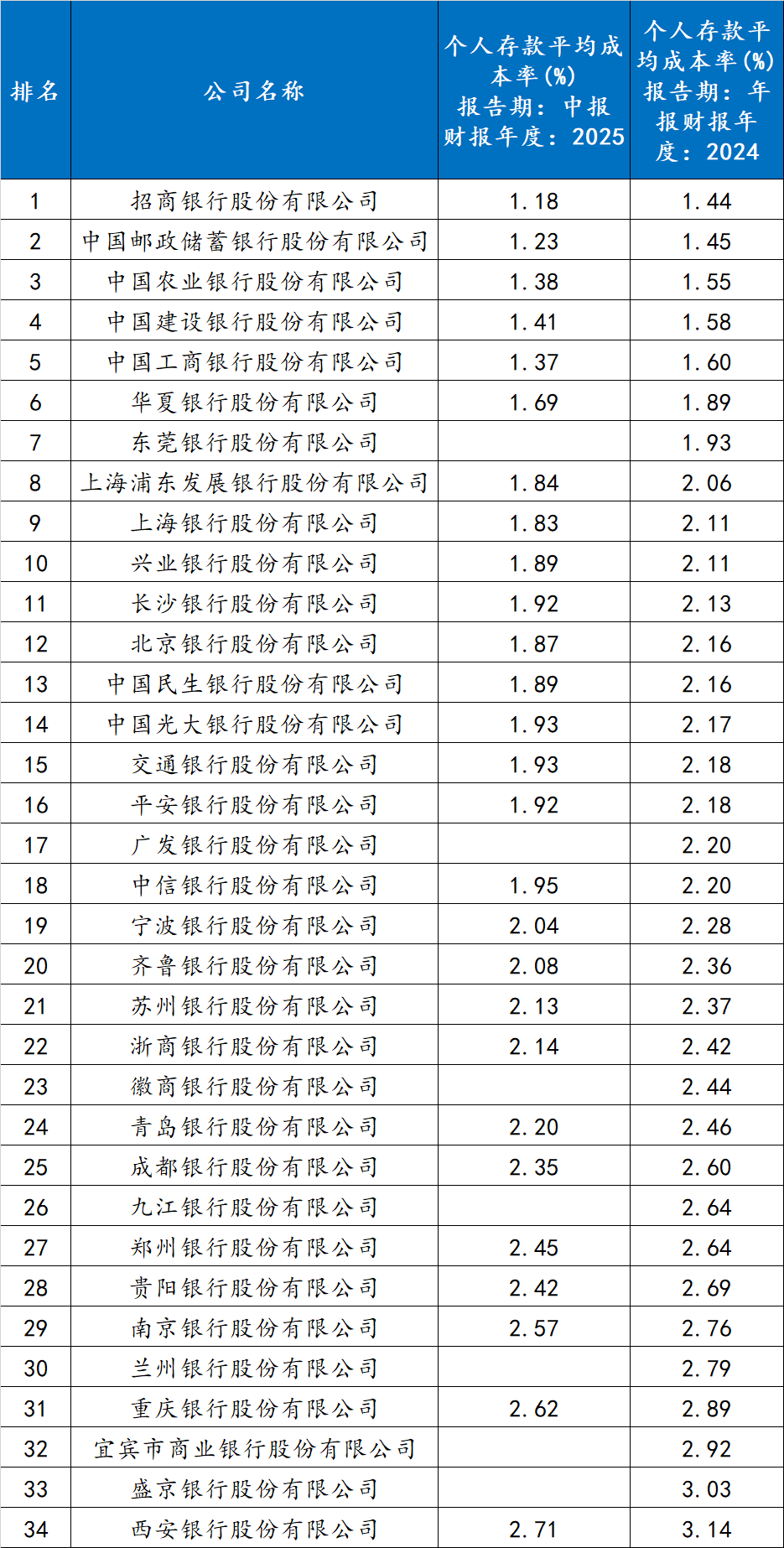
银行个人负债成本排名
Xin Lang Cai Jing· 2026-01-19 13:16
Core Insights - The average cost of personal deposits is a key indicator of banks' liability costs, with lower rates indicating stronger competitiveness in attracting deposits [1][7]. Group 1: Ranking of Banks by Deposit Cost - The banks with the lowest average cost of personal deposits are primarily state-owned large banks and some retail-focused joint-stock banks, with China Merchants Bank leading at 1.18% for the 2025 mid-year report [2][8]. - Following China Merchants Bank are China Postal Savings Bank at 1.23% and Agricultural Bank of China at 1.38%, benefiting from extensive branch networks and strong customer bases [2][8]. - The top six banks all have costs below 2%, indicating strong deposit cost control capabilities [2][8]. Group 2: Cost Trends and Observations - A notable trend is the general decline in average deposit costs across most banks when comparing 2024 annual reports to 2025 mid-year reports, with China Merchants Bank decreasing from 1.44% to 1.18% [6][12]. - This decline reflects a reduction in liability cost pressures for the banking industry, positively impacting net interest margins and profitability [6][12]. - However, lower deposit costs must align with asset yield and risk management capabilities, as a healthy bank seeks to balance these factors [12]. Group 3: Challenges for Joint-Stock and Regional Banks - Joint-stock banks and regional commercial banks generally face higher average deposit costs, often exceeding 2%, which can challenge their net interest margin management [5][11]. - National joint-stock banks like Industrial Bank and Minsheng Bank have costs ranging from 2.11% to 2.18%, while some regional banks experience even greater cost pressures [5][11].

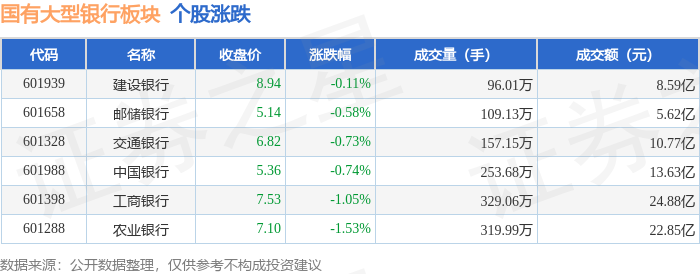
国有大型银行板块1月19日跌1.12%,农业银行领跌,主力资金净流出4.07亿元
Zheng Xing Xing Ye Ri Bao· 2026-01-19 08:58
Group 1 - The core viewpoint of the news is that the state-owned large bank sector experienced a decline of 1.12% on January 19, with Agricultural Bank leading the drop [1] - The Shanghai Composite Index closed at 4114.0, up 0.29%, while the Shenzhen Component Index closed at 14294.05, up 0.09% [1] - The trading performance of individual stocks in the state-owned large bank sector showed varied results, with Agricultural Bank down 1.53% and Industrial and Commercial Bank down 1.05% [1] Group 2 - The net outflow of main funds from the state-owned large bank sector was 407 million yuan, while retail investors saw a net inflow of 539 million yuan [1] - The detailed fund flow data indicates that the Agricultural Bank had a significant net outflow of 35.37 million yuan from main funds, but a net inflow of 73.72 million yuan from retail investors [2] - The overall trend shows that while main and speculative funds are withdrawing, retail investors are increasing their positions in certain banks [2]
银行资负跟踪20260119:降准降息还有空间
GF SECURITIES· 2026-01-19 04:26
Investment Rating - The industry investment rating is "Buy" [3] Core Viewpoints - The report indicates that there is still room for further cuts in reserve requirement ratios and interest rates, with a focus on structural monetary policy support for high-quality economic development [15][19] - The central bank has implemented a reduction of 0.25 percentage points in various structural monetary policy tool rates, signaling a supportive monetary policy stance [15][19] - The report emphasizes the importance of timing for future policy implementations, particularly in relation to government bond issuance peaks and the maturity schedule of high-interest bank deposits [15] Summary by Sections 1. Monetary Policy Adjustments - The report notes a reduction of 0.25 percentage points in structural monetary policy tool rates, with a focus on supporting key areas through increased re-lending [15] - Future attention is directed towards December economic data and January LPR [22] 2. Central Bank Dynamics and Market Rates - The central bank conducted a total of 9,515 billion yuan in 7-day reverse repos at an interest rate of 1.40%, with a net injection of 9,741 billion yuan [16] - The report highlights that the funding rates remained stable, with expectations of slight increases due to tax payments and government bond net repayments [16] 3. Bank Financing Tracking - The report indicates that the total outstanding amount of interbank certificates of deposit (CDs) is 19.09 trillion yuan, with an average issuance rate of 1.65% [20] - The report also notes that there were no commercial bank bond issuances during the period, with a total outstanding commercial bank bond size of 3.38 trillion yuan [20]


GYBrand发布2026年全球品牌价值500强榜单!中国78家企业名单一览
Sou Hu Cai Jing· 2026-01-19 04:13
Core Insights - The globalization of Chinese brands is accelerating, with brand value assessment becoming a strategic priority for sustainable development, shifting from an optional to a necessary approach for companies [2] - The GYBrand 2026 World Brand 500 list emphasizes a comprehensive evaluation system based on brand value, financial performance, brand strength, contribution, and sustainability [2] Group 1: Brand Rankings and Distribution - The 2026 GYBrand World Brand 500 includes brands from 33 countries, with a total value exceeding $14 trillion, representing a 7.11% increase from the previous year, and an average brand value of $28.544 billion [3] - The United States leads with 180 companies, while China ranks second with 78 companies, accounting for 15.6% of the total list [3] - Major cities like Beijing, Shanghai, Shenzhen, Guangzhou, and Hangzhou show significant brand concentration, with "Beijing, Shanghai, Shenzhen, Guangzhou, and Hangzhou" collectively contributing 60 companies to the list [3][12] Group 2: Chinese Brand Performance - In 2026, 78 Chinese companies made the GYBrand list, with a total brand value of $22,764 billion, representing 15.9% of the global total, and an average brand value of approximately $292 million [12] - Beijing is the leading city with 38 companies and a total brand value of $12,178 billion, while Shenzhen has 7 companies, all from the private sector [13] - The presence of state-owned enterprises in Beijing highlights its advantages in innovation resources and industrial clusters, reinforcing its leading position in brand value [13] Group 3: Challenges and Opportunities - Chinese brands face a "large but weak" dilemma, needing to transition from scale expansion to value deepening to enhance brand strength [16] - Comparisons with the Fortune Global 500 reveal that while China has a significant number of companies, their average revenue and profit lag behind those of U.S. companies [16] - The ongoing technological revolution and industrial transformation present new opportunities for Chinese brands to enhance their value through innovation, emotional connection, and cultural empowerment [17]

跨境流动性跟踪20260118:12月跨境净回流、净结汇规模均创历史新高
GF SECURITIES· 2026-01-19 02:46
Investment Rating - The industry investment rating is "Buy" [2] Core Views - December saw a record high in both cross-border net inflow and net settlement scale, with the bank's foreign-related payment surplus reaching 801.1 billion CNY, a year-on-year increase of 400.2 billion CNY [14][17] - The arbitrage trading return rate declined significantly, influenced by the depreciation of the US dollar against the offshore RMB, which fell by 1.32% to 6.98 [14][17] - The cross-border funds' net inflow in December was the highest on record, driven by a substantial increase in merchandise trade surplus [17][31] Summary by Sections Section 1: December Cross-Border Net Inflow and Settlement - The bank's foreign-related payment surplus in December was 801.1 billion CNY, with a year-on-year increase of 400.2 billion CNY, primarily due to a significant expansion in merchandise trade surplus [17] - The net settlement in December reached a historical high of 705.5 billion CNY, with a month-on-month increase of 589.1 billion CNY and a year-on-year increase of 780.6 billion CNY [31] Section 2: Arbitrage Trading Returns - The arbitrage trading return rate for 10Y US Treasury bonds in RMB terms fell by 1.43 percentage points to -1.77% due to the marginal appreciation of the RMB [14][17] - The 10Y China-US interest rate spread widened by 15 basis points, with the 10Y US Treasury yield rising by 16 basis points [14] Section 3: Cross-Border Funds and M2 Liquidity - Cross-border funds contributed significantly to M2 liquidity, with a total of 774.4 billion CNY added, reflecting an increase of 863.2 billion CNY month-on-month [55] - The cross-border funds' inflow had a pull rate of 0.10% on M2, indicating a continued upward trend [55]