
BANK OF CHINA(601988)

Search documents
数字赋能普惠金融 激活经济“微细胞”
Jin Rong Shi Bao· 2025-11-20 01:24
Core Viewpoint - The People's Bank of China has reported an ongoing optimization of the credit structure, with significant growth in various loan categories, indicating a focus on inclusive finance and support for small and micro enterprises [1][2][3] Group 1: Credit Structure Optimization - As of the end of September, loans for technology, green projects, inclusive finance, elderly care, and digital economy sectors have seen year-on-year growth rates of 11.8%, 22.9%, 11.2%, 58.2%, and 12.9% respectively, all surpassing the overall loan growth rate [1] - The balance of inclusive loans for small and micro enterprises reached 36.5 trillion yuan, a year-on-year increase of 12.1%, while inclusive agricultural loans totaled 14.1 trillion yuan, with an increase of 1.2 trillion yuan since the beginning of the year [2] - Major state-owned banks are playing a crucial role, with their inclusive loan contributions accounting for nearly 50% of the total industry [2] Group 2: Policy Support and Financial Innovation - The government continues to enhance support for inclusive finance through structural monetary policy tools, aiming to improve the accessibility and coverage of financing for small and micro enterprises [3][6] - Banks are innovating financial products tailored to the operational characteristics and needs of small and micro enterprises, significantly improving loan disbursement efficiency through digital service channels [3][5] - Digital technology is being widely adopted to reduce service costs and address key issues such as information asymmetry and high costs in inclusive finance [5][6] Group 3: Case Studies and Practical Applications - In Anqiu City, Shandong Province, a local bank provided a specialized "Ginger Loan" to a small enterprise, demonstrating proactive service and tailored financial solutions that resulted in significant profitability for the business [4] - The Agricultural Bank of China has launched an online inclusive product system, "Nongyin e-loan," which has greatly enhanced the efficiency of loan processing [5] Group 4: Future Directions - Experts suggest that the next phase of high-quality development in inclusive finance should focus on enhancing quality and efficiency, with policies aimed at optimizing the financing ecosystem and maintaining reasonable growth in loans for small and micro enterprises [7] - Banks are expected to continue upgrading services and integrating various data sources to improve risk management and service quality for small and micro enterprises [7]




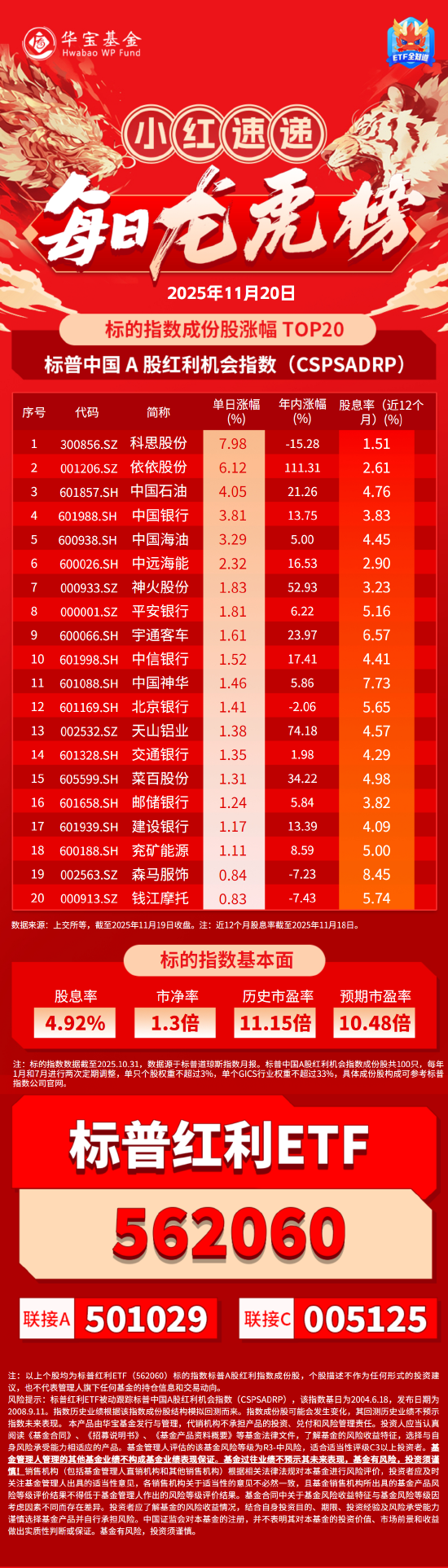
小红日报 | 银行、石油板块震荡走强!标普红利ETF(562060)标的指数小幅收跌
Xin Lang Ji Jin· 2025-11-20 01:09
Core Insights - The article highlights the top-performing stocks in the S&P China A-Share Dividend Opportunity Index, showcasing significant price increases and dividend yields for various companies [1]. Group 1: Stock Performance - The top stock, Kesheng Co., Ltd. (300856.SZ), experienced a daily increase of 7.98% but has a year-to-date decline of 15.28% with a dividend yield of 1.51% [1]. - Yiyi Co., Ltd. (001206.SZ) showed a remarkable year-to-date increase of 111.31%, with a daily rise of 6.12% and a dividend yield of 2.61% [1]. - China Petroleum (601857.SH) reported a daily increase of 4.05% and a year-to-date increase of 21.26%, with a dividend yield of 4.76% [1]. Group 2: Dividend Yields - China Bank (601988.SH) has a dividend yield of 3.83%, with a daily increase of 3.81% and a year-to-date increase of 13.75% [1]. - China National Offshore Oil Corporation (600938.SH) offers a dividend yield of 4.45%, with a daily increase of 3.29% and a year-to-date increase of 5.00% [1]. - Postal Savings Bank of China (601658.SH) has a dividend yield of 3.82%, with a daily increase of 1.24% and a year-to-date increase of 5.84% [1].




招商基金携手新西兰Smart及新西兰中国银行签署合作备忘录合作推进中新资本市场联通融合
Zhong Guo Ji Jin Bao· 2025-11-20 01:08
Group 1 - The core viewpoint of the news is the signing of a memorandum of cooperation between China Merchants Fund, Smart (a subsidiary of the New Zealand Stock Exchange), and the New Zealand branch of the Bank of China, aimed at enhancing the connectivity and integration of the capital markets between China and New Zealand [1][2] - Smart, established in 1996, is the first ETF issuer in New Zealand, managing over 150 billion NZD in funds and offering 44 ETF products focused on various markets including New Zealand, Australia, the US, and global stocks [1] - The cooperation is expected to deepen understanding of the New Zealand market and its investors, and to develop cross-border investment products that meet the needs of investors from both countries, thereby enriching the international product system [1] Group 2 - Mark Peterson, CEO of the New Zealand Stock Exchange, emphasized that this year marks the beginning of the second decade of the comprehensive strategic partnership between China and New Zealand, highlighting the strong bilateral relationship [2] - The Bank of China has been a proactive promoter of financial cooperation between China and New Zealand, aiming to leverage its cross-border financial advantages to facilitate capital connectivity between the two countries [2] - The signing of the memorandum is seen as a significant milestone in deepening financial cooperation and a practical exploration of the integration of the capital markets between China and New Zealand, with plans to continuously improve the cross-border product system [2]
PACIFIC LEGEND(08547)股东将股票由弘雅资本转入中国银行(香港) 转仓市值623.48万港元
Zhi Tong Cai Jing· 2025-11-20 01:00
(原标题:PACIFIC LEGEND(08547)股东将股票由弘雅资本转入中国银行(香港) 转仓市值623.48万港 元) 智通财经APP获悉,香港联交所最新资料显示,11月19日,PACIFIC LEGEND(08547)股东将股票由弘雅 资本转入中国银行(香港),转仓市值623.48万港元,占比7.75%。 PACIFIC LEGEND发布公告,于2025年11月18日(交易时段后),公司与认购人订立认购协议,据此,公 司有条件同意配发及发行而认购人有条件同意认购合共1710万股认购股份,认购价为每股认购股份0.17 港元。 ...
招商基金携手新西兰Smart及新西兰中国银行签署合作备忘录 合作推进中新资本市场联通融合
Zhong Guo Ji Jin Bao· 2025-11-20 00:29
Group 1 - The core point of the news is the signing of a memorandum of cooperation between China Merchants Fund, Smart (a subsidiary of the New Zealand Stock Exchange), and the Bank of China New Zealand branch, aimed at enhancing the connectivity and integration of the capital markets between China and New Zealand [2][5]. Group 2 - Smart, established in 1996 and fully owned by the New Zealand Stock Exchange, is the first ETF issuer in New Zealand, managing over NZD 15 billion in funds and offering 44 ETF products focused on various markets including New Zealand, Australia, the US, and global stocks [4]. - The cooperation is set against the backdrop of the updated Memorandum of Understanding on securities and futures regulatory cooperation signed between the China Securities Regulatory Commission and the New Zealand Financial Markets Authority on September 25, 2025, indicating a deepening regulatory collaboration [4]. - China Merchants Fund has 15 years of experience in ETF management, with a comprehensive product line covering currencies, bonds, A-shares, Hong Kong stocks, and cross-border investments, aiming to develop cross-border investment products that meet the needs of investors from both countries [4]. Group 3 - Mark Peterson, CEO of the New Zealand Stock Exchange, emphasized that this year marks the beginning of the second decade of the comprehensive strategic partnership between China and New Zealand, highlighting the strong bilateral relationship and the potential benefits for investors from both countries through this collaboration [5]. - The Bank of China has been a proactive promoter of financial cooperation between China and New Zealand, supporting the project and aiming to deepen practical cooperation and accelerate product innovation for mutual market opportunities [5]. - The signing of the memorandum is seen as a significant milestone in deepening financial cooperation among the three parties and a practical exploration of the integration of the capital markets between China and New Zealand [5].

招商基金携手新西兰Smart及新西兰中国银行签署合作备忘录 合作推进中新资本市场联通融合
中国基金报· 2025-11-20 00:22
Core Viewpoint - The signing of the memorandum of cooperation between China Merchants Fund, Smart, and Bank of China New Zealand marks a significant step towards enhancing the connectivity and integration of the capital markets between China and New Zealand, aiming to develop cross-border investment products that meet the needs of investors from both countries [1][3][4]. Group 1: Partnership Details - The cooperation memorandum was signed on November 19, 2025, in Beijing, with the involvement of the New Zealand Stock Exchange and Bank of China [1]. - Smart, established in 1996 and fully owned by the New Zealand Stock Exchange, manages over NZD 15 billion in funds and offers 44 ETF products focused on various markets including New Zealand, Australia, the US, and global stocks [3]. - The partnership aims to leverage the experience of China Merchants Fund in ETF management, which spans 15 years, to better understand the New Zealand market and develop suitable cross-border investment products [3]. Group 2: Strategic Importance - The year 2025 marks the beginning of the second decade of the comprehensive strategic partnership between China and New Zealand, with China being New Zealand's largest trading partner [4]. - The collaboration is seen as a vital link in enhancing the relationship between the capital markets and asset management industries of both countries, with expectations for mutual benefits for investors [4]. - Bank of China emphasizes its role as a facilitator of cross-border financial cooperation, supporting the project and aiming to accelerate product innovation for shared market opportunities [4].

中国银行A股股价创新高;现货黄金站上4100美元/盎司 | 金融早参
Mei Ri Jing Ji Xin Wen· 2025-11-19 23:24
Group 1: Central Bank Operations - The central bank conducted a 310.5 billion yuan 7-day reverse repurchase operation, with a bid amount and winning amount of 310.5 billion yuan, maintaining an operation rate of 1.40% [1] Group 2: Banking Sector Performance - A-shares in the banking sector experienced fluctuations but generally rose, with China Bank's stock price increasing over 2% to reach a new high, alongside significant gains from other banks such as Everbright Bank and CITIC Bank [2] - The rise in bank stock prices reflects positive market expectations for future growth in the financial industry, likely driven by economic recovery expectations and policy support [2] Group 3: Insurance Sector Performance - The insurance sector in A-shares continued to rise, with China Life and China Property & Casualty Insurance both increasing over 3%, along with other major insurers [3] - The notable growth in the insurance sector indicates investor optimism, potentially influenced by market perceptions of economic stability and increased risk management awareness among individuals [3] Group 4: Gold Market Trends - Spot gold prices reached 4,100 USD per ounce, reflecting a 0.85% increase during the day [4] - The rise in gold prices indicates a sustained preference for safe-haven assets, driven by increasing geopolitical risks and inflation pressures, showcasing gold's appeal as a traditional safe-haven investment [4]



四川百利天恒药业股份有限公司关于与中国银行股份有限公司四川省分行签订战略合作协议的公告
Shang Hai Zheng Quan Bao· 2025-11-19 18:18
Core Viewpoint - Sichuan Baile Tianheng Pharmaceutical Co., Ltd. has signed a strategic cooperation agreement with Bank of China Sichuan Branch to establish a long-term comprehensive strategic partnership, which aims to support the company's development in the innovative drug research and industrialization process [2][10]. Group 1: Agreement Details - The strategic cooperation agreement involves a commitment from Bank of China Sichuan Branch to provide a total of no less than 8 billion RMB in comprehensive credit support to the company [8]. - The agreement will facilitate deep cooperation in areas such as capital market operations, cross-border finance, and innovative financial services [9]. - The agreement is effective for five years and will automatically renew unless otherwise agreed upon by both parties [10]. Group 2: Impact on the Company - The signing of this strategic cooperation agreement is expected to accelerate the company's strategic layout in the global biopharmaceutical frontier, particularly in the fields of antibody-drug conjugates (ADC) and multi-specific antibodies [10]. - This partnership is anticipated to provide significant financial support for the company's future development, aligning with the company's development plan and benefiting all shareholders [10].

重磅发布!2025中国银行业天玑奖名单出炉,属于你的荣耀时刻来了
Zheng Quan Shi Bao Wang· 2025-11-19 14:26
Core Insights - The "2025 China Banking Industry Tianji Award" results were announced during the "19th Shenzhen International Financial Expo and 2025 China Financial Institutions Annual Conference" held on November 19-20 [2][3] - The conference theme was "Empowering through Synergy, Reshaping Value," featuring discussions on current hot topics in China's economy and finance by over 1,000 industry elites from leading banks, insurance companies, securities firms, and futures companies [1] Group 1 - The "Tianji Award" is a prestigious industry award organized by the Securities Times, focusing on the progress and development of commercial banks over the past year [3] - The award has been held for seven consecutive years, with nearly 100 participating institutions each year, making it one of the most professional and influential brand events in the domestic banking sector [3] - The evaluation process of the "Tianji Award" adheres to principles of fairness, openness, and impartiality, utilizing a combination of quantitative indicators, expert reviews, and WeChat voting to identify the best companies, valuable innovations, and meaningful practices in the Chinese banking industry [3]
百利天恒与中国银行四川省分行签订战略合作协议
Zhi Tong Cai Jing· 2025-11-19 13:51
Core Viewpoint - The company, Baillie Gifford Tianheng (688506.SH), has signed a strategic cooperation agreement with the Bank of China Sichuan Branch to establish a long-term comprehensive strategic partnership, which includes a commitment to provide no less than 8 billion yuan in credit support for the company's development strategy [1] Group 1: Strategic Cooperation - The agreement involves specific business operations that will require separate contracts to be signed [1] - The Bank of China has acknowledged the funding needs faced by the company in the process of innovative drug research and industrialization [1] Group 2: Financial Support - The strategic cooperation is expected to accelerate the company's strategic layout in the global biopharmaceutical frontier, reinforcing its leading position in fields such as antibody-drug conjugates (ADC) and multi-specific antibodies [1] - This partnership aims to seize new opportunities in the global biopharmaceutical industry, promoting mutual benefits and joint development [1]