BANK OF CHINA(601988)

Search documents
你的信用卡账单分期,国家要贴息啦
2 1 Shi Ji Jing Ji Bao Dao· 2026-01-24 02:33
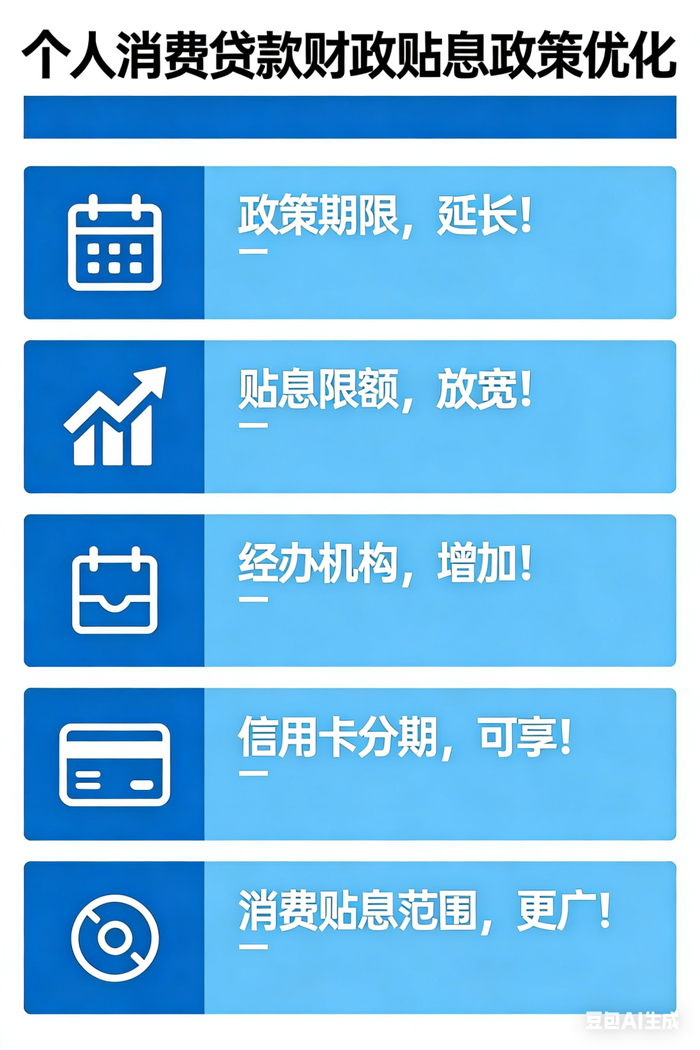
Group 1 - The core viewpoint of the news is the optimization of the personal consumption loan interest subsidy policy, which aims to stimulate consumer spending by extending the policy duration and expanding its coverage [1][2][4] - The new policy extends the implementation period until the end of this year and includes credit card installment payments in the subsidy scope, thereby broadening the areas eligible for interest subsidies [1][3] - Financial institutions, including major banks, are quickly responding to the policy by optimizing their services to ensure consumers can benefit from the subsidies seamlessly, enhancing the overall consumer experience [4][6] Group 2 - The collaboration between financial institutions and e-commerce platforms is highlighted, with initiatives like interest-free installment products being offered to consumers, which have led to significant increases in sales for participating brands [6] - The policy is part of a broader strategy to boost domestic demand and consumer confidence, aligning with the central economic work conference's focus on enhancing the domestic market [7] - The implementation of the policy is expected to improve consumer sentiment and market vitality, contributing to a stable economic outlook and encouraging higher quality consumption [7]




中国银行取得多交易达标计算方法专利
Sou Hu Cai Jing· 2026-01-24 01:49
Group 1 - The core point of the article is that the Bank of China has obtained a patent for a method and system related to multi-transaction compliance calculation, indicating its focus on innovation in financial services [1] - The patent was granted with the announcement number CN115099969B, and the application date was June 2022 [1] - The Bank of China, established in 1983 and located in Beijing, primarily engages in monetary financial services and has a registered capital of approximately 29.44 billion RMB [1] Group 2 - According to data from Tianyancha, the Bank of China has made investments in 16 companies and participated in 5,000 bidding projects [1] - The bank holds 1,474 trademark registrations and has 5,000 patent records, showcasing its extensive intellectual property portfolio [1] - Additionally, the Bank of China possesses 255 administrative licenses, reflecting its regulatory compliance and operational capabilities [1]
湖南启动湘医保健康增值服务活动
Zhong Guo Jin Rong Xin Xi Wang· 2026-01-24 01:48
Core Viewpoint - The "Xiang Medical Insurance Health Value-Added Service Alliance" launched by Hunan Provincial Medical Insurance Bureau and Bank of China Hunan Branch aims to enhance health services for insured individuals in Hunan Province through a variety of offerings and partnerships [1] Group 1: Event Overview - A press conference was held on January 23, where leaders from Hunan Provincial Medical Insurance Bureau and Bank of China Hunan Branch announced the launch of the health value-added service initiative [1] - The initiative has attracted thousands of institutions and stores across the province to join the alliance [1] Group 2: Service Offerings - The first phase of the "Insured Send Blessing Bag" activity will distribute health blessing bags containing 14 discount coupons across five categories: health check-ups, ophthalmology, dentistry, medication purchases, and fitness [1] - Basic medical insurance participants in Hunan can access these benefits by logging into the "Xiang Medical Insurance" public account or app [1] Group 3: Future Plans - The alliance plans to continuously expand its cooperation and enrich service offerings, aiming to shift medical insurance services from merely "covering diseases" to "promoting health" [1]
多家银行公告!落实个人消费贷款最新财政贴息政策
Sou Hu Cai Jing· 2026-01-23 19:43
Core Viewpoint - The implementation of the latest fiscal interest subsidy policy for personal consumption loans aims to boost consumption and expand domestic demand, with several major banks actively participating in this initiative [1][6][7][8][9]. Group 1: Policy Implementation - The fiscal interest subsidy policy for personal consumption loans has been extended until December 31, 2026, covering the period from September 1, 2025, to December 31, 2026 [6][10]. - The credit card installment payment subsidy policy will be effective from January 1, 2026, to December 31, 2026 [6]. Group 2: Policy Optimization - The policy has been optimized to include credit card installment payments, expanding the support range [9][11]. - The subsidy criteria have been broadened by removing the restriction on single transactions of 50,000 yuan and above [9][12]. - The subsidy standards have been improved by eliminating the 500 yuan cap on single transaction subsidies and the 1,000 yuan cap for individual borrowers at the same financial institution [9][12]. - Customers who have previously signed the personal consumption loan subsidy agreement will automatically benefit from the new subsidy policy starting January 1, 2026, without needing to re-sign the agreement [12].

观趋势,锚未来!《2026中国高净值人群财富管理白皮书》发布
2 1 Shi Ji Jing Ji Bao Dao· 2026-01-23 17:06
Core Insights - The white paper aims to present the current status and future expectations of wealth management for high-net-worth individuals in China, addressing the growing diversification of wealth accumulation and allocation needs [3][4] Group 1: Research Methodology - The research combines scientific, systematic, and practical principles, utilizing a multi-layered and three-dimensional research framework [4] - Over a thousand questionnaires were distributed nationwide to high-net-worth individuals, covering more than 30 provinces, ensuring broad representativeness [4] - The research team conducted in-depth interviews with over 40 high-net-worth individuals and experienced private banking professionals to capture deep customer demands and industry service pain points [4] Group 2: Wealth Management Trends - The macro environment and market evolution are pushing wealth management towards a value-deepening phase, with high-net-worth individuals shifting from simple value preservation to comprehensive, customized, and diversified wealth solutions [6] - The structure of high-net-worth individuals shows significant industry diversification and generational differences, with traditional industries remaining the main source of wealth while modern services and advanced manufacturing are also important [6] - Asset allocation trends indicate a focus on stability domestically and progress internationally, with domestic investments centered on financial products, deposits, and insurance, while international investments are more diverse and proactive, focusing on mature markets like Hong Kong, the U.S., and Singapore [6] Group 3: Service Demand Evolution - Service demands are extending beyond wealth management to encompass health, education, and inheritance, with high-net-worth individuals seeking personalized, professional, and secure services [7] - There is a trend towards younger and more proactive inheritance planning, with entrepreneurs driving the demand for integrated family and business services [7] - The findings of the white paper provide insights into market segmentation, demand upgrades, and global asset allocation trends, posing new requirements for wealth management institutions regarding strategic positioning and service capabilities [7] Group 4: Future Outlook - As China's economy continues to develop, the wealth management industry is expected to play a more significant role in supporting the real economy, promoting common prosperity, and safeguarding people's wealth [8] - The industry must maintain professionalism and compliance while building a customer-centric, open, collaborative, and warm service ecosystem to adapt to market changes and evolving customer needs [8]
中国银行:近期货币刺激的看法;财政刺激在路上;是时候重新关注中资银行了-China Banks_ Our take on recent monetary stimulus; Fiscal stimulus on the way; Time to revisit China banks
2026-01-23 15:35
Summary of China Banks Conference Call Industry Overview - The conference call focused on the Chinese banking sector, particularly the impact of recent monetary and fiscal policies on banks' performance and loan growth. Key Points Monetary Policy Changes - The People's Bank of China (PBoC) announced new supportive monetary policies on January 15, including: - Expansion of relending facilities with an additional quota of approximately RMB 1.1 trillion, targeting private enterprises and key industries such as agriculture, small businesses, technological innovation, carbon reduction, service consumption, and elderly care [1] - A 25 basis points (bps) interest rate cut for relending facilities, reducing the rate from 1.5% to 1.25% [7] - Potential for further cuts in the Reserve Requirement Ratio (RRR) and Loan Prime Rate (LPR) [1][2] Impact on Banks' Net Interest Margin (NIM) - The relending facilities rate cut is expected to benefit banks' NIM by approximately 0.3 bps, as banks can borrow cheaper funds from PBoC [1] - The balance of relending facilities reached around RMB 5 trillion by Q3 2025, representing about 1% of banks' total assets [1] - The anticipated fiscal stimulus, including interest subsidies on consumer and micro loans, is expected to have a limited negative impact on banks' NIM [1] Loan Growth Expectations - The stimulus measures are designed to incentivize banks to direct credit towards policy-favored sectors, supporting loan growth at the beginning of 2026, coinciding with the start of the 15th five-year plan [1] - Stronger than expected loan growth is anticipated in early 2026 due to targeted lending rate cuts [1] Treasury Bond Market Dynamics - Lower treasury bond yields are expected to widen the spread between banks' dividend yields and the 10-year China treasury bond yield, attracting yield-seeking investors [2][5] - The PBoC may actively participate in treasury bond trading to rebalance supply and demand dynamics, potentially lowering treasury bond yields [2] Investment Opportunities in China Banks - China banks' H-shares have underperformed the Hang Seng Index by 7 percentage points year-to-date in 2026, but there are expectations for recovery due to: - Increased premium growth from insurers, leading to more inflows into high-yield bank stocks [6] - Lower treasury bond yields enhancing the attractiveness of banks' dividend yields [6] - Monetary and fiscal stimulus benefiting loan growth with limited negative impact on NIM [6] - Specific banks highlighted for investment include: - ICBC-H and BOC-H due to their attractive dividend yields and valuations [6] - BONB-A and CSRCB-A for better-than-expected export performance and potential interest subsidies [6] Additional Insights - The conference call emphasized the importance of monitoring the evolving regulatory environment and its implications for banks' operations and profitability [6] - The potential for Ping An Insurance to increase its stake in BOC-H was noted, as it has been removed from the restricted investment list since October 2025 [6] Conclusion - The Chinese banking sector is poised for potential growth driven by supportive monetary policies and fiscal measures, with specific banks identified as attractive investment opportunities based on their dividend yields and market positioning.
2026怎么投?中国银行第八年发布《个人金融全球资产配置白皮书》
Feng Huang Wang Cai Jing· 2026-01-23 13:47
Core Viewpoint - The report emphasizes the dual opportunities presented by the global liquidity shift and the revaluation of Chinese assets in 2026, advocating for a resilient investment strategy that balances "risk aversion and growth" [1] Group 1: Chinese Equity Assets - In 2026, China's economic resilience positions it as a relatively stable choice for global asset allocation, with GDP surpassing 140 trillion yuan in 2025, reflecting a 5.0% year-on-year growth [2] - The A-share market is expected to transition from a valuation recovery driven by policy and liquidity to a solid increase supported by corporate profit improvements, establishing a "slow bull" market [2] - Chinese equity assets are shifting from "marginal allocation" to "core allocation," driven by external uncertainties and a transformation in domestic wealth structure, indicating a long-term trend towards equity investments [2] Group 2: Hong Kong Market - The Hong Kong market is poised to benefit from the U.S. interest rate cut cycle, with sectors like technology and innovative pharmaceuticals still at historical low valuations, suggesting a potential for value revaluation in 2026 [3] - In contrast, the U.S. stock market, despite the ongoing AI boom, is at historical high valuations, with profit growth concentrated among a few tech giants, indicating a "K-shaped" divergence [3] Group 3: Precious Metals (Gold) - Gold has emerged as a leading asset over the past three years, with a cumulative increase of nearly 150% from 2022 to 2025, driven by a reconstruction of trust, reassessment of monetary credit, and heightened demand for safe-haven assets [4] - The acceleration of de-dollarization, geopolitical risks, the U.S. Federal Reserve entering a rate-cutting cycle, and record-high holdings in gold ETFs support the continued recommendation for an "overweight" position in gold [5][6] - As of January 21, 2026, gold prices reached $4,835.07 per ounce, marking a significant increase of over 10% in the year, with a historical breakthrough of the $4,800 mark [5] Group 4: Investment Strategy - The report highlights the importance of a scientific approach to investment, utilizing tools like multi-asset allocation and risk assessment to navigate uncertainties [7] - The year 2026 is viewed as a pivotal year for wealth distribution over the next five years, with a focus on long-term investment strategies to capture systematic returns [7]
中国银行取得交易报文处理专利提升分布式交易顺序性
Sou Hu Cai Jing· 2026-01-23 12:30
声明:市场有风险,投资需谨慎。本文为AI基于第三方数据生成,仅供参考,不构成个人投资建议。 来源:市场资讯 国家知识产权局信息显示,中国银行股份有限公司取得一项名为"交易报文处理方法、装置、设备及存 储介质"的专利,授权公告号CN116708584B,申请日期为2023年5月。 天眼查资料显示,中国银行股份有限公司,成立于1983年,位于北京市,是一家以从事货币金融服务为 主的企业。企业注册资本29438779.1241万人民币。通过天眼查大数据分析,中国银行股份有限公司共 对外投资了16家企业,参与招投标项目5000次,财产线索方面有商标信息1474条,专利信息5000条,此 外企业还拥有行政许可255个。 ...
消费贷利率降至2%?银行优化贴息方案
Zhong Guo Zheng Quan Bao· 2026-01-23 12:17
Core Viewpoint - The recent optimization of the personal consumption loan interest subsidy policy by the Ministry of Finance, the People's Bank of China, and the financial regulatory authority aims to stimulate consumer spending and economic recovery by extending the policy until the end of 2026 and broadening its scope [1][2][3] Group 1: Policy Changes - The minimum annual interest rate for personal consumption loans is now 3%, with a subsidy rate of 1%, allowing for a maximum subsidy of 3,000 yuan for loans of 300,000 yuan [1] - The updated policy now includes credit card installment payments under the subsidy scheme, which was previously excluded [2] - Restrictions on the usage scenarios for subsidies have been lifted, allowing for broader applicability beyond specific categories like car purchases and home appliances [2] Group 2: Implementation and Impact - Borrowers can sign agreements through mobile banking to access the subsidy, with the system automatically calculating eligible subsidy amounts during repayment [3] - The policy is expected to enhance consumer spending potential and provide targeted support for economic recovery, as noted by industry experts [3]
2026怎么投?中国银行第八年发布《个人金融全球资产配置白皮书》
凤凰网财经· 2026-01-23 11:52
Core Viewpoint - The article emphasizes the importance of seizing opportunities in global liquidity shifts and the revaluation of Chinese assets in 2026, advocating for a resilient investment strategy that balances both "hedging and growth" [1] Group 1: Overweighting Chinese Equity Assets - In 2026, the global economy is expected to enter a "weak recovery" phase, with China emerging as a relatively stable asset allocation choice due to its policy consistency and economic resilience [2] - China's GDP reached 140.19 trillion yuan in 2025, marking a significant milestone with a year-on-year growth of 5.0%, providing a solid foundation for the capital market [2] - The A-share market is anticipated to transition from a valuation recovery driven by policy and liquidity to a solid upward trend supported by corporate profit improvements, establishing a "slow bull" market [2] - Chinese equity assets are shifting from "marginal allocation" to "core allocation," driven by external uncertainties and a transformation in domestic wealth structure, leading to a systematic migration of savings towards equity assets [2] Group 2: Hong Kong Market Insights - The Hong Kong market, as a bridge connecting global capital with Chinese assets, is expected to benefit from the U.S. interest rate cut cycle, with sectors like technology and innovative pharmaceuticals poised for value revaluation [3] - In contrast, the U.S. stock market, despite the ongoing AI boom, is facing high valuations and concentrated profit growth among a few tech giants, indicating a "K-shaped" divergence [3] Group 3: Overweighting Precious Metals (Gold) - Gold has emerged as the standout asset over the past three years, with a cumulative increase of nearly 150% from 2022 to 2025, driven by trust reconstruction, currency credit reassessment, and heightened demand for safe-haven assets [4] - The acceleration of de-dollarization is evident, with global central banks purchasing over 1,000 tons of gold for three consecutive years, indicating a long-term structural shift rather than short-term speculation [4] - Geopolitical risks are becoming normalized, with gold's role as a safe-haven asset becoming increasingly significant amid rising global tensions [4] - The Federal Reserve's entry into a rate-cutting cycle enhances the attractiveness of holding gold, with spot gold prices recently surpassing $4,800 per ounce, marking a significant milestone [5] - Gold ETF holdings reached historical highs in 2025, with global inflows into physical gold ETFs totaling $89 billion, reflecting unprecedented investor interest [5] Group 4: Strategic Investment Approach - The true strength of the report lies in its ability to make precise predictions and construct optimal risk-return ratios through scientific methodologies, including multi-asset allocation and risk assessment [6] - The investment landscape in 2026 is characterized as a patient journey, emphasizing the importance of aligning with broader trends rather than chasing fleeting market fads [6] - The year 2026 is viewed as a pivotal year that could shape the wealth landscape for the next five years, with a focus on long-term investment strategies and the revaluation of Chinese assets [6]