Bank Of Guiyang(601997)

Search documents
贵阳银行(601997) - 贵阳银行股份有限公司关于股东权益变动的提示性公告
2025-09-09 10:03
证券代码:601997 证券简称:贵阳银行 公告编号:2025-037 优先股代码:360031 优先股简称:贵银优 1 贵阳银行股份有限公司 关于股东权益变动的提示性公告 本公司董事会及全体董事保证本公告内容不存在任何虚假记载、 误导性陈述或者重大遗漏,并对其内容的真实性、准确性和完整性承 担法律责任。 重要内容提示: 1.本次权益变动系贵阳银行股份有限公司(以下简称公司)持股 5%以上股东贵州乌江能源投资有限公司(以下简称乌江能投)的控股 股东贵州乌江能源集团有限责任公司(以下简称乌江能源)被贵州能 源集团有限公司(以下简称贵州能源)吸收合并所致,不触及要约收 购。 2.本次权益变动后,贵州能源将间接持有公司 200,832,586 股 A 股普通股股票,占公司总股本的 5.49%。 一、本次权益变动基本情况 公司近日收到持股5%以上股东乌江能投出具的《贵州乌江能源投 资有限公司关于变更公司控股股东的函》,根据《省人民政府关于同 意贵州能源集团有限公司组建方案的批复》文件精神,贵州能源拟吸 收合并乌江能源,乌江能源所持有的乌江能投100%股权将由贵州能源 承继。截至公告日,贵州能源与乌江能源已签订吸收合并 ...
本周聚焦:2025上半年银行确认了多少金融资产处置收益?OCI浮盈有多少?
GOLDEN SUN SECURITIES· 2025-09-07 08:20
Investment Rating - The report maintains an "Increase" rating for the banking sector, indicating a positive outlook for the industry [1]. Core Insights - In the first half of 2025, the contribution of financial asset disposal gains from AC and OCI accounts to revenue reached 5.2%, an increase of 2.9 percentage points compared to 2024 [1][2]. - The investment income growth rate for 42 listed banks was 23.6%, with AC, OCI, and TPL gains showing year-on-year growth rates of 134.7%, 79.0%, and -8.4% respectively [1]. - The report highlights that the increase in disposal gains does not necessarily indicate a significant increase in asset disposal scale, as market conditions and strategies vary among banks [2]. Financial Asset Disposal Gains - The contribution of AC and OCI financial asset disposal gains to revenue was 5.2%, up 2.9 percentage points from 2024, with AC asset disposal gains contributing 2.6% [2]. - Among different types of banks, rural commercial banks had the highest contribution from AC and OCI disposal gains, reaching 11.0%, an increase of 6.2 percentage points from 2024 [2]. - Specific banks such as Jiangyin Bank, Sunong Bank, and Zijin Bank had high disposal gain ratios relative to their revenue, at 28.9%, 26.7%, and 22.7% respectively [2]. OCI Floating Profit Situation - The overall OCI floating profit decreased compared to the end of the previous year, accounting for 12.6% of the estimated profit for 2025 [3]. - Major state-owned banks like CCB and ABC reported significant OCI floating profits, with balances exceeding 30 billion [3]. - The average contribution of OCI floating profits to profits for city and rural commercial banks was notably high, with Ningbo Bank's ratio reaching 35% [3][6]. Sector Trends - The banking sector is expected to benefit from expansionary policies aimed at stabilizing the economy, with a focus on real estate and consumer spending [7]. - The report suggests a focus on banks with improving fundamentals, such as Ningbo Bank, and those with dividend strategies like Jiangsu Bank and Chengdu Bank [7]. - Attention is also drawn to banks with potential convertible bond conversion expectations, including Shanghai Bank and Industrial Bank [7].






上市银行1H25业绩总结:营收利润边际改善,看好板块配置价值有限
Dongxing Securities· 2025-09-05 09:38
Investment Rating - The report maintains a positive outlook on the banking sector's allocation value, suggesting continued investment interest in the sector [4][10]. Core Viewpoints - The performance of listed banks in the first half of 2025 shows a marginal improvement in revenue and profit margins, with year-on-year growth of 1.0% in revenue and 0.8% in net profit attributable to shareholders [4][5]. - The recovery in the bond market during the second quarter has alleviated some of the pressures on bond investment returns, contributing to the overall performance improvement [4][5]. - The report anticipates that the banking sector's revenue and net profit growth will remain around 1% year-on-year for 2025, despite ongoing pressures on the banking fundamentals [4][10]. Summary by Sections Performance Overview - In the first half of 2025, listed banks experienced a year-on-year revenue growth of 1.0% and a net profit growth of 0.8%, with quarter-on-quarter improvements of 2.8 percentage points and 2 percentage points respectively [4][5]. - The growth in interest-earning assets was 9.7% year-on-year, with a stable credit growth of 8% and a significant increase in financial investments by 14.9% [4][11]. - The net interest margin for the first half of 2025 was 1.33%, showing a year-on-year decline of 13 basis points, which is less than the decline seen in the same period last year [4][5]. Non-Interest Income - Non-interest income showed a positive trend, with a year-on-year increase of 10.8% in other non-interest income and a 3.1% increase in fee income [4][5][10]. - The report highlights that the recovery in the capital market has contributed to the improvement in non-interest income [4][10]. Asset Quality - The report notes that while the non-performing loan ratio remains stable, there is an increase in the generation rate of overdue and non-performing loans, particularly in retail banking [4][10]. - The provision coverage ratio remained stable, with an increase in provisioning efforts during the first half of 2025 [4][10]. Future Outlook - The banking sector is expected to face continued pressure in 2025, but signs of a potential turning point are emerging, with improved net interest margins and non-interest income [4][10]. - The report suggests that the demand for bank stocks will increase from long-term funds, driven by favorable policies encouraging investment in the banking sector [4][10].

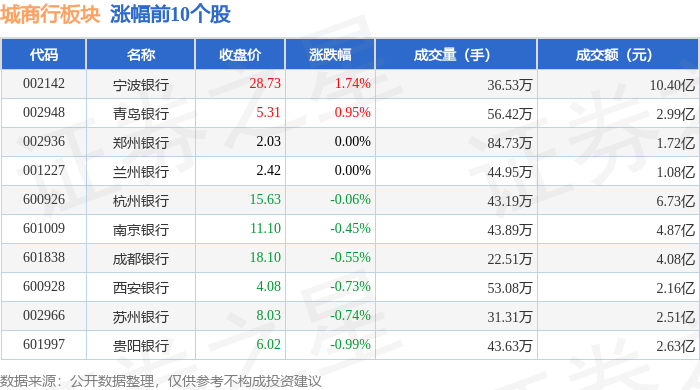
城商行板块9月5日跌0.37%,重庆银行领跌,主力资金净流出2.87亿元
Zheng Xing Xing Ye Ri Bao· 2025-09-05 08:56
Group 1 - The city commercial bank sector experienced a decline of 0.37% on September 5, with Chongqing Bank leading the drop [1] - The Shanghai Composite Index closed at 3812.51, up 1.24%, while the Shenzhen Component Index closed at 12590.56, up 3.89% [1] - Key individual stock performances in the city commercial bank sector included Ningbo Bank rising by 1.74% and Chongqing Bank falling by 1.34% [1][2] Group 2 - The net outflow of main funds from the city commercial bank sector was 287 million yuan, while retail investors saw a net inflow of 141 million yuan [2] - The trading volume for Chongqing Bank was 107,400 shares, with a transaction amount of 103 million yuan [2] - The overall trading activity showed a mixed trend, with some banks experiencing slight declines while others saw minor gains [1][2]


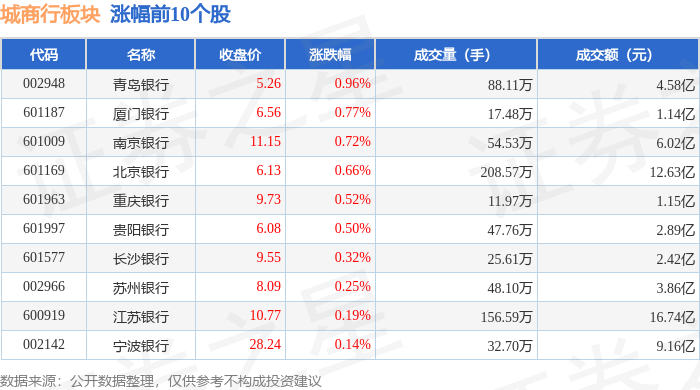
城商行板块9月4日涨0.14%,青岛银行领涨,主力资金净流入1.04亿元
Zheng Xing Xing Ye Ri Bao· 2025-09-04 08:48
Group 1 - The city commercial bank sector saw a slight increase of 0.14% on September 4, with Qingdao Bank leading the gains [1] - The Shanghai Composite Index closed at 3765.88, down 1.25%, while the Shenzhen Component Index closed at 12118.7, down 2.83% [1] - Key stocks in the city commercial bank sector showed varied performance, with Qingdao Bank closing at 5.26, up 0.96%, and Xiamen Bank at 6.56, up 0.77% [1] Group 2 - The city commercial bank sector experienced a net inflow of 1.04 billion yuan from institutional investors, while retail investors contributed a net inflow of 1.27 billion yuan [2] - The sector saw a net outflow of 2.31 billion yuan from speculative funds [2] - Individual stock performance varied, with Beijing Bank showing a net inflow of 1.52 million yuan from institutional investors, while Xiamen Bank had a net outflow of 730.79 million yuan [3]

银行研究框架及25H1业绩综述:营收及利润增速双双转正
GOLDEN SUN SECURITIES· 2025-09-04 06:14
Investment Rating - The report indicates a positive outlook for the banking industry, with overall revenue and net profit growth rates turning positive in the first half of 2025, at 1.0% and 0.8% respectively, showing improvements from the previous quarter [4]. Core Insights - The banking sector's net interest margin for the first half of 2025 is reported at 1.42%, a decrease of 10 basis points compared to the previous year, but the decline is narrowing due to improved cost management on the liability side [5]. - Non-interest income, particularly from fees and commissions, has increased by 3.1% year-on-year, driven by a recovery in wealth management and a more active market environment [5]. - The asset quality remains stable, with a non-performing loan ratio of 1.23% and a provision coverage ratio of 239%, indicating a solid credit environment [5]. Summary by Sections Financial Performance Overview - The overall revenue and net profit growth for listed banks in the first half of 2025 were 1.0% and 0.8%, respectively, with both metrics showing improvement from the first quarter [4][22]. - The total assets of listed banks reached 321.3 trillion yuan, growing by 6.35% year-to-date, with loans and advances totaling 179.4 trillion yuan, accounting for 55.84% of total assets [21][24]. Income Sources - Net interest income decreased by 1.3% year-on-year, but the decline rate has slowed, reflecting better management of funding costs [5]. - Fee and commission income grew by 3.1% year-on-year, benefiting from a recovering market and the gradual impact of regulatory changes [5]. - Other non-interest income saw a significant increase of 10.7%, primarily due to favorable market conditions in the bond market [5]. Asset Quality and Management - The non-performing loan ratio remained stable at 1.23%, with a provision coverage ratio of 239%, indicating a robust asset quality [5]. - The credit cost for the first half of 2025 was 0.81%, a decrease of 5 basis points year-on-year, suggesting manageable credit risks [5]. Loan Growth and Composition - Loan growth was primarily driven by corporate lending, with significant contributions from infrastructure and manufacturing sectors [20]. - Personal loan growth was weaker, with a year-on-year increase of only 3.6%, reflecting a cautious approach to consumer lending amid rising risks [20]. Investment and Market Conditions - The investment asset proportion decreased to 34% as banks adjusted their strategies in response to market volatility [20]. - The overall yield on bonds fluctuated significantly, prompting banks to engage in tactical trading to enhance returns [20].
金融中报观|银行零售业务梯队格局背后,谁在领跑,谁在补课
Bei Jing Shang Bao· 2025-09-03 14:17
Core Insights - The competitive landscape of retail banking in A-shares is becoming clearer as the 2025 mid-year reports are disclosed, revealing a distinct tiered structure in retail AUM (Assets Under Management) [1][2] - The first tier consists of major state-owned banks and China Merchants Bank, all exceeding 16 trillion yuan in retail AUM, while the second tier includes joint-stock banks and some leading city commercial banks [1][2] - The retail business performance is mixed, with many banks facing pressure on retail revenue and net profit, highlighting a structural issue of profit growth without revenue increase [1][6] Tiered Structure of Retail AUM - The first tier banks, including Industrial and Commercial Bank of China (ICBC) and Agricultural Bank of China (ABC), lead with AUM exceeding 16 trillion yuan, with ICBC at over 24 trillion yuan and ABC at 23.68 trillion yuan [2][3] - China Construction Bank (CCB) and Postal Savings Bank of China also show strong performance, with CCB managing over 22 trillion yuan and Postal Savings Bank at 17.67 trillion yuan [2] - China Merchants Bank, known as the "king of retail," has a retail AUM of 16.03 trillion yuan, reflecting a 7.39% increase from the previous year [2] Second Tier Performance - The second tier banks have retail AUM ranging from 1 trillion to 6 trillion yuan, with notable growth from banks like Bank of Communications at 5.79 trillion yuan and Industrial Bank at 5.52 trillion yuan [3] - Joint-stock banks are active in this tier, with CITIC Bank and Shanghai Pudong Development Bank also showing significant growth in retail AUM [3] Third Tier Characteristics - The third tier banks have retail AUM mostly below 1 trillion yuan, with Nanjing Bank and Shanghai Rural Commercial Bank showing notable growth rates of 14.25% and 3.99% respectively [4] - Regional banks are leveraging local advantages to deepen market penetration, but face challenges in competing with larger banks [5] Retail Profitability Challenges - The retail banking sector is undergoing significant adjustments, with a shift in customer demand towards diversified financial solutions, which raises the bar for product innovation and service customization [6] - Leading banks like ICBC and China Merchants Bank are showing resilience, with ICBC's net profit rising by 46.05% despite a slight revenue decline [6][7] - However, some banks, including ABC and Ping An Bank, are experiencing declines in both revenue and net profit, indicating a challenging environment [7] Asset Quality Concerns - The retail banking sector is facing challenges in asset quality, particularly in personal loans, with rising non-performing loan (NPL) ratios reported by several banks [9][10] - For instance, China Merchants Bank's retail loan NPL ratio increased to 1.04%, while Chongqing Rural Commercial Bank's rose to 2.04% [9] - Some banks, like Ping An Bank and Industrial Bank, have managed to improve their asset quality through refined risk management practices [10] Strategic Recommendations - Analysts suggest that banks, especially smaller ones, should focus on enhancing their support for small and micro enterprises and optimizing financial resource allocation to uncover new growth points [8] - There is a call for banks to improve their digital capabilities and customer experience to better compete with larger institutions [8]


城商行板块9月3日跌1.43%,宁波银行领跌,主力资金净流出1.17亿元
Zheng Xing Xing Ye Ri Bao· 2025-09-03 08:44
Market Overview - On September 3, the city commercial bank sector declined by 1.43%, with Ningbo Bank leading the drop [1] - The Shanghai Composite Index closed at 3813.56, down 1.16%, while the Shenzhen Component Index closed at 12472.0, down 0.65% [1] Individual Stock Performance - Qingdao Bank saw an increase of 2.76%, closing at 5.21, with a trading volume of 1.2139 million shares and a transaction value of 646 million yuan [1] - Ningbo Bank decreased by 2.69%, closing at 28.20, with a trading volume of 298,100 shares and a transaction value of 849 million yuan [2] - Other notable declines include Xiamen Bank down 2.40% to 6.51, and Zhengzhou Bank down 2.39% to 2.04 [2] Capital Flow Analysis - The city commercial bank sector experienced a net outflow of 117 million yuan from institutional investors, while retail investors saw a net outflow of 13.7037 million yuan [2] - Conversely, speculative funds recorded a net inflow of 130 million yuan [2] Detailed Capital Flow by Bank - Shanghai Bank had a net outflow of 54.9962 million yuan from institutional investors, with a retail net outflow of 36.3451 million yuan [3] - Nanjing Bank recorded a net inflow of 32.8769 million yuan from institutional investors, but a net outflow of 52.7283 million yuan from retail investors [3] - Beijing Bank had a net inflow of 19.6264 million yuan from institutional investors, while retail investors experienced a net outflow of 43.6984 million yuan [3]



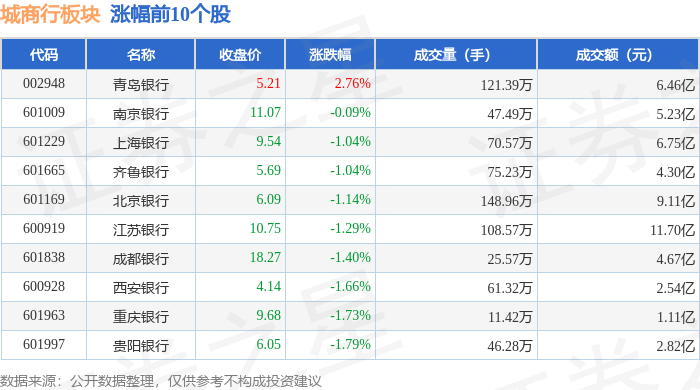
城商行板块9月2日涨1.65%,齐鲁银行领涨,主力资金净流入3.41亿元
Zheng Xing Xing Ye Ri Bao· 2025-09-02 08:59
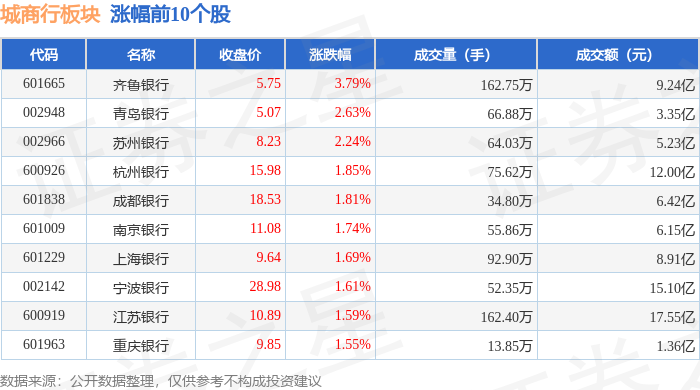
Group 1 - The city commercial bank sector increased by 1.65% on September 2, with Qilu Bank leading the gains [1] - The Shanghai Composite Index closed at 3858.13, down 0.45%, while the Shenzhen Component Index closed at 12553.84, down 2.14% [1] - Qilu Bank's closing price was 5.75, reflecting a 3.79% increase, with a trading volume of 1.6275 million shares and a transaction value of 924 million [1] Group 2 - The city commercial bank sector saw a net inflow of 341 million from main funds, while retail funds experienced a net outflow of 138 million [2] - Jiangsu Bank had a net inflow of 140 million from main funds, but a net outflow of 90.16 million from speculative funds [3] - The overall trading activity in the city commercial bank sector indicates a mixed sentiment among different types of investors, with main funds showing positive interest while retail and speculative funds withdrew [2][3]
从银行半年报看不良信号:风险主要还在地产和个贷
Di Yi Cai Jing· 2025-09-02 07:01
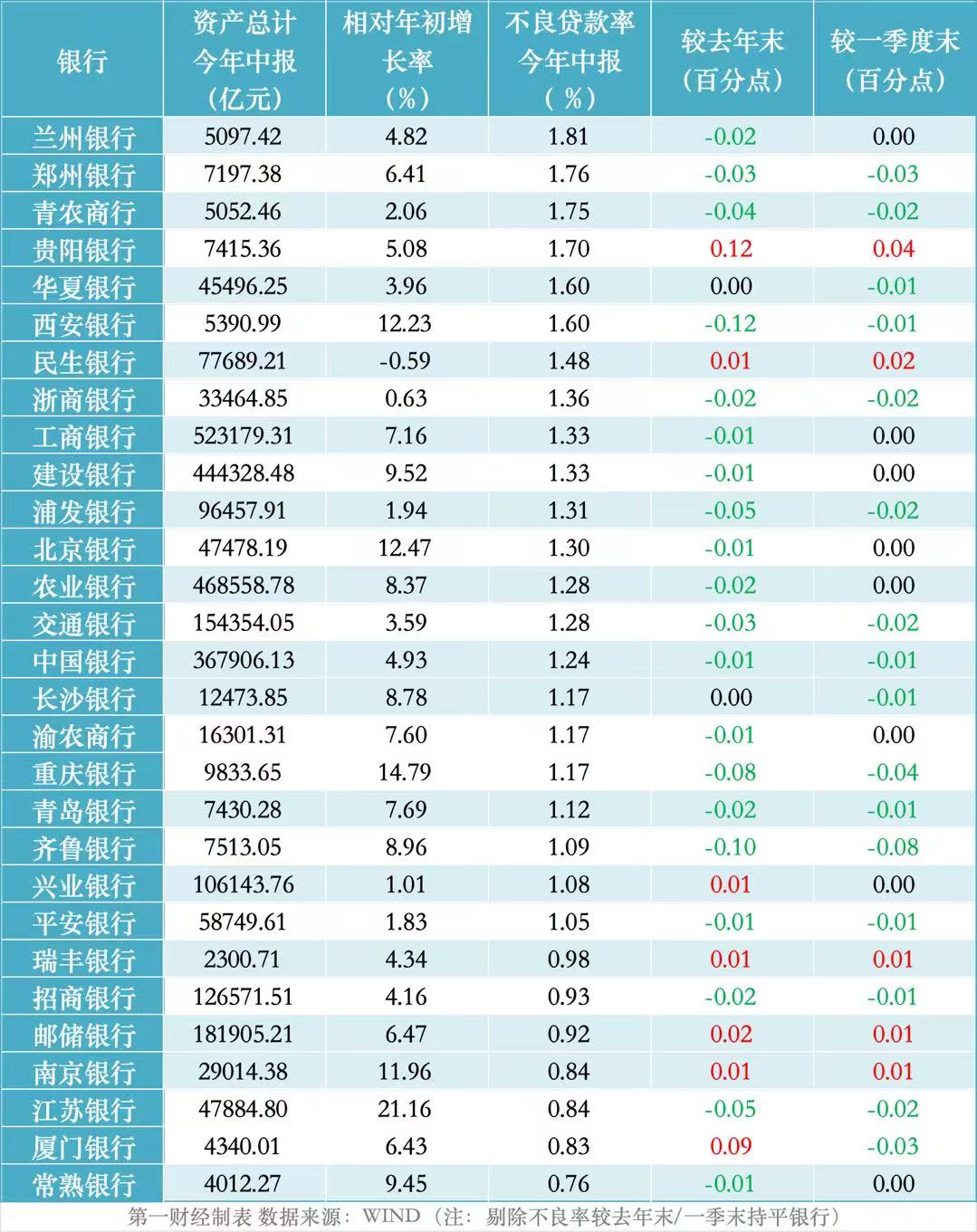
Core Viewpoint - The overall asset quality of the banking industry has improved, but there are still upward signals in non-performing loan (NPL) rates for personal loans, real estate, credit cards, and business loans [1][5]. Group 1: Asset Quality Trends - Most listed banks reported an improvement in asset quality in the first half of 2025, with a total asset scale of 321.33 trillion yuan, a growth of 6.35% from the beginning of the year [2]. - Among the state-owned banks, the total asset scale reached approximately 214 trillion yuan, growing by 7.18%, which is better than the industry average [2]. - 20 listed banks saw a decrease in NPL rates compared to the end of last year, while 7 banks experienced an increase [2]. Group 2: Non-Performing Loan Rates - The highest NPL rates among listed banks were reported by Lanzhou Bank (1.81%), Zhengzhou Bank (1.76%), and Qingnong Bank (1.75%) [3]. - The overall NPL rate for commercial banks was 1.49% at the end of the second quarter [3]. - Specific banks like Guiyang Bank saw a significant increase in NPL rates, with real estate NPLs rising by 70 basis points to 1.75% [5]. Group 3: Sector-Specific Risks - The real estate sector continues to pose risks, with several banks reporting significant increases in NPL rates in this area, including Qingnong Bank, which saw its real estate NPL rate surge from 7.17% to 21.32% [5][6]. - Personal loan NPL rates have also shown an upward trend, with many banks reporting increases of over 30 basis points [6][7]. - State-owned banks have generally seen a decline in corporate loan NPL rates, but some, like ICBC and Bank of Communications, reported increases in real estate NPL rates [6][9]. Group 4: Management Responses - Bank executives have acknowledged the ongoing pressure from asset quality, particularly in real estate and personal loans, and have outlined strategies for risk management [9][10]. - Measures include enhancing risk control in key sectors, improving loan management, and increasing support for high-quality clients [10][11]. - The focus will be on maintaining a balance between risk management and supporting economic growth through lending [10][12].