
Shanghai Ziyan Foods (603057)

Search documents
紫燕食品(603057) - 紫燕食品实际控制人之一致行动人通过大宗交易内部转让股份结果公告
2025-11-14 16:02
证券代码:603057 证券简称:紫燕食品 公告编号:2025-072 紫燕食品集团股份有限公司 实际控制人之一致行动人通过大宗交易内部转让股 份结果公告 本公司董事会、全体董事及相关股东保证本公告内容不存在任何虚假记载、 误导性陈述或者重大遗漏,并对其内容的真实性、准确性和完整性承担法律责任。 重要内容提示: 大股东持股的基本情况 本次内部转让股份计划实施前,宁国勤溯企业管理合伙企业(有限合 伙)(已更名上海勤溯企业管理合伙企业(有限合伙),以下简称"宁国勤 溯")为紫燕食品集团股份有限公司(以下简称"公司")实际控制人之一 致行动人,宁国勤溯持有公司 57,364,147 股,占公司总股本比例为 13.8724%。宁国勤溯为公司实际控制人持股的企业,其中钟勤沁为宁国勤 溯的执行事务合伙人,钟勤川为有限合伙人。 内部转让计划的实施结果情况 公司于 2025 年 9 月 27 日披露了《实际控制人之一致行动人通过大宗 交易内部转让股份计划的公告》(公告编号:2025-067),宁国勤溯的合伙 人钟勤沁、钟勤川拟自内部转让计划披露之日起的15个交易日后3个月内, 采用大宗交易方式将通过宁国勤溯间接持有的公司股份 ...

紫燕食品(603057.SH):宁国勤溯通过大宗交易内部转让1.3143%股份
Ge Long Hui A P P· 2025-11-14 07:56
格隆汇11月14日丨紫燕食品(603057.SH)公布,2025年11月14日,公司收到宁国勤溯出具的《减持结果 告知函》,宁国勤溯通过大宗交易方式内部转让公司股份543.5万股,内部转让比例为1.3143%,本次内 部转让计划实施完毕。 ...
紫燕食品:宁国勤溯通过大宗交易内部转让1.3143%股份
Ge Long Hui· 2025-11-14 07:53
格隆汇11月14日丨紫燕食品(603057.SH)公布,2025年11月14日,公司收到宁国勤溯出具的《减持结果 告知函》,宁国勤溯通过大宗交易方式内部转让公司股份543.5万股,内部转让比例为1.3143%,本次内 部转让计划实施完毕。 ...
紫燕食品:实控人一致行动人完成1.31%股份内部转让
Xin Lang Cai Jing· 2025-11-14 07:49
Core Viewpoint - The announcement from Ziyan Food indicates a significant change in shareholding structure due to the reduction of shares held by a key stakeholder, which may impact investor sentiment and market perception [1] Shareholding Changes - The actual controller and concerted actor, Ning Guoqin Su, previously held 57.3641 million shares, accounting for 13.8724% of the total share capital [1] - Partners Zhong Qinqin and Zhong Qinchuan plan to transfer 5.435 million shares (1.3143%) to an asset management plan through block trading starting from September 27, 2025, within a three-month period [1] - From October 31 to November 13, Ning Guoqin Su completed an internal transfer, reducing his shareholding to 12.5580% after selling shares at a price range of 16.25 to 17.35 yuan per share, totaling 46.0123 million yuan [1]
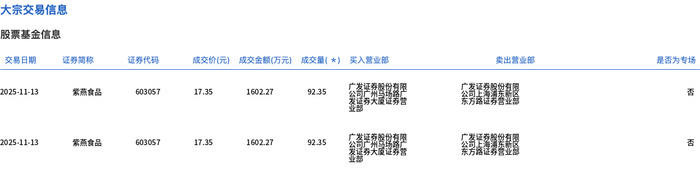
紫燕食品今日大宗交易折价成交184.7万股,成交额3204.54万元
Xin Lang Cai Jing· 2025-11-13 09:39
| 交易日期 | 证券简称 | 证券代码 | | | 成交价(元) 成交金额(万元) 成交量( *) 买入营业部 | | 类出管业部 | 是否为专场 | | --- | --- | --- | --- | --- | --- | --- | --- | --- | | 2025-11-13 | 家燕食品 | 603057 | 17.35 | 1602.27 | 92.35 | C 著年品盤堂表示 发证券大厦证券营 | - | 客 | | | | | | | | না হয় | | | | 2025-11-13 | 需蒸食品 | 603057 | 17.35 | 1602.27 | 92.35 | 公益性能量 第12级大局详细节 | 全部工程 1988 | Ka | 11月13日,紫燕食品大宗交易成交184.7万股,成交额3204.54万元,占当日总成交额的40.77%,成交价 17.35元,较市场收盘价19.47元折价10.89%。 ...

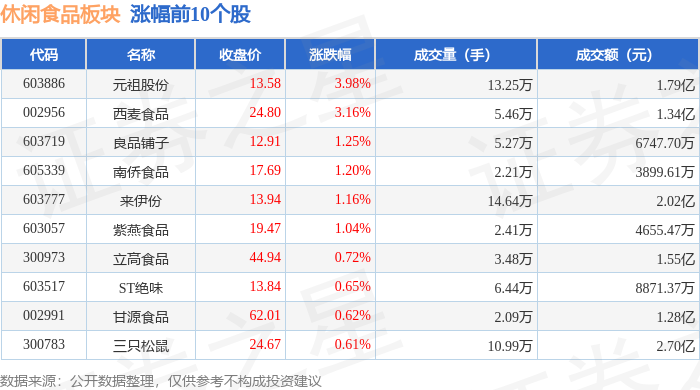
休闲食品板块11月13日涨0.21%,元祖股份领涨,主力资金净流出1.54亿元
Zheng Xing Xing Ye Ri Bao· 2025-11-13 08:44
Market Overview - The leisure food sector increased by 0.21% on November 13, with Yuanzi Co. leading the gains [1] - The Shanghai Composite Index closed at 4029.5, up 0.73%, while the Shenzhen Component Index closed at 13476.52, up 1.78% [1] Individual Stock Performance - Yuanzi Co. (603886) closed at 13.58, up 3.98% with a trading volume of 132,500 shares and a turnover of 179 million yuan [1] - Ximai Food (002956) closed at 24.80, up 3.16% with a trading volume of 54,600 shares and a turnover of 134 million yuan [1] - Other notable performers include: - Liangpinpuzi (603719) at 12.91, up 1.25% [1] - Nanjiao Food (605339) at 17.69, up 1.20% [1] - Laiyifen (603777) at 13.94, up 1.16% [1] Capital Flow Analysis - The leisure food sector experienced a net outflow of 154 million yuan from institutional investors, while retail investors saw a net inflow of 248 million yuan [2] - The capital flow for individual stocks shows: - Yuanzi Co. had a net inflow of 16.71 million yuan from institutional investors [3] - Salted Fish (002847) had a net inflow of 7.79 million yuan from institutional investors [3] - Purple Onion Food (603057) had a net inflow of 5.88 million yuan from institutional investors [3] Summary of Trading Data - The trading data for the leisure food sector indicates varied performance among stocks, with some experiencing significant gains while others faced declines [1][2] - The overall market sentiment appears positive, as indicated by the rise in major indices and the performance of leading stocks in the leisure food sector [1]



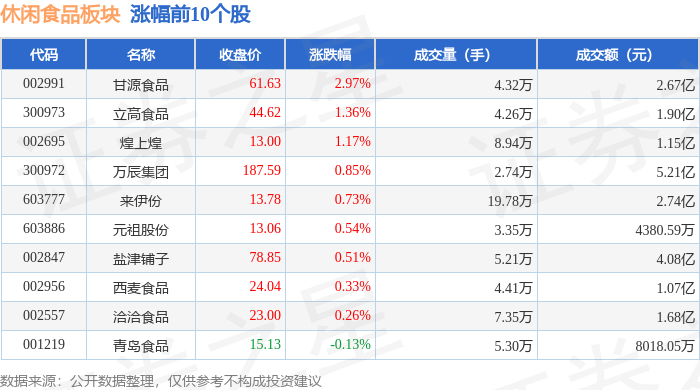
休闲食品板块11月12日跌0.01%,桂发祥领跌,主力资金净流出1.71亿元
Zheng Xing Xing Ye Ri Bao· 2025-11-12 08:42
Market Overview - The leisure food sector experienced a slight decline of 0.01% on November 12, with Gui Faxiang leading the drop [1] - The Shanghai Composite Index closed at 4000.14, down 0.07%, while the Shenzhen Component Index closed at 13240.62, down 0.36% [1] Stock Performance - Notable gainers in the leisure food sector included: - Ganyuan Food: closed at 61.63, up 2.97% with a trading volume of 43,200 lots and a transaction value of 267 million [1] - Lihai Food: closed at 44.62, up 1.36% with a trading volume of 42,600 lots and a transaction value of 206.1 million [1] - Major decliners included: - Gui Faxiang: closed at 14.30, down 2.26% with a trading volume of 273,100 lots and a transaction value of 394 million [2] - Ziyan Food: closed at 19.27, down 2.18% with a trading volume of 29,900 lots and a transaction value of 58.19 million [2] Capital Flow - The leisure food sector saw a net outflow of 171 million from institutional investors, while retail investors contributed a net inflow of 249 million [2] - Specific stock capital flows included: - Ganyuan Food: net inflow of 17.70 million from institutional investors, with a net outflow of 12.58 million from speculative funds [3] - Lihai Food: net inflow of 10.29 million from institutional investors, with a net outflow of 7.30 million from speculative funds [3]



每日报告精选-20251110
GUOTAI HAITONG SECURITIES· 2025-11-10 12:53
Macroeconomic Insights - Global asset performance shows mixed results, with the Hang Seng Index up 1.29% and the Shanghai Composite Index up 1.08%, while developed markets like the S&P 500 fell by 1.63%[6] - In October, the U.S. ISM Manufacturing PMI declined, indicating economic slowdown, while consumer confidence continued to drop according to the University of Michigan index[7] Inflation and Prices - October CPI in China rose by 0.2% year-on-year, while PPI decreased by 2.1%, indicating a stable inflation environment with core service prices reaching their highest level since March 2024[11] - The rise in core CPI is attributed to reduced food drag and increased service contributions, with gold prices significantly impacting jewelry costs[13] Trade and Exports - In October, China's exports fell by 1.1% year-on-year, while imports grew by 1.0%, leading to a slight decrease in trade surplus[16] - The export structure shows weakness in non-U.S. markets, particularly the EU, while exports to the U.S. and ASEAN remained strong[18] Investment Strategies - The asset allocation report suggests an overweight position in Chinese A-shares and industrial commodities, with equity allocation set at 45% and bonds at 45%[22] - The report emphasizes the importance of AI industry trends and the potential for volatility in global equity markets, recommending a focus on quality assets[23] Market Dynamics - The trading activity has decreased, with turnover rates and transaction volumes declining across indices, indicating a cautious market sentiment[28] - The report highlights a decrease in northbound capital flow, with a net outflow of 2.6 billion CNY in the recent week, reflecting investor sentiment shifts[34]




紫燕食品(603057):2025年三季报点评:增速转正,期待持续改善
Haitong Securities International· 2025-11-10 09:17
Investment Rating - The report maintains an "Outperform" rating for the company, with a target price of 25 RMB per share, reflecting a 15% upside potential based on a 50x PE for 2025 [4][8]. Core Insights - The company experienced a positive revenue turnaround in Q3 2025, with a revenue of 1.04 billion RMB, up 1.75% year-on-year, despite a significant decline in net profit [9]. - The gross profit margin (GPM) faced pressure, decreasing by 5.61 percentage points to 22.92%, primarily due to rising costs of imported beef [10]. - The company is focusing on expanding its store network, with a current total of 5,260 stores, targeting university towns and large factory canteens for new openings [12]. Financial Summary - Total revenue projections for 2023A to 2027E are as follows: 3,550 million RMB, 3,363 million RMB, 3,207 million RMB, 3,428 million RMB, and 3,760 million RMB, respectively, indicating a decline in the short term but potential growth in the long term [3]. - Net profit attributable to shareholders is projected to decrease significantly in 2025E to 205 million RMB, down 40.7% from 2024A [3]. - The earnings per share (EPS) forecast for 2025-2027 is 0.50 RMB, 0.62 RMB, and 0.73 RMB, respectively [4][8]. Product and Regional Performance - Fresh goods revenue showed a slight increase of 0.1% year-on-year to 874 million RMB in Q3 2025, with notable growth in other fresh goods, which increased by 27.4% [11]. - Regional performance varied, with East China revenue down 1.9%, while South China and overseas markets saw significant growth of 73.1% and 57.7%, respectively [11].
紫燕食品11月7日现2笔大宗交易 总成交金额3999.16万元 溢价率为-10.36%
Xin Lang Cai Jing· 2025-11-07 10:10
Group 1 - The core point of the article highlights the trading activity of Ziyan Food, which saw a closing price increase of 0.42% to 18.92 yuan on November 7, with significant block trades occurring [1] - Two major block trades were executed at a price of 16.96 yuan, each involving 117.90 million shares, totaling a transaction amount of 1,999.58 million yuan, with a discount rate of -10.36% [1] - Over the past three months, Ziyan Food has recorded a total of six block trades, amounting to 106 million yuan, and has experienced a cumulative increase of 3.11% in the last five trading days, with a net inflow of 150.25 million yuan from main funds [1]