YINGLIU(603308)

Search documents
华创证券:我国商用航空发动机市场潜力巨大,关注产业链三条线索
3 6 Ke· 2026-01-23 00:59
Core Viewpoint - The commercial aviation engine market in China has significant potential, with projections indicating a total market size exceeding 2.6 trillion yuan over the next 20 years, translating to an annualized scale of over 130 billion yuan [1] Group 1: Market Potential - The after-sales market is expected to reach approximately 100 billion yuan annually, contributing to a combined total of 240 billion yuan per year from both the engine market and after-sales services [1] Group 2: Investment Recommendations - The report suggests focusing on three key areas within the domestic aviation engine supply chain: - Core supporting companies, including Hangzhou Engine, Aero Engine Technology, and Aero Engine Control [1] - Suppliers of high-temperature alloys and other basic components, with continued recommendations for Yingliu Co., and attention to Wanze Co., Hangya Technology, and Hangyu Technology [1] - Raw material suppliers, highlighting AVIC High-tech [1]


华创交运航空强国系列研究(二):技术壁垒到估值高地,全球视角看商用航空发动机产业链
Huachuang Securities· 2026-01-22 13:25
Investment Rating - The report maintains a recommendation for the commercial aviation engine industry, indicating a positive investment outlook [1]. Core Insights - The commercial aviation engine is referred to as the "crown jewel" of modern industry, with engines accounting for approximately 25% of the total value of commercial aircraft [4][20]. - The report emphasizes the significant growth potential of China's commercial aviation engine market, projecting a total market size exceeding 2.6 trillion yuan over the next 20 years, with an annualized scale of over 130 billion yuan [5][11]. - The commercial aviation engine supply chain is characterized by high barriers to entry, with a global oligopoly dominated by a few major manufacturers [5][6]. Summary by Sections Industry Overview - The report introduces the commercial aviation engine as a critical component of modern industrial capabilities, highlighting China's reliance on imported engines and the low marketization rate of domestic engines, which is less than 1% [4][21]. Commercial Aviation Engine Analysis - The structure of commercial aviation engines includes key components such as fans, compressors, combustion chambers, and turbines, with the hot section being the most critical and challenging to manufacture [26][33]. - The aftermarket services for engines can generate revenues up to four times the initial sale price, indicating a lucrative long-term profit potential [4][18]. Business Model Exploration - The primary manufacturers operate under a "super blade + long-term blade" profit model, leveraging significant discounts on initial sales to capture market share while securing long-term service contracts for profitability [5][6]. - Suppliers in the engine manufacturing chain are positioned as "hidden champions," benefiting from high entry barriers and the need for extensive certification processes [5][6]. Global Valuation Perspective - The average price-to-earnings (PE) ratio for major engine manufacturers is reported at 30.2 times, with leading companies like GE Aerospace at 42 times, indicating robust valuation metrics driven by order backlog and aftermarket growth [5][6]. - Core suppliers exhibit an even higher average PE of 68.5 times, reflecting their scarcity and stable demand characteristics [5][6]. China's Commercial Aviation Engine Market - The report highlights the Longjiang series of engines as a key initiative to reduce reliance on foreign technology and enhance domestic capabilities [5][11]. - The projected growth of the Chinese aviation market is supported by forecasts indicating a compound annual growth rate (CAGR) of 4.4% from 2024 to 2044, with expectations of 10,175 aircraft by 2044 [5][11]. Investment Recommendations - The report suggests focusing on three key areas within the domestic aviation engine supply chain: core component suppliers, high-temperature alloy manufacturers, and raw material suppliers [5][11].

应流股份:目标 2028-29 年实现双电机产能 50 亿元、总营收 100 亿元;给予 “买入” 评级
2026-01-22 02:44
Summary of Yingliu (603308.SS) Conference Call Company Overview - **Company**: Yingliu (603308.SS) - **Industry**: Industrial Technology & Machinery Key Points Revenue and Capacity Guidance - Yingliu targets a firmwide revenue of Rmb10 billion and a two-engine capacity of Rmb5 billion, with a base case for achievement by 2030 and an aggressive case by 2028-29 [1][2] - The company anticipates new orders in 2026 to exceed Rmb3 billion, supported by strong order momentum [1][3] Order Momentum - New orders reached Rmb4.15 billion in 2025, up from Rmb3.2 billion in 2024 and Rmb2.6 billion in 2023, indicating a significant acceleration in demand [3] - The order backlog stood at Rmb2.96 billion at the end of 2025, with Rmb1.7-1.8 billion related to two-engine products [3] Customer Base - Core customers include Baker Hughes, Siemens Energy, and Ansaldo Energia, all of which have shown meaningful order acceleration [1][3] - Baker Hughes contributed approximately Rmb300 million to the backlog as of end-2025 [3] Pricing Strategy - The company maintains a disciplined pricing strategy with no direct price increases, focusing instead on securing more platforms and models [9][10] - Average selling prices (ASP) are rising structurally due to a shift towards higher-value platforms and complex components [10] Capacity Expansion - A new expansion cycle was initiated in 4Q25 with incremental capex of approximately Rmb150 million, focusing on debottlenecking rather than full production line replication [6] - Equipment delivery is expected within 10-12 months, with meaningful capacity release anticipated in 2027 [7] Commercial Space Opportunities - Yingliu expects Rmb20 million in revenue from commercial space in 2026, with significant demand from LandSpace Technology Corp [11] - The company is evaluating 3D printing technology, with a potential investment of Rmb100-200 million, though this remains optional [12] Performance with Key Clients - Revenue from Siemens Energy doubled in 2025 compared to 2024, with Rmb400 million in new orders signed [13] - Orders from Ansaldo saw a sharp increase, with Rmb240 million signed in November 2025 alone, compared to historical levels of Rmb40-50 million annually [13] Risks - Key downside risks include potential delays in capacity ramp-up, lower-than-expected order intake growth, and weakening demand from hyperscalers [15] Financial Projections - Market cap: Rmb37.0 billion / $5.3 billion - Revenue projections for 2026E: Rmb3,980.3 million, with EBITDA of Rmb1,059.7 million [14] Valuation - The 12-month price target is set at Rmb52.7, based on a 2028E P/E of 30x, discounted to 2026E at a cost of equity of 10% [14] Additional Insights - The company is focused on disciplined capacity expansion and pricing strategies to enhance competitiveness in the market [9][10] - Yingliu's strategic partnerships with major clients are expected to drive future growth and order intake [1][3]
商业航天:以第一性原理推演中国商业航天降本革命(附报告)
材料汇· 2026-01-21 15:30
Core Conclusion - By 2026, China's commercial aerospace industry is expected to reach a turning point in cost reduction for launch capacity, driven by the concentrated deployment of low Earth orbit (LEO) constellations and the normalization of high-frequency launches, with reusable rockets nearing breakthroughs in reducing unit launch costs. The industry's business model will shift from state-driven tasks to market-driven profitability, with a valuation logic transitioning towards "space infrastructure" as application scenarios and business models are restructured [3]. Market Outlook - 2026 is anticipated to be a prosperous year for China's commercial aerospace sector, with an accelerated pace of multi-constellation launches transitioning to large-scale deployment, leading to a rapid increase in rocket launch frequency. The commercial rocket launch service market in China is projected to grow from 10.26 billion yuan in 2025 to 47.39 billion yuan by 2030, corresponding to a CAGR of approximately 35.8%, primarily driven by high-frequency launch demand from dense deployment of LEO constellations [4][11]. - The industry is expected to maintain medium to long-term growth, with over 237,000 satellites needing to be deployed in accordance with ITU regulations by 2039. Starlink currently has over 9,000 satellites in orbit, and the demand for subsequent launches remains robust due to tightening frequency resources [4][11]. Cost Reduction Pathways - The essence of commercial rockets is a "space logistics" business, where core variables include efficiency improvements and cost reductions in launch capacity. Key pathways for cost reduction include breakthroughs in full-flow engine technology, high-frequency reuse capabilities, and industrialization in manufacturing [5]. - The unit cost of launching rockets is expected to decrease significantly through various stages: 1. Initial launch cost is approximately 55,000 yuan/kg 2. By around 2026, after achieving first-stage reuse, costs may drop to about 25,000 yuan/kg 3. Upgrading from aluminum to stainless steel structures could further reduce costs to approximately 19,000 yuan/kg 4. With the maturation of recovery methods, costs may decline to around 13,000 yuan/kg 5. Long-term, achieving second-stage reuse could bring costs close to 5,000 yuan/kg [5]. Industry Structure and Investment Opportunities - The commercial rocket industry is still in its early growth and valuation evolution phase. Key catalysts for valuation uplift in China's commercial aerospace sector include the realization of reusable rockets for large-scale LEO satellite networking and the transition from customized to standardized launches through long-term batch tasks [7][8]. - The valuation logic for commercial aerospace companies is shifting from manufacturing-oriented to platform and infrastructure-oriented technology enterprises, covering diverse long-term space mission needs such as manned flights and deep space exploration [8]. Key Players and Market Segments - The core technical barriers in rocket engines are concentrated in critical components such as thrust chambers and turbine pumps. The value in satellite manufacturing is primarily found in communication payloads [9]. - Key companies involved in the aerospace supply chain include: - Power Systems: Yingliu Co., Srey New Materials, Guoji Precision Engineering - Satellite Communication Systems: Shanghai Hantong, Aerospace Electronics, Guobo Electronics - Materials and Structural Components: Western Materials, Parker New Materials, Guoji Heavy Industry, Huazhuo High-Tech - Testing and Verification: Xicai Testing, Su Testing [9][10].





商业航天行业深度系列(一):以第一性原理推演中国商业航天降本革命
Shanghai Aijian Securities· 2026-01-21 10:19
Investment Rating - The report rates the industry as "stronger than the market" [1] Core Insights - The report concludes that 2026 will mark a turning point for China's commercial aerospace industry, with a shift from state-driven missions to market-driven profitability, driven by the deployment of low-orbit satellite constellations and advancements in reusable rocket technology [1][6] - The commercial rocket launch service market in China is projected to grow from 10.26 billion yuan in 2025 to 47.39 billion yuan by 2030, with a CAGR of approximately 35.8% [1][12] - The report emphasizes that the core components of rocket launch services are engines (54%) and structural components (24%), which together account for 78% of the value in the launch service segment [1][12] Summary by Sections Industry Overview - The commercial aerospace industry is defined as activities that provide aerospace products and services through social capital investment under national policy guidance, including the R&D, manufacturing, launch, and operation of spacecraft and rockets [6][7] - The global aerospace economy is expected to reach $612 billion by 2024, with commercial aerospace revenues accounting for approximately $480 billion, representing about 78% of the total [6][7] Market Dynamics - The demand for satellite launches is expected to surge as China enters a concentrated deployment phase for low-orbit satellite constellations, with over 200,000 satellites planned for deployment [18][19] - The report highlights that the competition for low-orbit frequency resources is intensifying, necessitating faster deployment of satellite constellations [19][21] Cost Structure and Efficiency - The report breaks down the cost structure of rockets, indicating that engines and structural components dominate the value chain [1][12] - It outlines a pathway for reducing launch costs, projecting that the unit cost of launching payloads could decrease significantly as technology advances [1][12] Investment Recommendations - The report suggests focusing on companies involved in key segments such as propulsion systems, satellite communication systems, materials and structural components, and testing and validation services [2][4] - Specific companies to watch include 应流股份 (603308), 斯瑞新材 (688102), and 上海瀚讯 (300762), among others [2][4]

未知机构:应流股份持续重点推荐加油太阳25年两机业务新签订单20亿左右24年两机收入9-20260120
未知机构· 2026-01-20 02:25
Company and Industry Summary Company: 应流股份 (Yingliu Co., Ltd.) Key Points - **New Orders and Revenue Growth** 应流股份 has secured approximately 2 billion in new orders for its two-machine business, with projected revenue of 950 million for 2024. The company has experienced rapid growth in this sector over the past two years, driven by increasing demand for gas turbine blades due to the surge in electricity demand from overseas AI computing power and tight global blade production capacity [1][3]. - **Production Capacity Expansion** Following the recent convertible bond fundraising, the company's monthly production value is expected to increase from 70-80 million to 200 million. This expansion is anticipated to support the company's performance growth over the next five years [1][4]. - **Key Client Relationships** 应流股份 has established strong partnerships with leading domestic and international clients. Internationally, the company collaborates with major players such as Baker Hughes, Siemens Energy, Ansaldo, and GE Aviation, with orders consistently exceeding expectations [2][5]. Domestically, the company supports large-scale projects from China’s major state-owned enterprises, indicating promising growth potential over the next five years [6]. - **Supply Chain and Value Addition** The company is expanding its supply range from solely casting to include upstream alloy smelting and downstream machining processes. This expansion is expected to enhance the value of individual blades by 50-100% due to increased demand for turbine hot-end components and the addition of post-processing capabilities [7][8]. - **Future Revenue Projections** By 2030, the two-machine business revenue is projected to reach approximately 5 billion, with a net profit margin expected to approach 20%. Revenue is anticipated to grow from 1.4 billion in 2025 to around 3 billion by 2027. The overall revenue forecast for 2030, including traditional business, nuclear power, and low-altitude operations, is expected to reach around 10 billion, with total revenue projected to exceed 10 billion [10]. - **Profitability Expectations** The company expects long-term gross margins to improve from the current 37-38% to 45-50%, while net margins are projected to rise from 13-14% to 20%, aligning closely with international benchmark companies like HOWMET [10].
技术突破叠加政策红利 核聚变产业入机构法眼
Zheng Quan Shi Bao· 2026-01-19 18:12
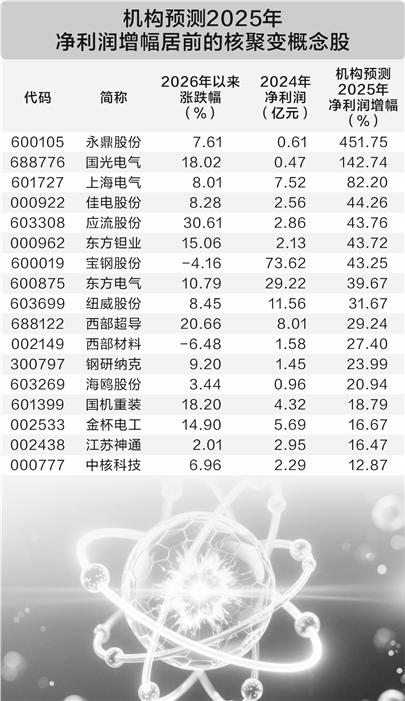
Group 1 - The core viewpoint of the news highlights significant advancements in the controlled nuclear fusion industry, which has become a national strategic focus in China, with substantial growth potential anticipated in the coming years [4][5] - The "14th Five-Year Plan" suggests a forward-looking layout for future industries, promoting hydrogen and nuclear fusion energy as new economic growth points [4] - The first fundamental law in China's nuclear energy sector, the "Atomic Energy Law," was enacted on January 15, 2023, encouraging scientific research and technological development in controlled thermonuclear fusion [4] Group 2 - Energy Singularity announced a breakthrough in high-temperature superconducting Tokamak technology, achieving a stable long pulse plasma operation of 335 seconds in its 5609th experiment [3] - The company has been focusing on the development of compact high-temperature superconducting Tokamak devices and their operational control software since its establishment in 2021 [3] - The nuclear fusion energy engineering in China has entered a substantial and systematic phase of industrial collaborative efforts, with multiple joint laboratories being established to focus on key technologies [3] Group 3 - According to CITIC Securities, the nuclear fusion industry has vast growth potential, driven by significant events and orderly domestic capital expenditures, with expectations for overseas progress to exceed forecasts [5] - The market size for nuclear fusion is projected to reach $496.55 billion by 2030, with the potential to create a trillion-dollar industrial cluster by 2050 [5] - As of January 16, 2026, there are 12 nuclear fusion concept stocks with net inflows exceeding 100 million yuan, with Western Superconducting, Western Materials, and Dongfang Electric leading the rankings [5] Group 4 - 20 nuclear fusion concept stocks are expected to see profit growth in 2025, with notable predictions for Yongding Co. and Guoguang Electric, expecting profit increases of 451.75% and 142.74% respectively [7] - Shanghai Electric is forecasted to have a profit increase of over 80%, while several other companies are expected to see growth rates exceeding 40% [7] - The controlled nuclear fusion sector is experiencing a surge in investment opportunities, particularly in the mid-to-upstream segments, driven by technological breakthroughs and policy support [5][6]




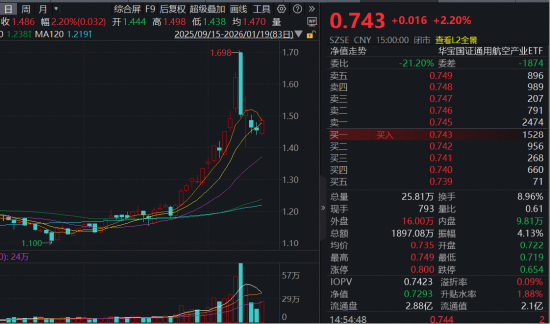
商业航天王者归来?中航机载、航发动力等三股涨停封板,通用航空ETF(159231)劲涨2.2%强势收复10日均线
Xin Lang Cai Jing· 2026-01-19 14:31
Core Viewpoint - The commercial aerospace sector has rebounded strongly after recent volatility, with the Huabao General Aviation ETF (159231) showing significant gains and increased trading volume, indicating positive market sentiment [1][4]. Group 1: Market Performance - The Huabao General Aviation ETF opened strong, rising over 3% at one point and closing up 2.20%, recovering above the 10-day moving average and touching the 5-day moving average, with a trading volume of 18.97 million yuan, a noticeable increase from the previous trading day [1][4]. - Among the 50 constituent stocks, 30 saw gains, with notable performers including China Aviation Industry Corporation (10.02% increase), Aero Engine Corporation of China (10.01% increase), and others exceeding 8% gains [4][11]. Group 2: Industry Trends - The commercial aerospace sector is supported by strong government policies and an upward trend in the industry. The National Venture Capital Guidance Fund is set to launch by the end of 2025, with investments in various sectors including aerospace [3][10]. - The International Telecommunication Union (ITU) has reported that China submitted an application for frequency and orbital resources for 203,000 new satellites, marking the largest international frequency application in the country's history, which is expected to drive further industry orders [3][10]. Group 3: Profitability Outlook - The profitability growth rate of the top 10 stocks in the commercial aerospace index improved from -14.5% in Q2 2025 to 1.5% in Q3 2025, with projections indicating a 37.5% year-on-year growth in 2026 [3][10]. - The commercial aerospace sector's performance is expected to continue improving, similar to the trends seen in the renewable energy sector, influenced by valuation sentiment, policies, and sector rotation [3][10].


华创交运公用可控核聚变双周报(第5期):核聚变能科技与产业大会召开,可控核聚变产业化进展或加速推进
Huachuang Securities· 2026-01-19 13:20
Investment Rating - The report maintains a "Recommended" rating for the controllable nuclear fusion industry, indicating an expectation of significant growth in the sector over the next 3-6 months [3][49]. Core Insights - The 2026 Nuclear Fusion Energy Technology and Industry Conference held in Hefei is expected to accelerate the industrialization of nuclear fusion, with major procurement projects and collaborative laboratory projects being signed [1][8]. - Star Ring Fusion has completed a 1 billion yuan Series A financing round, which will expedite the commercialization of nuclear fusion technology, with plans to complete engineering validation by 2028 and establish a demonstration reactor by around 2032 [9][1]. - The report anticipates that the domestic nuclear fusion projects will see a total investment of approximately 146.5 billion yuan, with capital expenditures expected to enter an expansion phase from 2025 to 2028, leading to increased orders in the industry chain [8][1]. Summary by Sections Industry Overview - The report highlights the significant participation of over 1,500 attendees from various sectors, including government, academia, and finance, at the 2026 Nuclear Fusion Energy Technology and Industry Conference [8]. - The conference aims to foster collaboration across innovation, industry, finance, and talent chains to build a synergistic nuclear fusion energy ecosystem [8]. Financing and Investment - Star Ring Fusion's 1 billion yuan financing round was led by Shanghai Guotou and other investment groups, focusing on developing a unique high-temperature superconducting spherical tokamak technology [9][1]. - The report notes that the nuclear fusion industry is entering a capital expenditure upcycle, with significant investments expected to drive order volumes in the supply chain [1][8]. Market Performance - The report provides a performance review of the nuclear fusion sector, noting that several companies have seen substantial stock price increases, with top performers including New Wind Power (+42%) and China Nuclear Construction (+27%) [22][26]. - The report also tracks bidding activities, indicating a total bidding amount of 1.28 billion yuan in early January 2026, with several high-value projects being awarded [12][15]. Recommended Companies - The report continues to recommend companies such as Hezhong Intelligent and Lianchuang Optoelectronics, while suggesting attention to Guoguang Electric [3][23]. - It emphasizes the importance of the magnet segment, recommending companies like Western Superconducting and Yongding Co., which have significant value contributions in the nuclear fusion supply chain [33][3].


AI设备文艺复兴时刻-半导体-燃机-PCB
2026-01-16 02:53
Summary of Key Points from Conference Call Records Industry Overview - The conference call discusses the AI equipment sector, focusing on semiconductor, gas turbine, PCB equipment, and liquid cooling technologies. [1][3] Company Highlights Guanggang Gas - Expected to double new orders from 150,000 cubic meters to approximately 300,000 cubic meters by 2026, with a market capitalization projected to grow from 26 billion to between 80 billion and 100 billion [1][4] - Profit margin anticipated to rise from 10% in 2025 to 34% in the first half of the current year [4] - Actively expanding into overseas markets and developing new products like supercritical carbon dioxide [4] Gas Turbine Sector - Global gas turbine orders expected to increase from 85 GW in 2025 to over 120 GW in 2026, driven by severe electricity shortages in the U.S. [1][5] - Jie Rui is highlighted as a key player, with a potential market capitalization of over 100 billion due to shortened delivery times and strong channel capabilities [5] Gas Turbine Blade Market - Ying Liu and Wan Ze hold less than 2% of a market worth approximately 170 billion, indicating significant growth potential [6] - Improvement in yield rates from 40% to 50-60% expected, enhancing order capacity and profit margins, which currently exceed 40% [6] Lian De Co. - Projected profits for 2026 could exceed expectations, reaching between 350 million and 360 million, with a potential increase to 500 million by 2027 [9] PCB Equipment - Notable companies include Dazhu Laser, New Qiwei, and Kaige, with Dazhu Laser expected to achieve profits of 2 billion by 2026, corresponding to a market cap of 80 billion [10] Liquid Cooling Technology - Companies like Hongsheng and Ying Wei are recommended, with Ying Wei's products being more reliable and likely to enter the U.S. AI supply chain [11] Optical Communication Equipment - Aotewei is identified as a key player with significant market potential in AOI and gold wire bonding machines, with a potential revenue increase of 2 to 2.5 billion if it captures 10% market share [12] Semiconductor Industry - Huahong Semiconductor is highlighted as a key player with a favorable competitive landscape and future growth potential [13] Additional Insights - The gas turbine sector is seen as the most sustainable segment within AI equipment, with increasing demand due to electricity shortages in the U.S. [5] - The liquid cooling technology is noted for its potential to ensure operational stability in data centers, especially under extreme weather conditions [11] - The PCB equipment sector is characterized by limited investment options, making it a secondary focus compared to gas turbines and liquid cooling [3] This summary encapsulates the key points and insights from the conference call, providing a comprehensive overview of the discussed companies and industry trends.