HUAYOU COBALT(603799)

Search documents
华友钴业(603799) - 华友钴业关于公开发行可转换公司债券项目募集资金专户完成销户的公告
2026-01-30 10:30
浙江华友钴业股份有限公司 关于公开发行可转换公司债券项目募集资金专户 完成销户的公告 本公司董事会及全体董事保证本公告内容不存在任何虚假记载、误导性陈述 或者重大遗漏,并对其内容的真实性、准确性和完整性承担法律责任。 一、募集资金基本情况 经中国证券监督管理委员会《关于核准浙江华友钴业股份有限公司公开发行可 转换公司债券的批复》(证监许可〔2022〕209号)核准,并经上海证券交易所同意, 浙江华友钴业股份有限公司(以下简称"公司") 于2022年2月24日公开发行了 76,000,000张可转换公司债券,每张面值为100.00元,募集资金总额为760,000.00万 元(含发行费用),扣除发行费用后募集资金净额为755,383.96 万元。上述募集资 金已于2022年3月2日全部到位,经天健会计师事务所(特殊普通合伙)验证并出具 《验证报告》(天健验[2022]72号)。 关于公开发行可转换公司债券项目募集资金专户完成销户的公告 股票代码:603799 股票简称:华友钴业 公告编号:2026-006 关于公开发行可转换公司债券项目募集资金专户完成销户的公告 案》,同意公司将公开发行可转换公司债券募投项目进行 ...
晚间公告|1月30日这些公告有看头




Di Yi Cai Jing· 2026-01-30 10:28
Group 1 - Yuehongyuan A announced the transfer of 45% equity in Hongxi Mining for 22.37 million yuan, aiming to optimize its business and promote transformation, expecting a positive impact on financial results with an estimated gain of over 22 million yuan [2] - Wanhua Chemical plans to increase capital by 19.086 billion yuan to its wholly-owned subsidiary Wanhua Olefins, consolidating its carbon two industry operations to enhance competitiveness [3] - Huayou Cobalt signed a cooperation framework agreement to build an integrated battery industry chain project in Indonesia, aiming to establish the country as a production base for electric vehicle batteries [4] Group 2 - Gansu Energy reported that the first batch of wind turbines for its 1 million kW green electricity aggregation pilot project has been connected to the grid, contributing to over 10% of the company's expected installed capacity by the end of 2025 [5] - Lingyi Zhizao completed the acquisition of 35% equity in Liminda for 875 million yuan, gaining control over 52.78% of voting rights, making Liminda a subsidiary [6] - Tianqi Lithium's third-phase expansion project for chemical-grade lithium concentrate produced its first batch of qualified products, enhancing raw material supply for its lithium chemical production bases [7] Group 3 - Ecovacs expects a net profit of 1.7 billion to 1.8 billion yuan for 2025, a year-on-year increase of 110.90% to 123.30% due to product upgrades and cost optimization [9] - Cambrian anticipates a turnaround with a net profit of 1.85 billion to 2.15 billion yuan for 2025, a significant increase in revenue driven by operational improvements [10] - China Southern Airlines expects a net profit of 800 million to 1 billion yuan for 2025, recovering from a loss of 1.696 billion yuan in the previous year [11] Group 4 - Shandong Gold forecasts a net profit of 4.6 billion to 4.9 billion yuan for 2025, a year-on-year increase of 56% to 66% due to improved production efficiency and rising gold prices [16] - Perfect World expects a net profit of 720 million to 760 million yuan for 2025, recovering from a loss of 1.288 billion yuan, driven by successful game launches and cost reductions [17] - CICC anticipates a net profit of 8.542 billion to 10.535 billion yuan for 2025, a year-on-year increase of 50% to 85% due to strong performance in investment banking and wealth management [18] Group 5 - *ST Songfa expects a net profit of 2.4 billion to 2.7 billion yuan for 2025, recovering from a loss of 76.64 million yuan, attributed to a major asset restructuring [19] - New Hope predicts a net loss of 1.5 billion to 1.8 billion yuan for 2025, down from a profit of 473.6 million yuan, impacted by fluctuations in the pig market [20] - 360 expects a net profit of 213 million to 318 million yuan for 2025, turning around from a loss, driven by increased investment income from equity method accounting [21]

华友钴业:拟在印度尼西亚合作建设电池产业链一体化项目
Mei Ri Jing Ji Xin Wen· 2026-01-30 09:48
Core Viewpoint - Huayou Cobalt (603799) announced a cooperation framework agreement with ANTAM and IBC to develop an integrated battery industry in Indonesia, focusing on the entire supply chain for electric vehicle batteries and other battery applications [1] Group 1: Company Developments - Huayou Cobalt's subsidiary HYD will collaborate with ANTAM and IBC to invest in the battery industry in Indonesia [1] - The partnership aims to establish Indonesia as a production base for electric vehicle batteries and other battery applications [1] Group 2: Industry Impact - The initiative is expected to positively influence Indonesia's sustainable economic development by supplying both domestic and international markets [1]
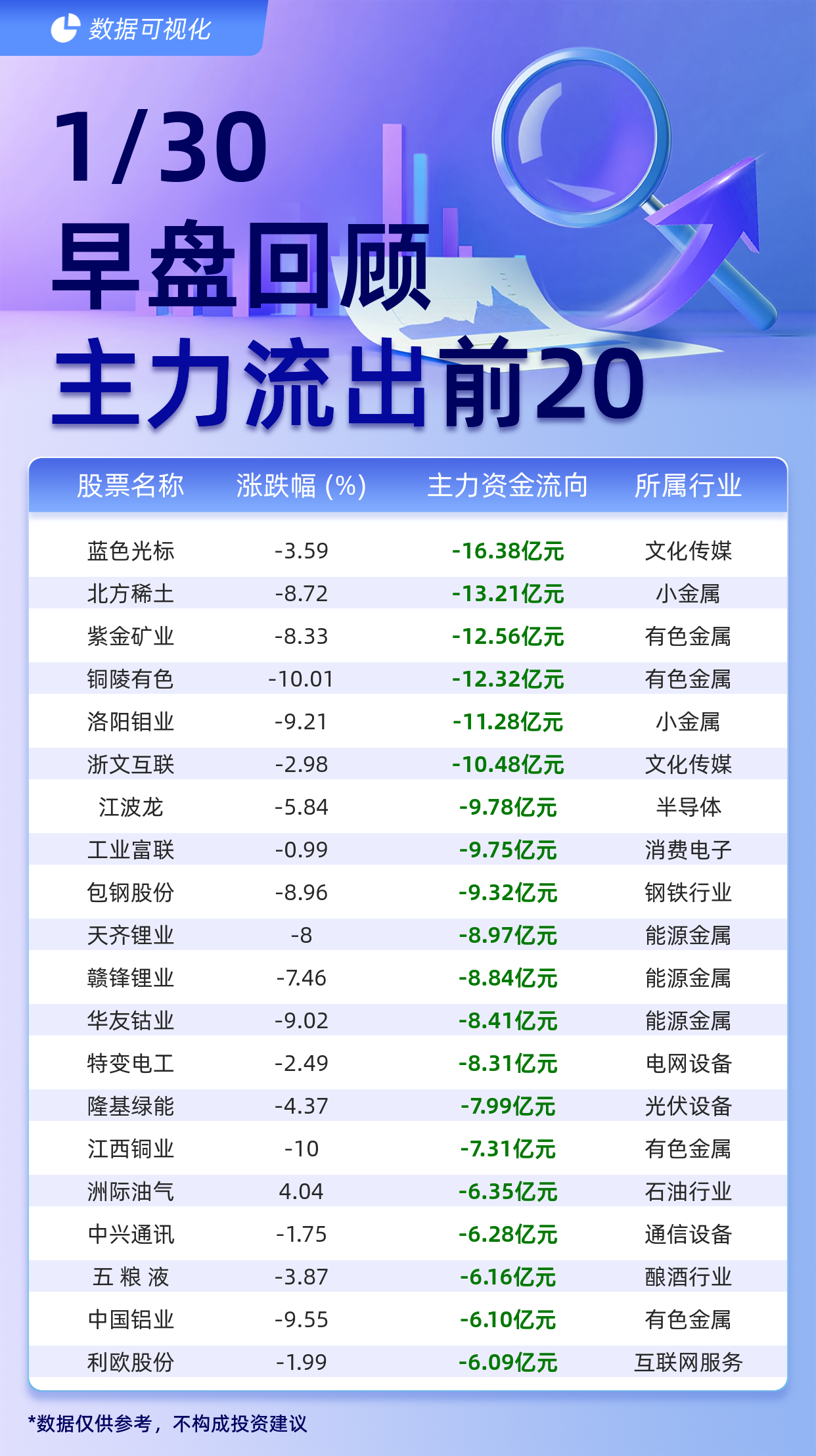
主力个股资金流出前20:蓝色光标流出16.38亿元、北方稀土流出13.21亿元




Jin Rong Jie· 2026-01-30 04:02
Core Viewpoint - The data indicates significant outflows of main funds from various stocks, with notable declines in share prices across multiple sectors, particularly in the rare metals and non-ferrous metals industries [1][2][3] Group 1: Stock Performance and Fund Outflows - BlueFocus Media experienced a fund outflow of 1.638 billion yuan, with a share price decline of 3.59% [2] - Northern Rare Earth saw a fund outflow of 1.321 billion yuan, with a share price drop of 8.72% [2] - Zijin Mining reported a fund outflow of 1.256 billion yuan, with a decrease in share price of 8.33% [2] - Tongling Nonferrous Metals had a fund outflow of 1.232 billion yuan, with a share price decline of 10.01% [2] - Luoyang Molybdenum experienced a fund outflow of 1.128 billion yuan, with a share price drop of 9.21% [2] Group 2: Sector Analysis - The rare metals sector, represented by Northern Rare Earth and Luoyang Molybdenum, is facing significant fund outflows and price declines [2][3] - The non-ferrous metals sector, including companies like Zijin Mining and Tongling Nonferrous Metals, is also experiencing substantial outflows, indicating potential challenges in this industry [2][3] - The energy metals sector, represented by Tianqi Lithium and Ganfeng Lithium, shows notable fund outflows, with share price declines of 8% and 7.46% respectively [2][3]
金属供需逻辑依然坚实,有色ETF鹏华(159880)盘中净申购1100万份
Sou Hu Cai Jing· 2026-01-30 03:37
Group 1 - The core viewpoint of the news is the anticipation of Kevin Warsh being nominated as the new Federal Reserve Chairman, which has led to a significant drop in the prices of non-ferrous stocks [1] - The market prediction for Warsh's nomination has surged to 87% according to Polymarket, indicating strong market sentiment towards a hawkish candidate [1] - The report from Guojin Securities outlines the main logic for the non-ferrous sector this year, highlighting low supply due to low capital expenditure, domestic anti-competition measures, and overseas resource nationalism [1] Group 2 - The demand for non-ferrous metals is driven by AI, new energy, and the reconstruction of manufacturing in Europe and the US [1] - The report emphasizes strong inventory replenishment due to low existing inventories across supply chains and the initiation of a national reserve cycle in the US [1] - Despite recent price volatility due to regional issues, the fundamental outlook for commodity prices remains strong, with macroeconomic fluctuations being the only potential disruptor [1] Group 3 - As of January 30, 2026, the non-ferrous metal industry index (399395) saw significant declines in major stocks, with Nanshan Aluminum leading at a drop of 10.05% [2] - The non-ferrous ETF Penghua (159880) decreased by 8.66%, with a latest price of 2.39 yuan and a net inflow of 11 million units over the past seven days [2] - The top ten weighted stocks in the non-ferrous metal industry index account for 51.65% of the index, including companies like Zijin Mining and Ganfeng Lithium [2]





A股异动丨锂矿股集体下挫,西藏珠峰、西部矿业等跌停,赣锋锂业跌超8%
Ge Long Hui A P P· 2026-01-30 02:50
Group 1 - The A-share market saw a collective decline in lithium mining stocks, with notable drops including Nepean Mining falling nearly 12% and several other companies hitting the daily limit down [1] - The main contract for lithium carbonate experienced a limit down, with a decrease of 11%, currently priced at 148,200 yuan per ton [1] Group 2 - Specific stock performances included Nepean Mining down 11.46% with a market cap of 8.152 billion yuan, and other companies like Meiyuan Co. and Tibet Zhufeng both down 10% [2] - Other significant declines included Western Mining down 9.99% with a market cap of 84.8 billion yuan, and Tianqi Lithium down 8.74% with a market cap of 88.5 billion yuan [2]





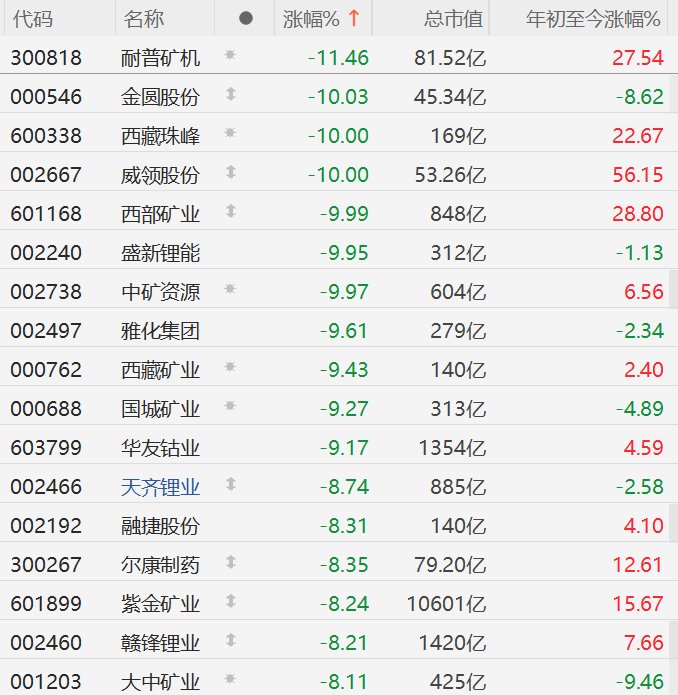
华友钴业股价跌5.47%,长城基金旗下1只基金重仓,持有14.61万股浮亏损失62.82万元
Xin Lang Cai Jing· 2026-01-30 01:57
Group 1 - The core point of the news is that Huayou Cobalt Co., Ltd. experienced a decline of 5.47% in its stock price, reaching 74.30 yuan per share, with a trading volume of 897 million yuan and a turnover rate of 0.63%, resulting in a total market capitalization of 140.93 billion yuan [1] - Huayou Cobalt, established on May 22, 2002, and listed on January 29, 2015, specializes in the research and manufacturing of new energy lithium battery materials and cobalt new materials [1] - The company's main business revenue composition includes: nickel products (34.54%), cathode materials (16.28%), trading and others (15.55%), nickel intermediates (14.91%), copper products (5.95%), ternary precursors (5.25%), lithium products (4.18%), and cobalt products (3.33%) [1] Group 2 - From the perspective of major fund holdings, one fund under Great Wall Fund has a significant position in Huayou Cobalt, specifically the Great Wall Value Growth Six-Month Holding Period Mixed A (010284), which held 146,100 shares, accounting for 2.44% of the fund's net value, ranking as the tenth largest holding [2] - The estimated floating loss for the fund today is approximately 628,200 yuan [2] - The Great Wall Value Growth Six-Month Holding Period Mixed A fund was established on March 16, 2021, with a current scale of 382 million yuan, and has achieved a year-to-date return of 5.12%, ranking 4937 out of 8872 in its category, while its one-year return is 47.22%, ranking 2424 out of 8126 [2]
能源金属板块1月29日跌1.24%,永杉锂业领跌,主力资金净流出12.08亿元
Zheng Xing Xing Ye Ri Bao· 2026-01-29 09:03
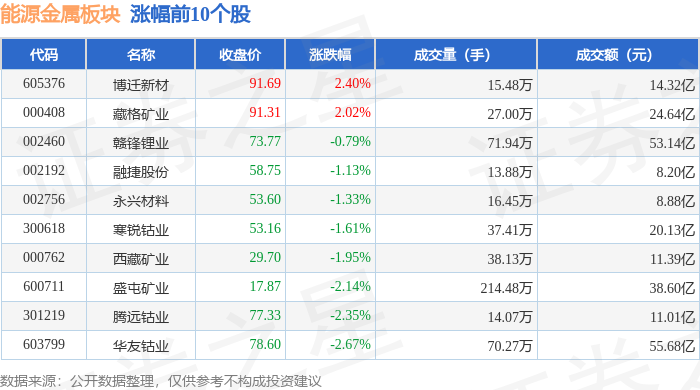
Core Viewpoint - The energy metals sector experienced a decline of 1.24% on January 29, with Yongshan Lithium Industry leading the drop. The Shanghai Composite Index rose by 0.16%, while the Shenzhen Component Index fell by 0.3 [1]. Group 1: Market Performance - The closing price of the Shanghai Composite Index was 4157.98, and the Shenzhen Component Index closed at 14300.08 [1]. - Key stocks in the energy metals sector showed mixed performance, with notable gainers including Boqian New Materials (+2.40%) and Zangge Mining (+2.02%), while Yongshan Lithium Industry led the decline at -4.00% [1][2]. Group 2: Trading Volume and Value - Boqian New Materials had a trading volume of 154,800 shares and a transaction value of 1.432 billion yuan, while Zangge Mining had a volume of 270,000 shares and a value of 2.464 billion yuan [1]. - The overall trading volume and value for the energy metals sector indicated significant activity, with major stocks like Ganfeng Lithium and Huayou Cobalt also contributing to the sector's dynamics [1][2]. Group 3: Capital Flow - The energy metals sector saw a net outflow of 1.208 billion yuan from institutional investors, while retail investors contributed a net inflow of 994 million yuan [2][3]. - Specific stocks like Zangge Mining and Boqian New Materials experienced varying levels of net inflow and outflow from different investor categories, indicating diverse investor sentiment [3].


3月19-20日 常州!2026锂电关键材料及应用市场高峰论坛
鑫椤锂电· 2026-01-29 08:00
Core Viewpoint - The lithium battery industry is poised for a significant growth cycle starting in 2026, characterized by strong demand recovery, accelerated global expansion, and disruptive technological advancements, leading to a "spiral rise" in both volume and price [3]. Group 1: Market Predictions - By 2025, global lithium battery production is expected to reach 2250 GWh, with a growth rate of 30% in 2026, and the energy storage sector projected to grow at an impressive 48.3% [5]. - The demand surge will create substantial pressure on the supply of battery cells and four key upstream materials, highlighting a potential supply gap that needs to be addressed for stable and efficient supply chains [5]. Group 2: Conference Details - The 2026 Lithium Key Materials and Application Market Summit will be held on March 19-20, 2026, in Changzhou, Jiangsu, organized by Xinluo Information [4]. - The summit will focus on three core topics: in-depth discussions on cutting-edge technologies and market supply-demand dynamics, B2B procurement matching, and strategic insights for high-quality development in the lithium battery industry [5][6]. Group 3: Key Discussion Topics - The conference will feature discussions on lithium carbonate futures and options, market volatility responses from lithium battery companies, and the potential of global lithium resources in 2026 [7]. - Other topics include the opportunities presented by solid-state battery development for lithium salt companies and the practical aspects of lithium carbonate futures and supply-demand outlooks [7][8]. Group 4: Industry Collaboration - The summit aims to facilitate B2B procurement connections among top global battery companies and material suppliers, covering the entire supply chain from cathode materials to electrolytes [6]. - It will also provide authoritative data releases, benchmark company rankings, and deep industry connections to help businesses seize growth opportunities in the lithium battery sector [6].




产品涨价,业绩回暖,锂电板块周期上行信号显现
Di Yi Cai Jing Zi Xun· 2026-01-28 14:25
Core Viewpoint - The lithium battery industry is expected to reach a performance turning point in 2025, with many companies reporting improved earnings due to rising prices of key lithium materials and sustained demand from the electric vehicle and energy storage sectors [2][3]. Group 1: Industry Performance - Among 28 lithium battery companies that disclosed earnings forecasts, 11 are expected to see profit increases, and 6 are projected to turn losses into profits, indicating a recovery in the lithium battery materials sector [2]. - Key players in lithium materials, such as lithium carbonate and hexafluorophosphate, have reported significant quarter-on-quarter earnings growth, driven by price increases and ongoing demand from the electric vehicle and energy storage markets [2][3]. Group 2: Price Trends - The price of battery-grade lithium carbonate has shown a "V-shaped" recovery, rising from 73,000 yuan/ton to approximately 120,000 yuan/ton, with peaks reaching around 134,000 yuan/ton by the end of 2025 [4]. - The increase in lithium carbonate prices has significantly improved the profitability of lithium salt companies, with major firms like Ganfeng Lithium and Yahua Group reporting substantial profit increases [4][5]. Group 3: Company-Specific Insights - Ganfeng Lithium is expected to turn a profit in 2025, with projected net profits ranging from 1.1 billion to 1.65 billion yuan, compared to a loss of 2.074 billion yuan in the previous year [4]. - Yahua Group anticipates a net profit of 600 million to 680 million yuan in 2025, representing a year-on-year growth of 133.36% to 164.47% [4]. - Tianqi Lithium and other suppliers are also expected to report significant profit increases due to rising prices of hexafluorophosphate and lithium carbonate [5]. Group 4: Market Demand and Future Outlook - The demand for energy storage and electric vehicles remains strong, with global energy storage battery shipments expected to reach 640 GWh in 2025, a year-on-year increase of 82.9% [6]. - The continuation of domestic vehicle replacement policies and the resumption of electric vehicle purchase subsidies in Germany are expected to further boost demand [6]. - Analysts suggest that as long as the demand for new energy remains strong, the prices of key upstream products like lithium carbonate are likely to continue rising, leading to a new cycle of prosperity in the industry [7].