HUAYOU COBALT(603799)

Search documents
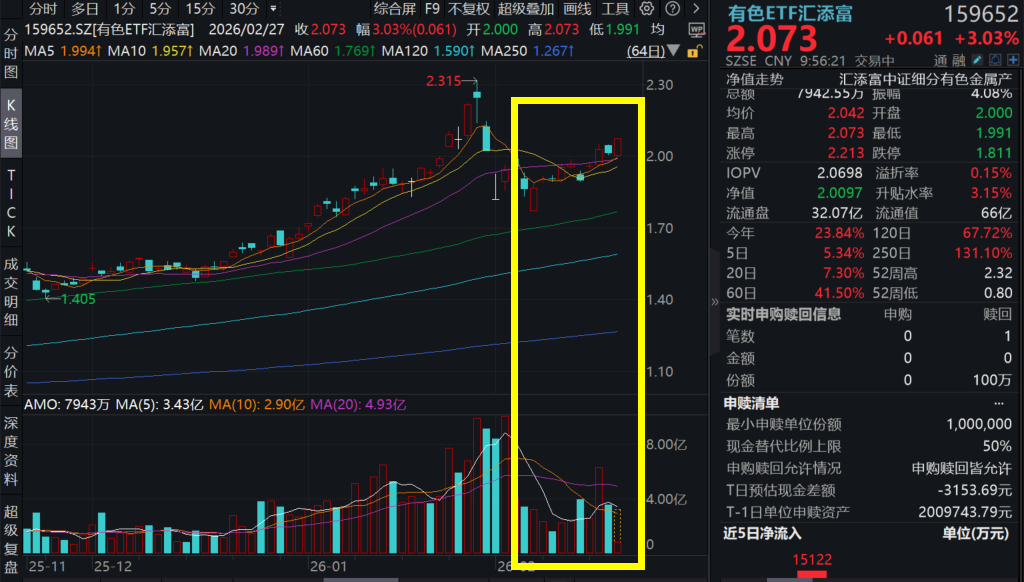
有色板块异军突起,钨价暴涨,厦门钨业涨超7%!有色ETF汇添富(159652)涨超3%!小金属继续暴涨,有色最新配置逻辑解析!
Xin Lang Cai Jing· 2026-02-27 02:21
Core Viewpoint - The A-share market experienced fluctuations with the non-ferrous metal sector showing resilience, particularly the Huatai-PineBridge Non-ferrous ETF (159652), which rose over 3% as of 9:50 AM on February 27 [1]. Non-Ferrous Metal Sector Performance - The Huatai-PineBridge Non-ferrous ETF (159652) saw most of its constituent stocks rise, with notable increases such as Xiamen Tungsten rising over 7%, Northern Rare Earth up over 5%, and Luoyang Molybdenum increasing over 4% [3]. - The top ten constituent stocks of the ETF include Zijin Mining, Luoyang Molybdenum, and Northern Rare Earth, with respective weightings of 14.47%, 7.55%, and 5.58% [4]. Tungsten Market Insights - The tungsten market has entered a strong upward trend since the beginning of 2026, with core prices reaching historical highs, driven by supply constraints, recovering demand, and a reassessment of its strategic value [5]. - Industry experts indicate that the tungsten market is currently in a state of supply-demand balance, with low inventory levels supporting prices. The long-term outlook remains positive due to increasing demand from new energy and high-end manufacturing sectors [5]. Precious Metals Outlook - Precious metals continue to attract investment, with India allowing significant funds to allocate more resources to gold and silver, reflecting a rising global demand for hard assets [5]. - The macroeconomic environment, including potential interest rate cuts by the Federal Reserve and increased central bank gold purchases, is expected to support precious metal prices [7]. Industrial Metals Analysis - Industrial metals are supported by supply-demand fundamentals, with a notable recovery in the U.S. manufacturing sector indicated by a January PMI of 52.6, which is significantly above expectations [8]. - The development of emerging industries such as AI and renewable energy is projected to create substantial new demand for industrial metals like copper and aluminum [8]. Investment Strategy for Non-Ferrous Sector - The Huatai-PineBridge Non-ferrous ETF (159652) is highlighted for its comprehensive coverage of various metal sectors, including gold, copper, aluminum, lithium, and rare earths, positioning it to benefit from the ongoing non-ferrous super cycle [9]. - The ETF boasts a high concentration of "gold and copper content," with copper at 34% and gold at 14%, leading the industry in this metric [11]. Performance Metrics - The Huatai-PineBridge Non-ferrous ETF (159652) has demonstrated superior performance metrics, with a Sharpe ratio leading its peers and a lower maximum drawdown compared to similar funds [14]. - The index's price-to-earnings ratio stands at 32.24, reflecting a 41% decrease from five years ago, indicating a favorable valuation relative to its earnings growth [14].







有色ETF华安(512940)开盘跌0.78%,重仓股紫金矿业跌0.43%,洛阳钼业跌0.35%
Xin Lang Cai Jing· 2026-02-27 01:42
Group 1 - The core point of the article highlights the performance of the Huazhong Nonferrous ETF (512940), which opened with a decline of 0.78% at 1.022 yuan [1] - Major holdings in the ETF include Zijin Mining, which fell by 0.43%, and Ganfeng Lithium, which dropped by 2.00% [1] - The ETF's performance benchmark is the CSI Nonferrous Metals Mining Theme Index, with a return of 3.32% since its establishment on February 4, 2026 [1] Group 2 - The fund is managed by Huazhong Fund Management Co., Ltd., with Xu Zhiyan as the fund manager [1] - Other notable stock performances include Luoyang Molybdenum down 0.35%, Northern Rare Earth up 0.05%, and China Aluminum down 0.82% [1] - The article provides a snapshot of the ETF's performance and its key holdings, reflecting the current market conditions in the nonferrous metals sector [1]
碳酸锂期货日报-20260227
Jian Xin Qi Huo· 2026-02-27 01:41
Report Summary 1. Report Industry Investment Rating - Not provided in the given content 2. Core View of the Report - The lithium carbonate futures rose and then fell, with the total open interest increasing by 2,957. The market continued to trade on the lithium mine ban in Zimbabwe. The responses from Yahua Group, Huayou Cobalt, and Zhongkuang Resources alleviated market concerns. The spot price of electric carbon increased by 10,700 to 176,000, Australian ore rose by 90, lithium mica rose by 155, ternary remained flat, and iron lithium rose by 2,000 - 2,100. The social inventory of lithium carbonate decreased by 2,839 tons to 100,093 tons compared to before the holiday. In the short term, as the hype on the supply side cools down, lithium prices face downward pressure, but with continuous destocking of domestic social inventory and the approaching peak demand season, there is strong support below. It is recommended to wait for buying opportunities after the price correction [12]. 3. Summary by Relevant Catalogs 3.1. Market Review and Operation Suggestions - The lithium carbonate futures rose and then fell, with the total open interest increasing by 2,957. The market continued to trade on the lithium mine ban in Zimbabwe. Responses from relevant companies alleviated market concerns, leading to some long - position holders taking profits. The spot price of electric carbon, Australian ore, lithium mica, and iron lithium increased, while ternary remained flat. The social inventory of lithium carbonate decreased by 2,839 tons to 100,093 tons compared to before the holiday. It is recommended to wait for buying opportunities after the price correction [12]. 3.2. Industry News - On February 26, Yahua Group stated on the interactive platform that the Zimbabwe export ban would not affect its normal production and operation. Its Zimbabwe project meets the requirements, has resubmitted the export application, and is expected to resume export in 1 - 2 weeks. The Zimbabwean government hopes that Chinese enterprises will accelerate the construction of lithium sulfate plants, and Yahua's project has started. The previously produced lithium concentrate has been shipped back, ensuring domestic production needs [13]. - On February 26, Core Lithium Ltd. announced selling a batch of ore inventory from its idle Finniss lithium mine in Australia to Glencore at a price of $2,023 per ton for about 5,100 tons of lithium concentrate to raise funds for potential project restart. The company retains the lithium fine powder inventory for better future processing options [13][14].


大涨超11%后显著回落!津巴布韦“暂停锂矿出口”影响有多大,碳酸锂后续怎么走?
Qi Huo Ri Bao· 2026-02-27 00:21
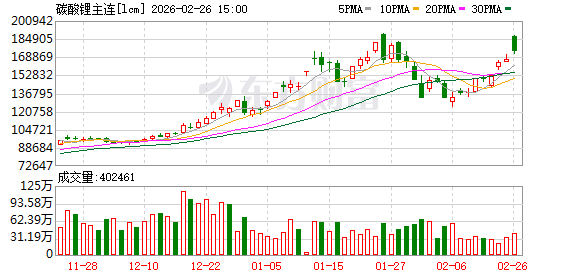
Core Viewpoint - The lithium carbonate market has shown strong performance post-Spring Festival, with futures prices experiencing significant increases due to both fundamental and news-driven factors [2]. Group 1: Market Performance - On February 26, lithium carbonate futures opened strongly, with the main contract LC2605 reaching a peak of 187,700 yuan/ton, reflecting an increase of over 11% at one point, and closing at 173,660 yuan/ton, up by 3.47% [1]. - The price increase is attributed to the rise in international commodity prices during the holiday and expectations of a tighter supply-demand balance in the spot market after March [2]. Group 2: Supply Concerns - The Zimbabwean Ministry of Mines announced an immediate suspension of all raw ore and lithium concentrate exports, including in-transit shipments, to enhance mineral regulation and accountability [2]. - This suspension has raised concerns about supply, as Zimbabwe accounts for approximately 10% of global lithium supply, and any long-term restrictions could significantly impact global lithium supply-demand dynamics [4]. Group 3: Company Impact - Domestic companies such as Shengxin Lithium Energy, Zhongkuang Resources, and Huayou Cobalt have lithium mining operations in Zimbabwe [3]. - Companies like Huayou Cobalt and Zhongkuang Resources have existing lithium production capacities, with Huayou's 50,000-ton lithium sulfate project expected to be operational soon, while Zhongkuang's 30,000-ton capacity is projected for 2027 [3]. - The impact of Zimbabwe's policy is considered short-term, with companies having inventory plans in place, and the overall effect on those with mining qualifications is expected to be limited [4]. Group 4: Future Outlook - Analysts predict that the lithium carbonate market will maintain a strong fundamental position in the short term, with supply-demand dynamics remaining tight [5]. - Increased shipments of lithium salts from Chile are expected to alleviate some supply pressures, but the overall trend of inventory depletion is likely to continue [5]. - The market is anticipated to remain in a tight balance, supported by recovering production from lithium salt enterprises and positive production expectations from material companies [5].

大涨超11%后显著回落!津巴布韦“暂停锂矿出口”影响有多大 碳酸锂后续怎么走?
Qi Huo Ri Bao· 2026-02-27 00:16
Group 1 - The lithium carbonate market has shown strong performance after the Spring Festival, with futures prices rising significantly, reaching a peak of 187,700 yuan/ton, and closing at 173,660 yuan/ton, a 3.47% increase on the day [1] - Analysts attribute the price increase to a combination of strong fundamentals and positive news, with expectations of a tighter supply-demand balance in the spot market after March [1][5] - The recent suspension of all raw ore and lithium concentrate exports by Zimbabwe's Ministry of Mines has raised concerns about supply, as Zimbabwe accounts for approximately 10% of global lithium supply [3][5] Group 2 - Companies such as Shengxin Lithium Energy, Zhongmin Resources, and Huayou Cobalt have lithium mining operations in Zimbabwe, with Huayou Cobalt's 50,000-ton lithium sulfate project expected to be operational soon [3][4] - The impact of Zimbabwe's export suspension is considered short-term, with companies like Yahua Group having already shipped their lithium concentrates, thus limiting the overall effect [4] - Analysts believe that Zimbabwe will likely not permanently halt exports, as such a move would significantly impact the global lithium supply and the country's economy [5][6] Group 3 - The lithium carbonate market is expected to maintain a strong fundamental outlook, with increased shipments from Chile anticipated to alleviate some supply tightness, although overall inventory levels remain low [5][6] - Demand from material companies is projected to improve in March, with expectations of returning to full production capacity, further supporting lithium carbonate prices [6]
津巴布韦暂停锂矿出口,13家锂矿公司或将受益,其中7家年报预增
Sou Hu Cai Jing· 2026-02-26 17:37
Core Viewpoint - Zimbabwe's sudden ban on lithium ore and concentrate exports has created significant disruptions in the global lithium supply chain, affecting nearly 20% of China's lithium raw material supply and potentially leading to a supply gap of approximately 14,000 to 15,000 tons of lithium carbonate equivalent per month starting in May 2026 [1][3][4]. Group 1: Impact of Zimbabwe's Ban - Zimbabwe's Ministry of Mines announced an immediate suspension of all lithium ore and concentrate exports, including shipments already at sea, to strengthen mineral regulation and promote domestic processing [1][3]. - In 2025, China imported 7.75 million tons of lithium concentrate, with 1.2 million tons (19%) coming from Zimbabwe, highlighting the critical role of Zimbabwe in China's lithium supply [3]. - The ban is expected to lead to a significant increase in lithium prices, with domestic carbonate lithium futures prices surging to over 171,440 yuan per ton, reflecting a nearly 17% increase in just two trading days [4]. Group 2: Market Reactions and Opportunities - The immediate market reaction saw a spike in lithium prices, with the benchmark price for battery-grade lithium carbonate reaching 162,000 yuan per ton, an increase of over 8% since the beginning of the month [4]. - Companies with integrated mining and processing capabilities in Zimbabwe are positioned to benefit from the ban, as they can still apply for export licenses while others face supply constraints [6]. - A total of 13 domestic companies with lithium carbonate production or lithium mining resources are now in the spotlight, with 7 of them forecasting significant profit increases for 2025 [7]. Group 3: Company Profiles and Strategies - The first tier of companies, termed "ban immune," includes Huayou Cobalt, which has established deep processing capacity in Zimbabwe and is set to produce lithium sulfate, allowing it to circumvent the export ban [9]. - Zhongjin Lingnan has a strong position with its control over the Bikita lithium mine, which allows it to apply for export licenses despite the ban, and it has a stockpile of 150,000 tons of lithium concentrate to buffer against short-term export restrictions [11]. - The second tier includes resource giants like Ganfeng Lithium, which has diversified global resources and is expected to see a significant increase in production from 200,000 tons to 500,000 tons by 2026, benefiting from rising lithium prices [11][13]. Group 4: Long-term Industry Implications - The ban is prompting a reevaluation of companies with overseas resources, local processing capabilities, or stable domestic sources, as their strategic value is being reassessed in the market [17]. - The surge in lithium carbonate futures and the rising stock prices of lithium mining companies reflect this market reassessment and the potential for long-term growth in the sector [17].



涨价潮,轮到碳酸锂了?
格隆汇APP· 2026-02-26 12:29
Group 1 - The article discusses the recent volatility in the lithium market, highlighting a significant increase in lithium carbonate futures prices, which rose by over 11.42% to nearly 187,700 yuan per ton [2][4] - There is a stark divergence in stock performance among lithium companies, with some like Salt Lake Co., Tianqi Lithium, and Ganfeng Lithium seeing strong gains, while others like Shengxin Lithium and Yahua Group faced substantial declines [5][20] - The article emphasizes the geopolitical implications of lithium resources, particularly following Zimbabwe's unexpected announcement of a complete ban on lithium concentrate exports, which was initially planned for 2027 but has been moved up by a year [10][12] Group 2 - Zimbabwe's ban is seen as a strategic move to alter the global profit distribution of mineral resources, as the country aims to enhance local value addition rather than relying on raw mineral exports [11][14] - The article notes that Zimbabwe is the fourth-largest lithium producer globally, with expectations that its lithium production will reach 235,000 tons by 2026, accounting for about 12% of global supply [12][14] - The domestic lithium salt refining capacity in China is heavily reliant on Zimbabwean ore, with 19% of lithium concentrate imports coming from Zimbabwe, amounting to approximately 120,000 tons [15][16] Group 3 - The article highlights the impact of the export ban on downstream battery manufacturers, indicating that companies like CATL have also experienced stock declines due to supply chain uncertainties [18] - The supply disruption is expected to lead to upward pressure on lithium prices, as the market anticipates potential shortages if alternative supply sources cannot be developed in the medium to long term [18][19] - The article suggests that companies with domestic low-cost resources, such as Salt Lake Co., may benefit from the price surge, while those relying on raw mineral exports could face significant challenges [24][27] Group 4 - Despite the surge in lithium futures prices, the overall stock performance of lithium mining companies has been mixed, with some companies facing operational challenges due to the export ban [20][21] - The article points out that companies with established local processing capabilities may be better positioned to navigate the new regulatory landscape, while those with a "mining and shipping" model may struggle [21][23] - The article concludes that the era of simply holding mining licenses for high valuations is over, as geopolitical factors increasingly influence operational costs and market dynamics [32][33]


津巴布韦禁止锂矿出口,碳酸锂直逼19万元/吨
高工锂电· 2026-02-26 11:00
Core Viewpoint - The ban imposed by Zimbabwe on the export of raw lithium and lithium concentrate is not only a short-term shock to supply and prices but also serves as a long-term warning regarding supply chain security [1][19]. Group 1: Ban Details - The Zimbabwean Ministry of Mines announced an immediate ban on all exports of lithium ore and lithium concentrate, including goods already in transit [3][4]. - The ban applies to all lithium raw ore and concentrate exports, with exemptions only for companies holding valid mining rights and approved processing/refining facilities [4]. - The long-term goal is to completely ban lithium concentrate exports by 2027, allowing only deep-processed products like lithium sulfate to be exported [4][5]. Group 2: Market Impact - Following the announcement, domestic lithium carbonate prices surged, with futures prices nearing 190,000 yuan per ton, and lithium mining stocks opened significantly higher [2]. - Zimbabwe is the largest lithium supplier in Africa and the fourth largest globally, making its export ban impactful on the global lithium market [8]. - If Zimbabwe halts lithium concentrate exports for one month, it could affect domestic production by approximately 10,000 tons of lithium carbonate equivalent [10]. Group 3: Industry Response - Major Chinese companies such as Huayou Cobalt, Zhongjin Lingnan, Shengxin Lithium Energy, and Yahua Group are key contributors to Zimbabwe's lithium supply [13]. - Huayou Cobalt has already launched a 50,000-ton lithium sulfate project in Zimbabwe, while Zhongjin Lingnan plans to start a 30,000-ton lithium sulfate project by Q3 2027 [14]. - Companies are responding differently to the ban; Zhongjin Lingnan has paused all exports and is awaiting further policy details, while Yahua Group has already shipped its lithium concentrate and does not expect production impacts [15][16]. Group 4: Global Resource Management Trends - The ban reflects a broader trend of resource-rich countries tightening control over their resources, as seen in the recent agreements among South American countries to manage lithium resources collectively [17][18]. - This shift indicates a move from freely traded commodities to strategically controlled resources, with countries seeking to maximize local value through processing and joint pricing mechanisms [18]. Group 5: Future Considerations - The Zimbabwean ban highlights the need for companies to develop stable, compliant, and controllable supply chains rather than merely focusing on cost advantages [20]. - Accelerating the development of recycling systems and diversifying technological routes will be essential for reducing reliance on lithium resources and ensuring industry security [21].

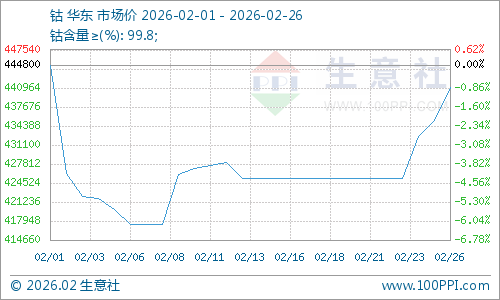
生意社:供给减少 节后钴价震荡上涨
Xin Lang Cai Jing· 2026-02-26 10:21
Core Viewpoint - After the Spring Festival, cobalt prices have shown a fluctuating upward trend due to increased demand from the recovering electric vehicle market and reduced supply in the cobalt market [3][6]. Cobalt Market Supply - The supply of cobalt is expected to decrease as Japan's Sumitomo Corporation announced the closure of its Ambatovy nickel-cobalt project in Madagascar due to damage from Tropical Cyclone Gaisang [4][14]. - The Ambatovy project, owned by Sumitomo, produced approximately 28,000 tons of nickel and about 2,500 tons of cobalt in 2024 [4][14]. Cobalt Market Demand - According to the China Association of Automobile Manufacturers, in January 2026, the production and sales of new energy vehicles in China reached 1.041 million and 945,000 units, respectively, representing year-on-year growth of 2.5% and 0.1% [5][15]. - The domestic power battery installation volume in January was 42.0 GWh, a month-on-month decrease of 57.2% but a year-on-year increase of 8.4% [5][15]. - The share of ternary battery installations decreased to 22.3%, with a month-on-month decline of 48.6% and a year-on-year increase of 9.6% [5][15]. - Despite a slight increase in new energy vehicle production and sales, the promotion of low-cobalt batteries has led to a decline in demand expectations for cobalt [5][15]. Market Overview and Future Outlook - Analysts believe that the slow growth in new energy vehicle production and sales, along with declining demand expectations for cobalt, combined with reduced supply from the Madagascar cobalt mine and inventory replenishment by downstream customers after the Spring Festival, have led to a temporary increase in cobalt demand [6][16]. - Overall, the combination of demand support and reduced supply is expected to result in a fluctuating upward trend in cobalt prices in the future [6][16]. Related Listed Companies - Relevant listed companies include Huayou Cobalt (603799), Hanrui Cobalt (300618), and Luoyang Molybdenum (603993) [7][17].

津巴布韦暂停锂矿出口,碳酸锂期货价一度逼近19万元关口
Xin Lang Cai Jing· 2026-02-26 09:16
Core Viewpoint - Zimbabwe has suspended the export of lithium concentrates and ores, affecting all in-transit minerals, to enhance accountability and promote value retention within the country [3][4]. Group 1: Export Suspension Details - The suspension includes all in-transit minerals and requires mining companies to hold valid mining rights and approved processing plants to be authorized for export [3]. - Export license applications must include recommendations from provincial mining offices detailing processing capacity and compliance status [3]. - The government aims to curb improper export practices and mineral loss, having previously announced adjustments to export processes on February 17 [3]. Group 2: Market Impact - Following the news, lithium carbonate futures surged by 12% to 187,000 CNY/ton, closing up 3.47% at 173,700 CNY/ton on February 26 [3]. - The average price of battery-grade lithium carbonate in Shanghai rose to 173,100 CNY/ton, an increase of 8,650 CNY from the previous working day [3]. - Analysts predict that the suspension will lead to a significant impact on lithium carbonate supply starting in May, potentially driving prices up due to supply disruptions and increased demand [6]. Group 3: Industry Response - Chinese companies such as Huayou Cobalt, Zhongjin Lingnan, and Shengxin Lithium Energy have established lithium production capacities in Zimbabwe, primarily exporting concentrates to China for further processing [7]. - Despite the suspension, Huayou Cobalt and Zhongjin Lingnan are developing lithium sulfate projects, which are not affected by the export ban [7]. - Companies are currently assessing the situation, with some indicating that they are in communication with local authorities regarding the export suspension [8][11].