
LBX(603883)

Search documents
老百姓2025年半年度权益分派:每股拟派利0.14元
Ge Long Hui· 2025-11-05 09:37
Core Viewpoint - The company announced a cash dividend distribution plan for the first half of 2025, with a total cash dividend of 106 million yuan to be distributed to shareholders [1] Group 1: Dividend Distribution Details - The total share capital before the distribution is 759 million shares [1] - The cash dividend per share is set at 0.14 yuan (including tax) [1] - The record date for the dividend distribution is November 11, 2025, and the ex-dividend date is November 12, 2025 [1]
老百姓没钱了为啥还要刺激消费?
Sou Hu Cai Jing· 2025-11-04 19:31
Group 1 - The core argument is that the government aims to stimulate consumer spending to drive economic growth, as low consumer spending leads to a vicious cycle of reduced income and further decreased spending [1][10] - The current economic situation shows that many households are financially constrained, with 5.6 billion people having empty bank accounts and 90% of families having savings of less than 100,000 yuan [3][5] - The government is not merely pushing for increased spending but is trying to create an environment where consumers feel confident to spend by addressing their financial concerns [7][10] Group 2 - The government is implementing measures such as lowering deposit interest rates to encourage spending by making money feel less valuable, thus prompting consumers to spend rather than save [5][8] - Issuing consumption vouchers is intended to provide consumers with a sense of financial security, making them feel that their purchases are worthwhile [5][10] - The government recognizes that simply providing financial incentives is insufficient; it is focusing on improving income, social security, and reducing living costs to enhance consumers' spending capacity [10][11] Group 3 - The ultimate goal is to increase consumption growth rates to 5-6% and raise the proportion of final consumption in GDP to over 60%, which requires a multifaceted approach beyond just issuing consumption vouchers [10] - The shift in government strategy emphasizes enhancing consumer capability rather than just stimulating short-term spending, aiming for a healthier and more sustainable economy [10][11] - The government seeks to create a consumer environment where individuals feel they have the financial means and confidence to spend, thus revitalizing the consumption market [11]

医药商业板块11月4日跌0.5%,百洋医药领跌,主力资金净流入3234.11万元
Zheng Xing Xing Ye Ri Bao· 2025-11-04 08:45
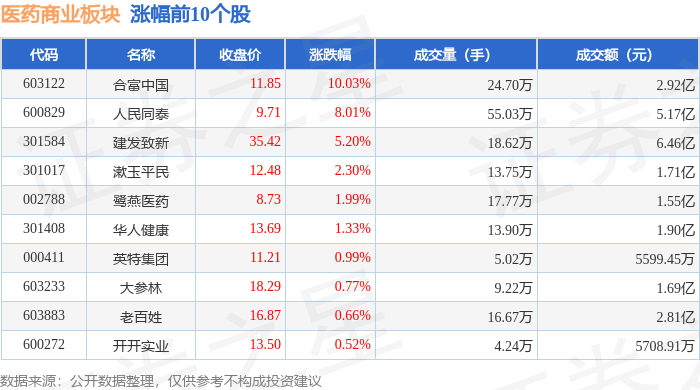
Market Overview - The pharmaceutical commercial sector declined by 0.5% on November 4, with Baiyang Pharmaceutical leading the drop [1] - The Shanghai Composite Index closed at 3960.19, down 0.41%, while the Shenzhen Component Index closed at 13175.22, down 1.71% [1] Stock Performance - Notable gainers included: - HeFu China (603122) with a closing price of 11.85, up 10.03% [1] - Renmin Tongtai (600829) at 9.71, up 8.01% [1] - Jianfa Zhixin (301584) at 35.42, up 5.20% [1] - Baiyang Pharmaceutical (301015) saw a significant decline, closing at 25.62, down 6.09% [2] - Other notable decliners included: - Yifeng Pharmacy (603939) at 23.76, down 3.22% [2] - Saili Medical (603716) at 24.78, down 3.17% [2] Capital Flow - The pharmaceutical commercial sector experienced a net inflow of 32.34 million yuan from institutional investors, while retail investors saw a net outflow of 41.10 million yuan [2] - The capital flow for key stocks showed: - Renmin Tongtai had a net inflow of 63.04 million yuan from institutional investors [3] - Yifeng Pharmacy experienced a net outflow of 32.44 million yuan from retail investors [3]


老百姓涨2.03%,成交额1.20亿元,主力资金净流入1000.37万元
Xin Lang Cai Jing· 2025-11-04 03:16
Core Viewpoint - The company "老百姓" (Lao Bai Xing) has experienced fluctuations in stock performance and financial metrics, indicating a mixed outlook for its business operations and market position [1][2]. Group 1: Stock Performance - On November 4, the stock price of 老百姓 increased by 2.03%, reaching 17.10 CNY per share, with a trading volume of 120 million CNY and a turnover rate of 0.94%, resulting in a total market capitalization of 12.977 billion CNY [1]. - Year-to-date, the stock price has risen by 4.97%, with a 3.01% increase over the last five trading days, a 3.70% increase over the last 20 days, but a decline of 9.52% over the last 60 days [1]. Group 2: Financial Performance - For the period from January to September 2025, the company reported a revenue of 16.07 billion CNY, reflecting a year-on-year decrease of 1.00%, while the net profit attributable to shareholders was 529 million CNY, down 16.11% year-on-year [2]. - Cumulative cash dividends since the A-share listing amount to 2.069 billion CNY, with 991 million CNY distributed over the past three years [2]. Group 3: Shareholder and Institutional Holdings - As of October 31, the number of shareholders for 老百姓 reached 63,700, an increase of 1.94% from the previous period, while the average circulating shares per person decreased by 1.90% to 11,921 shares [2]. - Among the top ten circulating shareholders, Hong Kong Central Clearing Limited is the fifth largest, holding 7.7558 million shares, a decrease of 7.3246 million shares from the previous period [2].
医药商业板块短线拉升,人民同泰涨停




Xin Lang Cai Jing· 2025-11-04 02:57
Core Viewpoint - The pharmaceutical commercial sector experienced a short-term surge, with notable stock performances from various companies, indicating a positive market sentiment in this industry [1] Group 1: Company Performance - Renmin Tongtai reached the daily limit increase in stock price [1] - He富中国 achieved a consecutive six-day stock price increase [1] - Other companies such as Shuyu Pingmin, Jianfa Zhixin, Luyan Yiyao, Laobaixing, and Huaren Health also saw stock price increases [1]
5家上市湘企合计派发现金红利约3.2亿元 三季报分红方案纷纷出炉
Chang Sha Wan Bao· 2025-11-03 12:42
Core Insights - A total of 217 A-share listed companies have announced or implemented their third-quarter dividend plans as of November 3, with a total dividend amount of approximately 3.2 billion yuan from five listed companies in Hunan [1] Company Summaries - **吉比特 (Gigabit)**: The company has the highest cash dividend ratio, proposing a cash dividend of 60 yuan for every 10 shares. For the third quarter of 2025, it reported earnings per share of 16.85 yuan and a net profit of 121.41 million yuan, with a year-on-year growth rate of 84.66%. The company focuses on game development and operations, utilizing AI technology to enhance efficiency [1] - **五粮液 (Wuliangye)**: The company reported earnings per share of 5.54 yuan and a net profit of approximately 2.15 billion yuan, with a year-on-year decline of 13.72%. It aims to enhance brand value and market share, launching cocktails in Europe and sparkling wines in South Korea. The company plans to increase its dividend rate in line with stable growth [2] - **老百姓 (Laobaixing)**: The company achieved third-quarter revenue of 5.296 billion yuan, a slight increase of 0.07% year-on-year, and a net profit of 1.31 billion yuan, up 2.62%. It plans to distribute a cash dividend of 0.14 yuan per share, totaling 1.06 billion yuan [3] - **克明食品 (Keming Food)**: The company reported a net profit of approximately 123.71 million yuan for the first three quarters of 2025, while the parent company recorded a net loss of about 18.08 million yuan. It proposes a cash dividend of 1.5 yuan per 10 shares, totaling around 50 million yuan [3] - **盐津铺子 (Yanjinpuzi)**: The company reported a net profit of approximately 604.61 million yuan for the first three quarters, with a proposed cash dividend of 4 yuan per 10 shares, totaling about 109.11 million yuan [3] - **和顺石油 (Heshun Petroleum)**: The company achieved a net profit of approximately 21.81 million yuan for the first three quarters and plans to distribute a cash dividend of 0.1 yuan per share, totaling about 17.19 million yuan [4]





老百姓(603883) - 2025年三季报解读会纪要(2025年10月)
2025-10-30 08:44
老百姓大药房连锁股份有限公司 2025 年三季报解读会纪要(2025 年 10 月) 一、会议情况 (一)会议时间:2025 年 10 月 29 日 15:30-16:30 (二)会议形式:电话会议 (三)参会人员: 1. 公司参会人员: 董事长、总裁:谢子龙 董事长特别助理:王忠新 2025 年第三季度,公司营业收入 52.96 亿元、同比增长 0.07%,归母净利润 1.31 亿元、同比增长 2.6%,经营业绩逐季改善,持续向好。 副总裁:万鑫 董事长助理:谭坚 财务负责人:陈立山 新零售中心总经理:王宁宁 董事会秘书:冯诗倪 2. 机构参会人员: 中信建投、中信证券、中金公司、东北证券、东吴证券、兴业证券、国金证券、国 盛证券、JP Morgan、西部证券、开源证券、广发证券、国泰海通、天风证券、Morgan Stanley、 HSBC、Daiwa、华创证券、浙商证券、华福证券、招商证券、中信里昂、高盛、瑞银证 券、野村证券、华泰证券、光大证券、国海证券、中银国际证券、中邮证券、华鑫证券、 信达证券、东海证券、建信养老金、嘉实基金、上银基金、红土创新基金、创金合信基 金、博远基金、天治基金、金信基金、上 ...
经济学家王德培:中国老百姓是不容易的,已进入急剧大洗牌阶段!
Sou Hu Cai Jing· 2025-10-30 03:16
Economic Overview - The current economic environment in China is characterized by a significant restructuring phase, affecting various sectors and individuals alike [1][5][19] - Economic cycles such as the pig cycle, capacity cycle, technology cycle, and real estate cycle are all peaking simultaneously, leading to widespread financial strain among the populace [3][5] Industry Insights - The automotive industry exemplifies the current state of economic "involution," with severe overcapacity and a mismatch between production and consumer demand [7][9] - Over 400 automotive companies in China have a total design capacity exceeding 35 million vehicles, far surpassing domestic demand, resulting in many smaller firms exiting the market [7][9] - The manufacturing sector is experiencing a similar trend, with companies facing overcapacity, weak demand, and intense competition, leading to widespread layoffs across various roles [9][10] Global Expansion - In response to domestic challenges, many companies are looking to expand overseas, with significant investment growth in countries like Vietnam and Indonesia [11][13] - Successful examples include companies like CATL, which have localized their operations abroad to mitigate trade barriers and better serve local markets [13] Workforce Adaptation - The job market is evolving, with a notable increase in demand for new roles such as AI trainers and carbon neutrality managers, reflecting the need for skill upgrades among workers [15][17] - The competition among cities is intensifying, with emerging regions like the Chengdu-Chongqing economic circle attracting young talent due to their focus on industrial ecology and supportive policies [17] Policy Support - The Chinese government is implementing policies to support "specialized, refined, and innovative" enterprises, enhancing R&D tax deductions to stimulate innovation [17] - The shift in focus from resource allocation to efficiency and quality is emphasized as a critical factor for both companies and individuals to thrive in the changing economic landscape [17][19]

老百姓20251029
2025-10-30 01:56
Summary of the Conference Call for Lao Bai Xing Pharmacy Company Overview - **Company**: Lao Bai Xing Pharmacy - **Industry**: Pharmaceutical Retail Key Financial Performance - **Q3 2025 Revenue**: 5.296 billion yuan, a slight increase of 0.07% year-on-year, reversing the negative trends of the first two quarters which were -1.9% and -1.1% respectively [3][4] - **Q3 2025 Net Profit**: 130 million yuan, up 2.6% year-on-year, significantly better than the first quarter's -22% and second quarter's -18.9% [3][4] - **YTD Revenue (First Three Quarters 2025)**: 16.07 billion yuan, down 1% year-on-year, with net profit at 529 million yuan, down 16.11% [4] Store Expansion and Structure - **Total Stores**: 15,492, with 9,741 direct-operated and 5,751 franchise stores [2][4] - **New Stores**: 756 new stores added, with a significant proportion being franchise stores, indicating a focus on franchise expansion [2][4] - **Franchise Transition**: 74.2% of old stores transitioned to franchise, a year-on-year increase of 38.9 percentage points [7] Digital Transformation and AI Integration - **AI Implementation**: "Xiao Wan Zi AI" upgraded to cover key business scenarios including medical insurance policies, enhancing internal efficiency and service capabilities [9][17] - **Online Sales Growth**: Online channel sales reached 2.23 billion yuan in the first nine months, a 28% increase year-on-year [9][19] Supply Chain and Product Management - **Self-Brand Sales**: Increased to 22.8% of total sales, up approximately 0.9 percentage points year-on-year [8][10] - **Inventory Turnover Days**: Reduced to 90 days, down 8 days year-on-year [8] Healthcare Insurance Business - **Insurance Store Proportion**: 92.78% of direct-operated stores are medical insurance stores, with over 4,600 stores holding insurance qualifications [6][12] - **Impact of Insurance Policies**: The stability of insurance policies and high regulatory pressure favor large compliant chain pharmacies [11] Industry Trends and Challenges - **Market Consolidation**: Increased concentration in the pharmacy industry, with a projected 20%-30% of stores expected to close in the next two to three years due to stricter compliance requirements [13][14] - **Response to Industry Challenges**: The company leverages its supply chain and product advantages to attract customers from smaller chains and independent pharmacies [14] Non-Pharmaceutical Diversification - **Product Diversification**: Introduced over 300 carefully selected non-pharmaceutical SKUs, focusing on health needs and enhancing customer experience [15] Future Strategies - **Online Business Strategy**: Focus on profitability and market share, with plans to enhance operational efficiency and quality through digitalization [19] - **Offline Retail Margin Improvement**: Plans to optimize product management and reduce costs to improve offline retail margins [20] - **Store Expansion Strategy**: Emphasis on franchise model for expansion, with cautious consideration for acquisitions due to market uncertainties [20] Conclusion - **Overall Performance**: Lao Bai Xing Pharmacy shows signs of recovery with improved quarterly performance, a strong focus on digital transformation, and strategic expansion through franchising, while navigating industry challenges and regulatory pressures.
机构风向标 | 老百姓(603883)2025年三季度已披露前十大机构持股比例合计下跌3.63个百分点
Xin Lang Cai Jing· 2025-10-29 02:37
Group 1 - The core viewpoint of the article is that the institutional investors hold a significant portion of the shares of Laobaixing (老百姓), with a total of 3.70 billion shares, accounting for 48.73% of the total share capital, although this represents a decrease of 3.63 percentage points from the previous quarter [1] - Among public funds, there was an increase in holdings from one fund, Guotai Dajiankang Stock A, while two funds, Southern CSI 1000 ETF and Guotai Medical Health Stock A, saw a decrease in their holdings [1] - A total of 105 public funds did not disclose their holdings in this quarter, including notable funds such as Huaxia CSI 1000 ETF and GF Healthcare Stock A [1] Group 2 - From the perspective of foreign investment, one new foreign institution disclosed its holdings this quarter, which is Hong Kong Central Clearing Limited [2]