
SRX(605168)

Search documents
三人行股价下跌1.06%,传媒板块整体调整
Jing Ji Guan Cha Wang· 2026-02-14 03:48
Group 1 - The stock price of Sanrenxing (605168) is 41.90 yuan, down 1.06% from the previous day, with a daily fluctuation of 3.52% and a turnover rate of 1.36% [1][2] - Over the past five days, the cumulative decline is 0.48%, but the year-to-date increase is 8.61% [1][2] - The current price-to-earnings ratio (TTM) is 102.59, and the price-to-book ratio is 3.30 [1][2] Group 2 - The media sector declined by 1.43% on the same day, while the advertising and marketing sector fell by 3.46% [1][2] - The overall market indices also adjusted, with the Shanghai Composite Index down 1.26% and the Shenzhen Component Index down 1.28% [2]

广告营销板块2月4日跌4.2%,天地在线领跌,主力资金净流出67.27亿元
Zheng Xing Xing Ye Ri Bao· 2026-02-04 08:57
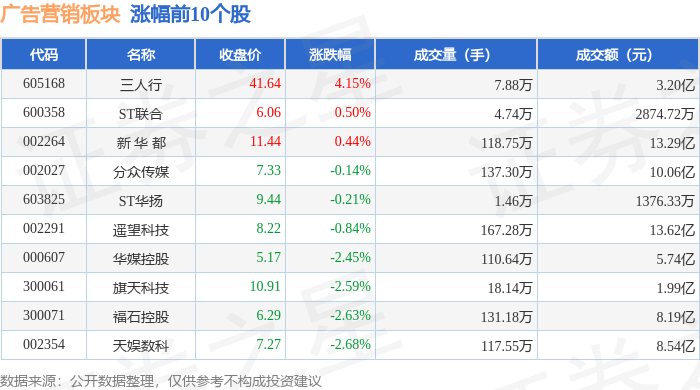
Core Viewpoint - The advertising and marketing sector experienced a decline of 4.2% on February 4, with Tian Di Online leading the drop, while the overall stock market indices showed slight increases [1]. Group 1: Market Performance - The Shanghai Composite Index closed at 4102.2, up 0.85% [1]. - The Shenzhen Component Index closed at 14156.27, up 0.21% [1]. Group 2: Individual Stock Performance - Tian Di Online (002995) saw a significant drop of 10.00%, closing at 33.29, with a trading volume of 308,900 shares and a transaction value of 1.055 billion [2]. - Other notable declines included InSai Group (300781) down 9.39% to 48.84, and YiDianTianXia (301171) down 9.25% to 63.85 [2]. - The top gainer was SanRenXing (605168), which increased by 4.15% to 41.64, with a transaction value of 320 million [1]. Group 3: Capital Flow - The advertising and marketing sector experienced a net outflow of 6.727 billion in main funds, while retail investors saw a net inflow of 5.481 billion [2][3]. - The main funds showed a net inflow of 39.924 million into SanRenXing (605168), while other stocks like FenZhongChuanMei (002027) and JiaYunKeJi (300242) experienced net outflows [3].



三人行传媒集团股份有限公司关于公司股东协议转让部分股份过户完成的公告
Shang Hai Zheng Quan Bao· 2026-02-03 18:48
Core Viewpoint - The announcement details the completion of a share transfer agreement involving 16,865,359 shares of Sanrenxing Media Group Co., Ltd., representing 8% of the company's total share capital, from the controlling shareholder to a new party, without affecting the company's control structure or governance [1][2][4]. Group 1: Share Transfer Agreement - On November 30, 2025, the controlling shareholder, Qingdao Duoduo Investment Co., Ltd., and associated parties signed a share transfer agreement to transfer 16,865,359 unrestricted circulating shares to Yan Jianya [1][3]. - The share transfer was confirmed by the Shanghai Stock Exchange and completed on February 2, 2026, with the shares representing 8% of the total share capital [2][4]. Group 2: Impact of the Transfer - The share transfer will not result in any changes to the controlling shareholder or actual controller of the company, nor will it involve a tender offer or significantly impact the company's governance structure or future operations [2][4]. - The transferred shares are free from any pledges or restrictions, complying with relevant laws and regulations [4].
三人行(605168) - 三人行:关于公司股东协议转让部分股份过户完成的公告
2026-02-03 09:46
证券代码:605168 证券简称:三人行 公告编号:2026-004 三人行传媒集团股份有限公司 关于公司股东协议转让部分股份过户完成的公告 本公司董事会、全体董事及相关股东保证本公告内容不存在任何虚假记载、 误导性陈述或者重大遗漏,并对其内容的真实性、准确性和完整性承担法律责任。 2025 年 11 月 30 日,公司控股股东青岛多多、实际控制人钱俊冬、崔蕾及 一致行动人华软动力与严建亚签署了《股份转让协议》,约定转让方将其合计持 有的公司 16,865,359 股无限售条件流通股,占公司总股本的 8%,通过协议转让 重要内容提示: 2025 年 11 月 30 日,三人行传媒集团股份有限公司(以下简称"三人行" 或"公司")控股股东青岛多多行投资有限公司(以下简称"青岛多多")、实 际控制人钱俊冬、崔蕾及一致行动人北京华软新动力私募基金管理有限公司(代 表"新动力大运量化 FOF2 号私募证券投资基金")(以下简称"华软动力") (以下合并简称"转让方")与严建亚(以下简称"受让方")签署了《股份转 让协议》,约定转让方将其合计持有的公司 16,865,359 股无限售条件流通股,占 公司总股本的 8%, ...
1月29日重要公告一览
Xi Niu Cai Jing· 2026-01-29 03:04
Group 1 - Zhongyuan Expressway (600020) expects a net profit of approximately 612 million yuan for 2025, a decrease of about 30% year-on-year [1] - Bomin Electronics (603936) anticipates a net profit of 15 million to 22 million yuan for 2025, achieving a turnaround from loss to profit compared to the previous year [2] - Fangda Special Steel (600507) forecasts a net profit of 835 million to 998 million yuan for 2025, an increase of 236.9% to 302.67% year-on-year [3] Group 2 - Jiadu Technology (600728) expects a net profit of 160 million to 200 million yuan for 2025, recovering from a loss of 115 million yuan in the previous year [4] - Changyang Technology (688299) predicts a net loss of 116 million to 168 million yuan for 2025 [5] - Zhongzi Technology (688737) anticipates a net loss of 45.24 million to 67.86 million yuan for 2025 [6] Group 3 - Two-sided Needle (600249) expects a net profit of 5 million to 10 million yuan for 2025, a decline of 87.67% to 93.83% year-on-year [7] - Sanrenxing (605168) forecasts a net profit of 181 million to 209 million yuan for 2025, an increase of 46.79% to 69.5% year-on-year [8] - Shubeide (300322) anticipates a net profit of 60 million to 70 million yuan for 2025, recovering from a loss of 64.46 million yuan in the previous year [9] Group 4 - Maoye Commercial (600828) expects a net loss of 201 million to 242 million yuan for 2025 [10] - Hongsheng Huayuan (601096) forecasts a net profit of 348 million to 400 million yuan for 2025, an increase of 51.22% to 73.82% year-on-year [11] - Huafeng Technology (688629) anticipates a net profit of 338 million to 388 million yuan for 2025, achieving a turnaround from loss to profit [12] Group 5 - Aerospace Rainbow (002389) expects a net profit of 25 million to 31 million yuan for 2025, a decrease of 64.84% to 71.65% year-on-year [14] - Shangong Shenbei (600843) predicts a net loss of 120 million to 150 million yuan for 2025, compared to a loss of 244 million yuan in the previous year [15] - Chaoxun Communication (603322) anticipates a net profit of 36 million to 54 million yuan for 2025, achieving a turnaround from loss to profit [16] Group 6 - Guannong Co. (600251) expects a net profit of 330 million to 340 million yuan for 2025, an increase of 61.29% to 66.18% year-on-year [17] - Shandong Steel (600022) forecasts a net profit of around 100 million yuan for 2025, recovering from a loss of 2.891 billion yuan in the previous year [18] - Baili Technology (603959) anticipates a net loss of 140 million to 200 million yuan for 2025 [19] Group 7 - Electric Power Investment Hydropower (600292) expects a net profit of approximately 517 million yuan for 2025, a year-on-year increase of about 1337% [20] - Aibulu (301259) forecasts a net profit of 26 million to 33.8 million yuan for 2025, recovering from a loss of 30.84 million yuan in the previous year [21] - Yipin Hong (300723) announced that its subsidiary received approval for clinical trials of a new drug [22] Group 8 - Meixin Sheng (688458) plans to acquire 100% equity of Xinyan Micro for 160 million yuan [23][24] - Lanshi Heavy Industry (603169) expects a net loss of 370 million to 440 million yuan for 2025, transitioning from profit to loss [25] - Hongyang (000525) anticipates a net loss of 260 million to 390 million yuan for 2025, compared to a profit of 388 million yuan in the previous year [26] Group 9 - Tianzhihang (688277) predicts a net loss of 165 million to 198 million yuan for 2025, with losses expected to widen by 36.22% to 63.46% compared to the previous year [27] - Tongda Co. (002560) announced plans for a major shareholder to reduce holdings by no more than 1% [28] - *ST Chengchang (001270) expects a net profit of 95 million to 124 million yuan for 2025, recovering from a loss of 31.12 million yuan in the previous year [29] Group 10 - Yirui Technology (688301) reported a net profit of 661 million yuan for 2025, a year-on-year increase of 42.15% [30] - Hualitai (001217) anticipates a net loss of 28 million to 38 million yuan for 2025, transitioning from profit to loss [31] - Yunjiji Group (001288) expects a net profit of 220 million to 252 million yuan for 2025, a year-on-year increase of 40% to 60% [32] Group 11 - Heertai (002402) forecasts a net profit of 638 million to 729 million yuan for 2025, an increase of 75% to 100% year-on-year [33] - Shenhao Technology (300853) anticipates a net loss of 185 million to 220 million yuan for 2025, compared to a loss of 238 million yuan in the previous year [34] - Zhongyan Dadi (003001) expects a net profit of 10 million to 15 million yuan for 2025, a decline of 75.97% to 83.98% year-on-year [35] Group 12 - Landai Technology (002765) forecasts a net profit of 180 million to 200 million yuan for 2025, a year-on-year increase of 44.83% to 60.93%, with a non-recurring profit of 140 million to 160 million yuan, an increase of 113.1% to 143.54% [37] - Yingfeite (300582) plans to raise product prices by 5% to 15% starting March 1, 2026, due to rising raw material costs [38] - Lanzhou Bank (001227) plans to distribute 285 million yuan in cash dividends for the 2025 interim profit distribution [39] Group 13 - Wancheng Group (300972) announced plans for shareholders to reduce holdings by no more than 1.27% [40] - *ST Huarong (600421) expects to turn a profit in 2025, with a projected net profit of 6.5 million to 8 million yuan [41] - Jiaheng Home (300955) anticipates a net loss of 29 million to 39 million yuan for 2025, compared to a loss of 23.69 million yuan in the previous year [42] Group 14 - Aide Biology (300685) announced plans for a major shareholder to reduce holdings by no more than 1.22% [43] - Haixia Innovation (300300) expects a net profit of 100 million to 150 million yuan for 2025, a year-on-year increase of 1660.56% to 2540.85% [44]


三人行:预计2025年净利润同比增加46.79%至69.50%
Ge Long Hui· 2026-01-28 10:42
Core Viewpoint - The company expects a significant increase in net profit for the year 2025, with projections indicating a rise of 46.79% to 69.50% compared to the previous year [1] Financial Performance - The estimated net profit attributable to the parent company for 2025 is projected to be between 181 million to 209 million yuan [1] - The estimated net profit after deducting non-recurring gains and losses is expected to range from 189 million to 247 million yuan, reflecting a year-on-year change of -19.63% to 5.04% [1] Business Development - The company has actively expanded its client base and optimized its business structure, successfully acquiring new clients across various sectors including finance, consumer goods, smart terminals, and automotive [1] - Notable new clients include Industrial Bank, COFCO Group, TCL, Seres, Zhengzhou Nissan, Beijing Hyundai, and Jietu Automobile [1] Innovation and Efficiency - The company emphasizes the use of AI innovation technology to drive performance growth, enhancing personnel efficiency and achieving cost reduction [1] - The focus on high-growth sectors has led to successful investments in several benchmark enterprises with strong growth prospects, such as Huaying Aviation, contributing to the company's diversified profit structure [1]
三人行(605168.SH):预计2025年净利润同比增加46.79%至69.50%
Ge Long Hui A P P· 2026-01-28 10:34
Core Viewpoint - The company expects a significant increase in net profit for the year 2025, with projections indicating a rise of 46.79% to 69.50% compared to the previous year [1] Financial Performance - The estimated net profit attributable to the parent company for 2025 is projected to be between 181 million to 209 million yuan [1] - The estimated net profit after deducting non-recurring gains and losses is expected to range from 189 million to 247 million yuan, reflecting a year-on-year change of -19.63% to 5.04% [1] Business Development - The company has actively expanded its client base and optimized its business structure, successfully acquiring new clients across various sectors including finance, consumer goods, smart terminals, and automotive [1] - Notable new clients include Industrial Bank, COFCO Group, TCL, Seres, Zhengzhou Nissan, Beijing Hyundai, and Jietu Automobile [1] Innovation and Efficiency - The company emphasizes the use of AI innovation technology to drive performance growth, enhancing personnel efficiency and achieving cost reduction [1] - The focus on high-growth sectors has led to successful investments in several benchmark enterprises with strong operational conditions, such as Huaying Aviation, contributing to the company's diversified profit structure [1]
三人行(605168) - 2025 Q4 - 年度业绩预告
2026-01-28 10:05
Financial Performance Forecast - The company expects a net profit attributable to shareholders for 2025 to be between 181 million to 209 million CNY, representing an increase of 57.7 million to 85.7 million CNY compared to the previous year, which is a year-on-year increase of 46.79% to 69.50%[3] - The expected net profit after deducting non-recurring gains and losses for 2025 is projected to be between 189 million to 247 million CNY, with a potential decrease of 46.2 million to an increase of 1.2 million CNY compared to the previous year, indicating a year-on-year change of -19.63% to 5.04%[5] - In 2024, the total profit was 128.3 million CNY, and the net profit attributable to shareholders was 123.3 million CNY[7] - The performance forecast is based on preliminary calculations by the finance department and has not yet been audited by certified public accountants[10] - There are no significant uncertainties affecting the accuracy of this performance forecast[10] - Investors are advised that the forecast data is preliminary and the final audited financial data will be disclosed in the official 2025 annual report[11] Business Expansion and Strategy - The company has successfully expanded its client base across various sectors, including finance, consumer goods, smart terminals, and automotive, with notable clients such as Industrial Bank, COFCO Group, and TCL[9] - The company emphasizes the use of AI technology to enhance operational efficiency and reduce costs, contributing to improved financial performance[9] - Investments in high-growth sectors, such as Huaying Aviation, have yielded value appreciation, enhancing the company's current earnings and supporting a diversified profit structure[9]
三人行:2025年全年净利润同比预增46.79%~69.50%
Mei Ri Jing Ji Xin Wen· 2026-01-28 09:55
Core Viewpoint - The company expects a significant increase in net profit for the year 2025, projecting a range of 181 million to 209 million yuan, which represents a year-on-year growth of 46.79% to 69.50% [1] Financial Projections - The projected net profit for 2025 is estimated to be between 181 million yuan and 209 million yuan [1] - This forecast indicates a substantial increase compared to the previous year's performance, with a growth rate between 46.79% and 69.50% [1]
三人行:2025年全年净利润同比预增46.79%—69.50%
2 1 Shi Ji Jing Ji Bao Dao· 2026-01-28 09:53
Core Viewpoint - The company expects a significant increase in net profit for 2025, driven by new client acquisition and AI technology implementation [1] Financial Performance - The projected net profit attributable to shareholders for 2025 is estimated to be between 181 million and 209 million yuan, representing a year-on-year increase of 46.79% to 69.50% [1] - The projected net profit excluding non-recurring gains and losses is expected to be between 189 million and 247 million yuan, with a year-on-year change of -19.63% to 5.04% [1] Business Strategy - The company has actively expanded its client base and optimized its business structure, successfully acquiring clients across various sectors including finance, consumer goods, smart terminals, and automotive [1] - Notable new clients include Industrial Bank, COFCO Group, TCL, Seres, Zhengzhou Nissan, Beijing Hyundai, and Jietu Automobile [1] Innovation and Efficiency - The company emphasizes the use of AI innovation technology to enhance performance and achieve cost reduction and efficiency improvement [1] - The application of AI technology has led to increased personnel efficiency and improved financial performance [1] Investment and Growth - The company focuses on high-growth sectors and has successfully invested in several robust industry benchmark enterprises, such as Huaying Aviation, which have contributed to investment appreciation [1] - These investments not only enhance current earnings but also help establish a diversified profit structure, laying a solid foundation for sustainable long-term development [1]