
Junshi Biosciences(688180)

Search documents
★"第五套上市标准"蓄新能 科创板制度包容性不断提升
Shang Hai Zheng Quan Bao· 2025-07-03 01:56
Core Insights - The establishment of the Sci-Tech Innovation Board (STAR Market) has enabled 20 innovative biopharmaceutical companies to list under the fifth set of listing standards, reshaping China's biopharmaceutical landscape [1] - The China Securities Regulatory Commission (CSRC) has introduced measures to enhance the STAR Market's support for high-growth, unprofitable tech companies, emphasizing the importance of "hard technology" [1][3] - The fifth set of listing standards allows unprofitable innovative companies to raise funds, breaking traditional capital market constraints and facilitating financing for R&D-focused firms [1][2] Industry Developments - Since its inception, the STAR Market has seen 20 innovative biopharmaceutical companies adopt the fifth set of listing standards, with significant fundraising efforts directed towards advanced technologies such as antibody drugs and ADCs [1] - In 2024, these 20 companies collectively achieved revenue of 14.21 billion yuan, a year-on-year increase of 44.17%, with several companies projected to exceed 1 billion yuan in revenue soon [1] - Companies like Dizhe Pharmaceutical have reported substantial revenue growth, with a 294.24% increase to 360 million yuan, driven by innovative drug development [2] Company Performance - Companies such as Junshi Biosciences have successfully raised over 8 billion yuan through the STAR Market, significantly advancing their clinical projects and R&D initiatives [2][3] - Ailis, which listed under the fifth set of standards, achieved commercialization of its core product within 2 years and 5 months, demonstrating the effectiveness of the STAR Market in supporting innovative firms [3] - ShenZhou Cell has transitioned from having no products or revenue at the time of listing to achieving 2.51 billion yuan in revenue, marking a successful turnaround [5] Innovation Ecosystem - The STAR Market has fostered an innovation-driven ecosystem, enhancing the flow of resources and increasing recognition of innovative technologies within the capital market [3][4] - Companies are increasingly focusing their resources on R&D, maintaining high levels of investment intensity, and establishing a virtuous cycle of research and development [6] - The introduction of the STAR Market has led to a fundamental shift in the development logic of listed companies, prioritizing quality over scale and fostering collaborative ecosystems [6]


君实生物接待74家机构调研,包括万家基金、中信资管、华安基金等
Jin Rong Jie· 2025-07-01 14:00
Core Viewpoint - Junshi Bioscience has reported significant growth in its core product, Toripalimab, with a domestic sales revenue of 1.501 billion yuan in 2024, representing a year-on-year increase of approximately 66% [1][2]. Group 1: Sales Performance - The domestic revenue for Toripalimab in the first quarter of 2025 was approximately 447 million yuan, showing a year-on-year growth of about 45.72% [1][2]. - Toripalimab has received approval for 12 indications in mainland China, with 10 of these included in the national medical insurance catalog, enhancing its market accessibility [2][3]. Group 2: R&D Pipeline - The company has expanded its innovative research and development to cover five major therapeutic areas, including oncology, autoimmune diseases, chronic metabolic diseases, neurological diseases, and infectious diseases [3][4]. - Currently, the company has four commercialized drugs and nearly 30 drugs in clinical trials, with over 20 drugs in preclinical development [3][4]. Group 3: Clinical Trials and Internationalization - The PD-1/VEGF bispecific antibody is in Phase II clinical trials, while the anti-BTLA monoclonal antibody combined with Toripalimab is undergoing Phase III clinical research with over 300 patients enrolled [2][5]. - The company aims to achieve globalization through organic growth and strategic partnerships, enhancing its overseas clinical team and pursuing international multi-center clinical trials [5][6].
科创生物医药ETF(588250)上涨近1%,药品追溯码全面应用
Sou Hu Cai Jing· 2025-07-01 02:12
Group 1 - The Shanghai Stock Exchange Sci-Tech Innovation Board Biopharmaceutical Index (000683) increased by 0.93% as of July 1, 2025, with notable gains from stocks such as Rongchang Biopharmaceutical (688331) up 7.21% and Shanghai Yizhong (688091) up 3.61% [1] - Starting July 1, 2025, a new policy mandates that all drug sales must include a verification code for medical insurance reimbursement, with full traceability of drug codes required by January 1, 2026, which is expected to enhance drug circulation regulation and impact the entire pharmaceutical industry chain [1] - The current bull market in innovative drugs is driven by the improvement of China's pharmaceutical innovation capabilities, with a trend towards international collaboration in new drug development expected to enhance profitability and market potential for Chinese pharmaceutical companies [2] Group 2 - As of June 30, 2025, the top ten weighted stocks in the Shanghai Stock Exchange Sci-Tech Innovation Board Biopharmaceutical Index accounted for 50.3% of the index, including companies like United Imaging Healthcare (688271) and BeiGene (688235) [3] - The Sci-Tech Biopharmaceutical ETF closely tracks the performance of the Shanghai Stock Exchange Sci-Tech Innovation Board Biopharmaceutical Index, which includes 50 large-cap companies in various biopharmaceutical sectors [2]


板块出现缩量上涨,持续看好创新药(附PCSK9靶点研究)(2025.06.23-2025.06.29)
Tai Ping Yang Zheng Quan· 2025-06-29 14:14
Investment Rating - The report maintains a "Buy" rating for multiple companies in the pharmaceutical sector, including Junshi Bioscience, Hualing Pharmaceutical-B, and others [2]. Core Insights - The report emphasizes the broad market for lipid-lowering treatments, particularly focusing on the competitive landscape of PCSK9-targeted drugs, with approximately 500 million adults in China suffering from dyslipidemia, including 120 million with high cholesterol [3][15]. - The pharmaceutical sector saw a 1.60% increase this week, underperforming the CSI 300 index by 0.35 percentage points, with sub-sectors like medical infrastructure and life sciences performing better than generics and innovative drugs [4][31]. Summary by Sections 1. Industry Perspective and Investment Recommendations - The lipid-lowering market is vast, with intense competition in PCSK9-targeted drugs [15]. - Investment strategies should focus on innovative drugs, particularly in the context of increased liquidity and risk appetite in the market [4][31]. 2. Pharmaceutical Sector Performance - The pharmaceutical sector's performance was mixed, with medical infrastructure and life sciences leading, while generics and innovative drugs lagged [4][37]. - The overall P/E ratio for the pharmaceutical industry is 27.69, with a premium of 35.26% compared to the broader A-share market [37]. 3. Company Dynamics - Notable company announcements include Baiyoutai's licensing agreement for BAT2406 in Latin America and Yifan Pharmaceutical's approval for clinical trials of a growth hormone injection [38][40]. - Companies like WuXi AppTec and Lijun Group have made significant moves, including share buybacks and new product approvals [39][41]. 4. Industry Trends - The report highlights the upcoming patent expirations for major small molecule drugs, which could lead to increased demand for raw materials [5][32]. - The report also notes the expected recovery in overseas demand, which may improve the performance of CXO companies [34]. 5. Research and Development Focus - The report discusses the clinical progress of various PCSK9-targeted therapies, including monoclonal antibodies and gene editing approaches, indicating a strong pipeline in this area [3][23][25]. - The competitive landscape for PCSK9 drugs in China is characterized by pricing and adherence challenges, with several products already on the market [27].





君实生物(688180) - 君实生物2018年股权激励方案第三个行权期行权限售股上市流通公告
2025-06-27 11:49
证券代码:688180 证券简称:君实生物 公告编号:临 2025-037 上海君实生物医药科技股份有限公司 2018 年股权激励方案第三个行权期 行权限售股上市流通公告 本公司董事会及全体董事保证本公告内容不存在任何虚假记载、误导性陈述 或者重大遗漏,并对其内容的真实性、准确性和完整性依法承担法律责任。 重要内容提示: 本次股票上市类型为股权激励股份;股票认购方式为网下,上市股数为 1,845,200股。 本次股票上市流通总数为1,845,200股。占公司总股本比例为 0.18%,限售期为 自行权之日起三年。 本次股票上市流通日期为2025 年 7 月 7 日。 一、本次上市流通的限售股类型 本次上市流通的限售股为上海君实生物医药科技股份有限公司(以下简称 "公司")2018 年股权激励方案第三个行权期行权形成,本次上市流通的限售股 股份数量为 1,845,200 股,占截至本公告披露日公司总股本的 0.18%,限售期为自 行权之日起三年,涉及限售股股东 187 名。该部分限售股将于 2025 年 7 月 7 日起 上市流通。 二、本次上市流通的限售股形成后至今公司股本数量变化情况 (一)2020 年限制性 ...
君实生物股价连续3天下跌累计跌幅4.41%,工银瑞信基金旗下1只基金持58万股,浮亏损失90.49万元
Xin Lang Cai Jing· 2025-06-27 07:09
Group 1 - The core viewpoint of the news is that Junshi Biosciences has experienced a decline in stock price, with a cumulative drop of 4.41% over three consecutive days, currently trading at 33.81 CNY per share [1] - Junshi Biosciences, established on December 27, 2012, focuses on the research and commercialization of monoclonal antibody drugs and other therapeutic protein drugs, with 84.18% of its revenue coming from drug sales [1] - The company has a total market capitalization of 34.712 billion CNY and reported a trading volume of 270 million CNY with a turnover rate of 1.04% [1] Group 2 - According to data, the ICBC Credit Suisse Fund has a significant holding in Junshi Biosciences, with the Kexin Medical ETF (588860) reducing its stake by 242,800 shares, now holding 580,000 shares, which represents 4.15% of the fund's net value [2] - The Kexin Medical ETF has experienced a year-to-date return of 23.12% and ranks 168 out of 4241 in its category since its inception [2] - The fund manager, Shi Baojiao, has been in position for 3 years and 210 days, with the best fund return during this period being 35.42% [2]
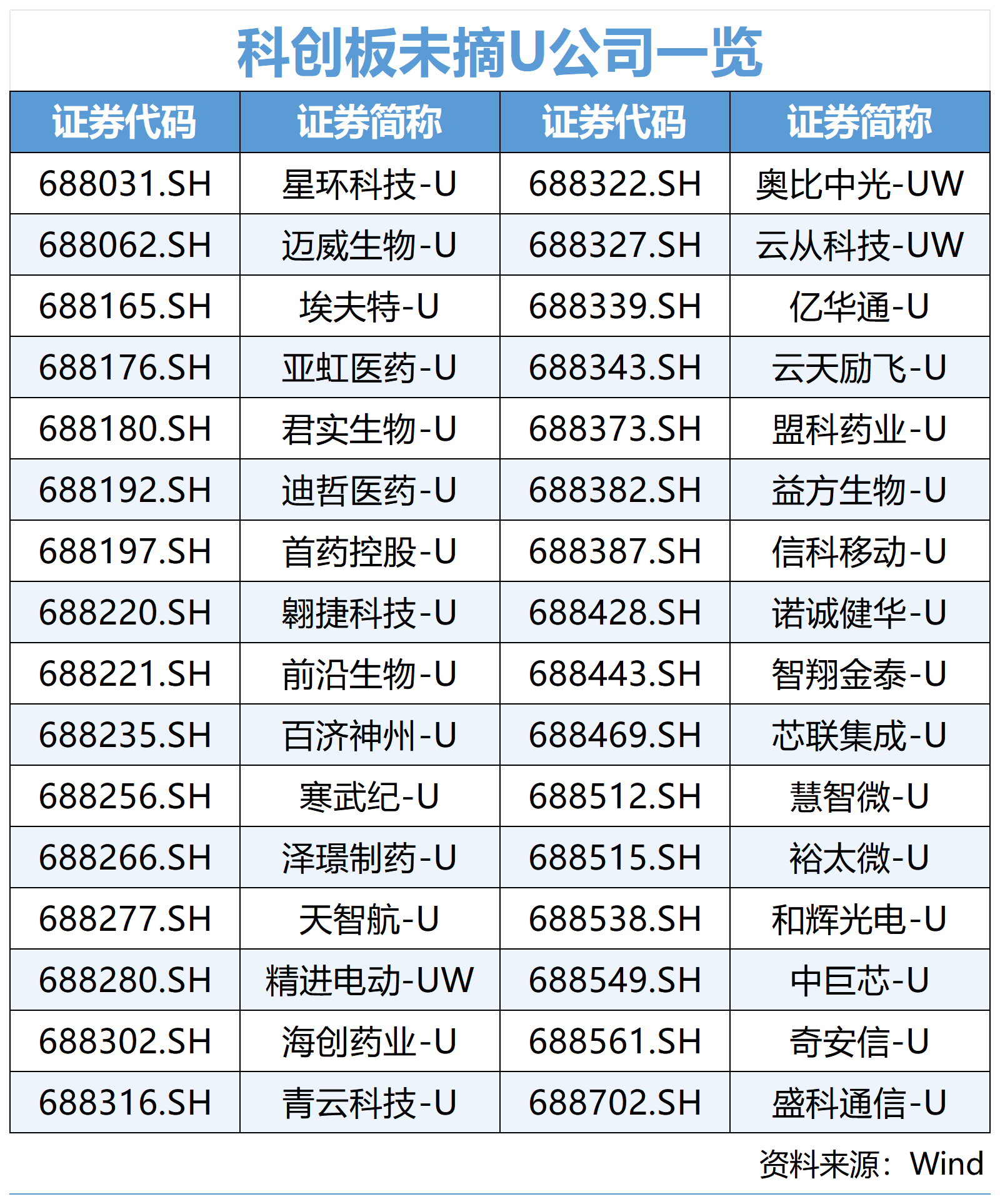
32家科创板未摘U公司纳入成长层 将受益两项“新老划断”安排
Zhong Guo Jing Ying Bao· 2025-06-26 03:22
Core Viewpoint - The newly established "Science and Technology Innovation Board Growth Layer" aims to support unprofitable technology companies by providing a more accommodating regulatory framework, benefiting existing companies while posing higher challenges for new entrants [1][2][5]. Group 1: Regulatory Changes - The Shanghai Stock Exchange has released the "Self-Regulatory Guidelines No. 5 for Science and Technology Innovation Board Listed Companies," which will include companies that have not yet achieved profitability since their listing [1][2]. - Currently, there are 32 companies on the Science and Technology Innovation Board that have not been delisted and will be classified as existing companies in the growth layer [2][3]. - The guidelines introduce a "new and old distinction" in the criteria for delisting and investor suitability management, favoring existing unprofitable companies [5][6]. Group 2: Impact on Companies - Existing companies will only need to achieve profitability for the first time to remain in the growth layer, while new companies face stricter criteria, including a requirement for positive net profit over the last two years or a minimum revenue of 100 million yuan [4][5]. - The introduction of a specialized risk disclosure document for investors in new registered companies increases compliance costs and liquidity pressure for these firms [5][6]. Group 3: Market Implications - The growth layer is designed to support technology companies with significant breakthroughs and ongoing R&D investments, even if they are currently unprofitable [6][8]. - The policy aims to enhance investor expectations for unprofitable companies, potentially improving their market valuation and financing environment [6][7]. - The reforms reflect a commitment to adapt the capital market to better serve the real economy and support emerging industries [6][8]. Group 4: Future Directions - Future reforms should focus on strengthening information disclosure regulations to ensure investors receive timely and accurate information [8][9]. - Enhancements to trading mechanisms, such as relaxing price limits and introducing more market makers, are suggested to improve market liquidity and attract quality technology companies [9]. - A refined delisting system is necessary to maintain a healthy market ecosystem by allowing non-compliant companies to exit while retaining high-quality firms [9].

《学习时报》称加快创新药研发具有多重战略意义,创新药ETF天弘(517380)冲击三连涨,机构持续看好创新药为医药板块投资主线
2 1 Shi Ji Jing Ji Bao Dao· 2025-06-25 02:23
Group 1 - The A-share market indices showed positive performance, with the pharmaceutical sector remaining active, particularly the innovative drug ETF Tianhong (517380), which rose by 1.53% [1] - The innovative drug ETF Tianhong is the largest in the market, covering both A-shares and Hong Kong stocks, and has achieved a net value growth rate of 24.96% over the past year, outperforming its benchmark by 5.45% [1] - The Biopharmaceutical ETF (159859) also saw an increase of 0.55%, with a trading volume exceeding 20 million yuan, indicating strong investor interest [1] Group 2 - The article from "Learning Times" emphasizes the strategic importance of accelerating innovative drug research and development, highlighting the need for a sustainable investment and financing system in the pharmaceutical sector [2] - Recommendations include enhancing multi-tiered capital market support for pharmaceutical companies, encouraging long-term funds to invest in biopharmaceuticals, and creating a favorable incubation environment for the industry [2] - The article also suggests improving mechanisms for handling innovation failures and enhancing intellectual property protection to incentivize high-quality research outputs [2] Group 3 - According to Zhongtai Securities, innovative drugs represent a clear industry trend with significant growth potential, and the investment focus on innovative drugs is expected to remain unchanged throughout the year [3] - Guojin Securities expresses strong confidence in the pharmaceutical sector reversing its trend by 2025, with innovative drugs being a key investment opportunity [3] - Xiangcai Securities notes that after a decade of investment in innovative drugs, the sector is entering a phase of results realization, supported by continuous clinical data and accelerated commercialization [3]
君实生物H股年涨超100%却高折价“输血”,创新药企 “融资—研发—再融资”的繁华与困局|创新药观察
Hua Xia Shi Bao· 2025-06-20 12:15
Core Viewpoint - Junshi Biosciences has raised approximately HKD 1.026 billion through a discounted placement of H-shares, reflecting significant cash flow pressures and concerns regarding the sustainability of its financing and R&D model [2][4]. Financing and Capital Structure - The recent placement at HKD 25.35 per share represents an 11.52% discount, marking the largest discount financing in the Hong Kong biopharmaceutical sector this year [2]. - This is the third large-scale financing for Junshi Biosciences in four years, with total fundraising since 2021 reaching approximately RMB 7 billion [3]. - The company has accumulated losses exceeding RMB 10.9 billion since its establishment in 2012, with R&D expenditures totaling RMB 11.419 billion, indicating a heavy reliance on external capital [4]. Financial Performance and Ratios - Junshi's asset-liability ratio increased from 24.64% in 2021 to 47.98% in Q1 2025, indicating rising financial pressure [5][6]. - The company's liquidity ratios have declined significantly, with the current ratio dropping to 1.40 and the quick ratio to 1.20 in Q1 2025, both below industry averages [6][8]. - Cash reserves have decreased from a peak of RMB 6.031 billion at the end of 2022 to RMB 2.522 billion by Q1 2025, a reduction of over 58% [5]. Revenue and Product Dependency - Junshi's revenue heavily relies on its core product, Toripalimab (Tuoyi®), which accounted for over 88% of total revenue in Q1 2025, despite the company still facing losses [9][10]. - The company reported a total revenue of RMB 1.948 billion in 2024, with a net loss of RMB 1.281 billion, although the loss narrowed by 43.90% year-on-year [9]. - International revenue has fluctuated dramatically, dropping from RMB 3.341 billion in 2021 to RMB 0.093 billion in 2024, highlighting instability in the company's revenue structure [10].

君实生物: 君实生物关于完成根据一般授权配售新H股的公告
Zheng Quan Zhi Xing· 2025-06-20 12:07
Core Viewpoint - The company successfully completed the placement of 41 million new H shares, raising approximately HKD 1.039 billion, with net proceeds of about HKD 1.026 billion allocated primarily for innovative drug research and general corporate purposes [1][2]. Summary by Sections Placement Completion - The placement of 41,000,000 new H shares was completed on June 20, 2025, after all conditions were met, including approval from the Hong Kong Stock Exchange [1]. - The placement price was set at HKD 25.35 per share, representing approximately 15.75% of the total issued H shares and 3.99% of the total issued shares post-placement [2]. Use of Proceeds - The net proceeds from the placement will be allocated as follows: 70% for innovative drug research, including projects like JS207, JS212, and JS213, and 30% for general corporate purposes [2]. Share Capital Changes - Following the placement, the total number of issued shares increased from 985,689,871 to 1,026,689,871, with H shares rising to 260,295,700 while A shares remained at 766,394,171 [3]. - The shareholding structure showed a decrease in the controlling shareholders' stake from 18.67% to 17.92% due to the dilution effect of the new shares issued [4]. Shareholder Changes - The major shareholders, including the actual controllers and their concerted parties, experienced a reduction in their shareholding percentages post-placement, with specific reductions noted for individual shareholders [4][5].