
BeiGene(688235)

Search documents
速递|央视点赞,全球首个!南京医疗团队治疗糖尿病取得重大进展
GLP1减重宝典· 2025-12-23 03:19
Core Viewpoint - The article highlights significant advancements in the efficacy and safety of the drug Masitide in treating Type 2 Diabetes (T2D), demonstrating its potential for effective blood sugar control and weight loss in patients [4][12]. Group 1: Clinical Research Findings - Two Phase III clinical studies on Masitide were published back-to-back in the journal Nature, marking a first in the field of metabolic and endocrine diseases [6][8]. - The studies, DREAMS-1 and DREAMS-2, focus on Masitide's effectiveness as a monotherapy and in combination with oral hypoglycemic agents, based on clinical data from Chinese patients [8]. Group 2: Drug Mechanism and Benefits - Masitide is the first and only approved GCG/GLP-1 dual-target drug for weight loss and blood sugar reduction, enhancing insulin secretion and promoting satiety [10][12]. - The dual mechanism of action—suppressing appetite and accelerating metabolism—addresses complex metabolic issues such as visceral fat accumulation and insulin resistance in obese patients [10]. Group 3: Clinical Outcomes - The results from the published studies indicate that Masitide outperforms both placebo and Dulaglutide (1.5mg) in blood sugar control and weight loss, while also improving various cardiovascular, liver, and kidney-related indicators [12].

2025年中国合成致死药物行业政策、产业链、市场规模、竞争格局、重点企业及未来前景研判:抗癌药开发中的新策略,需求持续增加,知名药企已竞相布局PRMT5赛道[图]
Chan Ye Xin Xi Wang· 2025-12-23 01:22
Core Viewpoint - Synthetic lethality drugs are emerging as a promising treatment strategy in oncology, allowing for the selective killing of cancer cells while sparing normal cells, with PARP inhibitors being a notable success in this field [1][6][7]. Industry Definition and Principles - Synthetic lethality refers to a biological phenomenon where mutations in two non-lethal genes do not affect cell survival individually, but simultaneous mutations lead to cell death. This principle is leveraged in cancer treatment to target specific pathways that cancer cells depend on [2][6]. - The concept of synthetic lethality has gained traction, particularly with the success of PARP inhibitors, which target DNA damage repair mechanisms [6][7]. Current Development Status - The global synthetic lethality drug market is projected to reach $4.3 billion in 2024, with China's market expected to grow to 3.6 billion yuan. By 2025, these figures are anticipated to rise to $4.8 billion globally and 4.6 billion yuan in China [1][7]. - The sales of PARP inhibitors reached $3.072 billion globally in 2024, showing a growth of approximately 9.3% after ten years on the market. Sales are expected to reach $3.4 billion by 2025 [1][7]. Industry Chain - The synthetic lethality drug industry chain includes upstream components such as biological raw materials, animal models, and chemical reagents; midstream focuses on drug research and production; and downstream applications are primarily in clinical settings, including hospitals and research institutions [8]. Competitive Landscape - Major companies in the synthetic lethality space include Hengrui Medicine and BeiGene, with several others like Clovis Oncology and AstraZeneca also involved. The market features a variety of PARP inhibitors, with ongoing research into additional synthetic lethality targets [2][9][10]. - The success of PARP inhibitors has led to increased interest in synthetic lethality as a viable strategy for cancer treatment, with multiple companies exploring this avenue [9][10]. Future Development - The role of synthetic lethality in modern cancer precision therapy is becoming increasingly significant, with ongoing research paving the way for new treatment avenues. Despite progress, challenges remain in the application of synthetic lethality in clinical settings [13][14].


行业高景气,持续关注创新药械产业链
Haitong Securities International· 2025-12-22 15:09
Investment Rating - The report maintains a focus on the innovative drug and medical device industry chain, indicating a high level of interest in this sector [1][6]. Core Insights - The innovative drug sector is experiencing high prosperity, with a recommendation to pay attention to pharmaceutical companies that are likely to see a revaluation of their value, such as Jiangsu Heng Rui Medicine, Hansoh Pharmaceutical Group, 3SBio, Sichuan Kelun Pharmaceutical, and Jiangsu Nhwa Pharmaceutical [6][25]. - The report highlights the Biopharma/Biotech sector, which is expected to see performance improvements as innovative pipelines are realized, with companies like Innovent Biologics, BeiGene, and others being of particular interest [6][25]. - Attention is also drawn to CXO and upstream companies benefiting from innovation, including WuXi AppTec and WuXi Biologics [6][25]. - The report emphasizes the potential recovery of leading medical device companies such as United Imaging Healthcare and Lepu Medical [6][25]. Summary by Sections A-Shares Performance - In the third week of December 2025, the A-share pharmaceutical sector performed similarly to the overall market, with the Shanghai Composite Index rising by 0.03% and the SW Pharma and Biotech index falling by 0.1%, ranking 19th among Shenwan primary industries [8][10]. - Sub-sectors that performed relatively well included pharmaceutical commerce (+4.9%), medical equipment (+1.2%), and medical services (+0.5%) [10][25]. - Notable individual stock performances included Anhui Huaren Health Pharmaceutical Co., Ltd. (+55.9%), Luyan Pharma (+36.8%), and ShuYu Civilian (+35.7%) [13][25]. Hong Kong and U.S. Market Performance - The Hong Kong pharmaceutical sector underperformed the market, with the Hang Seng Healthcare index down by 1.8% and the Hang Seng Index down by 1.1% [19][25]. - In contrast, the U.S. pharmaceutical sector outperformed the market, with the S&P Healthcare Select Sector rising by 0.6% compared to the S&P 500's 0.1% increase [19][25].


CTLA4专题:技术革新来临,聚焦“增效减毒”的新一代疗法投资机遇
ZHONGTAI SECURITIES· 2025-12-22 06:36
Investment Rating - The report maintains an "Overweight" rating for the industry [5] Core Insights - The pharmaceutical sector is experiencing a phase of oscillation and differentiation, with a recommendation to seize thematic rotation and bottom adjustment opportunities, particularly in the innovative drug supply chain and AI+ sectors [6][13] - The long-term growth driver for the pharmaceutical sector is technological innovation, with key focuses on "continuation of policy benefits," "breakthroughs in frontier technologies," and "international BD transactions" [6][13] - The report highlights the potential of new generation CTLA-4 therapies that address toxicity issues, thereby unlocking market potential [7] Summary by Sections Industry Overview - The pharmaceutical industry comprises 499 listed companies with a total market value of 71,291.29 billion [2] - The industry is currently valued at 25.8 times PE based on 2025 earnings forecasts, with a premium of 10.2% over the overall A-share market [22] Market Dynamics - The report notes a 14.49% return for the pharmaceutical sector since the beginning of 2025, underperforming the CSI 300 index by 1.60 percentage points [19] - Recent market movements show a decline in the pharmaceutical sector, with specific segments like pharmaceutical commerce and medical devices showing positive growth [19][6] Key Recommendations - Focus on companies involved in innovative drug development and AI applications, such as 恒瑞医药 (Hengrui Medicine), 中国生物制药 (China National Pharmaceutical Group), and 康方生物 (Kangfang Biopharma) [6][13] - The report emphasizes the importance of addressing clinical pain points and enhancing safety in new generation immuno-oncology drugs [7] Notable Companies - The report recommends several companies for investment, including 康方生物 (Kangfang Biopharma), 药明合联 (WuXi AppTec), and 泰格医药 (Tigermed) [7][30] - It highlights the performance of specific stocks, noting that the average decline for 中泰医药 (Zhongtai Medicine) was 2.51% this month, while it outperformed the industry by 0.68% this week [29][30]


中国生物医药十年突围
Cai Jing Wang· 2025-12-20 23:36
Core Insights - The Chinese biopharmaceutical industry has significantly improved in both the quantity and quality of innovative drugs, with 43 innovative drugs approved in the first half of 2025, a 59% year-on-year increase, and domestic innovative drugs accounting for 93% of this total [1][7] - The industry has evolved from a focus on generic drugs to a strong emphasis on original innovation, supported by policy reforms and increased R&D investment [5][7] - The geopolitical landscape poses challenges for the industry, necessitating a strategic global positioning and market diversification to mitigate risks associated with supply chain security and international cooperation barriers [2][3] Industry Development - The transformation of the Chinese biopharmaceutical industry began with the 2015 reform of the drug approval system, which shifted the focus to clinical value and significantly shortened approval times [5] - The industry has seen a shift from a model of "combination of imitation and innovation" to "source innovation," with substantial increases in R&D investment over the past decade [5][6] - The successful case of the drug Senglitin, which bypassed phase II clinical trials due to its strong performance in phase I trials, exemplifies the supportive environment for innovation in China [6] Global Positioning - The Chinese biopharmaceutical industry is increasingly targeting emerging markets in Southeast Asia and the Middle East, facilitated by regulatory cooperation under the Belt and Road Initiative [2][3] - The industry is forming a diversified international cooperation model, addressing local healthcare needs while enhancing resilience against geopolitical risks [3] Capital Market Dynamics - The capital market for biopharmaceuticals has experienced volatility, with a significant contraction in financing since 2022, but signs of recovery are emerging as of mid-2025 [8][9] - The need for "patient capital" is emphasized, with suggestions to relax investment restrictions for long-term capital sources to strengthen the ecosystem [9][10] - A proposed mechanism linking IPO approvals to the outcomes of major national drug projects aims to enhance funding opportunities for innovative companies [10] Technological Advancements - The application of artificial intelligence (AI) in drug development is becoming a key driver for innovation, improving efficiency in clinical trials and enhancing drug accessibility [11][12] - AI's role in integrating data across various stakeholders is crucial for establishing reasonable pricing and ensuring the sustainability of innovative drugs [12] Future Outlook - The transition from a "China New" to a "Global New" paradigm requires ongoing collaboration among policymakers, industry leaders, researchers, and capital markets, focusing on clinical value and global perspectives [13]
双总裁时代的百济神州 还有哪些故事可讲?
Guo Ji Jin Rong Bao· 2025-12-19 15:33
Group 1 - The core point of the article is the appointment of Dr. Wang Lai as the new President of BeiGene, marking the beginning of a dual presidency alongside Wu Xiaobin, who remains COO [2][3][4] - Dr. Wang has been with the company since April 2021 as the global head of R&D and has played a significant role in the commercialization of key products [4] - BeiGene is a global biotech company focused on oncology drug development, with major products including BTK inhibitor Brukinsa, PD-1 inhibitor Tislelizumab, and PARP inhibitor Pamiparib [4] Group 2 - In 2025, BeiGene reported a significant turnaround, achieving a net profit of 450 million RMB in the first half of the year, compared to a loss of 2.877 billion RMB in the same period last year [5] - The revenue growth was primarily driven by the sales of self-developed products, with Brukinsa generating 12.527 billion RMB in global sales, a 56.2% increase year-on-year [5] - The company adjusted its full-year revenue guidance for 2025, now expecting between 36.2 billion RMB and 38.1 billion RMB [5] Group 3 - Despite the positive financial performance, BeiGene faces significant competition in the oncology market, particularly for its key products Tislelizumab and Brukinsa [7][8] - The PD-1 inhibitor Tislelizumab is facing intense competition in the domestic market, with several local competitors entering the market and price wars becoming common [7] - Brukinsa, while projected to achieve global sales of 18.859 billion RMB in 2024, is overshadowed by the first-in-class BTK inhibitor ibrutinib, which holds a significant market share [8]
双总裁时代的百济神州,还有哪些故事可讲?
Guo Ji Jin Rong Bao· 2025-12-19 15:25
Core Viewpoint - BeiGene has appointed Dr. Wang Lai as co-CEO alongside Wu Xiaobin, marking a dual-CEO structure aimed at enhancing management stability and addressing market concerns [1][5]. Group 1: Leadership Changes - Dr. Wang Lai, previously the global head of R&D, will now also serve as the President of BeiGene, overseeing R&D, business development, and alliance management [1]. - Wu Xiaobin remains as co-CEO and COO, recognized for his significant contributions to the company, including the successful commercialization of key products [2]. Group 2: Financial Performance - BeiGene reported a turnaround in profitability, with a net profit of 450 million RMB in the first half of 2025, compared to a loss of 2.877 billion RMB in the same period last year, driven by strong sales of its self-developed products [3]. - The company’s revenue for the first three quarters reached 27.595 billion RMB, a year-on-year increase of 44.2%, prompting an upward revision of its full-year revenue guidance to between 36.2 billion and 38.1 billion RMB [4]. Group 3: Product Performance - The global sales of the BTK inhibitor, Zepzelca (Zebutinib), reached 12.527 billion RMB in the first half of 2025, marking a 56.2% increase, with the U.S. market contributing significantly [3]. - The PD-1 inhibitor, Tislelizumab (BeiGene's key product), generated sales of 2.643 billion RMB in the same period, reflecting a 20.6% increase, bolstered by new indications and increased hospital access [3]. Group 4: Market Challenges - Despite the positive financial results, BeiGene faces intense competition in the oncology immunotherapy sector, particularly for its main products, Tislelizumab and Zepzelca [5][6]. - The PD-1 market in China is highly competitive, with multiple domestic players and established international competitors, necessitating strategic maneuvers to maintain market share [6]. - Zepzelca, while showing strong sales growth, competes against the established BTK inhibitor, Ibrutinib, which holds a significant market share and poses challenges for BeiGene's growth [6][7]. Group 5: R&D and Future Outlook - Continuous investment in R&D is crucial for BeiGene to keep pace with rapid technological advancements in the oncology field and to develop new products that can sustain growth [7].
两位总裁?百济神州又有人事调整!
Xin Lang Cai Jing· 2025-12-19 12:48
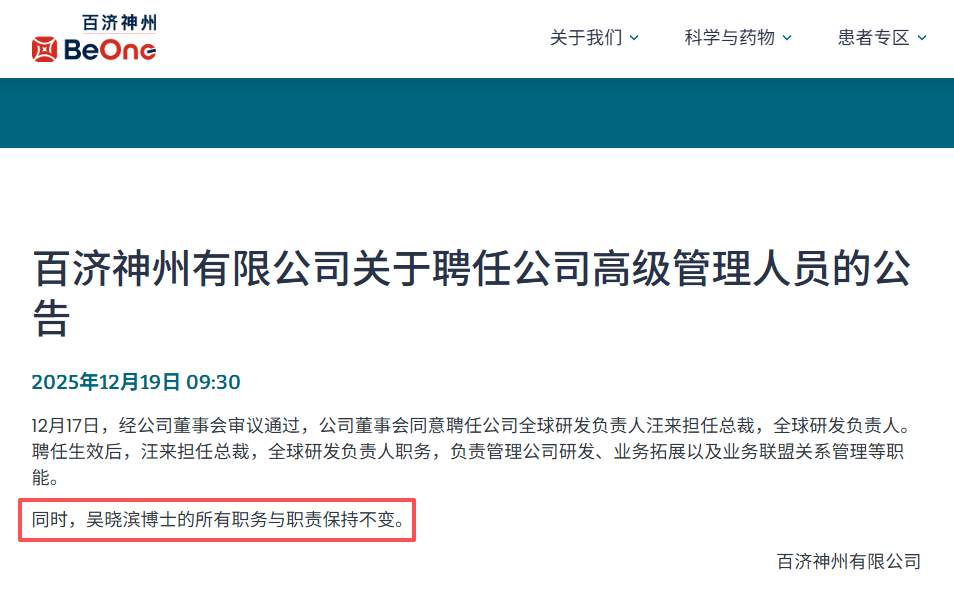
12月18日晚,百济神州公告,聘任公司全球研发负责人汪来博士担任公司总裁,全球研发负责人,负责管理公司研发、业务拓展以及业 务联盟关系管理等职能。同时,吴晓滨博士的所有职务与职责保持不变。 汪来于2011年加入百济神州,最初担任生物标志物和体内药理学组的负责人,自2021年4月起担任公司全球研发负责人。 加入百济神州 之前,2008年至2011年,汪来在位于美国德克萨斯州达拉斯的生物技术公司JoyantPharmaceuticals担任研究主管。汪来于1996年获得复 旦大学理学学士学位,2001年获得德克萨斯大学圣安东尼奥健康科学中心博士学位。 公告一经发出,业内纷纷猜测吴晓滨是否不再担任总裁一职。据智通财经、每日经济新闻等多家媒体向百济神州求证,吴晓滨职务并未 发生变化,依旧任公司总裁兼首席运营官,也就是说百济神州目前处于"双总裁"的情况。 公开资料显示,吴晓滨2018年加入百济神州。1982年,吴晓滨通过考试获取公派留学德国的机会,前往德国留学,获得德国康斯坦茨大 学分子生物学硕士学位和生物化学与药理学博士学位。 在加入百济神州之前,吴晓滨曾在拜耳、惠氏、辉瑞等药企工作,他在拜耳工作了13年,在辉瑞工作 ...
百济神州(688235) - 美股公告:临时报告8-K表格
2025-12-19 12:01
美国证券交易委员会 华盛顿特区 20549 8-K 表格 根据 1934 年证券交易法 第 13 或 15(d)条规定提交的 临时报告 报告日期(所报告最早事件之日期):2025 年 12 月 16 日 百济神州有限公司 BEONE MEDICINES LTD. (注册人章程中列明的注册人准确名称) 瑞士 001-37686 98-1209416 (如自上一份报告起有改动,则为公司曾用名或原地址) 若 8-K 表格的呈递旨在同时满足下列任何条例项下的注册人报告义务,请勾选相应方格: ☐ 根据证券法第 425 条发出书面通讯 (17 CFR 230.425) ☐ 根据交易法第 14a-12 条的征集资料 (17 CFR 240.14a-12) ☐ 根据交易法第 14d-2(b)条发出生效日期前通讯 (17 CFR 240.14d-2(b)) ☐ 根据交易法第 13e-4(c)条发出生效日期前通讯 (17 CFR 240.13e-4(c)) 根据证券交易法第 12(b)条注册的证券: | 各类别名称 | | | 交易代码 | 注册所在之各交易所名称 | | --- | --- | --- | --- | --- ...
百济神州:关于聘任公司高级管理人员的公告
Zheng Quan Ri Bao Zhi Sheng· 2025-12-19 08:43
(编辑 任世碧) 证券日报网讯 12月18日晚间,百济神州发布公告称,2025年12月17日,经公司董事会审议通过,公司 董事会同意聘任公司全球研发负责人汪来博士担任公司总裁,全球研发负责人。聘任生效后,汪来博士 担任公司总裁,全球研发负责人职务,负责管理公司研发、业务拓展以及业务联盟关系管理等职能。 ...