Cambricon(688256)

Search documents
今日财经要闻TOP10|2025年12月15日
Xin Lang Cai Jing· 2025-12-15 11:56
Group 1: Autonomous Driving - China's first batch of L3 conditional autonomous driving vehicles has received approval for road testing in designated areas of Beijing and Chongqing, marking a significant step towards commercialization [1] - The two approved models include an electric sedan capable of 50 km/h in congested traffic and another capable of 80 km/h on highways and urban expressways, both limited to specific routes [1] Group 2: Financial Sector Reforms - The China Securities Regulatory Commission (CSRC) has initiated reforms to enhance the inclusivity and attractiveness of the capital market, focusing on the implementation of the "1+6" reform measures for the Sci-Tech Innovation Board [3][10] - The CSRC aims to promote high-quality development in the private equity fund sector and expedite the pilot program for commercial real estate REITs [10] - A new round of corporate governance initiatives will be launched to encourage quality companies to increase dividend payouts and share buybacks [11] Group 3: Company Financials - Cambrian Technology plans to use approximately 2.78 billion yuan from its capital reserve to offset accumulated losses, with the aim of bringing its negative retained earnings to zero by the end of 2024 [8] - TCL Technology intends to acquire a 10.7656% stake in Shenzhen Huaxing Semiconductor for 6.045 billion yuan, increasing its ownership from 84.21% to 94.98%, to enhance its competitiveness in the semiconductor display industry [12] Group 4: Currency and Real Estate Market - The onshore and offshore RMB against the USD reached a 14-month high, with the onshore rate peaking at 7.0500 and the offshore rate at 7.046, indicating a favorable external environment for the RMB [13] - In November 2025, the sales prices of commercial residential properties in 70 major cities in China showed a month-on-month decline, with first-tier cities experiencing a 0.4% decrease in new residential prices [14]


寒武纪(688256.SH)拟使用27.78亿元资本公积金弥补亏损
智通财经网· 2025-12-15 11:23
智通财经APP讯,寒武纪(688256.SH)发布公告,公司拟使用母公司资本公积27.78亿元用于弥补母公司 累计亏损。本次公积金弥补亏损以公司2024年末母公司未分配利润负数弥补至零为限。根据相关规定, 公司现通知债权人,债权人可自接到通知之日起30日内或自公告披露之日起45日内申报债权。 ...
36氪晚报|马斯克:特斯拉启动无安全员Robotaxi路测;咨询机构:美股七巨头光环褪色;寒武纪:拟使用27.78亿元资本公积金弥补亏损
3 6 Ke· 2025-12-15 11:13
Group 1: Ant Group - Ant Group upgraded its AI health application AQ to "Ant Afu," which now has over 15 million monthly active users, ranking among the top five AI apps in China and becoming the leading health management AI app [1] Group 2: Cambricon - Cambricon announced plans to use 2.778 billion yuan of its capital reserve to cover accumulated losses, with the aim of bringing its negative retained earnings to zero by the end of 2024 [2] Group 3: TCL Technology - TCL Technology's subsidiary, TCL Huaxing, intends to acquire a 10.7656% stake in Shenzhen Huaxing Semiconductor for 6.045 billion yuan, increasing its total ownership from 84.2105% to 94.9761%, which is expected to enhance the company's profitability [3] Group 4: Tongrentang - Tongrentang responded to allegations of false labeling regarding a product, initiating a full process review and traceability for the involved product, and has taken legal action against the company responsible for unauthorized use of its name [4] Group 5: Juneyao Airlines - Juneyao Airlines announced that its shareholder, Eastern Airlines Industry Investment Co., plans to reduce its stake by up to 1% of the company's total shares, amounting to approximately 21.84 million shares, between January 8 and April 7, 2026 [5] Group 6: Palantir - Palantir announced the renewal of a three-year cooperation agreement with the French National Directorate of Security, continuing a nearly ten-year partnership to provide software and technical support [6] Group 7: Fosun Pharma - Fosun Pharma's subsidiary plans to invest a total of 1.412 billion yuan in Green Valley Pharmaceutical, acquiring part of its equity and subscribing to new registered capital, resulting in a 53% ownership stake [7] Group 8: Inks - Inks, a humanoid robot and core component enterprise, completed nearly 200 million yuan in a new financing round, led by Huakong Fund and Shenzhen Capital Group, marking its third financing round this year [8] Group 9: STMicroelectronics - STMicroelectronics has delivered over 5 billion RF antenna chips to SpaceX for its Starlink satellite network, with expectations to double this number by 2027 [9] Group 10: Shenyang Xingye Machine Tool - Shenyang Xingye Machine Tool announced the completion of 50 million yuan in Series A financing, which will be used for core technology iteration, smart workshop expansion, and talent development [10] Group 11: Autonomous Driving - The Ministry of Industry and Information Technology has granted conditional approval for two L3-level autonomous driving vehicle models from Changan Automobile and BAIC Blue Valley Magna [12]
寒武纪拟使用27.78亿元资本公积金弥补累计亏损
Bei Jing Shang Bao· 2025-12-15 10:47
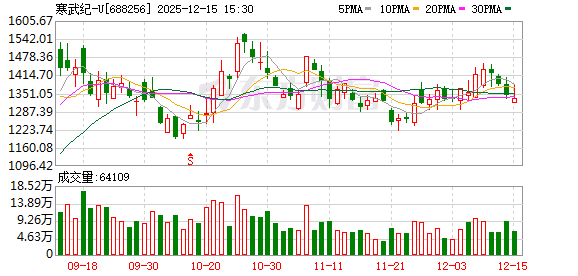
交易行情显示,12月15日,寒武纪收跌0.9%,收于1331.9元/股,总市值5616亿元。 北京商报讯(记者 马换换 李佳雪)12月15日晚间,寒武纪(688256)披露公告称,公司拟使用母公司 资本公积27.78亿元用于弥补母公司累计亏损。本次公积金弥补亏损以公司2024年末母公司未分配利润 负数弥补至零为限。 公告显示,寒武纪债权人自接到通知之日起30日内、未接到通知的自公告披露之日起45日内,均有权凭 有效债权证明文件及相关凭证要求公司清偿债务或提供相应担保。 ...
寒武纪(688256) - 关于使用公积金弥补亏损通知债权人的公告
2025-12-15 10:30
证券代码:688256 证券简称:寒武纪 公告编号:2025-080 根据《公司法》、财政部《关于公司法、外商投资法施行后有关财务处理问题 的通知》中"使用资本公积金弥补亏损的公司应自股东会作出资本公积金弥补亏 损决议之日起三十日内通知债权人或向社会公告"之规定,公司现通知债权人: 公司债权人自接到通知之日起 30 日内、未接到通知的自本公告披露之日起 45 日 内,均有权凭有效债权证明文件及相关凭证要求公司清偿债务或提供相应担保。 债权人未在规定期限内行使上述权利的,不会因此影响其债权的有效性,相关债 务(义务)将由公司根据原债权文件的约定继续履行。 中科寒武纪科技股份有限公司 关于使用公积金弥补亏损通知债权人的公告 本公司董事会及全体董事保证本公告内容不存在任何虚假记载、误导性陈述 或者重大遗漏,并对其内容的真实性、准确性和完整性依法承担法律责任。 一、通知债权人的原因 中科寒武纪科技股份有限公司(以下简称"公司")于 2025 年 11 月 28 日、 2025 年 12 月 15 日分别召开第三届董事会第一次会议、2025 年第二次临时股东会, 审议通过了《关于使用公积金弥补亏损的议案》。 根据天健会 ...
寒武纪(688256) - 北京市中伦律师事务所关于中科寒武纪科技股份有限公司2025年第二次临时股东会的法律意见书
2025-12-15 10:30
二〇二五年十二月 北京 • 上海 • 深圳 • 广州 • 武汉 • 成都 • 重庆 • 青岛 • 杭州 • 南京 • 海口 • 东京 • 香港 • 伦敦 • 纽约 • 洛杉矶 • 旧金山 • 阿拉木图 Beijing • Shanghai • Shenzhen • Guangzhou • Wuhan • Chengdu • Chongqing • Qingdao • Hangzhou • Nanjing • Haikou • Tokyo • Hong Kong • London • New York • Los Angeles • San Francisco • Almaty 北京市中伦律师事务所 关于中科寒武纪科技股份有限公司 北京市中伦律师事务所 关于中科寒武纪科技股份有限公司 2025 年第二次临时股东会的 法律意见书 2025 年第二次临时股东会的 法律意见书 致:中科寒武纪科技股份有限公司 北京市中伦律师事务所(以下简称"本所")接受中科寒武纪科技股份有限 公司(以下简称"公司")委托,指派本所律师列席公司 2025 年第二次临时股东 会,并出具本法律意见书。 为出具本法律意见书,本所律师列席了公司 ...
寒武纪(688256) - 2025年第二次临时股东会决议公告
2025-12-15 10:30
证券代码:688256 证券简称:寒武纪 公告编号:2025-079 中科寒武纪科技股份有限公司 2025年第二次临时股东会决议公告 本公司董事会及全体董事保证公告内容不存在任何虚假记载、误导性陈述或 注:截至本次股东会股权登记日,公司回购专用账户中股份数为 36,600 股,不享有股东会 表决权。 (四) 表决方式是否符合《公司法》及公司章程的规定,股东会主持情况等。 者重大遗漏,并对其内容的真实性、准确性和完整性依法承担法律责任。 重要内容提示: 本次会议是否有被否决议案:无 一、 会议召开和出席情况 (一) 股东会召开的时间:2025 年 12 月 15 日 (二) 股东会召开的地点:北京市海淀区知春路 25 号北京丽亭华苑酒店二层金 辉 6 厅 (三) 出席会议的普通股股东、特别表决权股东、恢复表决权的优先股股东及 其持有表决权数量的情况: | 1、出席会议的股东和代理人人数 | 1,430 | | --- | --- | | 普通股股东人数 | 1,430 | | 2、出席会议的股东所持有的表决权数量 | 284,399,259 | | 普通股股东所持有表决权数量 | 284,399,259 | | ...
大摩重磅机器人年鉴:AI走向实体化,机器人迎来寒武纪大爆发,中国领先优势明显
Hua Er Jie Jian Wen· 2025-12-15 10:20
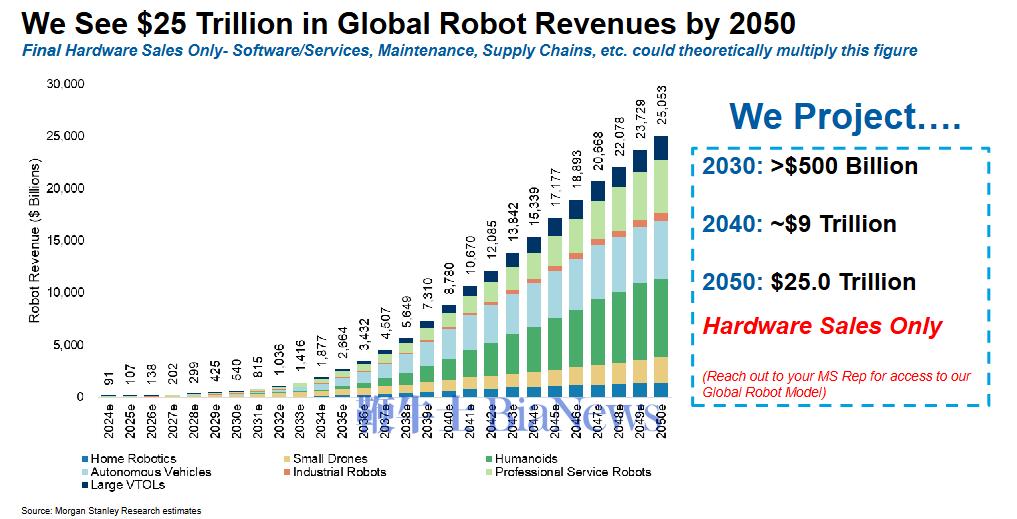
Core Insights - A fundamental shift in artificial intelligence is occurring, transitioning from the digital world to the physical world, which is expected to create a global robotics hardware market worth up to $25 trillion by 2050 [1][3] - Morgan Stanley's latest report predicts that global robotics hardware sales will surge from approximately $100 billion in 2025 to $500 billion by 2030, reaching $9 trillion by 2040 and $25 trillion by 2050 [1][4] Market Growth Factors - Five key factors are driving exponential growth in the global robotics market, with an estimated 1.4 billion robots expected to be sold by 2050 and a total of 6.5 billion operational robots [4] - The diversity of robot forms will include industrial robots, service robots, drones, autonomous vehicles, humanoid robots, and household robots, covering various applications from manufacturing to healthcare and agriculture [7] Component Demand Surge - The explosive growth of the robotics industry will create significant opportunities for upstream component suppliers, with projections indicating the need for 5.7 billion cameras, 27 billion motors, and 4.1 billion bearings by 2050 [8][11] - The demand for edge computing capabilities is expected to increase by 40,000 times, while the need for rare earth magnets and battery capacity will also see substantial growth [8] Investment Opportunities - The demand surge will present major business opportunities for suppliers of motors, bearings, rare earth materials, cameras, sensors, AI chips, and batteries [11] - Small drones and low-altitude robotic systems are identified as the most promising investment areas, driven by ease of navigation, government prioritization due to lessons from the Ukraine conflict, and the maturation of regulatory frameworks [11] China's Competitive Advantage - China is demonstrating a clear lead in the robotics sector, particularly in manufacturing capabilities, control of rare earth materials, and policy support, with expectations of continued expansion over the next decade [3][14] - By 2050, China is projected to account for approximately 26% of global robot sales, with even higher shares in industrial robots and drones [15] - The country is expected to maintain a competitive edge in the robotics supply chain, particularly in the "body" segment of humanoid robots, where it holds a 63% market share [15]

解密主力资金出逃股 连续5日净流出687股


Zheng Quan Shi Bao Wang· 2025-12-15 10:08
Core Insights - As of December 15, a total of 687 stocks in the Shanghai and Shenzhen markets have experienced net outflows of main funds for five consecutive days or more [1] - ST Jinglan has the longest streak of net outflows, with 26 consecutive days, while Jin Gu shares follow with 20 days [1] - Tianfu Communication has the highest total net outflow amount, with 4.516 billion yuan over five days, followed by Changying Precision with 4.123 billion yuan [1] Summary by Category Net Outflow Duration - ST Jinglan: 26 days of net outflow [4] - Jin Gu shares: 20 days of net outflow [1] Total Net Outflow Amount - Tianfu Communication: 4.516 billion yuan over 5 days [1] - Changying Precision: 4.123 billion yuan over 5 days [1] - Heertai: 4.056 billion yuan over 7 days [1] - Aerospace Development: 3.937 billion yuan over 7 days [1] Proportion of Net Outflow to Transaction Amount - ST Zhengping has the highest proportion of net outflow, with a 36.95% drop over 8 days [1] - Other notable stocks with significant net outflow proportions include Heertai and Changying Precision [1] Cumulative Price Change - ST Jinglan: -4.49% [4] - Tianfu Communication: -11.52% [1] - Changying Precision: -18.64% [1] - Heertai: -24.47% [1]
科创板百元股达71只 寒武纪-U股价最高
Zheng Quan Shi Bao Wang· 2025-12-15 09:54
Core Insights - The average stock price on the STAR Market is 40.75 yuan, with 71 stocks priced over 100 yuan, and the highest priced stock is Cambrian-U at 1331.90 yuan [2][3] - A total of 172 stocks increased in price while 416 stocks decreased, with the average decline for stocks over 100 yuan being 3.16% [2][3] - The premium of stocks over their issue prices averages 498.01%, with notable premiums for companies like Shunwei New Materials and Cambrian-U [2][3] Stock Performance - Cambrian-U closed at 1331.90 yuan, down 0.90%, followed by Moer Thread-U at 764.90 yuan and SourceJet Technology at 633.00 yuan [2][3] - Among the stocks priced over 100 yuan, 10 stocks saw an increase, with the largest gainers being Zhenray Technology, Haooubo, and Jingfeng Mingyuan [2][3] - The sectors with the highest concentration of stocks over 100 yuan include electronics, pharmaceuticals, and computers, with 38, 9, and 8 stocks respectively [2][3] Capital Flow - The net outflow of main funds from stocks over 100 yuan totaled 4.123 billion yuan, with Zhenray Technology, Zhongwei Company, and Anji Technology seeing the highest net inflows [3] - The total margin balance for stocks over 100 yuan is 95.915 billion yuan, with Cambrian-U, Zhongxin International, and Haiguang Information having the highest margin balances [3] Detailed Stock List - A detailed list of stocks over 100 yuan includes Cambrian-U, Moer Thread-U, and SourceJet Technology, with their respective closing prices and percentage changes [4][5]