
BIOKIN PHARMACEUTICAL(688506)

Search documents
化学制药板块9月17日跌0.2%,华纳药厂领跌,主力资金净流出15.41亿元
Zheng Xing Xing Ye Ri Bao· 2025-09-17 08:42
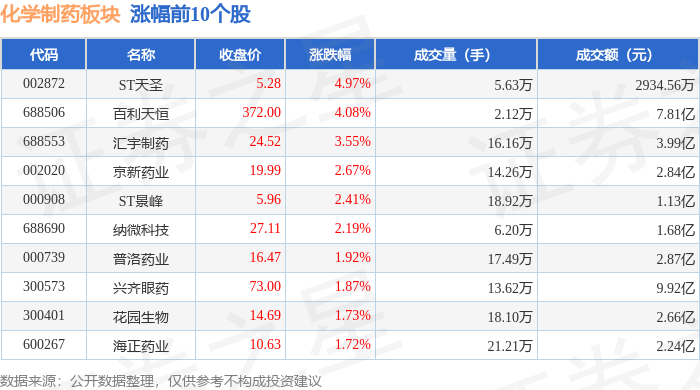
Group 1 - The chemical pharmaceutical sector experienced a decline of 0.2% on September 17, with Warner Pharmaceuticals leading the drop [1] - The Shanghai Composite Index closed at 3876.34, up 0.37%, while the Shenzhen Component Index closed at 13215.46, up 1.16% [1] - Notable gainers in the chemical pharmaceutical sector included ST Tian Sheng, which rose by 4.97% to a closing price of 5.28, and Bai Li Tian Heng, which increased by 4.08% to 372.00 [1] Group 2 - Warner Pharmaceuticals saw a significant decline of 9.22%, closing at 57.92, contributing to the overall downturn in the sector [2] - Other notable decliners included Anglikang, down 4.53% to 41.28, and Guangsheng Tang, down 4.40% to 111.91 [2] - The sector experienced a net outflow of 1.541 billion yuan from major funds, while retail investors saw a net inflow of 1.516 billion yuan [2][3] Group 3 - Major fund inflows were observed in companies like Heng Rui Pharmaceutical, which had a net inflow of 3.43 million yuan, while retail investors showed a net outflow of 58.13 million yuan [3] - The top net inflows from retail investors were seen in Hai Zheng Pharmaceutical, with 34.03 million yuan, and Hua Yuan Biological, with 30.05 million yuan [3] - The overall trend indicates a shift in investment dynamics within the chemical pharmaceutical sector, with retail investors showing resilience despite major fund outflows [3]




10款药品被暂停采购资格 涉及舒泰神、百利药业等企业
Xin Jing Bao· 2025-09-17 06:55
Core Viewpoint - The Shanghai Municipal Medical Procurement Management Office announced the suspension of procurement qualifications for certain drugs due to non-compliance with price adjustment requirements, affecting multiple companies including Shutaishen and Baili Pharmaceutical [1][2]. Group 1: Impact on Shutaishen - Shutaishen's product, Compound Polyethylene Glycol (3350) Quality Vitamin C Powder, is set to be launched on October 9, 2024, as the first domestic generic, aimed at bowel cleansing before medical procedures [1]. - Shutaishen has experienced a continuous decline in revenue for three years and has reported losses for five consecutive years, totaling over 1 billion yuan [2]. - In the first half of 2025, Shutaishen reported revenue of 126 million yuan, a year-on-year decline of 31.14%, with a net profit of -24.64 million yuan [2]. Group 2: Impact on Baili Pharmaceutical - Baili Pharmaceutical's product, Oral Solution of Enalapril Maleate, is also included in the suspended procurement list [2]. - Baili Pharmaceutical reported revenue of 113 million yuan in the first half of 2025, accounting for 66% of its parent company Baili Tianheng's revenue, with a net profit of -23.48 million yuan [2]. - Baili Tianheng's revenue has been declining due to falling sales in its chemical and traditional Chinese medicine product segments, which are crucial for supporting innovative drug research and development [2]. Group 3: Other Affected Products - Other drugs affected by the procurement suspension include Vancomycin Capsules, Betamethasone Ointment, Calcium Acetate Oral Solution, and several others from various pharmaceutical companies [3].

百利天恒股价涨5.2%,大成基金旗下1只基金重仓,持有3759股浮盈赚取6.98万元
Xin Lang Cai Jing· 2025-09-17 03:04
大成上证科创板综合指数增强A(023893)成立日期2025年4月29日,最新规模8339万。成立以来收益 34.21%。 大成上证科创板综合指数增强A(023893)基金经理为夏高、刘旺。 截至发稿,夏高累计任职时间10年289天,现任基金资产总规模22.6亿元,任职期间最佳基金回报 217.4%, 任职期间最差基金回报-71.74%。 刘旺累计任职时间1年260天,现任基金资产总规模6.37亿元,任职期间最佳基金回报34.27%, 任职期 间最差基金回报30.17%。 风险提示:市场有风险,投资需谨慎。本文为AI大模型自动发布,任何在本文出现的信息(包括但不 限于个股、评论、预测、图表、指标、理论、任何形式的表述等)均只作为参考,不构成个人投资建 议。 9月17日,百利天恒涨5.2%,截至发稿,报375.99元/股,成交4.06亿元,换手率1.08%,总市值1507.72 亿元。百利天恒股价已经连续4天上涨,区间累计涨幅4.2%。 资料显示,四川百利天恒药业股份有限公司位于四川省成都市温江区成都海峡两岸科技产业园百利路 161号一幢一号,香港湾仔皇后大道东183号合和中心46楼,成立日期2006年8月17 ...
百利天恒涨2.06%,成交额2.00亿元,主力资金净流出1392.23万元
Xin Lang Zheng Quan· 2025-09-17 02:40
Core Viewpoint - The stock of Baile Tianheng has shown significant growth this year, with a 90.27% increase, despite a substantial decline in revenue and net profit reported for the first half of 2025 [1][2]. Group 1: Stock Performance - As of September 17, Baile Tianheng's stock price increased by 2.06%, reaching 364.80 CNY per share, with a trading volume of 200 million CNY and a turnover rate of 0.54% [1]. - The company has experienced a 90.27% increase in stock price year-to-date, with recent trading performance showing a 6.35% increase over the last five days, 16.99% over the last 20 days, and 22.05% over the last 60 days [1]. Group 2: Financial Performance - For the first half of 2025, Baile Tianheng reported an operating revenue of 171 million CNY, a significant decrease of 96.92% year-on-year, and a net profit attributable to shareholders of -1.118 billion CNY, down 123.96% year-on-year [2]. Group 3: Shareholder Information - As of June 30, 2025, the number of shareholders increased by 4.25% to 4,780, with an average of 21,525 circulating shares per shareholder, reflecting a 7.19% increase [2]. - The top ten circulating shareholders include notable funds such as Huaxia SSE Sci-Tech Innovation Board 50 ETF and others, with varying changes in their holdings [3].
9月16日医疗健康R(480016)指数跌0.33%,成份股泽璟制药(688266)领跌
Sou Hu Cai Jing· 2025-09-16 10:30
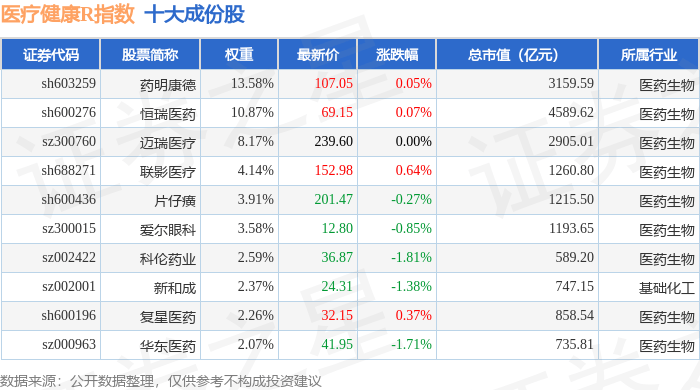
Core Points - The Medical Health R Index (480016) closed at 8278.77 points, down 0.33%, with a trading volume of 31.765 billion yuan and a turnover rate of 1.08% [1] - Among the index constituents, 18 stocks rose while 31 fell, with Yirui Technology leading the gainers at a 4.4% increase and Zexin Pharmaceutical leading the decliners at a 5.37% decrease [1] Index Constituents Summary - The top ten constituents of the Medical Health R Index include: - WuXi AppTec (sh603259) with a weight of 13.58% and a market cap of 315.96 billion yuan [1] - Hengrui Medicine (sh600276) with a weight of 10.87% and a market cap of 458.96 billion yuan [1] - Mindray Medical (sz300760) with a weight of 8.17% and a market cap of 290.50 billion yuan [1] - United Imaging Healthcare (sh688271) with a weight of 4.14% and a market cap of 126.08 billion yuan [1] - Other notable constituents include Pianzai Shou (sh600436), Yierfu Technology (sz300015), Kelun Pharmaceutical (sz002422), New Hope Liuhe (sz002001), Fosun Pharma (sh600196), and East China Pharmaceutical (sz000963) [1] Capital Flow Analysis - The net outflow of main funds from the index constituents totaled 1.638 billion yuan, while retail investors saw a net inflow of 1.098 billion yuan [1] - Notable capital flows include: - Kailai Ying (002821) with a main fund net inflow of 101 million yuan [2] - Mindray Medical (300760) with a main fund net inflow of approximately 90.77 million yuan [2] - Yuyue Medical (002223) with a main fund net inflow of 24.60 million yuan [2]




中国这款新药,肿瘤治疗潜力获中美官方认证
Mei Ri Jing Ji Xin Wen· 2025-09-15 14:14
Core Viewpoint - A Chinese innovative drug, iza-bren, has received breakthrough therapy designations from both the FDA and the Chinese drug regulatory authority, showcasing significant potential in lung cancer treatment, particularly highlighted by a 100% objective response rate (ORR) at the WCLC 2025 conference [2][3][4]. Group 1: Clinical Data and Breakthroughs - The Phase II clinical trial of iza-bren combined with Osimertinib for treating EGFR-mutant non-small cell lung cancer (NSCLC) reported a 100% ORR, the highest recorded for first-line treatments in this category [3][5]. - The trial included 40 patients at a specific dosage of 2.5 mg/kg, which is now the recommended dose for subsequent Phase III studies [3][7]. - The treatment demonstrated a significant tumor reduction, with a median tumor shrinkage of nearly 57% from baseline, indicating a strong potential for long-term control of the disease [5][6]. Group 2: Future Research and Development - The ongoing Phase III study aims to compare the efficacy and safety of the combination therapy against Osimertinib alone, with primary endpoints focusing on progression-free survival (PFS) and secondary endpoints on overall survival (OS) [7][8]. - The study has received regulatory approval and is actively enrolling patients, with the first patient enrolled in February 2023 [7][9]. Group 3: Market Position and Global Collaboration - The collaboration with BMS (Bristol-Myers Squibb) is structured as a long-term joint development, retaining Chinese rights and supply chain control, which enhances the global clinical trial execution [9][10]. - Iza-bren is positioned as a leading antibody-drug conjugate (ADC) with unique dual-targeting capabilities, potentially setting a new direction in cancer combination therapies [10][11]. Group 4: Regulatory Recognition and Market Potential - Iza-bren has received multiple breakthrough therapy designations, which expedite its development and review process, allowing for faster patient access upon approval [13][14]. - The drug is expected to redefine treatment standards for EGFR-TKI resistant patients, with a median PFS of 12.5 months reported, significantly higher than existing therapies [11][12]. Group 5: Industry Impact - The advancements of iza-bren signify that Chinese innovative drug companies are now competing at the global forefront, with the potential to reshape treatment paradigms across various cancer types [14].
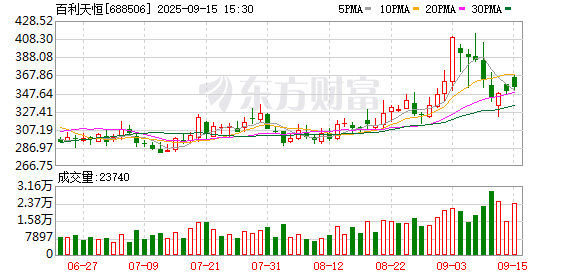
百利天恒自主研发的iza-bren治疗EGFR突变肺癌的一项研究客观缓解率达100%
Zheng Quan Ri Bao· 2025-09-15 07:35
Group 1 - Sichuan Baili Tianheng Pharmaceutical Co., Ltd. announced that its self-developed drug, iza-bren (EGFR×HER3 dual antibody ADC), has been recognized at the 2025 World Lung Cancer Conference (WCLC) with two research results selected for the official press program [2] - The phase II study results of iza-bren combined with Osimertinib for patients with locally advanced or metastatic EGFR mutation non-small cell lung cancer (NSCLC) were presented by Professor Zhou Fei from the Eastern Hospital of Tongji University, involving 154 patients [2] - Among the 40 patients receiving the 2.5 mg/kg D1D8Q3W dose of iza-bren combined with Osimertinib, the objective response rate (ORR) reached 100%, with a progression-free survival (PFS) rate of 92.1% and overall survival (OS) rate of 94.8% at 12 months [3] Group 2 - A separate study led by Professor Fang Wenfeng from Sun Yat-sen University Cancer Center on the monotherapy of iza-bren for patients with locally advanced or metastatic EGFR mutation NSCLC showed a median PFS of 12.5 months and a tumor shrinkage rate of 94% among 50 patients previously treated with EGFR-TKI [3] - The ongoing phase III studies for both combination and monotherapy of iza-bren are being conducted globally and in China, with the first patient already dosed in the registration phase [3]
金改前沿|“多元上市路径”激活潜力 科创板为未盈利企业打开“资本入口”
Xin Hua Cai Jing· 2025-09-15 02:33
Core Insights - The Shanghai Stock Exchange emphasizes its mission to support technological innovation and enhance its role as a capital market hub, particularly through the STAR Market [1] - The STAR Market has established five sets of listing standards, with the second to fifth sets not requiring profitability, thus providing diverse listing pathways for unprofitable companies [1][2] - As of now, 54 unprofitable companies have collectively raised over 200 billion yuan through IPOs, demonstrating effective transformation of R&D capabilities into operational performance [1][3] Listing Standards - The STAR Market's second to fourth listing standards focus on revenue scale combined with R&D intensity, cash flow, or market capitalization, catering to hard-tech companies with specific characteristics [1][2] - The fifth standard does not set performance requirements but emphasizes market capitalization and developmental achievements, suitable for innovative companies with clear market prospects [1][2] Company Performance - Among the 54 unprofitable companies, 40% have achieved profitability, with a total revenue of 1,745 billion yuan in 2024, marking a 24% year-on-year increase [3] - Notable companies like BeiGene and Cambricon have shown significant R&D investments, with BeiGene's R&D expenditure reaching 7.278 billion yuan, accounting for 42% of its revenue [2][3] - The semiconductor sector, led by companies like SMIC, has seen substantial advancements, enhancing the industry's self-sufficiency and innovation capabilities [3][4] Market Developments - The STAR Market's fifth standard companies are entering a new phase of commercial development, with 46 drugs/vaccines approved for market entry, showcasing rapid commercialization [4] - The introduction of the "1+6" policy framework aims to further support unprofitable companies in high-tech sectors, balancing innovation support with market risk management [4][5] - Since the implementation of the "1+6" policy, 15 new IPO applications have been accepted, including four from unprofitable companies, indicating ongoing market dynamism [5]



科创板"多元入口"激活未盈利企业潜力 加速创造行业"DeepSeek时刻"
Zheng Quan Shi Bao· 2025-09-14 15:19
Core Viewpoint - The Sci-Tech Innovation Board (STAR Market) has successfully created a multi-path listing approach for unprofitable companies, allowing them to access capital markets without the traditional profit threshold, thus promoting the transformation of R&D capabilities into operational performance and industrial value [1][2]. Group 1: Listing Standards - The STAR Market has five sets of listing standards, with the second to fifth sets not requiring profit, instead focusing on revenue scale and R&D intensity, cash flow, and market capitalization [2]. - The second to fourth sets cater to "hard technology" companies with characteristics such as R&D strength and stable business models, while the fifth set evaluates companies based on market capitalization and developmental achievements, suitable for innovative firms with clear market prospects [2][4]. Group 2: Performance of Unprofitable Companies - Among the 54 unprofitable companies listed, 40% have achieved profitability, with a total revenue of 1,745 billion yuan in 2024, marking a 24% year-on-year increase, and a net loss of 136 billion yuan, reduced by 36% [3]. - By the first half of 2025, these companies reported a revenue of 999 billion yuan, an 8% increase year-on-year, with a net loss of 15 billion yuan, a 70% reduction compared to the previous year [3][6]. Group 3: Industry Innovations - Leading companies like Cambricon and SMIC are driving significant advancements in the semiconductor sector, enhancing the self-sufficiency of the supply chain and breaking foreign monopolies [4]. - The fifth set of standards has enabled unprofitable companies to transition into a new phase of commercial development, with 46 drugs/vaccines approved for market, including 20 innovative drugs that have not been previously launched domestically or internationally [4]. Group 4: Policy Impact - The introduction of the "1+6" policy and the establishment of the "Sci-Tech Growth Layer" aim to support unprofitable companies in high-tech sectors, balancing innovation support with market risk prevention [5][6]. - Since the policy's implementation, 15 new IPO applications have been accepted, including four from unprofitable companies, indicating a positive response to the new listing standards [6].

用“多元入口”激活“盈利潜力” 科创板助力企业加速从“U”到优
Zheng Quan Ri Bao Wang· 2025-09-14 14:05
Core Viewpoint - The Shanghai Stock Exchange emphasizes its mission to support the real economy and enhance its capacity to support technological innovation through the STAR Market, which has established inclusive listing standards for unprofitable companies [1][5]. Group 1: Listing Standards - The STAR Market has developed five sets of listing standards, with the second to fifth sets not imposing profit thresholds, thereby creating diverse pathways for unprofitable companies to access the capital market [1][2]. - The second to fourth sets of standards assess companies based on "revenue scale + R&D intensity," "revenue scale + cash flow," and "revenue scale + market capitalization," respectively, catering to hard technology enterprises with strong R&D capabilities [1][2]. - The fifth set of standards evaluates companies based on "market capitalization + stage of R&D achievements," allowing innovative firms with promising technologies but no commercialization to list [2]. Group 2: Performance of Unprofitable Companies - As of 2024, 54 unprofitable companies listed on the STAR Market achieved a total revenue of 1,745 billion, a 24% year-on-year increase, with 26 companies exceeding 100 million in revenue [3]. - These companies collectively reduced their net losses by 36% to 136 billion, with 22 companies achieving profitability and "delisting" from the unprofitable category [3]. - In the first half of 2025, these companies reported a total revenue of 999 billion, an 8% increase, and reduced net losses by 70% to 15 billion [3]. Group 3: Industry Highlights - Leading companies in the innovative drug sector, such as BeiGene and Baillie Gifford, have achieved significant sales milestones, with BeiGene's new drug generating over 10 billion in sales in just six months [4]. - In the semiconductor sector, companies like SMIC and Cambrian are breaking foreign monopolies and enhancing domestic capabilities in AI chip development [4]. - The STAR Market has facilitated the approval of 46 drugs/vaccines, with 20 new innovative drugs launched domestically, showcasing the rapid advancement of unprofitable companies towards commercialization [6]. Group 4: Policy Impact - The STAR Market's "1+6" policy framework aims to further support unprofitable companies by creating a "STAR Growth Layer" that focuses on emerging sectors like AI and commercial aerospace [6]. - Since the implementation of this policy, 15 new IPO applications have been accepted, including four from unprofitable companies, indicating a positive market response [6]. - Companies in the STAR Growth Layer reported a 38% year-on-year revenue growth and a significant reduction in net losses by 71 billion in the first half of 2025 [6]. Group 5: Future Outlook - The STAR Market is positioned to assist unprofitable hard technology companies in transitioning from research to market, reinforcing the importance of capital support for technological self-reliance [7].
