
PAB(000001)

Search documents
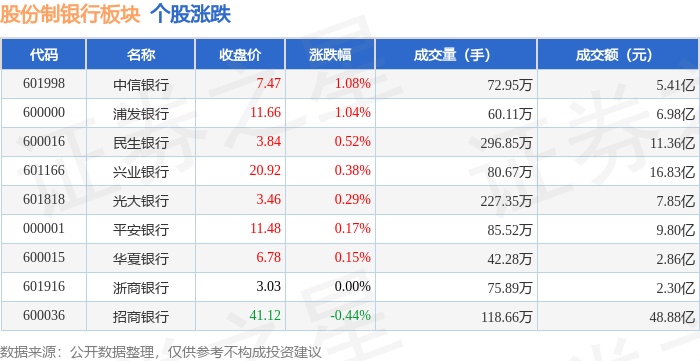
股份制银行板块1月12日涨0.26%,中信银行领涨,主力资金净流出10.83亿元
Zheng Xing Xing Ye Ri Bao· 2026-01-12 09:04
Group 1 - The banking sector saw a slight increase of 0.26% on January 12, with CITIC Bank leading the gains [1] - The Shanghai Composite Index closed at 4165.29, up 1.09%, while the Shenzhen Component Index closed at 14366.91, up 1.75% [1] - The trading volume and turnover for major banks were significant, with CITIC Bank's closing price at 7.47, reflecting a 1.08% increase and a turnover of 541 million yuan [1] Group 2 - The net outflow of main funds from the banking sector was 1.083 billion yuan, while retail investors saw a net inflow of 579 million yuan [1] - CITIC Bank had a net inflow of 53.24 million yuan from main funds, despite a net outflow from retail investors [1] - The overall fund flow indicated a mixed sentiment, with some banks experiencing significant net outflows from main funds, such as Industrial Bank with a net outflow of 75.54 million yuan [1]






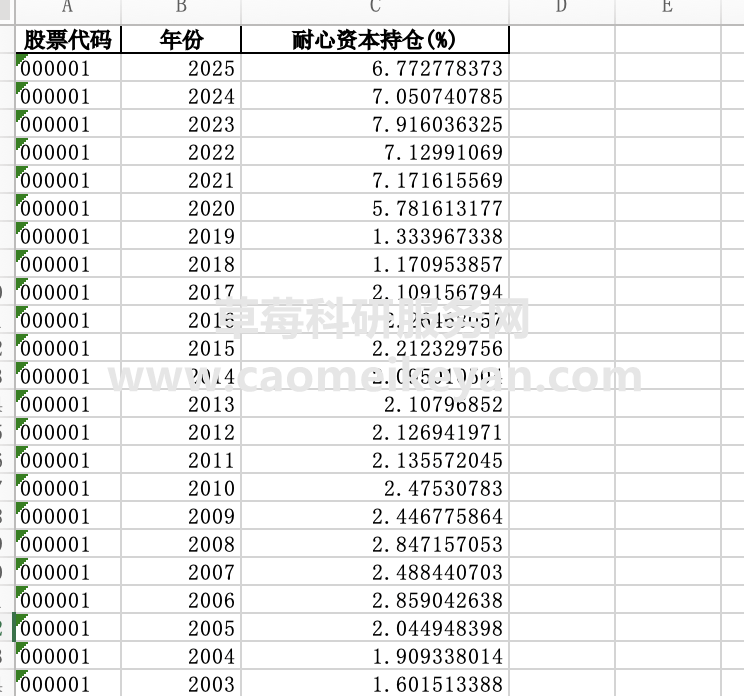
2025-2003年上市公司企业耐心资本持仓数据、基金耐心资本持仓数
Sou Hu Cai Jing· 2026-01-12 02:50
Core Insights - The article presents data on the holdings of Patience Capital in publicly listed companies from 2003 to 2025, focusing on the percentage of holdings relative to the fund's net value [1] - The analysis utilizes a comprehensive dataset covering over 40,000 companies, including more than 9,000 firms across various stock exchanges and ETFs, ensuring a thorough examination of Patience Capital's investment style [1] Data Analysis - The methodology for calculating the holdings percentage is based on the approach outlined by Li Xinwu in a top journal, where the fund's holding in a company is expressed as a percentage of the fund's net value [1] - The dataset includes original daily data, but annual data is used for calculations, leading to larger values represented in logarithmic form [1] - The holding data from 2019 to 2003 is noted to be incomplete, but other original data and holdings from 2020 to 2025 were used for extrapolation [1] Reference Data - The article provides specific holding percentages for a particular stock (code: 000001) over the years, showing a significant increase from 1.33% in 2019 to 6.77% in 2025 [1] - The holding percentages for the years 2020 to 2025 are as follows: 5.78% (2020), 7.17% (2021), 7.13% (2022), 7.92% (2023), and 7.05% (2024) [1]

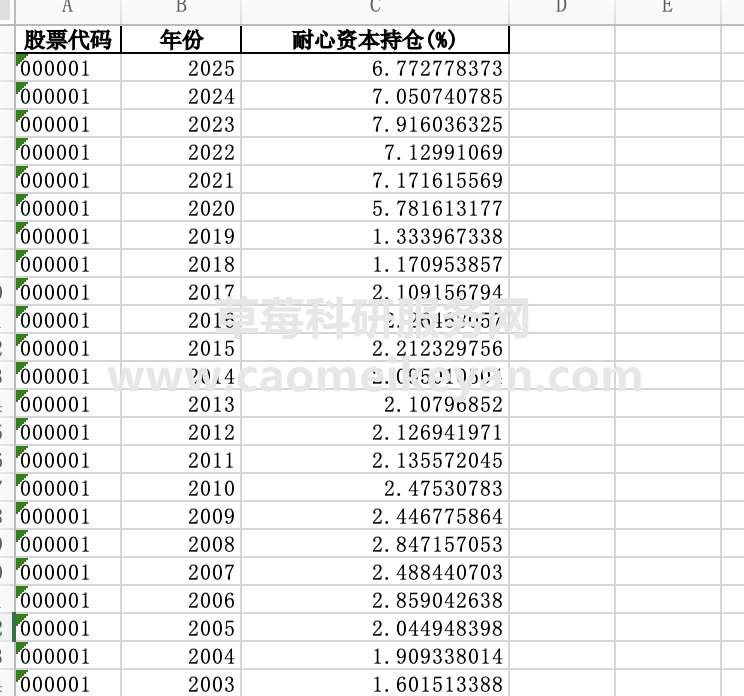
2025-2003年上市公司企业耐心资本持仓数据、基金耐心资本持仓数据
Sou Hu Cai Jing· 2026-01-12 02:39
Core Insights - The article presents data on the holdings of Patience Capital in publicly listed companies from 2003 to 2025, focusing on the percentage of holdings relative to the fund's net value [1]. Group 1: Data Overview - The analysis is based on over 40,000 companies, with more than 9,000 companies included in the dataset, covering various stock exchanges and ETFs [1]. - The methodology follows a model proposed by Li Xinwu, calculating the holding percentage of Patience Capital in each company for each year [1]. - The original data is daily, but annual data is used for calculations, resulting in larger values represented in logarithmic form [1]. Group 2: Holding Trends - The holding percentage of Patience Capital in stock code 000001 shows a significant increase from 1.33% in 2019 to 6.77% in 2025 [1]. - Yearly holding percentages for stock code 000001 are as follows: 7.05% in 2024, 7.92% in 2023, 7.13% in 2022, and 5.78% in 2020, indicating a general upward trend over the years [1]. - The data also reveals fluctuations in holdings from 2010 to 2019, with a notable increase starting in 2020 [1].
中国平安20260110
2026-01-12 01:41
Summary of Ping An Bank Conference Call Company Overview - **Company**: Ping An Bank - **Industry**: Banking and Financial Services Key Points and Arguments Credit Structure Adjustment - Ping An Bank is shifting its credit focus from high-yield, high-risk assets to medium-yield assets, particularly in retail lending, where consumer loan and credit card rates are decreasing while mortgage rates remain stable. Overall yield is experiencing a gradual decline [2][3][9] Deposit Cost Management - The bank is actively controlling deposit costs by reducing high-cost deposits and increasing the proportion of demand deposits to improve deposit structure. This strategy is expected to stabilize the loan growth rate in 2026, with a slight increase anticipated [2][7] Loan Growth and Yield Outlook - For 2026, Ping An Bank expects loan yields to face downward pressure but aims to stabilize margins through optimized funding costs. New loan rates may slightly decline due to macroeconomic factors affecting consumer income and spending [2][8][20] Risk Management - The bank maintains a low Loan-to-Value (LTV) ratio for mortgages, ensuring strong collateral and asset quality control. Risks associated with consumer loans and credit cards have been significantly cleared, allowing for better risk management in retail lending [2][10] Credit Cost Stability - Credit costs are expected to remain stable in 2026, with a consistent provision coverage ratio. The bank plans to maintain a sufficient loan-to-provision ratio to manage future risks effectively [2][12] Retail Business Recovery - Since Q4 2025, the recovery trend in retail business has continued, with sustained investment in mortgages and medium-yield assets while reducing high-risk assets. The bank aims for a dual recovery in revenue and performance in 2026 [4][20] Corporate Lending Strategy - Corporate lending will focus on sectors such as real estate, infrastructure, and energy, with a slight decrease in growth expected. The bank will prioritize risk control in the retail sector due to a weak consumer environment [6][20] Macro Economic Outlook - Ping An Bank holds an optimistic view of the macroeconomic environment for 2026, anticipating that government policies will effectively stimulate economic recovery and consumer spending [8][20] Non-Interest Income and Insurance Business - The bank's insurance business is a strategic focus, contributing approximately 30-40% of wealth management income. The bank expects continued growth in this area, enhancing overall revenue support [4][12][13] Future Asset Growth and Dividend Policy - The bank does not have a specific growth target for 2026 but aims for stability in corporate lending while maintaining a dividend payout ratio of around 27% [16][17] Medium-Yield Asset Development - Ping An Bank is committed to developing medium-yield assets as a key product to improve risk management and meet customer needs, with a target of 30 billion yuan for 2025 and ongoing discussions for 2026 [17] Overseas Business Development - Currently, Ping An Bank operates a branch in Hong Kong focused on cross-border financing, with plans to maintain a light business model and prioritize retail banking in the long term [18][19] Performance Expectations for 2026 - The bank anticipates a phase of performance recovery in 2026, aiming for improved revenue and profitability compared to the previous two years, although quarterly performance will need to be monitored closely [20]

过渡期收官在即,银行业首席合规官密集就位
Mei Ri Jing Ji Xin Wen· 2026-01-11 12:29
Core Insights - The banking industry is undergoing a restructuring wave in risk and compliance systems due to tightening regulatory rules and a complex risk environment [1][2] - A surge in appointments for Chief Risk Officers (CROs) and Chief Compliance Officers (CCOs) is expected by the end of 2025 and early 2026, with over 20 banks and branches already approved for relevant positions since the beginning of 2025 [1][2] Regulatory Changes - The "Measures for Compliance Management of Financial Institutions" requires financial institutions to establish a CCO at their headquarters, who will be classified as a senior management position [2] - The transitional period for compliance with this regulation is set to expire one year after its implementation on March 1, 2025 [2] Appointment Trends - A variety of banks, including Ping An Bank, Industrial Bank, and Minsheng Bank, have announced the appointment of CCOs as the transitional deadline approaches [2] - The trend shows a mix of large, medium, and small institutions moving forward with these appointments [2] Governance Models - Two governance models are emerging: "one person holding multiple roles" and "independent separation" for CCOs and CROs [3] - The "one person holding multiple roles" model is prevalent among smaller banks, allowing for unified decision-making in risk and compliance management [3] - The "independent separation" model is more common in larger banks, emphasizing specialized development and independent oversight in risk management [3][4] Talent Acquisition Challenges - The establishment of CCO and CRO positions presents new challenges for talent acquisition, with a preference for candidates possessing a combination of frontline business experience, cross-regional vision, and professional qualifications [6] - Some banks are adopting market-based recruitment strategies for CCOs, breaking traditional selection models [6] Compensation Trends - The compensation for CCOs is rising, with annual total income expected to be no less than the average for senior management positions [6] - Reports indicate that the reference monthly salary for these positions can reach between 100,000 to 130,000 yuan [6] Compliance Management Evolution - Effective compliance management is evolving from a "cost center" to a "value guardian," playing a crucial role in mitigating credit, market, and liquidity risks [7] - The compliance governance system is expected to become more institutionalized and refined, with clearer responsibilities and a growing demand for composite compliance talent [7][8] Core Competencies for CCOs - The core competencies for CCOs are identified as business insight, regulatory interpretation, execution capability, and cross-departmental collaboration [8] - These competencies are essential for CCOs to effectively support governance and create compliance value [8]

过渡期收官在即,银行业首席合规官密集就位,如何推进从“被动遵循”到“主动治理”?
Mei Ri Jing Ji Xin Wen· 2026-01-09 10:51
Core Viewpoint - The tightening of regulatory rules and the complexity of the risk environment are driving a restructuring wave in the banking industry's risk and compliance systems [1][7]. Group 1: Appointment Trends - A surge in appointments for Chief Risk Officers (CROs) and Chief Compliance Officers (CCOs) is expected from late 2025 to early 2026, with nearly 10 banks increasing related personnel configurations in the past month [1][7]. - Since the beginning of 2025, over 20 banks and branches have had relevant qualifications approved by regulators [1][7]. - The trend is influenced by the impending expiration of a one-year transition period set by the "Financial Institutions Compliance Management Measures," which requires financial institutions to establish a CCO at their headquarters [1][7]. Group 2: Governance Models - The banking sector exhibits two governance models for CCOs and CROs: "one person holding both positions" and "independent separation" [2][9]. - The "one person holding both positions" model is prevalent, particularly in smaller banks, allowing for unified decision-making in risk and compliance management [2][9]. - Conversely, the "independent separation" model is more common in larger banks, enhancing professional checks and balances within the risk control system [3][10]. Group 3: Talent Acquisition and Challenges - The demand for composite talents is rising, with banks favoring candidates with extensive experience in finance or legal compliance [11][12]. - Some banks are adopting market-based recruitment methods for CCOs, breaking traditional selection models [11]. - Salary levels for CCO positions are increasing, with some banks offering monthly salaries between 100,000 to 130,000 yuan [11]. Group 4: Compliance Management Evolution - Effective compliance management is evolving from a "cost center" to a "value guardian," playing a crucial role in mitigating credit, market, and liquidity risks [12][13]. - The future of compliance governance in the banking industry is expected to become more institutionalized and refined, with clearer responsibilities and a focus on composite compliance talents [12][13]. - The core competencies for CCOs are expected to include deep business insight, precise regulatory interpretation, efficient execution, and strong cross-departmental collaboration [13].

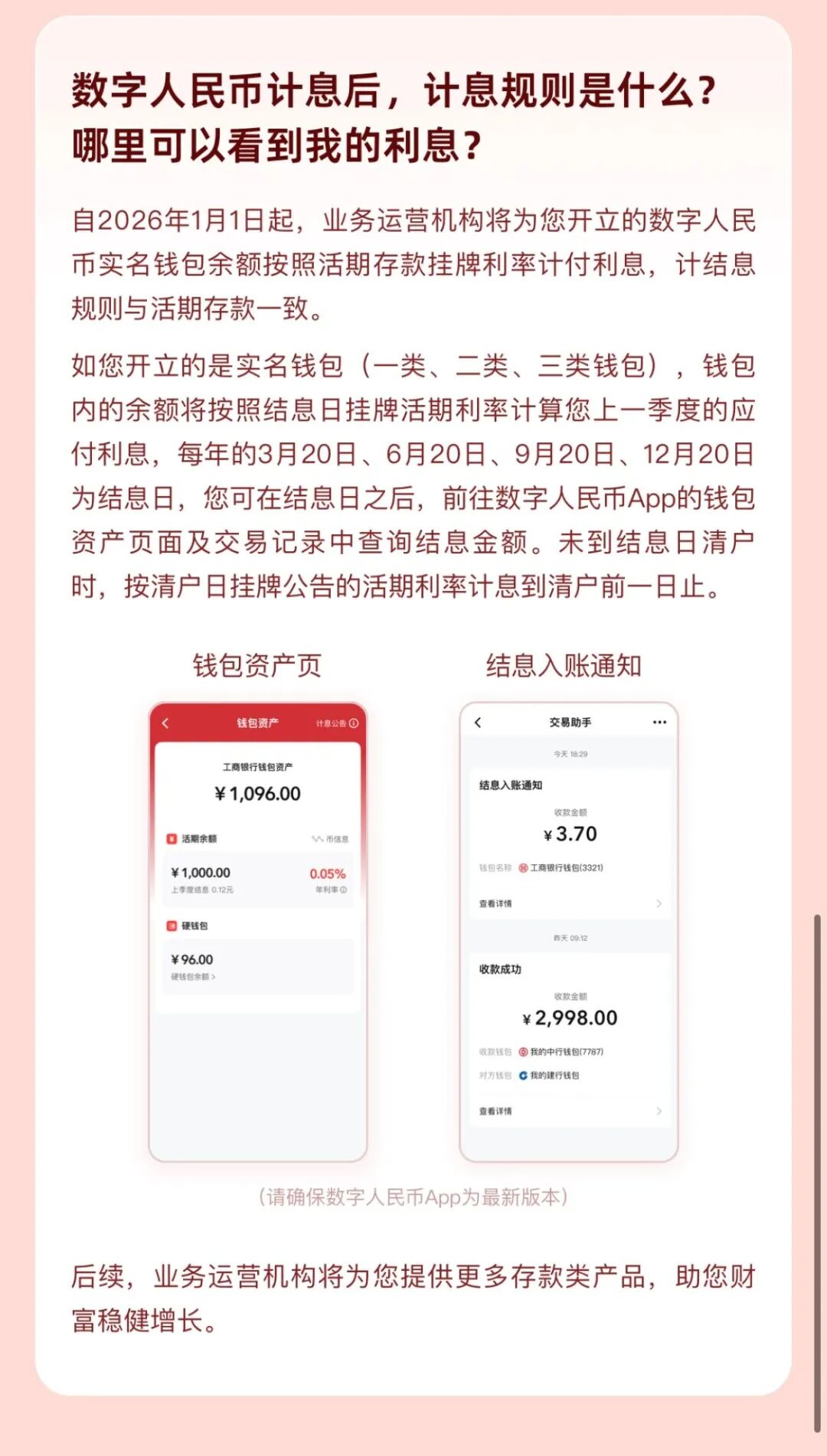
可计付利息!数字人民币升级2.0版影响几何?
Guo Ji Jin Rong Bao· 2026-01-09 10:00
Core Viewpoint - The transition of digital renminbi from cash-type 1.0 version to deposit currency-type 2.0 version will allow for interest payments on real-name digital renminbi wallet balances, aligning with bank demand deposit rates, thus enhancing its appeal and functionality in the financial system [1][8][12]. Group 1: Changes in Digital Renminbi - Starting January 1, 2026, real-name digital renminbi wallet balances will earn interest based on the bank's demand deposit rates, with interest calculated quarterly [1][8]. - The new deposit currency-type 2.0 version will include a "safety net" where commercial banks will manage digital renminbi wallets, ensuring customer security and compliance with regulations [8][9]. - The People's Bank of China has introduced a digital management service framework that emphasizes an "account system + currency string + smart contracts" approach to enhance the digital renminbi ecosystem [9][10]. Group 2: Impacts of the Transition - The shift to deposit currency-type 2.0 version positions China as a leader in central bank digital currency (CBDC) by allowing digital renminbi to integrate more easily into global interbank payment systems [12][13]. - The digital renminbi will improve data flow and information exchange, enhancing the precision and effectiveness of monetary policy transmission [12]. - The transition will provide users with cash-like convenience, such as offline payments and real-time settlements, while banks will gain asset-liability management rights, stimulating participation in the digital renminbi ecosystem [12][13]. Group 3: Recommendations for Future Development - It is suggested to expand the regulatory framework for digital renminbi, clarify its legal status, and broaden the pilot scope nationwide to encourage public participation [13]. - There is a call for accelerating the coverage of all scenarios and enhancing functional innovations to optimize the digital renminbi ecosystem [13].




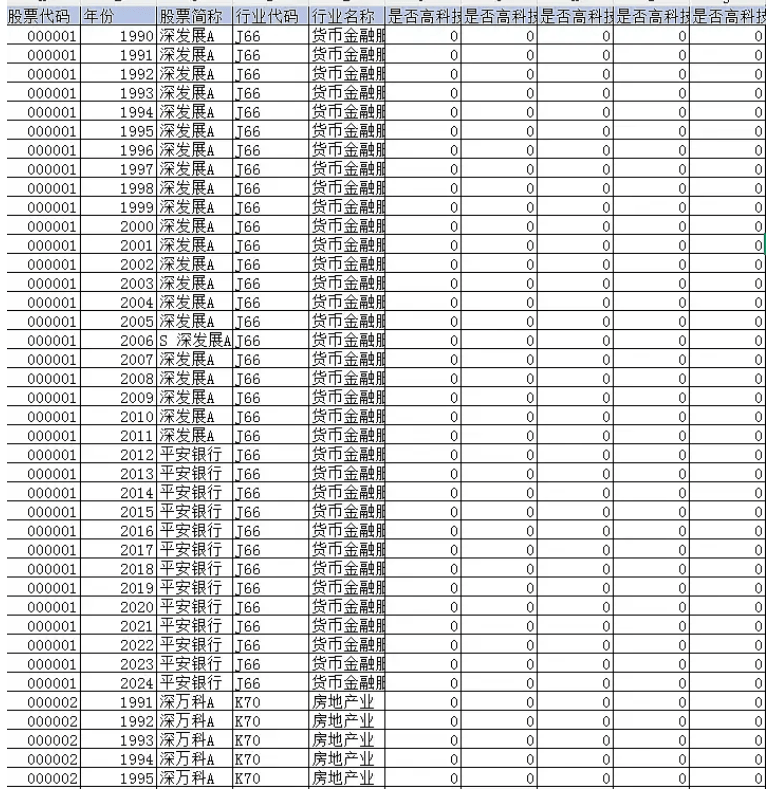
上市公司是否为高科技行业1990-2024年
Sou Hu Cai Jing· 2026-01-09 07:19
Group 1 - The high-tech industry is defined as sectors that operate at the forefront of scientific technology, utilizing advanced scientific knowledge and innovative technologies for research, production, and services [1] - The assessment of high-tech industries is based on four dimensions: technological field classification, innovation capability indicators, economic characteristics and policy orientation, and comparison of international and domestic standards [1] Group 2 - The data covers publicly listed companies from 1990 to 2024, indicating whether they belong to the high-tech industry across five different classification methods [2] - The dataset includes stock codes, years, stock names, industry codes, industry names, and multiple indicators to determine high-tech status [2][3]

上海爱建集团股份有限公司 关于为控股子公司提供担保的公告
Zhong Guo Zheng Quan Bao - Zhong Zheng Wang· 2026-01-08 23:07
Core Viewpoint - The company has signed a comprehensive credit limit contract with Ping An Bank for a total credit limit of RMB 10 million, providing a joint liability guarantee for its subsidiary, Aijian Import and Export Company, to enhance its financing capabilities and support its business development [1][11]. Group 1: Guarantee Details - The guarantee amount is RMB 10 million, with a joint liability guarantee structure [4][8]. - The guarantee period extends from the effective date of the contract until three years after the debt fulfillment deadline under the main contract [9]. - The guarantee covers all debts under the main contract, including principal, interest, penalties, and costs related to debt recovery [7]. Group 2: Internal Decision-Making Process - The board of directors approved the external guarantee plan for 2025, with a total expected guarantee amount of RMB 9.8 billion, which includes existing guarantees [1][12]. - The company has authorized its legal representative and management team to adjust specific guarantee amounts within the approved limits based on business needs [1]. Group 3: Financial Position - As of the announcement date, the total external guarantee amount approved for 2025 is RMB 9.8 billion, representing 83.23% of the company's most recent audited net assets [12]. - The current guarantee balance is RMB 1.72 billion, accounting for 14.60% of the company's most recent audited net assets, with no overdue guarantees reported [13].

平安银行股份有限公司 关于公司章程修订获核准及不再设置监事会的公告
Zhong Guo Zheng Quan Bao - Zhong Zheng Wang· 2026-01-08 23:04
证券代码:000001 证券简称:平安银行 公告编号:2026-001 登录新浪财经APP 搜索【信披】查看更多考评等级 自公司章程核准之日起,本行监事会及监事依法撤销,由董事会审计委员会行使《中华人民共和国公司 法》和监管制度规定的监事会职权,监事会议事规则等监事会相关公司治理制度同步废止。 叶望春先生、车国宝先生、王春汉先生、韩小京先生、孙永桢女士和邓红女士不再担任本行监事及监事 会相关职务。本行对各位监事在任职期间作出的重要贡献表示衷心感谢! 特此公告。 平安银行股份有限公司董事会 优先股代码:140002 优先股简称:平银优01 平安银行股份有限公司 关于公司章程修订获核准及不再设置监事会的公告 本公司及董事会全体成员保证信息披露的内容真实、准确、完整,没有虚假记载、误导性陈述或重大遗 漏。 平安银行股份有限公司(以下简称本行)于2025年12月16日召开的2025年第一次临时股东会审议通过了 《关于修订〈平安银行股份有限公司章程〉的议案》。 近日,本行收到《国家金融监督管理总局关于平安银行修改公司章程的批复》(金复〔2026〕9号), 本行公司章程已获核准并生效。修改后的公司章程全文详见巨潮资讯网( ...