TCL TECH.(000100)

Search documents
TCL科技:正积极拓展车载、IT、VR/AR等新兴显示市场
Ge Long Hui· 2025-11-12 11:20
Core Viewpoint - TCL Technology is focusing on the development of its core businesses in semiconductor displays, new energy photovoltaics, and semiconductor materials, indicating stable operations across its various business segments [1] Group 1: Business Focus - The company is actively expanding into emerging display markets such as automotive, IT, and VR/AR [1] - TCL Technology is enhancing its core competitiveness through technological upgrades [1] Group 2: Financial Performance - The company aims to deliver solid performance to reward its shareholders [1]

TCL科技:投资者质疑高管高薪,公司称薪酬体系科学合理
Xin Lang Cai Jing· 2025-11-12 10:15
Core Viewpoint - The company is facing criticism for high executive compensation and incentive plans despite poor stock performance and shareholder losses, raising concerns about prioritizing management interests over shareholder returns [1] Group 1 - The company maintains a scientific and reasonable compensation management system, considering multiple factors and adhering to corporate governance regulations [1] - The company emphasizes that its compensation practices are aligned with overall corporate interests and shareholder value [1] - There is a question from investors regarding whether future evaluations of executives will include market performance metrics to address these concerns [1]
TCL华星越南基地IT产品量产出货
Zheng Quan Shi Bao Wang· 2025-11-12 06:31
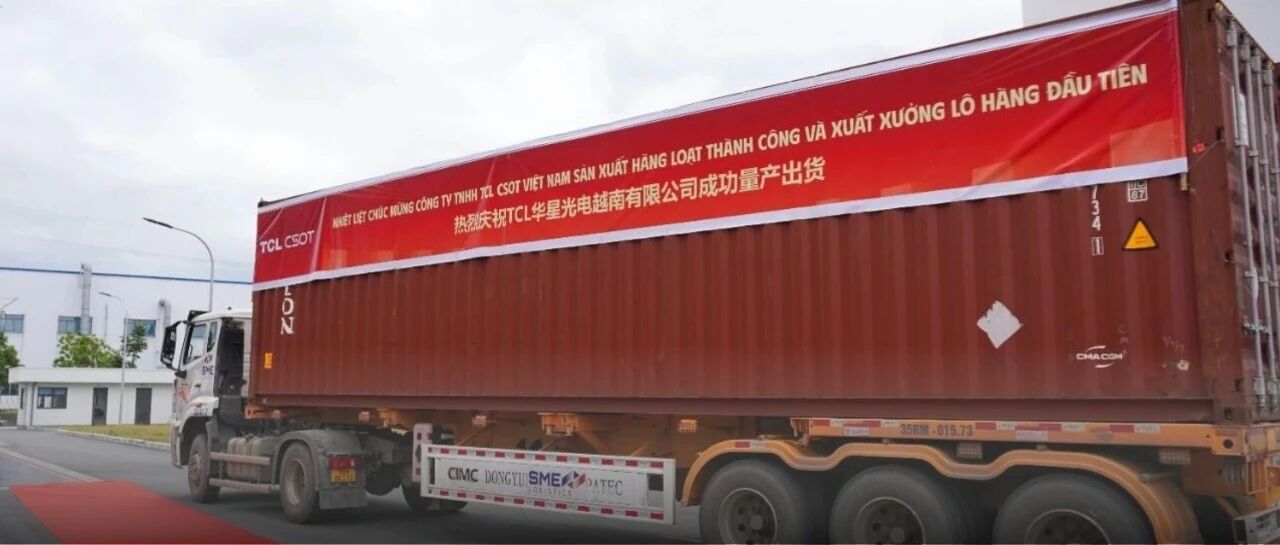
Core Insights - TCL Huaxing's Vietnam base has officially commenced mass production and shipment of IT products, marking a significant advancement in the company's global strategy from "single-point drive" to "multi-dimensional resonance" [1] Company Developments - The commencement of IT product mass production at TCL Huaxing's Vietnam facility signifies a strategic upgrade in the company's global operations [1]
TCL华星评估在越南拓展多产品线生产布局计划
Xin Lang Cai Jing· 2025-11-12 06:29
Core Viewpoint - TCL Huaxing has commenced mass production and shipment of IT products at its Vietnam facility, indicating a strategic expansion in manufacturing capabilities [1] Production Capacity - The Vietnam facility is equipped with one display (MNT) line and one notebook (NB) module line, with an annual production capacity of 4.8 million units [1] - The company is actively evaluating plans to expand its production layout in Vietnam to include multiple product lines [1]
TCL华星:越南基地IT产品正式量产出货
WitsView睿智显示· 2025-11-12 02:45
Core Insights - TCL Huaxing has officially commenced mass production and shipment of IT products from its Vietnam base, marking it as the company's second overseas manufacturing hub after India [1] - The Vietnam facility is designed to produce both display modules and notebook computer modules, with an annual capacity of 4.8 million units [2] - The factory has received RBA certification and ISO9001 quality management system certification, ensuring stable supply chain delivery and product quality [2] Production Capacity and Clientele - The Vietnam base focuses on IT products, specifically one display (MNT) line and one notebook computer (NB) module line, achieving a combined annual capacity of 4.8 million units [2] - Potential clients for the display modules include Dell and HP, with HP also being a potential customer for notebook modules [2] - TCL Huaxing is evaluating plans to expand its product line production in Vietnam to enhance its global supply chain and market responsiveness [2] Industry Context - Other panel manufacturers, including BOE, AUO, and LG Display, are also establishing display and notebook module production in Vietnam [4] - Companies like AUO and BOE are building their own production lines, while LG Display is collaborating with third parties for capacity [4] - The competitive landscape in Vietnam is intensifying, with multiple players planning production capacity for both display and notebook modules [4]

【读财报】电子行业三季报:超七成公司盈利 源杰科技、寒武纪等扭亏为盈
Xin Hua Cai Jing· 2025-11-11 23:29
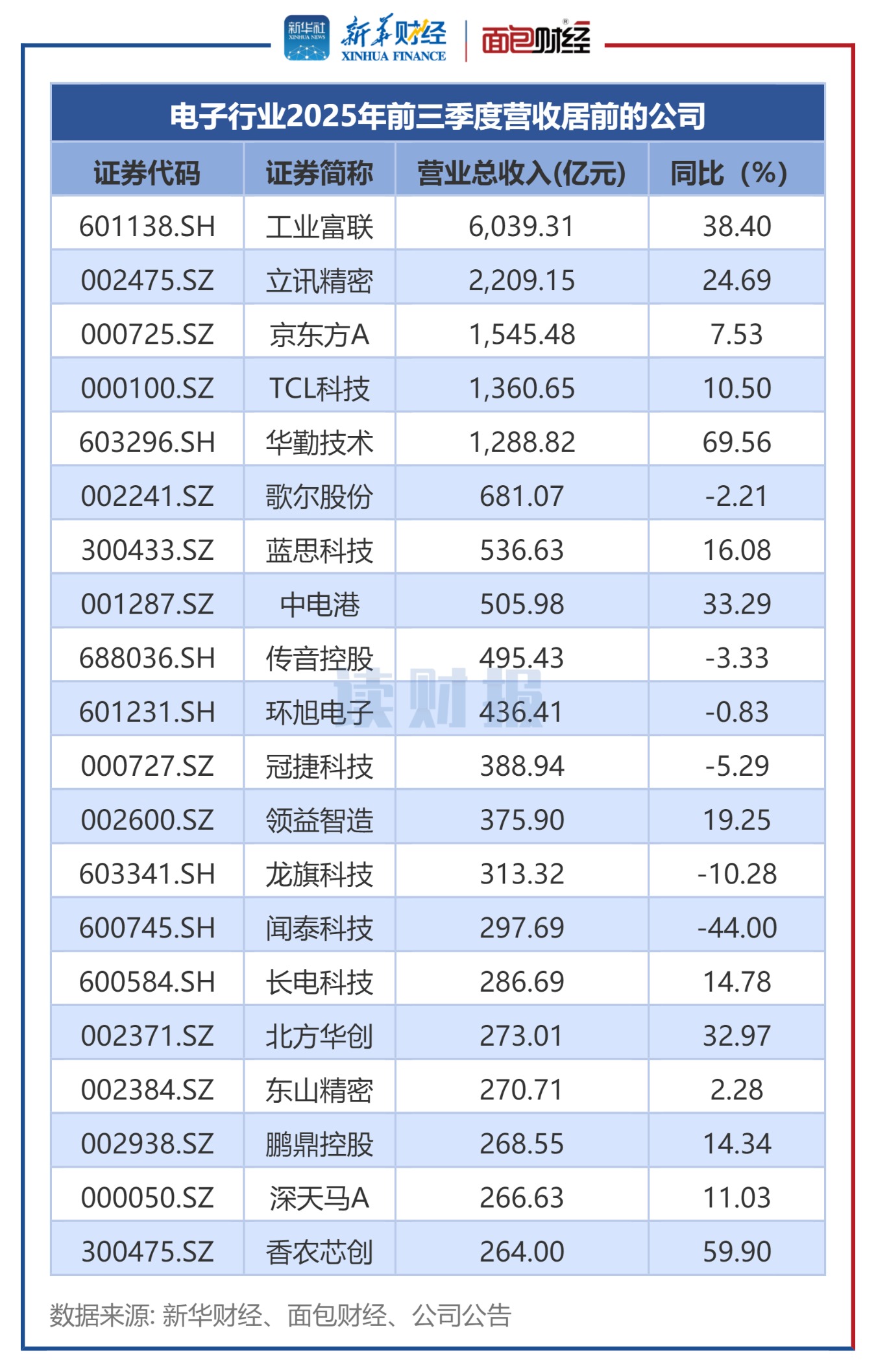
Core Insights - The electronic industry in China reported a total revenue of 29,542.16 billion yuan for the first three quarters of 2025, marking a year-on-year growth of 17.5% [1][2] - The net profit attributable to shareholders reached 1,462.02 billion yuan, reflecting a year-on-year increase of 33.11% [1][2] - Over 70% of companies in the electronic sector achieved revenue growth, with more than 70% also reporting an increase in net profit [1][2] Revenue Performance - The top three companies by revenue in the electronic industry for the first three quarters of 2025 are: - Industrial Fulian: 6,039.31 billion yuan - Luxshare Precision: 2,209.15 billion yuan - BOE Technology Group: 1,545.48 billion yuan [3][4] - TCL Technology and Huaqin Technology also exceeded 100 billion yuan in revenue during the same period [4] Profitability - The average gross profit margin for A-share electronic companies was 25.68%, a decrease of 0.3 percentage points year-on-year [1][10] - Companies such as Xindong Lian Ke and Zhenlei Technology reported gross profit margins exceeding 80% [10][13] - Industrial Fulian and Luxshare Precision both reported net profits exceeding 100 billion yuan [6][8] Growth and Recovery - Companies like Cambrian and Yuanjie Technology turned losses into profits, contributing to the overall positive trend in the industry [8][9] - Cambrian achieved a remarkable revenue growth of 2,386.38% year-on-year, reaching 46.07 billion yuan [5][8] - Nearly 60% of electronic companies reported a year-on-year increase in net profit for the first three quarters of 2025 [8] Market Dynamics - The data center market significantly contributed to the revenue growth of Yuanjie Technology, which reported a revenue of 3.83 billion yuan, up 115.09% year-on-year [15] - The overall performance indicates a robust recovery and growth trajectory for the electronic industry in China [1][2]





国际奥委会主席考文垂访问TCL 双方签署合作备忘录
Zhong Guo Jing Ji Wang· 2025-11-11 06:32
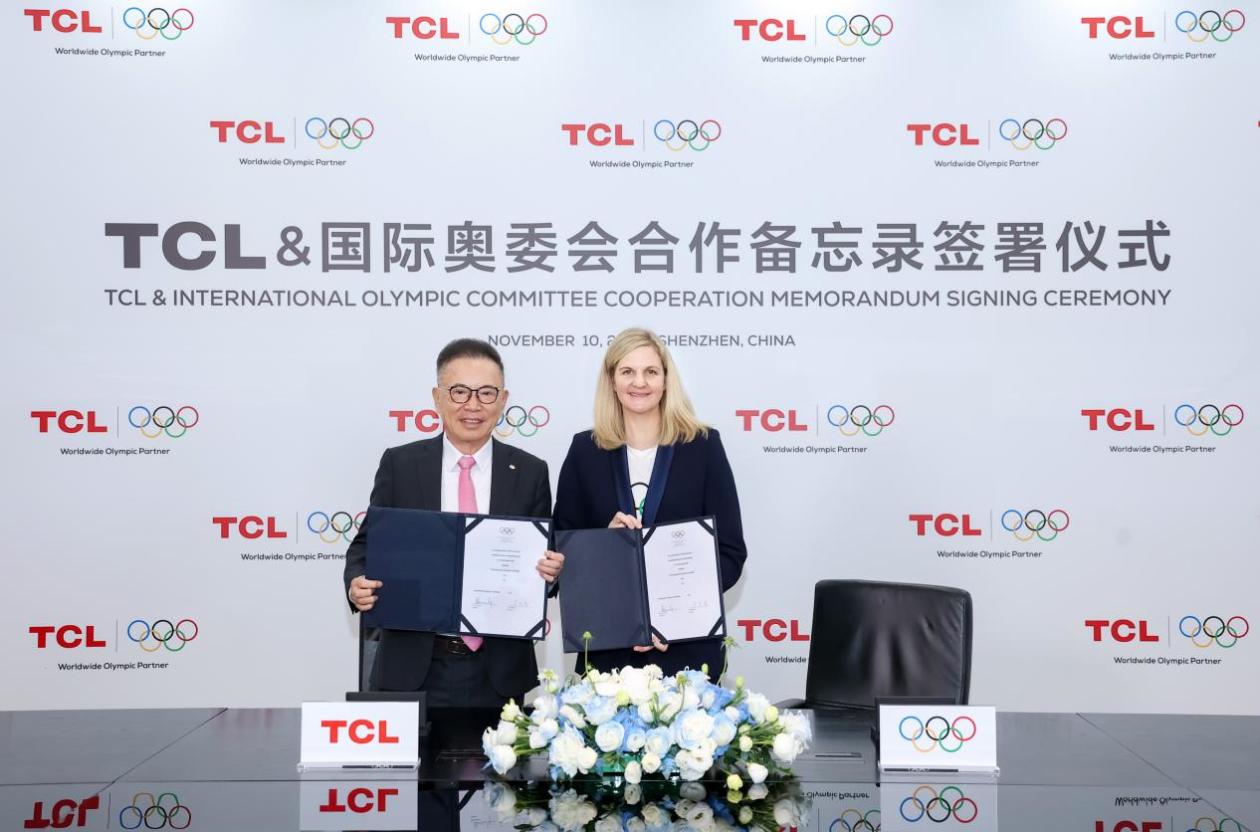
Core Insights - The International Olympic Committee (IOC) President Thomas Bach visited TCL, marking the first visit to a Chinese company since his appointment, emphasizing TCL's role as a key global partner for the Olympics [1][2] - A memorandum of cooperation was signed between TCL and the IOC, focusing on strategic collaboration for upcoming Olympic events, including the Milan Winter Olympics and the Los Angeles Olympics [2][3] Group 1: Partnership and Collaboration - TCL is one of only 12 global Olympic partners, highlighting its significance in the Olympic ecosystem alongside companies like Alibaba and Mengniu [2] - The partnership aims to leverage TCL's advanced technologies in areas such as AI and ESG to enhance the Olympic experience for athletes and global audiences [2][3] - The collaboration will include deploying TCL's cutting-edge display technologies and smart home products in Olympic venues, enhancing both athlete and viewer experiences [3] Group 2: Global Presence and Strategy - TCL has a strong global presence, with nearly half of its revenue coming from international markets, positioning it as the most globalized Chinese company among Olympic partners [4] - The company has been expanding its global operations since 1999, with a presence in over 160 countries and regions, and aims to establish five regional operational centers to deepen its local market engagement [5] - Future plans include expanding strategic partnerships with the IOC and national Olympic committees, focusing on promoting Olympic values and supporting youth and para-sports development [5]
国际奥委会主席考文垂:真切感受到顶尖的中国科技水平
Xin Hua Wang· 2025-11-10 17:19
Core Insights - The President of the International Olympic Committee, Thomas Bach, praised the technological advancements and sustainable development efforts of Chinese companies, particularly TCL, during her visit to Shenzhen [1] - TCL is recognized for its leading position in various technological fields and its commitment to developing energy-efficient products, aligning with the Olympic values of sustainability [1] - The visit aims to foster deeper communication with Olympic partners to understand their development visions and explore future collaboration opportunities [1] Company Highlights - TCL is one of the three Chinese companies among the 12 global Olympic partners, indicating the growing influence of Chinese enterprises in the global economy [1] - TCL's founder and chairman, Li Dongsheng, expressed confidence that more Chinese brands will be visible in future global sporting events, reflecting the rise of China's economic power [1]
国际奥委会主席考文垂访问TCL,双方签署合作备忘录
Huan Qiu Wang· 2025-11-10 11:06
Core Insights - The International Olympic Committee (IOC) President Thomas Bach visited TCL, marking the first visit to a Chinese company since his appointment, focusing on strategic cooperation for the Milan Winter Olympics and global promotion of the Olympic movement [1][4] Group 1: Strategic Partnership - TCL is one of only 12 global Olympic partners, with three being Chinese companies, highlighting its significant role in the Olympic ecosystem [4] - The memorandum of cooperation includes comprehensive strategic collaboration for upcoming Olympic events, leveraging TCL's advanced technology to enhance athlete and viewer experiences [4][5] - The partnership aims to explore new cooperation models, enhancing the Olympic viewing experience through technology and cultural integration [4][5] Group 2: Technological Contributions - TCL plans to provide cutting-edge display technologies, including Mini LED and Micro LED products, to create an "Olympic Screen Universe" for the Milan Winter Olympics [5] - Smart home devices will be supplied to the Olympic Village, enhancing the athletes' experience and connectivity with their families post-competition [5] Group 3: Global Expansion and Impact - TCL has a strong global presence, with nearly half of its revenue coming from overseas, which positions it well to support the Olympic movement's growth in diverse markets [6] - The company aims to establish regional operational centers to deepen its local engagement and support Olympic initiatives in emerging markets [6][7] - Future collaborations will focus on promoting the Olympic spirit, youth sports, and inclusivity, integrating TCL's brand initiatives into Olympic-themed activities [7]
政策发力、价格飙涨,资金疯抢
Ge Long Hui· 2025-11-10 10:57
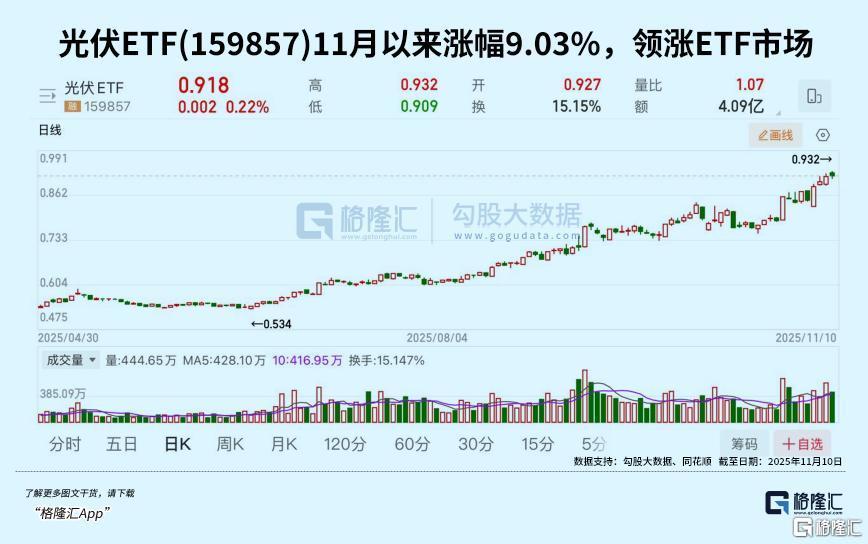
Core Viewpoint - The photovoltaic industry is experiencing a significant rebound in prices and performance, driven by policy support, market adjustments, and technological innovations, marking a critical turning point for the sector in 2025 [3][10][31]. Price Rebound - The photovoltaic sector has collectively strengthened, primarily due to rising prices [4]. - The price of polysilicon hit a low in mid-2025 and began a strong rebound in the third quarter, with N-type silicon prices increasing from approximately 34,400 yuan/ton to around 47,100 yuan/ton in just one month, reflecting a 37% increase [5][6][7]. - By September 2025, polysilicon prices surpassed 50,000 yuan/ton, leading to price increases in downstream products like silicon wafers and battery cells [8]. - The average price of domestic TOPCon double-glass modules in September 2025 was about 0.715 yuan/watt, a 3.6% increase from July [9]. - The price rebound is attributed to strong policy interventions and market clearing, moving the industry away from a cycle of losses [10][11]. Performance Recovery - Recent performance data from leading photovoltaic companies indicate a recovery phase, with many entering a "significant loss reduction" phase [15][17]. - For instance, Sunshine Power reported a Q3 2025 revenue of 22.869 billion yuan, a 20.83% year-on-year increase, and a net profit of 4.147 billion yuan, up 57.04% [16]. - Longi Green Energy recorded a revenue of 50.915 billion yuan in Q3 2025, with losses narrowing by 48% compared to the previous year [16]. - Overall, the industry is showing signs of recovery, with institutional funds reallocating towards the photovoltaic sector, marking a shift from previous net outflows [18]. Future Drivers - The long-term demand for photovoltaic energy remains strong, with the International Energy Agency predicting that renewable energy will account for 43% of global electricity generation by 2030 [21][22]. - The "anti-involution" policy is fundamentally changing the industry by shifting focus from price competition to high-quality value competition [24][25]. - This policy is leading to a gradual recovery of product prices, with polysilicon prices in Q3 2025 rising above the comprehensive cost line, setting the stage for profitability across the industry [25]. - The industry is also witnessing a shift in focus towards technological innovation, with resources being directed towards advanced technologies like BC back-contact cells and perovskite materials [27][28]. Conclusion - The photovoltaic industry is at a critical turning point in 2025, characterized by rational valuation, visible performance inflection points, favorable policy environments, accelerated technological iterations, and renewed capital inflows [31][32]. - The overall attractiveness of the photovoltaic sector is drawing investment, particularly towards leading companies with strong operational and financial health [32][33].