TCL TECH.(000100)

Search documents
TCL科技:公司积极推进Mini LED、Micro LED等新型显示技术
Zheng Quan Ri Bao· 2025-11-03 09:13
Core Viewpoint - TCL Technology is actively promoting new display technologies such as MiniLED and MicroLED, aiming to build a leading global semiconductor display technology ecosystem while maintaining an open and proactive attitude towards deepening capital and business cooperation with industry partners [2] Group 1: Company Initiatives - The company is focusing on advancing MiniLED and MicroLED technologies [2] - TCL Technology is committed to collaborating with industry chain partners to enhance capital and business cooperation [2] Group 2: Subsidiary Operations - Tianjin Printronics, a comprehensive manufacturer of various types of printed circuit board products, is a subsidiary of TCL Technology [2] - The company will assist its subsidiary in expanding its business to achieve sustainable development [2]


TCL科技:股东持股情况请参阅公司于指定信息披露媒体披露的定期报告及相关公告
Zheng Quan Ri Bao· 2025-11-03 09:13
Core Viewpoint - TCL Technology responded to investor inquiries on November 3, indicating that shareholders' equity information can be found in the company's periodic reports and related announcements published in designated information disclosure media [2] Group 1 - The company addressed investor questions regarding shareholder equity [2] - The company emphasized the importance of referring to official periodic reports for detailed shareholder information [2]
TCL科技:公司资金安排兼顾业务发展、股东回报与资金效率
Zheng Quan Ri Bao Wang· 2025-11-03 09:13
Group 1 - The core viewpoint of the article is that TCL Technology emphasizes a balanced approach in its financial arrangements, focusing on business development, shareholder returns, and capital efficiency [1] - The company states that its dividend policy takes into account both shareholder interests and sustainable development [1] - TCL Technology plans to continuously optimize its capital structure to enhance the efficiency of fund utilization [1]
TCL科技:公司始终重视所有股东权益
Zheng Quan Ri Bao Wang· 2025-11-03 09:13
Core Viewpoint - TCL Technology emphasizes the importance of shareholder rights and actively responds to shareholder concerns through cash dividends, information disclosure, and multi-channel communication [1] Group 1: Acquisition Details - In the first half of 2025, the company will complete the acquisition of 100% equity in LG Display (China) Co., Ltd. and LG Display (Guangzhou) Co., Ltd., integrating them under the name T11 with a production capacity of 180k units per month [1] - The contribution of this acquisition to the company's operating performance is gradually becoming evident [1] Group 2: Strategic Benefits - The acquisition is expected to enhance the company's ability to leverage scale and industrial synergy [1] - It will also enrich the semiconductor display production line technology, deepen international customer strategic cooperation, and improve long-term profitability [1]
TCL科技:t8项目发布会旨在向市场及合作伙伴传递公司技术布局与发展信心
Zheng Quan Ri Bao Wang· 2025-11-03 09:13
证券日报网讯 TCL科技(000100)11月3日在互动平台回答投资者提问时表示,t8项目发布会旨在向市 场及合作伙伴传递公司技术布局与发展信心。公司始终坚持精益管理原则,将持续优化资源配置,确保 资金使用效率。 ...
TCL科技:公司管理层对公司未来的发展充满信心
Zheng Quan Ri Bao· 2025-11-03 08:09
证券日报网讯 TCL科技11月3日在互动平台回答投资者提问时表示,关于员工持股计划,其实施严格遵 循监管规则及公司制度,旨在建立长效激励机制、促进员工与公司共同发展,进而提升公司业绩和股东 回报。相关详情可查阅公司已披露的公告。公司管理层对公司未来的发展充满信心。公司将继续勤勉尽 责,坚持稳健经营,努力提升公司的投资价值,以优异业绩回报广大投资者的信任与支持。 (文章来源:证券日报) ...
TCL科技:公司始终秉持科学合理的薪酬管理体系
Zheng Quan Ri Bao· 2025-11-03 08:08
(文章来源:证券日报) 证券日报网讯 TCL科技11月3日在互动平台回答投资者提问时表示,公司始终秉持科学合理的薪酬管理 体系,公司会综合考虑多方面因素,严格遵循公司治理相关规定及内部决策流程,确保符合公司整体利 益和股东价值。 ...
京东方、TCL科技透露最新消息
WitsView睿智显示· 2025-11-03 08:04
Core Viewpoint - Both BOE and TCL Technology have shown positive financial performance in recent quarters, with significant year-on-year growth in revenue and net profit, indicating a recovery in the display industry and potential for future growth [2][7]. BOE - In the first three quarters of this year, BOE achieved a cumulative revenue of 154.55 billion yuan, a year-on-year increase of 7.53%, and a net profit of 4.60 billion yuan, up 39.03% [2]. - The revenue composition of BOE's display business includes TV products (28%), IT products (37%), LCD mobile phones and others (12%), and OLED products (23%) [2]. - For LCD products, BOE anticipates a slight growth in total shipment volume and area by 2025, with TV product shipments expected to grow, although the trend towards larger sizes may slow temporarily due to increased demand for smaller TVs in emerging markets [3]. - In the OLED segment, BOE's third-quarter shipments reached approximately 40 million units, with expectations for double-digit growth for the year, and aims to exceed 71 million units in the first half of 2025, a year-on-year increase of 7.5% [5]. - Capital expenditures are expected to peak in 2025 due to significant investments in the Chengdu 8.6-generation OLED production line, with a substantial decrease anticipated starting in 2027 as new production lines are not planned [6]. TCL Technology - In the first three quarters of this year, TCL Technology reported a cumulative revenue of 135.9 billion yuan, a year-on-year increase of 10.5%, and a net profit of 3.05 billion yuan, up 99.8% [7]. - TCL Huaxing achieved a revenue of 78.01 billion yuan, a year-on-year increase of 17.5%, and a net profit of 6.1 billion yuan, up 53.5% [7]. - In the large-size segment, TCL Technology expects inventory levels to normalize in the fourth quarter, with potential production adjustments based on supply and demand dynamics [9]. - The acquisition of LG Display's Guangzhou 8.5-generation LCD production line has been successfully integrated, enhancing TCL's production capacity and competitive edge [9]. - In the medium-size segment, TCL's T9 production line is expected to improve profitability through product structure optimization and operational efficiency [10]. - In the IT sector, TCL reported a 10% year-on-year increase in MNT sales and a 63% increase in NB sales, indicating strong demand in this area [10]. - Depreciation costs are expected to peak in 2025, with a significant decrease anticipated starting in 2026 as older production lines complete their depreciation [10].


TCL科技:TCL华星武汉G5.5代印刷OLED产线(t12项目)目前已实现量产交付
Mei Ri Jing Ji Xin Wen· 2025-11-03 07:49
Core Viewpoint - TCL Technology has successfully achieved mass production of its G5.5 generation printed OLED production line in Wuhan, with initial products being medical display screens, which also lays the groundwork for future G8.6 generation line production experience [2]. Group 1 - TCL Technology's G5.5 generation printed OLED production line (T12 project) has commenced mass production and delivery [2]. - The first batch of products from the G5.5 line is focused on medical display screens [2]. - The experience gained from the G5.5 line will support the upcoming G8.6 generation line (T8 project) [2].
集邦咨询:第三季度全球电视出货量首度跌破5000万台
Zhi Tong Cai Jing· 2025-11-03 06:19
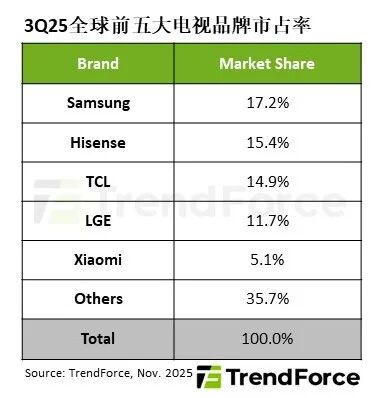
Core Insights - Global TV shipments are projected to fall below 50 million units for the first time in history in Q3 2025, with an estimated 49.75 million units, reflecting a 4.9% year-over-year decline and a 6% quarter-over-quarter increase [1] - The decline is attributed to extended consumer purchase cycles, changes in international circumstances affecting demand, and the diminishing effects of subsidy policies in the Chinese market [1] - Despite the overall decline, a seasonal sales surge is expected in Q4 due to promotional activities in Europe and North America, as well as China's Double 11 and Double 12 shopping events, leading to an estimated 7.3% quarter-over-quarter increase in global shipments to 53.21 million units [1] Market Share and Brand Performance - The top five brands in Q3 2025 by shipment volume are Samsung, Hisense, TCL, LGE, and Xiaomi, collectively holding a market share of 64.3% [4] - Hisense regained its position as the second-largest global TV brand in Q3 2025, with shipments reaching 7.66 million units, a 9.7% quarter-over-quarter increase, and a market share of 15.4%, marking a record high for the brand [4] Size Segment Trends - The penetration rate of large-sized TVs (60 inches and above) has reached 28.2% for the first time, driven by demand in the Chinese market [5] - Samsung and Hisense lead the 65-inch and 75-inch segments with market shares of 26% and 22%, respectively, while Hisense and TCL dominate the 85/86-inch segment, each capturing nearly a quarter of the market [5] - TCL has emerged as the leader in the 98-inch market, while Hisense holds nearly half of the 100-inch market share [5] Future Market Dynamics - The growth momentum for large-sized TVs is expected to slow down as the effects of subsidy policies in China wane, with 65-inch shipments stagnating and 75-inch growth rates dropping to 13%, half of last year's figures [6] - The focus of brands is shifting from merely increasing size to upgrading product specifications, emphasizing differentiation through advanced features like RGB Mini LED, high refresh rates, and AI integration [6]