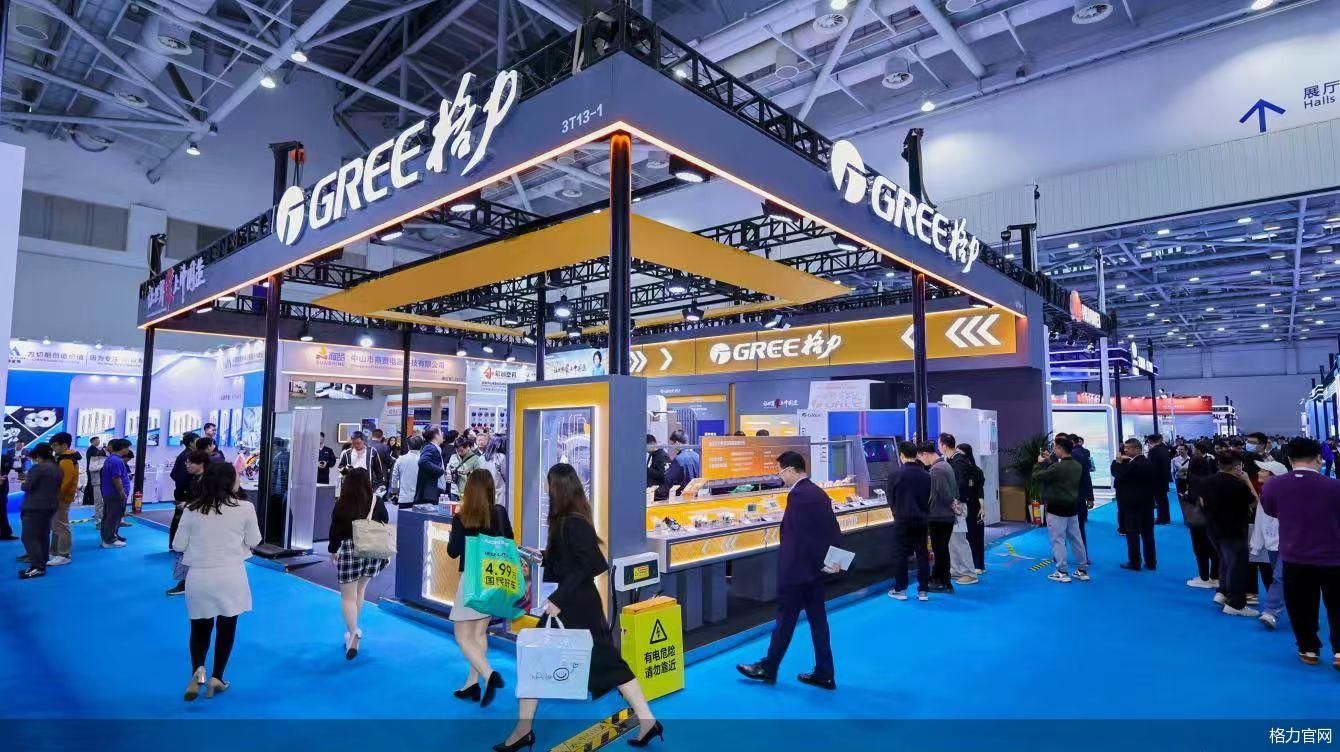
GREE(000651)

Search documents
格力电器取得开关壳体及智能开关专利
Sou Hu Cai Jing· 2026-01-09 06:39
Group 1 - The State Intellectual Property Office of China has granted a patent titled "A Switch Shell and Intelligent Switch with It" to Zhuhai Gree Electric Appliances Inc. and Zhuhai Lianyun Technology Co., Ltd., with the authorization announcement number CN110676084B and an application date of September 2019 [1] - Zhuhai Gree Electric Appliances Inc., established in 1989, is primarily engaged in the manufacturing of electrical machinery and equipment, with a registered capital of 6,015.73 million RMB. The company has invested in 98 enterprises, participated in 5,000 bidding projects, and holds 5,000 trademark and patent information records, along with 908 administrative licenses [1] - Zhuhai Lianyun Technology Co., Ltd., founded in 2018, focuses on software and information technology services, with a registered capital of 50 million RMB. The company has participated in 9 bidding projects and has 4,573 patent information records, in addition to holding 14 administrative licenses [1]

格力电器:公司稳步推进多元化战略
Zheng Quan Ri Bao Wang· 2026-01-08 14:13
Group 1 - The company owns three major consumer brands: Gree, TOSOT, and Jinghong, along with industrial brands such as Lingda, Kaibang, and Xinyuan, covering both consumer goods and industrial equipment sectors [1] - The consumer appliance segment is primarily supported by the air conditioning business, which includes a range of products such as refrigeration, washing machines, kitchen appliances, and environmental appliances [1] - The industrial products and equipment segment focuses on smart equipment, industrial robots, compressors, motors, and molds, indicating a diverse industrial strategy [1] Group 2 - The company is committed to a diversified strategy based on core technology and market demand, continuously optimizing its industrial layout [1]
格力电器:近10年实施现金分红15次
Zheng Quan Ri Bao Wang· 2026-01-08 13:43
Core Viewpoint - Gree Electric Appliances emphasizes its commitment to high-quality development through steady operations and technological innovation, ensuring strong profitability and sustainable dividend capabilities for long-term shareholder value creation [1] Group 1: Financial Performance - The company ranks 7th in cumulative dividend amount over the past ten years and 8th over the past five years among A-share listed companies, excluding the financial and oil & petrochemical sectors [1] - Gree has implemented cash dividends 15 times in the last decade, including the mid-term distribution for 2025, showcasing a strong commitment to shareholder returns [1] Group 2: Dividend Policy - The company prioritizes investor returns by adhering to a stable and sustainable dividend policy, reflecting its focus on maintaining a high level of dividend consistency and stability compared to other listed companies [1]
A股回购增持潮涌:一年规模超2200亿元,产业资本传递信心
2 1 Shi Ji Jing Ji Bao Dao· 2026-01-08 11:55
Core Viewpoint - The A-share market in 2025 shows a positive trend, with the Shanghai Composite Index returning to 4000 points and nearly 80% of listed companies experiencing stock price increases, supported by significant capital repurchases and increases by industry players [1][2] Group 1: Market Performance - In 2025, the total transaction volume of the A-share market reached a historic record of 420 trillion yuan [1] - A total of 1494 listed companies implemented share repurchases, with a total amount of 142.736 billion yuan [1] - 534 companies announced shareholding increases, with a maximum proposed increase amount of 83.922 billion yuan [1] Group 2: Capital Support - The trend of repurchases and increases is supported by a special loan program, with 522 companies or their shareholders disclosing repurchase and increase loan situations, amounting to a maximum of 111.165 billion yuan [1] - As of January 8, 2026, the number of disclosed repurchase and increase loans reached 789, with a total maximum loan amount of 160.62 billion yuan [1] Group 3: Leading Companies - In 2025, 293 companies repurchased over 100 million yuan, with 15 companies repurchasing over 1 billion yuan, and one company exceeding 10 billion yuan [3] - Midea Group led with a total repurchase amount of 11.545 billion yuan, being the only company to exceed 10 billion yuan in repurchases for the year [3] - Guizhou Moutai repurchased a total of 6 billion yuan in 2025, marking its first-ever cancellation-style repurchase since its listing [4] Group 4: Loan Policy Changes - The People's Bank of China optimized the stock repurchase and increase loan policy, reducing the self-funding ratio requirement from 30% to 10% and extending the maximum loan term from 1 year to 3 years [6] - The total quota for the combined tools of 500 billion yuan for securities, funds, and insurance companies and 300 billion yuan for stock repurchase and increase loans was raised to 800 billion yuan [6] Group 5: Economic Impact - The stock repurchase and increase loans provide low-cost funding for companies, facilitating effective market value management and enhancing investor confidence [7] - Recommendations for future loan programs include expanding coverage to more quality enterprises and optimizing pricing mechanisms [7]





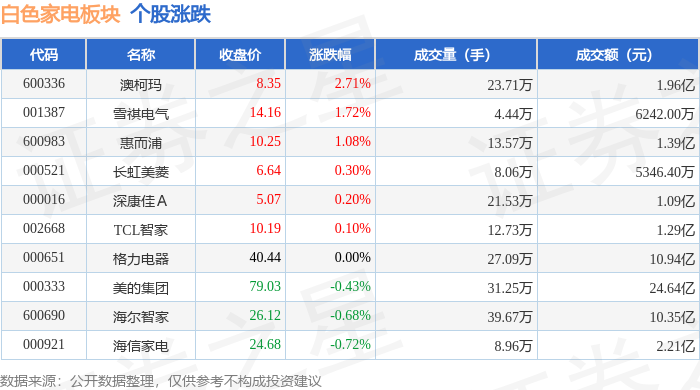
白色家电板块1月8日跌0.33%,海信家电领跌,主力资金净流入2.97亿元
Zheng Xing Xing Ye Ri Bao· 2026-01-08 08:51
Market Overview - The white goods sector experienced a decline of 0.33% on January 8, with Hisense Appliances leading the drop [1] - The Shanghai Composite Index closed at 4082.98, down 0.07%, while the Shenzhen Component Index closed at 13959.48, down 0.51% [1] Stock Performance - Aokema (600336) saw a closing price of 8.35, with an increase of 2.71% and a trading volume of 237,100 shares, totaling a transaction value of 196 million yuan [1] - Snow Qi Electric (001387) closed at 14.16, up 1.72%, with a trading volume of 44,400 shares [1] - Whirlpool (600983) closed at 10.25, up 1.08%, with a trading volume of 135,700 shares, totaling 139 million yuan [1] - Gree Electric (000651) remained unchanged at 40.44, with a trading volume of 270,900 shares, totaling 1.094 billion yuan [1] - Hisense Appliances (000921) closed at 24.68, down 0.72%, with a trading volume of 89,600 shares, totaling 221 million yuan [1] Capital Flow - The white goods sector saw a net inflow of 297 million yuan from institutional investors, while retail investors experienced a net outflow of 4.7875 million yuan [1] - Midea Group (000333) had a net inflow of 3.27 billion yuan from institutional investors, but a net outflow of 2.40 billion yuan from speculative funds [2] - Haier Smart Home (600690) recorded a net inflow of 3.55 million yuan from retail investors, despite a net outflow of 30.6562 million yuan from speculative funds [2] - Hisense Appliances (000921) experienced a net outflow of 215,580 yuan from institutional investors [2]


多家企业回应空调涨价
Jing Ji Wang· 2026-01-08 02:44
Group 1 - The air conditioning industry is experiencing price adjustments, with major companies like Midea and Meibo announcing price increases of 5% for their products, while Gree Electric has committed to not raising prices [1] - The rise in raw material costs, particularly for copper and aluminum, is a significant factor driving the price adjustments in the air conditioning sector, with expectations of further increases by 2026 [1][2] - Industry experts suggest that the air conditioning market is shifting from a strategy of "price for volume" to "intelligence for profit," emphasizing the need for companies to leverage artificial intelligence and product innovation to enhance profitability [2][3] Group 2 - Companies are focusing on high-end product structures and innovative technologies to cope with rising costs, which is expected to accelerate industry consolidation [2] - The continuation of government subsidies for replacing old appliances is seen as a favorable opportunity for companies to promote high-efficiency and intelligent products, aiding the transition to a more profitable business model [3] - The recent price hikes reflect a deeper evolution in the competitive logic of the home appliance industry, driven by cost pressures, policy opportunities, and market reshuffling [3]
逆势不涨价 格力不从容
Xin Lang Cai Jing· 2026-01-07 16:09
Core Viewpoint - The air conditioning industry is shifting from growth expansion to optimizing existing stock, with rising copper prices and price wars pushing companies to make strategic choices [1] Group 1: Industry Trends - The air conditioning market is experiencing a transition where the demand for replacements is expected to exceed 60% in 2024, indicating a shift towards a stock replacement model [1] - The cost pressure from copper, which constitutes 15%-20% of air conditioning costs, is significant, with copper prices projected to exceed 90,000 yuan per ton by the end of 2025, reflecting a year-on-year increase of over 35% [1] - The copper-aluminum price ratio has reached 3.9:1, making the idea of substituting aluminum for copper appealing to many companies [1] Group 2: Cost Pressures - The long-term trend of rising copper prices is exacerbating cost pressures in the air conditioning industry, with a cumulative return of 92.13% in the copper index over the past year [4] - The global copper supply is expected to face zero or negative growth by 2026 due to constraints on supply, while demand is rising due to factors like AI expansion and increased investment in power grids, leading to a projected supply gap of approximately 830,000 tons [5] Group 3: Technological Developments - Companies like Midea, Haier, and TCL are exploring aluminum as a substitute for copper, but the technology is still in its early stages and not yet a mainstream solution [5][6] - The penetration rate of aluminum in air conditioning heat exchangers is currently limited, and the risks associated with aluminum, such as higher electrochemical corrosion, pose additional challenges [5] Group 4: Market Dynamics - The air conditioning market is showing signs of differentiation, with online sales increasing by 9.48% and 11.41% in volume, while offline sales are declining [7] - The average price of online air conditioners decreased by 1.73% to 2,688 yuan, and offline prices fell by 3.05% to 4,174 yuan, indicating a price competition driven by market share concerns [7] - Major brands are under pressure to maintain high profit margins while competing with lower-cost alternatives, leading to a decline in market share for top brands [10][11] Group 5: Company Performance - Gree Electric's revenue for the first three quarters of 2025 was 137.18 billion yuan, a year-on-year decline of 6.5%, with net profit down 2.3% [10] - The company is facing multiple pressures, including rising consumer demand for cost-effectiveness and competition from digital reforms by rivals [10] - The competitive landscape is shifting, with lower-tier brands gaining market share through aggressive pricing strategies, while top brands are losing ground [11]
格力高管炮轰创维海报抄袭,“彩电大王”跨界造车难圆千亿梦?
凤凰网财经· 2026-01-07 14:14
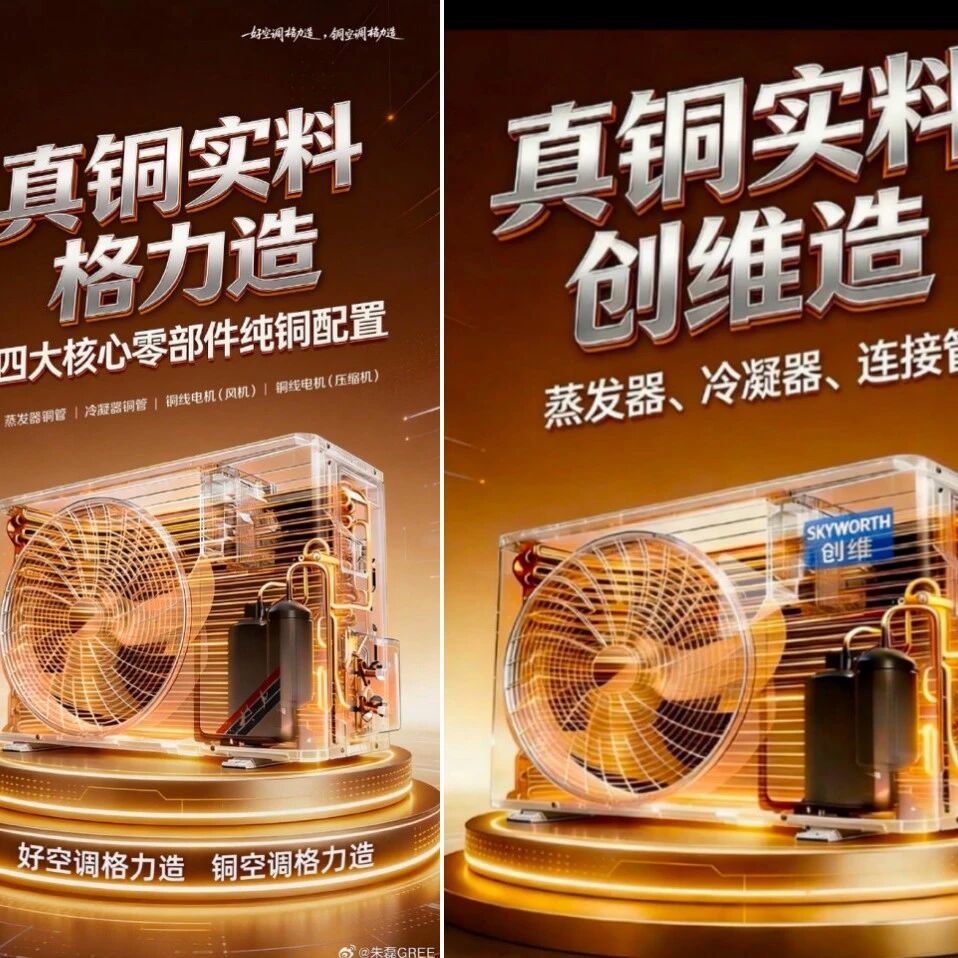
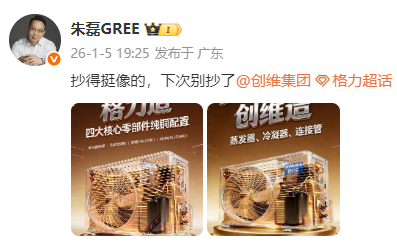
Core Viewpoint - Gree Electric Appliances' executive Zhu Lei publicly accused Skyworth of plagiarizing Gree's advertising design style, highlighting a growing tension in the air conditioning market regarding material technology and branding strategies [1][5][6]. Group 1: Market Dynamics and Competition - The air conditioning market remains competitive, with ongoing discussions about the use of aluminum instead of copper in core materials, which has become a focal point for public scrutiny [5]. - Gree has stated it will not increase prices or adopt aluminum technology, while competitors like Haier and Midea are moving forward with such applications [6]. - Gree emphasizes its "true copper" product positioning, asserting that all key components of its air conditioners are made from pure copper, contrasting with Skyworth's ambiguous stance on aluminum technology [9][13]. Group 2: Skyworth's Business Challenges - Skyworth, once a leading television brand, is struggling with a transition from home appliance manufacturing to diversification, including ventures into smart cars and global markets [14][20]. - The company has repeatedly failed to meet its ambitious revenue target of 100 billion yuan, with 2023 revenues at 69.031 billion yuan, a 29.1% increase, but a projected decline in 2024 to 65.013 billion yuan, a 5.8% drop [23]. - Complaints about Skyworth's air conditioning products have surfaced, indicating issues with warranty service and product quality, which could impact brand reputation [15]. Group 3: Automotive Ventures - Skyworth's foray into the automotive sector, initiated in 2010, has faced challenges, particularly in the domestic market, with only about 40,000 units sold in 2024 [24]. - The overseas market has become a crucial support for Skyworth's automotive division, with significant sales in the Middle East, contributing approximately 87.5% of total global sales [24]. - To achieve its revenue goals, Skyworth is considering spinning off its white goods, solar energy, and automotive divisions for additional funding, while also focusing on AI transformation in its operations [25][31].
格力公开指责创维抄袭!
Shen Zhen Shang Bao· 2026-01-07 13:38
Core Viewpoint - Gree Electric Appliances accuses Skyworth Group of plagiarizing its air conditioning promotional materials, highlighting similarities in design and messaging [1][2]. Group 1: Accusations and Responses - Gree's marketing director publicly criticized Skyworth for its air conditioning advertisement, stating it closely resembles Gree's own promotional materials [1][2]. - The comparison shows that both advertisements emphasize "genuine copper materials," with Gree detailing four core components made of pure copper, while Skyworth mentions similar components without specific details [4]. Group 2: Industry Context and Material Debate - The air conditioning industry is currently experiencing a debate over the use of aluminum versus copper materials, with 19 companies, including Midea and Xiaomi, advocating for aluminum due to rising copper prices [4]. - Gree has stated that copper constitutes about 20% of air conditioning costs and has no plans to switch to aluminum, citing performance and reliability concerns [4][5]. Group 3: Company Performance and Market Position - Gree reported a revenue of 137.65 billion yuan for the first three quarters of 2025, a 6.6% year-on-year decline, with its air conditioning business underperforming compared to industry averages [5]. - In contrast, Skyworth's air conditioning segment saw a 34.1% year-on-year revenue increase in the first half of 2025, reaching 3.936 billion yuan, although it still lags behind Gree in overall market share [6].
逆势不涨价,但格力不从容
Bei Jing Shang Bao· 2026-01-07 13:02
Core Viewpoint - The air conditioning industry is shifting from incremental expansion to optimizing existing stock, driven by rising copper prices and intense price competition, pushing companies to make strategic choices [1] Group 1: Industry Trends - The air conditioning market is experiencing a transition where the demand for replacement units is expected to exceed 60% in 2024, indicating a shift towards a stock replacement model [1] - The cost of copper, which constitutes 15%-20% of air conditioning costs, has surged, with prices expected to exceed 90,000 yuan per ton by the end of 2025, reflecting a year-on-year increase of over 35% [1] - The copper-to-aluminum price ratio has reached 3.9:1, prompting companies to consider alternatives like aluminum to reduce costs, although this option is not yet mature for widespread adoption [4][6] Group 2: Competitive Landscape - The air conditioning market is witnessing a bifurcation, with online sales growing by 9.48% and 11.41% in revenue and volume respectively, while offline sales are declining by 10.25% and 8.14% [6] - The average price of online air conditioners has decreased by 1.73% to 2,688 yuan, while offline prices have dropped by 3.05% to 4,174 yuan, indicating a general trend of price reduction across channels [6] - Major brands are under pressure to maintain market share amidst rising competition, leading to aggressive pricing strategies, particularly in the second half of 2025 [7] Group 3: Company Performance - Gree Electric's revenue for the first three quarters of 2025 was 137.18 billion yuan, a decline of 6.5% year-on-year, with net profit dropping by 2.3% to 21.46 billion yuan [9] - The company has faced challenges from increasing market demand for cost-effective products while needing to maintain high profit margins, resulting in a decrease in market share [9][10] - Competitors are leveraging digital transformation and price competitiveness to gain market share, with some internet brands achieving rapid sales growth through extended warranties and new factory production [10]