
BOE(000725)

Search documents
京东方取得显示面板及装置制作方法专利
Sou Hu Cai Jing· 2026-01-28 02:05
Group 1 - The core point of the article is that BOE Technology Group Co., Ltd. has obtained a patent for a display panel and its manufacturing method, with the patent announcement number CN118675412B and an application date of May 2024 [1] Group 2 - BOE Technology Group Co., Ltd. was established in 1993 and is located in Beijing, primarily engaged in the manufacturing of computers, communications, and other electronic devices. The company has a registered capital of 3,741,388.0464 million RMB [1] - The company has invested in 73 enterprises and participated in 303 bidding projects. It holds 775 trademark records and 5,000 patent records, along with 47 administrative licenses [1] Group 3 - Chengdu BOE Optoelectronics Technology Co., Ltd. was established in 2007 and is located in Chengdu, primarily engaged in the manufacturing of instruments and meters. The company has a registered capital of 2,500,000 million RMB [1] - Chengdu BOE has participated in 922 bidding projects and holds 5,000 patent records, along with 522 administrative licenses [1]

京东方取得显示装置专利提升柔性面板耐用性
Sou Hu Cai Jing· 2026-01-28 02:05
Group 1 - The core point of the article is that BOE Technology Group Co., Ltd. has obtained a patent for a "display device," with the authorization announcement number CN111986578B, and the application date being September 2020 [1] - BOE Technology Group Co., Ltd. was established in 1993 and is located in Beijing, primarily engaged in the manufacturing of computers, communications, and other electronic devices. The registered capital is approximately 37.41 billion RMB [1] - The company has invested in 73 enterprises, participated in 303 bidding projects, and has 775 trademark records and 5000 patent records, along with 47 administrative licenses [1] Group 2 - Chengdu BOE Optoelectronics Technology Co., Ltd. was established in 2007 and is located in Chengdu, primarily engaged in the manufacturing of instruments and meters. The registered capital is approximately 2.5 billion RMB [1] - Chengdu BOE Optoelectronics Technology Co., Ltd. has participated in 922 bidding projects, holds 5000 patent records, and has 522 administrative licenses [1]
京东方取得驱动补偿电路专利提升显示效果
Sou Hu Cai Jing· 2026-01-28 01:11
Group 1 - The core point of the article is that BOE Technology Group Co., Ltd. has obtained a patent for a "drive compensation circuit, drive circuit, display panel, and display device," with the authorization announcement number CN119446028B, and the application date is November 2024 [1] Group 2 - BOE Technology Group Co., Ltd. was established in 1993 and is located in Beijing, primarily engaged in the manufacturing of computers, communications, and other electronic devices. The company has a registered capital of 37,413.880464 million RMB [1] - The company has invested in 73 enterprises and participated in 303 bidding projects, with 775 trademark information entries and 5,000 patent information entries, in addition to holding 47 administrative licenses [1] Group 3 - Chengdu BOE Display Technology Co., Ltd. was established in 2015 and is located in Chengdu, primarily engaged in software and information technology services. The company has a registered capital of 2,155 million RMB [1] - Chengdu BOE Display Technology Co., Ltd. has participated in 620 bidding projects, holds 560 patent information entries, and has 841 administrative licenses [1]
京东方取得改善FDC区域画质均一性的显示面板专利
Sou Hu Cai Jing· 2026-01-28 00:59
Group 1 - BOE Technology Group Co., Ltd. has obtained a patent titled "A Display Panel and Display Device," with authorization announcement number CN116312323B, and the application date is March 2023 [1] - BOE Technology Group Co., Ltd. was established in 1993 and is located in Beijing, primarily engaged in the manufacturing of computers, communications, and other electronic devices. The registered capital is approximately 37.41 billion RMB [1] - The company has invested in 73 enterprises, participated in 303 bidding projects, and holds 775 trademark records and 5,000 patent records, along with 47 administrative licenses [1] Group 2 - Chengdu BOE Optoelectronics Technology Co., Ltd. was established in 2007 and is located in Chengdu, primarily engaged in the manufacturing of instruments and meters. The registered capital is approximately 2.5 billion RMB [1] - Chengdu BOE Optoelectronics Technology Co., Ltd. has participated in 922 bidding projects, holds 5,000 patent records, and possesses 522 administrative licenses [1]
电子行业周报:缺货涨价从结构性到全面性,AI 算力+存力持续高景气-20260127
Guoxin Securities· 2026-01-27 14:03
Investment Rating - The report maintains an "Outperform" rating for the electronics industry [1][10]. Core Insights - The report highlights a transition from structural shortages and price increases to a more widespread inflation across the electronics industry, driven by sustained high demand for AI computing and storage capabilities [1]. - It emphasizes the optimistic outlook for 2026 as a year of significant growth in domestic hard technology, driven by innovations in AI smartphones, AI glasses, and foldable screens [1]. - The report recommends focusing on companies involved in self-controllable manufacturing and the overseas supply chain for storage and computing [1]. Summary by Sections Market Trends - The Shanghai Composite Index rose by 0.84%, while the electronics sector increased by 1.39% over the past week, with optical electronics up by 3.21% and consumer electronics down by 0.69% [1][13]. - Global AI computing and storage demand continues to drive resource competition within the supply chain, leading to price increases across various components [1]. Semiconductor Developments - Alibaba's AI chip subsidiary, Pingtouge, is preparing for an independent IPO, indicating a strong trend towards domestic alternatives in computing chips [2]. - The report expresses confidence in the growth of domestic GPU and ASIC companies, such as Cambricon and Aojie Technology [2]. Storage Market Dynamics - NAND Flash prices have risen by 18% and DRAM prices by 33% in the past month, leading to increased cost proportions for PC manufacturers [3]. - Companies like Demingli and Jiangbolong are expected to see significant profit growth due to the ongoing storage cycle [3]. PCB Industry Insights - The report notes that rising raw material prices and increasing demand are positively impacting the performance of PCB upstream manufacturers [4]. - Companies such as Shenghong Technology and Jinan Guojiji are highlighted for their strong performance and market expectations [4]. Key Investment Recommendations - The report recommends several companies across different segments, including: - Optical Electronics: Lantech Optical, Aojie Technology, and others [1]. - Storage: Demingli, Jiangbolong, and others [3]. - PCB: Shengyi Technology and others [4]. - A focus on semiconductor companies like SMIC and Aojie Technology is also advised [9].





京东方取得显示基板裂纹检测专利
Sou Hu Cai Jing· 2026-01-27 13:30
声明:市场有风险,投资需谨慎。本文为AI基于第三方数据生成,仅供参考,不构成个人投资建议。 来源:市场资讯 成都京东方光电科技有限公司,成立于2007年,位于成都市,是一家以从事仪器仪表制造业为主的企 业。企业注册资本2500000万人民币。通过天眼查大数据分析,成都京东方光电科技有限公司参与招投 标项目922次,专利信息5000条,此外企业还拥有行政许可522个。 北京京东方技术开发有限公司,成立于2016年,位于北京市,是一家以从事计算机、通信和其他电子设 备制造业为主的企业。企业注册资本3800万人民币。通过天眼查大数据分析,北京京东方技术开发有限 公司共对外投资了1家企业,参与招投标项目92次,专利信息3874条,此外企业还拥有行政许可4个。 国家知识产权局信息显示,京东方科技集团股份有限公司取得一项名为"一种显示基板及其裂纹检测方 法、显示面板、显示装置"的专利,授权公告号CN116507169B,申请日期为2023年5月。 天眼查资料显示,京东方科技集团股份有限公司,成立于1993年,位于北京市,是一家以从事计算机、 通信和其他电子设备制造业为主的企业。企业注册资本3741388.0464万人民币 ...
京东方取得显示面板温度补偿专利
Sou Hu Cai Jing· 2026-01-27 13:18
国家知识产权局信息显示,京东方科技集团股份有限公司取得一项名为"显示面板、显示装置及信号补 偿方法"的专利,授权公告号CN117413311B,申请日期为2022年3月。 声明:市场有风险,投资需谨慎。本文为AI基于第三方数据生成,仅供参考,不构成个人投资建议。 天眼查资料显示,京东方科技集团股份有限公司,成立于1993年,位于北京市,是一家以从事计算机、 通信和其他电子设备制造业为主的企业。企业注册资本3741388.0464万人民币。通过天眼查大数据分 析,京东方科技集团股份有限公司共对外投资了73家企业,参与招投标项目303次,财产线索方面有商 标信息775条,专利信息5000条,此外企业还拥有行政许可47个。 来源:市场资讯 云南创视界光电科技有限公司,成立于2017年,位于昆明市,是一家以从事软件和信息技术服务业为主 的企业。企业注册资本304000万人民币。通过天眼查大数据分析,云南创视界光电科技有限公司参与招 投标项目276次,专利信息474条,此外企业还拥有行政许可8个。 ...
光学光电子板块1月27日涨1.5%,蓝特光学领涨,主力资金净流入9.2亿元
Zheng Xing Xing Ye Ri Bao· 2026-01-27 08:49
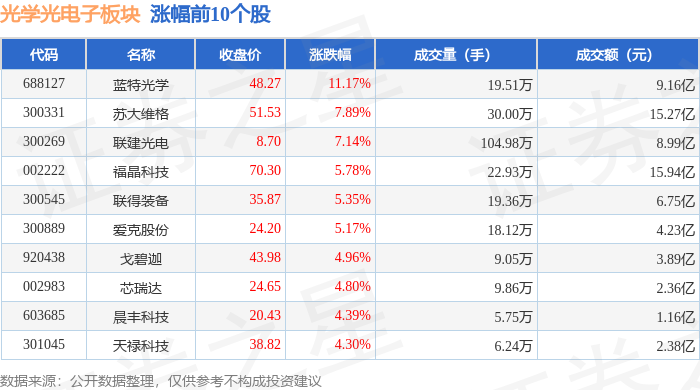
Core Viewpoint - The optical and optoelectronic sector experienced a 1.5% increase on January 27, with notable gains from companies like Bente Optics, while the overall market indices showed modest growth [1]. Group 1: Market Performance - The Shanghai Composite Index closed at 4139.9, up 0.18%, and the Shenzhen Component Index closed at 14329.91, up 0.09% [1]. - The optical and optoelectronic sector saw significant individual stock movements, with Bente Optics leading with a closing price of 48.27, reflecting an increase of 11.17% [1]. Group 2: Stock Performance - Key performers in the optical and optoelectronic sector included: - Bente Optics (688127) with a closing price of 48.27 and a rise of 11.17% on a trading volume of 195,100 shares [1]. - Su Dawei Ge (300331) closed at 51.53, up 7.89% with a trading volume of 300,000 shares [1]. - Lianjian Optoelectronics (300269) closed at 8.70, up 7.14% with a trading volume of 1,049,800 shares [1]. - Fuzheng Technology (002222) closed at 70.30, up 5.78% with a trading volume of 229,300 shares [1]. Group 3: Capital Flow - The optical and optoelectronic sector saw a net inflow of 920 million yuan from institutional investors, while retail investors experienced a net outflow of 445 million yuan [2]. - Major stocks with significant capital inflows included: - TCL Technology (000100) with a net inflow of 501 million yuan, accounting for 14.84% of the total [3]. - BOE Technology (000725) with a net inflow of 403 million yuan, representing 8.10% [3]. - Sanan Optoelectronics (600703) with a net inflow of 361 million yuan, making up 8.56% [3].


京东方取得柔性显示屏及制作方法和电子设备专利
Sou Hu Cai Jing· 2026-01-27 08:23
Group 1 - BOE Technology Group Co., Ltd. has obtained a patent for "a flexible display screen and its manufacturing method and electronic device," with authorization announcement number CN118645046B, applied on June 2024 [1] - BOE Technology Group Co., Ltd. was established in 1993 and is located in Beijing, primarily engaged in the manufacturing of computers, communications, and other electronic devices. The registered capital is 3,741,388.0464 thousand RMB [1] - The company has invested in 73 enterprises, participated in 303 bidding projects, holds 775 trademark records, and has 5,000 patent records, along with 47 administrative licenses [1] Group 2 - Chengdu BOE Optoelectronics Technology Co., Ltd. was established in 2007 and is located in Chengdu, primarily engaged in the manufacturing of instruments and meters. The registered capital is 2,500,000 thousand RMB [1] - Chengdu BOE has participated in 922 bidding projects, holds 5,000 patent records, and has 522 administrative licenses [1] - Beijing BOE Technology Development Co., Ltd. was established in 2016 and is located in Beijing, primarily engaged in the manufacturing of computers, communications, and other electronic devices. The registered capital is 38,000 thousand RMB [2] - Beijing BOE has invested in 1 enterprise, participated in 92 bidding projects, holds 3,871 patent records, and has 4 administrative licenses [2]
京东方A(000725) - 京东方科技集团股份有限公司2026年面向专业投资者公开发行科技创新公司债券(第一期)在深圳证券交易所上市的公告
2026-01-27 07:58
京东方科技集团股份有限公司 2026 年面向专业投资者公开 根据深圳证券交易所债券上市的有关规定,京东方科技集团股份有限公司 2026 年面向专业投资者公开发行科技创新公司债券(第一期)符合深圳证券交 易所债券上市条件,将于 2026 年 1 月 28 日起在深圳证券交易所上市,并面向专 业投资者中的机构投资者交易,交易方式包括匹配成交、点击成交、询价成交、 竞买成交和协商成交。债券相关要素如下: | 债券名称 | 京东方科技集团股份有限公司 年面向专业投资者公开发行科技创 2026 新公司债券(第一期) | | --- | --- | | 债券简称 | 26BOEK1 | | 债券代码 | 524641.SZ | | 信用评级 | 主体 AAA、债项无 | | 评级机构 | 联合资信评估股份有限公司 | | 发行总额(亿元) | 10 | | 债券期限 | 年 5 | | 票面年利率(%) | 2.06 | | 利率形式 | 固定利率 | | 付息频率 | 按年付息 | | 发行日 | 年 月 年 月 日 2026 1 22 日-2026 1 23 | | 起息日 | 年 月 日 2026 1 23 | | ...