
FAW Jiefang(000800)

Search documents
一汽解放申请DPF再生方法、装置、计算机设备和存储介质专利,减少对额外喷油加热的依赖
Jin Rong Jie· 2025-06-17 00:58
Group 1 - The company, FAW Jiefang Automotive Co., Ltd., has applied for a patent for a DPF regeneration method, device, computer equipment, and storage medium, with the publication number CN120159639A and application date of April 2025 [1] - The patent involves a method that utilizes the pressure difference of the DPF to determine carbon load and employs engine braking to regenerate the DPF, reducing fuel consumption and enhancing energy efficiency [1] - The method aims to minimize reliance on additional fuel injection for heating during DPF regeneration, thereby lowering regeneration costs [1] Group 2 - FAW Jiefang Automotive Co., Ltd. was established in 2002 and is primarily engaged in the automotive manufacturing industry, with a registered capital of 1,080,301.25 million RMB [2] - The company has made investments in 23 enterprises and participated in 5,000 bidding projects, indicating a significant presence in the market [2] - The company holds 273 trademark registrations and 5,000 patent records, along with 181 administrative licenses, showcasing its extensive intellectual property portfolio [2]

一央企飞行汽车总部落户深圳大鹏新区
2 1 Shi Ji Jing Ji Bao Dao· 2025-06-16 11:22
Core Insights - China FAW Group Corporation (FAW) has officially established its flying car headquarters in Shenzhen's Dapeng New District, marking a significant step in the development of the flying car industry in China [1][2] - FAW will register a new company, FAW Qiyu (Shenzhen) Technology Co., Ltd., to focus on research, manufacturing, testing, and operation of flying cars, aiming to become the global headquarters for FAW's flying car initiatives [1] - The collaboration involves multiple parties focusing on the research, production, and market expansion of flying cars, with an emphasis on technological breakthroughs and policy innovation to promote the high-quality development of the flying car industry in Shenzhen [1][3] Company Developments - FAW's flying car, the Hongqi Tianran No. 1, has been showcased at various auto shows and supply chain expos, featuring a split design and an aerial range exceeding 200 kilometers, with plans for its first flight within the year [2] - The Dapeng New District offers a rich natural resource base and diverse terrain suitable for low-altitude economic development, with specific areas designated for testing and experimentation [2] Industry Trends - Dapeng New District is actively promoting the integration of low-altitude economic activities with tourism and marine industries, with plans to establish a drone testing base and numerous low-altitude routes and landing points by 2026 [3]
【联合发布】新能源商用车周报(2025年6月第2周)
乘联分会· 2025-06-16 08:36
Market Overview - The market for new energy heavy-duty trucks continues to experience rapid growth, with sales in April reaching 16,384 units, a year-on-year increase of 245%, and a penetration rate of 21.75% [8][10]. - The top 10 companies in new energy heavy-duty truck sales for the first four months of 2025 have all surpassed 7,500 units, with Shanghai leading the regions with 7,155 units sold [8][9]. Policy and Regulations - Chongqing's plan aims to establish a comprehensive electrification pilot area for public vehicles by the end of 2025, promoting over 180,000 new energy vehicles, with a target of over 90% electrification for public service vehicles [7][10]. - The Jiaxing Municipal Development and Reform Commission has set goals for carbon neutrality, including increasing renewable energy generation capacity to over 64% by the end of 2025 [11]. Industry Data - In the first four months of 2025, the sales of new energy heavy-duty trucks showed significant growth across all fuel types, with charging products continuing to gain market share [8][9]. - The penetration rate of new energy heavy-duty trucks is projected to increase significantly, with various models showing year-on-year growth rates exceeding 300% [8][9]. Corporate Developments - Jianghuai Automobile launched its new energy light truck solutions in Guangzhou, targeting various logistics scenarios including cold chain and urban distribution [15]. - Dongfeng Commercial Vehicle received an order for 1,000 new energy heavy-duty trucks, optimized for diverse terrains and conditions in Xinjiang [17]. - XCMG's new energy traction vehicles have been delivered to coal transportation fronts, marking a significant step in green logistics [15][17].



新能源牵引车5月销超1万辆大增285%!徐工夺冠 解放/创维等暴涨超5倍 | 头条
第一商用车网· 2025-06-16 07:01
Core Viewpoint - The domestic sales of new energy heavy trucks in May 2025 reached 15,100 units, marking a year-on-year increase of 190%, with new energy tractors showing even higher growth rates [1][4]. Sales Performance - In May 2025, new energy tractors sold 11,000 units, representing a year-on-year increase of 285% [3][4]. - The overall sales of new energy heavy trucks in May 2025 decreased by 5% month-on-month but increased by 190% year-on-year [4]. - The market share of new energy tractors in the new energy heavy truck segment was 72.95% in May, slightly down from 73.20% in April [6]. Market Trends - The sales performance of new energy tractors from January to May 2025 indicates a strong upward trend, with the monthly sales figures ranking among the highest in the history of the segment [8]. - The overall heavy truck market in May 2025 saw sales of 63,100 units, with tractors accounting for 33.11% of the total sales [10]. Fuel Type Distribution - The majority of new energy tractors are pure electric, with 98.17% of the 44,500 units registered from January to May 2025 being electric vehicles [13][14]. Competitive Landscape - XCMG maintained its position as the monthly sales champion in May 2025, selling 2,107 units, followed by FAW Liberation and SANY with sales exceeding 1,400 units each [20]. - The competitive environment is heating up, with 13 companies selling over 100 units in May, and 5 companies exceeding 1,000 units [18]. Market Share Analysis - From January to May 2025, five companies achieved market shares exceeding 10%, with XCMG and FAW Liberation leading the market with shares of 16.84% and 15.79%, respectively [27][28]. - The market share of new energy tractors has significantly increased compared to the previous year, with FAW Liberation showing the most substantial growth of 8.02 percentage points [28]. Future Outlook - The new energy tractor market is expected to remain robust, with cumulative sales reaching 44,500 units by May 2025, which is 80% of the total sales for the entire year of 2024 [30].






醇氢+纯电新品全球首秀 远程构建绿色交通新生态
第一商用车网· 2025-06-16 07:01
Group 1 - The core viewpoint of the article highlights the significant growth in the sales of multi-cylinder diesel engines, with Weichai selling 330,000 units and Yuchai 260,000 units, while Yunnei and Quanchai are competing for the top three positions [3] - In May, sales of new energy heavy trucks exceeded 15,000 units, achieving a record high penetration rate, with XCMG, SANY, and Jiefang competing for the championship, and one company experiencing a 15-fold increase in sales [3] - SANY is set to showcase a 500-kilometer range electric heavy truck, indicating a rapid advancement in mid-to-long-distance electrification [3] Group 2 - Chongqing is accelerating the electrification of commercial vehicles, with plans to deploy 6,500 buses and 60,000 logistics vehicles [3] - A recent tender in a specific region has been announced for 279 new energy buses, reflecting ongoing investments in sustainable transportation [3]



ESG信披观察 | A股新能源汽车整车行业近七成企业披露碳排放数据,产品安全披露不足
Mei Ri Jing Ji Xin Wen· 2025-06-15 13:43
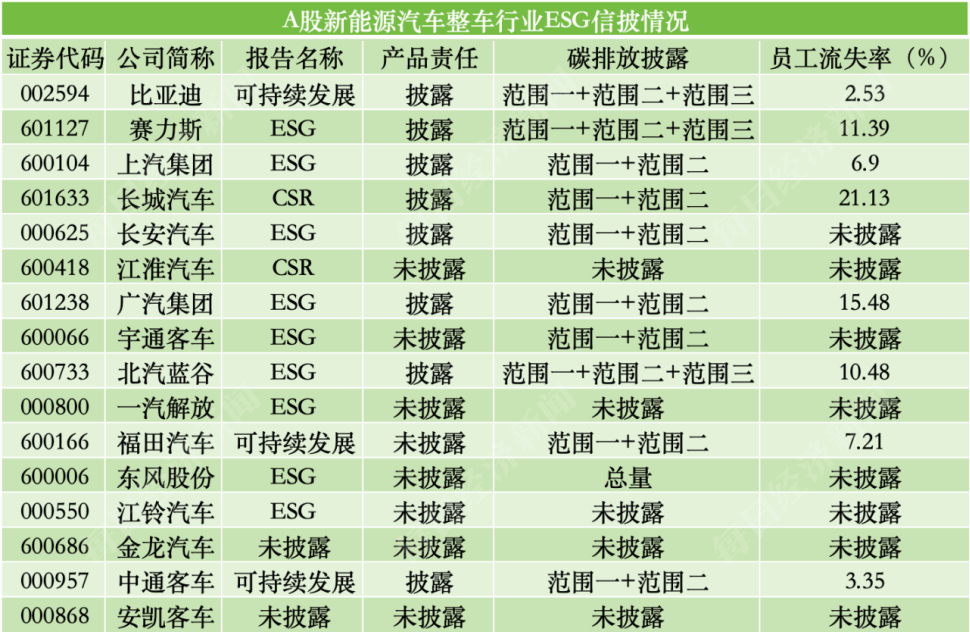
Core Viewpoint - The recent release of new models by leading electric vehicle companies has drawn significant market attention, highlighting the importance of ESG (Environmental, Social, and Governance) issues for the survival and development of these companies [1] ESG Disclosure Summary - Among the 16 listed companies in the A-share electric vehicle sector, 14 have disclosed ESG-related reports, resulting in a disclosure rate of 87.5%, which is significantly higher than the overall industry rate of 45.94% [1][2] - In terms of carbon emissions, 11 companies have disclosed relevant data, achieving a disclosure rate of 68.75%. However, only 3 companies have disclosed Scope 3 emissions data, resulting in a low disclosure rate of 18.75% [2][4] - The types of reports disclosed include 3 sustainability reports, 2 corporate social responsibility reports, and 9 ESG reports, with sustainability reports being favored due to their broader applicability [2] Product Responsibility and Employee Turnover - Eight companies have disclosed product responsibility-related issues, but the quantitative data on product quality, such as recall rates and customer complaints, is limited [6][8] - Employee turnover rates have been disclosed by 8 companies, with Great Wall Motors reporting the highest turnover rate. However, most companies only report voluntary turnover rates, with little information on involuntary turnover [9] Challenges in Carbon Emission Disclosure - The ability to disclose carbon emissions varies among companies, with larger firms having more leverage to require suppliers to provide data. Smaller companies may lack this capability, affecting their disclosure practices [4][5] Market Dynamics and ESG Importance - The high ESG disclosure rates among electric vehicle companies are partly driven by the need to meet international sustainability standards, especially for those exporting to Europe [1][2]




科学评估体系构筑行业公信力 2025年一季度汽车品牌影响力指数正式发布
Zheng Quan Ri Bao Wang· 2025-06-15 12:44
Core Insights - The report highlights a significant shift in the automotive brand influence landscape in China, particularly in the passenger vehicle sector, where domestic brands have made historic breakthroughs, with six out of the top ten positions occupied by Chinese brands [1][3][5] Passenger Vehicle Market - BYD leads the passenger vehicle market with verified sales of 623,400 units, surpassing Volkswagen by 180,000 units, indicating a strong market dominance driven by its advancements in new energy technology [3] - Aito (问界) has established a new benchmark in brand reputation with an impressive 89.67% netizen voice share and only 29 complaints, showcasing its quality management as a model for high-end market strategies [3] - New entrants like Li Auto and Xpeng maintain a strong presence in the mid-market segment, while Xiaomi's vehicle has not yet matched its high media presence with corresponding sales figures [3] Commercial Vehicle Market - Jiangling Motors stands out in the light commercial vehicle sector, ranking first with a score of 684.22, despite having only 44% of the second-place competitor's media voice, demonstrating effective conversion of positive sentiment into sales [4] - The pickup truck market continues to see a concentration of market share, with Great Wall Motors dominating 47% of the total sales in the top ten, while Jiangling maintains a strong second position [4] - In the light truck segment, Foton leads with 91,900 units sold, capturing 34% of the market share, while the new energy player, Dongfeng, leads in electric vehicle discussions with a 72.18% netizen voice share [5] Industry Trends - The report indicates a core trend of transformation within the automotive industry, with domestic brands reshaping competitive dynamics in the passenger vehicle sector and local companies establishing dominance in the commercial vehicle market [5] - The upcoming data collection for the second quarter will continue to provide authoritative references for policy-making, corporate strategy, and investment decisions, reflecting the ongoing evolution of the Chinese automotive industry [5]

想要60天内结款,车企供应商还得过6道关
阿尔法工场研究院· 2025-06-15 11:39
Core Viewpoint - The commitment of car manufacturers to a maximum payment term of 60 days for suppliers is a response to the revised "Regulations on Payment for Small and Medium Enterprises" effective June 1, 2025, but suppliers express skepticism about the effectiveness of this change due to existing operational hurdles and potential price reductions tied to these commitments [4][6][32]. Group 1: Commitment to Payment Terms - Multiple car manufacturers, including major players like GAC, BYD, and NIO, have publicly committed to a maximum payment term of 60 days for suppliers [2]. - In addition to the 60-day payment term, some manufacturers like SAIC and BAIC have pledged not to use commercial acceptance bills, which can increase financial pressure on suppliers [3][38]. - The new regulations stipulate that large enterprises must pay small and medium enterprises within 60 days of delivery, with no conditions tied to third-party payments [6]. Group 2: Supplier Concerns - Despite the commitment to better payment terms, suppliers are frustrated with the numerous hurdles they face in receiving payments, including complex approval processes and lengthy verification stages [7][20]. - Suppliers report that the bidding process has become increasingly competitive and challenging, with frequent re-bidding and price pressures that erode profit margins [16][19]. - The verification process for payments is often cumbersome, with suppliers facing difficulties in confirming project completion and receiving timely payments [25][30]. Group 3: Payment Mechanisms - Suppliers express strong dissatisfaction with the use of commercial acceptance bills, preferring bank acceptance bills due to their better liquidity and lower costs [34][35]. - The reliance on acceptance bills can create additional financial burdens for suppliers, as they may face challenges in discounting these bills [36]. - The commitment from manufacturers to avoid commercial acceptance bills is seen as a more genuine effort to support suppliers compared to merely extending payment terms [38]. Group 4: Industry Dynamics - The financial dynamics of car manufacturers often involve significant liabilities to suppliers, which contrasts with foreign manufacturers that tend to owe more to banks and financial institutions [41]. - The rapid development of the automotive industry in China has led to a focus on cost-cutting at the expense of supplier relationships, highlighting a need for manufacturers to adopt a more collaborative approach [42][43]. - The overall sentiment in the industry suggests a desire for a more equitable and transparent competitive environment, as the current practices lead to mutual dissatisfaction among both manufacturers and suppliers [46].



中国一汽飞行汽车总部项目落户深圳市大鹏新区
news flash· 2025-06-15 02:54
Core Insights - The establishment of the headquarters for China's first flying car project by China FAW Group in Shenzhen's Dapeng New District marks a significant step in the development of the flying car industry [1] Group 1: Project Details - The signing of the cooperation framework agreement involves Shenzhen Dapeng New District, the Shenzhen Municipal Bureau of Industry and Information Technology, the Municipal Transportation Bureau, and China FAW Group [1] - The collaboration will focus on the research and development, production, and market expansion of flying cars, emphasizing technical breakthroughs, practical applications, and ecosystem development [1] Group 2: Product Information - The Red Flag Tianyan No.1 flying car features a modular design with an aerial range exceeding 200 kilometers and supports vertical takeoff and landing in designated areas [1] - The first flight of the Red Flag Tianyan No.1 flying car is planned for this year [1]
大鹏迎来“飞行汽车总部” 助力深圳打造“低空经济第一城”
Shen Zhen Shang Bao· 2025-06-14 16:53
Core Insights - The signing of a cooperation framework agreement between Dapeng New District, Shenzhen's Industrial and Information Technology Bureau, Transportation Bureau, and China FAW Group marks the establishment of China FAW's flying car headquarters in Dapeng New District [1] - The collaboration will focus on the research, production, and market expansion of flying cars, aiming to drive high-quality and large-scale development of Shenzhen's flying car industry and promote innovative policies and technological breakthroughs [1][2] - Shenzhen's low-altitude economy, a strategic emerging industry, has an annual output value exceeding 90 billion yuan and continues to grow rapidly, positioning Shenzhen as a leader in China's low-altitude economy [1][2] Company Developments - China FAW is one of the earliest state-owned enterprises to engage in the research and development of flying cars and eVTOL technology [2] - The company plans to establish FAW Qiyu (Shenzhen) Technology Co., Ltd. in Dapeng New District to conduct research, manufacturing, testing, and operation of flying cars, along with a research center and operational service center [2][3] - The Red Flag Tianran No. 1 flying car developed by China FAW features a modular design, with an aerial range exceeding 200 kilometers, and is designed for vertical takeoff and landing in restricted areas, targeting various applications including intercity transport and tourism [3]