工业有色ETF

Search documents
量化择时周报:两会来临,短期关注政策驱动
ZHONGTAI SECURITIES· 2026-03-01 13:25
Investment Rating - The industry investment rating is "Increase" with an expectation of a relative increase of over 10% compared to the benchmark index in the next 6 to 12 months [17]. Core Insights - The market is currently in an upward trend, with the core observation variable being the change in profit effect, which is at 1.91%, indicating a potential for continued market growth [5][8]. - The upcoming Two Sessions (Lianghui) period is expected to drive short-term policy focus, historically associated with stable market performance [5][8]. - The market has shown resilience despite geopolitical tensions in the Middle East, which may suppress risk appetite [5][8]. Summary by Sections Market Overview - The overall market (WIND All A Index) has shown an increase of 2.75% and reached a new high, with small-cap stocks (CSI 1000) rising by 4.34% and mid-cap stocks (CSI 500) by 4.32% [2][7]. - The steel sector has performed particularly well, with an increase of 11.8%, while the media sector has declined by 4.44% [2][7]. Timing System Analysis - The distance between the 20-day and 120-day moving averages is 6.28%, indicating a positive market trend, with the short-term average above the long-term average [2][5]. - The market trend line is positioned around 6812 points, suggesting a favorable environment for continued investment [5][8]. Sector Allocation - The industry trend configuration model suggests waiting for a reversal signal in the real estate chain (Construction Materials ETF code 159745.SZ) during the Two Sessions window, which may present short-term opportunities [6][15]. - The TWO BETA model continues to recommend the technology sector, particularly focusing on commercial aerospace (Satellite ETF code 563230.SH) for rebound opportunities [6][15]. - The performance trend model highlights the importance of focusing on the computing-related industry chain (Semiconductor Equipment ETF code 159516.SZ, Communication ETF code 515880.SH) as well as non-ferrous metals (Industrial Non-ferrous ETF code 560860.SH, Rare Earth ETF code 516150.SH) and chemicals (Chemical ETF code 159870.SZ) [6][15]. Valuation Metrics - The PE ratio of the WIND All A Index is near the 90th percentile, indicating a high valuation level, while the PB ratio is at the 50th percentile, suggesting a moderate valuation level [9][11]. - Based on the short-term trend assessment, an 80% allocation in absolute return products based on the WIND All A Index is recommended [9].
量化择时周报:两会来临,短期关注政策驱动-20260301
ZHONGTAI SECURITIES· 2026-03-01 12:42
Quantitative Models and Construction Methods 1. Model Name: Timing System Signal - **Model Construction Idea**: The model uses the distance between the short-term and long-term moving averages of the WIND All A Index to determine market trends and timing signals [2][7][13] - **Model Construction Process**: 1. Define the short-term moving average (20-day) and long-term moving average (120-day) of the WIND All A Index 2. Calculate the distance between the two moving averages: $ Distance = \frac{Short\text{-}term\ MA - Long\text{-}term\ MA}{Long\text{-}term\ MA} $ 3. If the absolute value of the distance is greater than 3%, it indicates a significant trend signal [2][7][13] - **Model Evaluation**: The model effectively identifies market trends and provides actionable timing signals [2][7][13] 2. Model Name: Industry Trend Allocation Model - **Model Construction Idea**: This model identifies industry allocation opportunities based on medium-term reversal expectations and performance trends [6][8][15] - **Model Construction Process**: 1. Monitor medium-term reversal signals for specific industries, such as the real estate chain 2. Use performance trend analysis to identify industries with strong growth potential, such as technology, semiconductors, and chemicals 3. Recommend ETF products corresponding to these industries for allocation [6][8][15] - **Model Evaluation**: The model provides clear industry allocation guidance and captures sectoral opportunities effectively [6][8][15] 3. Model Name: Position Management Model - **Model Construction Idea**: This model determines the recommended equity allocation ratio based on valuation levels and market trends [9] - **Model Construction Process**: 1. Assess the PE and PB valuation levels of the WIND All A Index 2. Combine valuation levels with short-term market trends to determine the recommended equity allocation ratio 3. For example, with the current PE at the 90th percentile and PB at the 50th percentile, the model suggests an 80% equity allocation [9] - **Model Evaluation**: The model provides a systematic approach to position management, balancing valuation and trend considerations [9] --- Model Backtesting Results 1. Timing System Signal - Moving average distance: 6.28% (absolute value > 3%) - Market trend line: 6812 points - Profitability effect: 1.91% (significantly > 0) [2][7][13] 2. Industry Trend Allocation Model - Recommended sectors: - Real estate chain (e.g., Building Materials ETF: 159745.SZ) - Technology (e.g., Satellite ETF: 563230.SH) - Semiconductors and communication (e.g., Semiconductor Equipment ETF: 159516.SZ, Communication ETF: 515880.SH) - Metals and chemicals (e.g., Industrial Metals ETF: 560860.SH, Rare Earth ETF: 516150.SH, Chemical ETF: 159870.SZ) [6][8][15] 3. Position Management Model - Recommended equity allocation: 80% [9] --- Quantitative Factors and Construction Methods 1. Factor Name: Profitability Effect - **Factor Construction Idea**: Measures the market's profitability to assess upward momentum [2][7][13] - **Factor Construction Process**: 1. Calculate the profitability effect as a percentage of profitable stocks in the market 2. A positive profitability effect indicates upward momentum [2][7][13] - **Factor Evaluation**: The factor effectively captures market sentiment and momentum [2][7][13] --- Factor Backtesting Results 1. Profitability Effect - Current value: 1.91% (significantly > 0) [2][7][13]
【ETF洞察】稀土爆发,多只ETF大涨超6%!两大指数差别一文看懂
Sou Hu Cai Jing· 2026-02-25 13:25
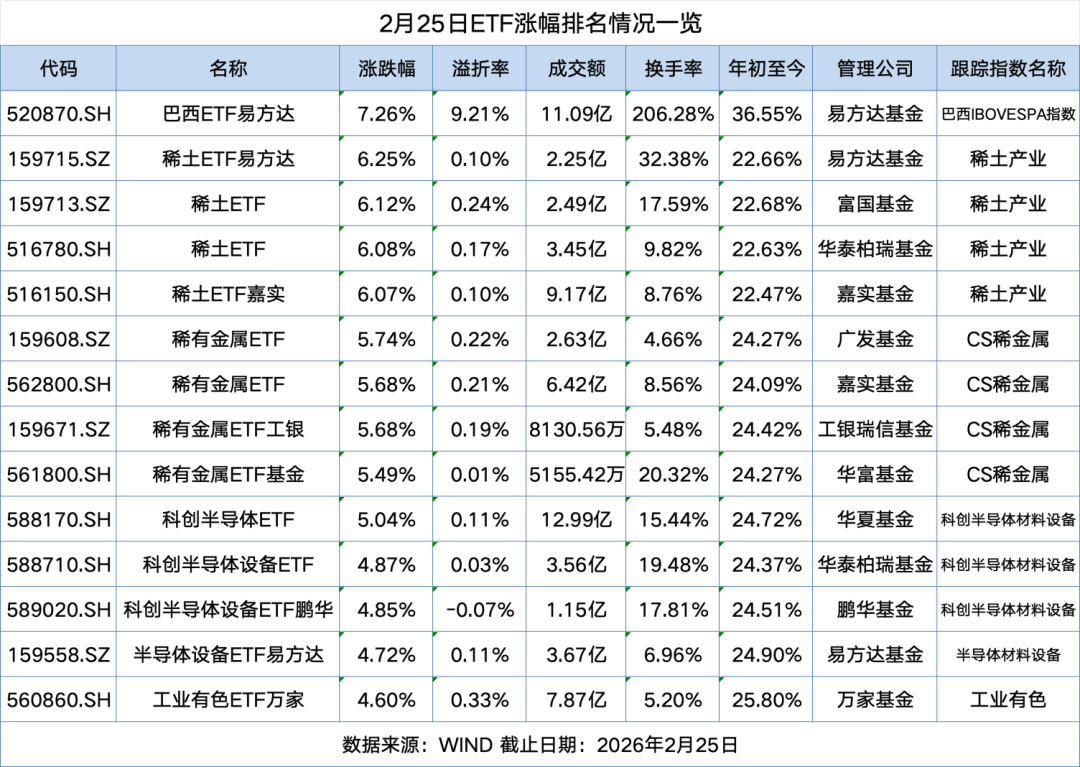
Core Viewpoint - The rare earth sector has shown significant growth, with related ETFs experiencing strong performance, particularly on February 25, when the A-share market surged and the rare earth sector rose by 8% [1][5]. ETF Performance - On February 25, a total of 1,052 ETFs increased in value, with the highest gain reaching 7.26% [1]. - The top-performing ETFs included the Brazil ETF from E Fund, which rose by 7.26%, and several rare earth ETFs, such as the E Fund Rare Earth ETF, which increased by 6.25% [2][8]. - The trading volume for the Brazil ETF was 1.109 billion, indicating high investor interest [2]. Sector Analysis - The rare earth industry accounts for 29.23% of the CSI Rare Earth Industry Index, while the CSI Rare Metals Theme Index has a lower allocation of 18.72% to rare earths [6]. - The demand for rare earth materials is driven by the explosive growth in AI hardware, which has increased the need for rare earth permanent magnet materials [7]. Market Sentiment - The market sentiment is bullish, with significant inflows into stock ETFs, totaling 5.634 billion on February 24, reversing the trend of outflows seen prior to the holiday [9]. - The overall market is experiencing heightened enthusiasm, with various sectors, including semiconductors and steel-related ETFs, also showing considerable gains [8].


量化择时周报:牛市格局仍在延续,主题投资重回主线-20260125
ZHONGTAI SECURITIES· 2026-01-25 13:29
Quantitative Models and Construction Methods 1. **Model Name**: Timing System Model **Model Construction Idea**: The model uses the distance between the short-term moving average (20-day) and the long-term moving average (120-day) of the WIND All A Index to determine the market trend[2][7] **Model Construction Process**: - Define the short-term moving average (20-day) and long-term moving average (120-day) of the WIND All A Index - Calculate the difference between the two moving averages - If the short-term moving average is above the long-term moving average and the absolute difference exceeds 3%, the market is considered to be in an upward trend - Latest data: 20-day moving average = 6668, 120-day moving average = 6245, difference = 6.78%[2][7] **Model Evaluation**: The model effectively captures the market's upward trend and provides a clear signal for timing decisions[2][7] 2. **Model Name**: Industry Trend Allocation Model **Model Construction Idea**: This model identifies industry opportunities based on medium-term reversal expectations and performance trends[6][7] **Model Construction Process**: - Use medium-term reversal expectation signals to identify industries with potential recovery, such as innovative healthcare - Apply the TWO BETA model to recommend sectors like technology, commercial aerospace, space photovoltaics, and stablecoin concepts - Use performance trend signals to highlight opportunities in semiconductors, industrial metals, and chemicals[6][7] **Model Evaluation**: The model provides actionable insights into sector allocation, focusing on industries with strong growth potential or recovery signals[6][7] 3. **Model Name**: Position Management Model **Model Construction Idea**: This model determines the recommended equity allocation based on valuation levels and market trends[8] **Model Construction Process**: - Assess the valuation levels of the WIND All A Index using PE and PB ratios - Combine valuation levels with short-term trend signals to recommend an equity allocation - Current recommendation: 80% equity allocation for absolute return products based on the WIND All A Index[8] **Model Evaluation**: The model provides a systematic approach to managing equity exposure, balancing valuation and trend considerations[8] --- Model Backtesting Results 1. **Timing System Model**: - Moving average distance: 6.78% (absolute value > 3%, indicating an upward trend)[2][7] - Profitability effect: 2.7% (positive, supporting the upward trend)[2][7] 2. **Industry Trend Allocation Model**: - Recommended sectors: Innovative healthcare, technology, commercial aerospace, space photovoltaics, stablecoin concepts, semiconductors, industrial metals, and chemicals[6][7] 3. **Position Management Model**: - Recommended equity allocation: 80%[8] --- Quantitative Factors and Construction Methods No specific quantitative factors were explicitly mentioned in the report. The analysis primarily focuses on models rather than individual factors. --- Factor Backtesting Results No specific factor backtesting results were provided in the report. The focus remains on model-level performance and recommendations.
周期行业ETF双周报:地区冲突不断,关注石化和黄金相关ETF
金融街证券· 2026-01-23 13:30
Investment Rating - The report maintains an "Outperform" rating for the petrochemical and gold sectors, indicating a positive outlook compared to the broader market [1]. Core Insights - The report highlights significant geopolitical tensions affecting oil supply, particularly due to U.S. military actions in Venezuela and potential sanctions on Iran, which could impact global energy markets [22][29]. - It emphasizes the importance of chemical and gold-related ETFs in the current market environment, suggesting that investors should focus on these sectors due to their resilience amid geopolitical uncertainties [40]. Market Overview - The Shanghai Composite Index increased by 2.20% during the period from January 5 to January 16, 2026, with notable gains in the industrial metals sector, which rose by 15.52%, and precious metals, which saw a 12.83% increase [3][5]. - The report notes that the main sectors experiencing capital inflows include non-ferrous metals and chemicals, while the tourism sector faced a decline of 1.96% [8][9]. Sector Performance - The industrial metals index (H11059.CS) showed a remarkable increase of 15.52%, while the CS Rare Metals index (930632.CSI) and Non-ferrous Metals index (000819.SH) also performed well with increases of 12.83% and 12.71%, respectively [7][8]. - The report indicates that the chemical sector ETF (159870.SZ) and gold stock ETF (517520.SH) are recommended for investment due to their strong performance and market conditions [40]. ETF Analysis - The top-performing ETFs during the period included the Industrial Metals ETF (560860.SH) with a gain of 15.48%, the Gold Stock ETF (517520.SH) with 13.92%, and the Non-ferrous Metals ETF (512400.SH) with 12.87% [15]. - The report also highlights significant capital inflows into the Non-ferrous Metals ETF, which saw a net inflow of 100.87 billion, indicating strong investor interest [15][40].
权益ETF,谁是主题轮动下一棒?
HUAXI Securities· 2026-01-20 07:41
Group 1: Report's Investment Rating - No information about the industry investment rating is provided in the report. Group 2: Core Viewpoints - In early 2026, the market sentiment has significantly warmed up, and the market has risen strongly. However, the risk - return ratio of chasing the rising market may not be high. Thematic investment remains popular, and funds from previously over - heated themes are expected to shift to other thematic sectors [1][7]. - The technology main line is still the market consensus. Funds are likely to flow into sectors such as semiconductor computing power and robotics within the technology sector, while lithium battery, non - ferrous metals, power grid, chemical, and innovative drugs are important supplementary sectors for the market [2][22]. Group 3: Summary by Directory 1. Which theme ETFs are expected to be the direction of capital return? - **Market situation**: In early 2026, the market has risen strongly, with commercial aerospace, AI applications, and non - ferrous metals becoming the focus. But there are signs of the market correcting irrational behaviors under regulatory guidance, and the risk - return ratio of chasing the rising market may be low. Thematic investment is still very popular. As of January 19, 2026, the cumulative net capital inflow of thematic index ETFs in the past five days exceeded 42.254 billion yuan, while industry index ETFs only had a net inflow of 9.763 billion yuan, and broad - based index ETFs showed a large net outflow [1][7]. - **Analysis from the perspective of rise and valuation**: Technological industries generally have high rises, while traditional cyclical industries such as liquor, coal, and breeding have relatively low rises. New energy sectors like lithium battery, photovoltaic, and new - energy vehicles, as well as the chemical industry, have risen but still have room to reach previous highs. From the valuation dimension, the current valuations of the game, intelligent driving, lithium battery, and breeding sectors are low [8]. - **Analysis using the quadrant chart**: - **First quadrant (high rise and high congestion)**: Mainly includes commercial aerospace, communication, AI, and non - ferrous metals. Non - ferrous metals (such as copper) and AI have relatively moderate congestion, and relevant sectors are still worthy of attention [2][17]. - **Second quadrant (high rise and low congestion)**: There are relatively few relevant industries, mainly semiconductor equipment (including related industrial chains such as storage) and lithium battery. The sector sentiment is not over - heated, and the industrial supply - demand pattern is optimized, so they are still worthy of attention [2][17]. - **Third quadrant (low rise and low congestion)**: Sectors such as innovative drugs, chemicals, and games have both industrial logic and market capacity, with large potential for a supplementary rise. For example, since 2026, the chemical ETF has re - entered the state of net inflow [2][17]. - **Fourth quadrant (low rise and high congestion)**: Includes robotics, power grid equipment, consumer electronics, and software. Power grid equipment has received renewed attention due to the unexpected increase in the 14th Five - Year Plan expenditure, and robotics has also been favored by the market because Tesla's third - generation robot has entered the scheme confirmation stage [2][21]. - **Specific ETF selection**: For ETFs tracking the same index, products with larger scale, relatively lower fees, and smaller tracking errors are selected. Specific ETF lists are provided in the report [22].
ETF互联互通标的扩至364只
Zheng Quan Ri Bao· 2026-01-18 17:17
Core Viewpoint - The recent expansion of the ETF (Exchange-Traded Fund) interconnection marks a significant increase in the number of ETFs available for northbound trading, enhancing investment opportunities for both domestic and international investors [1] Group 1: ETF Interconnection Expansion - On January 19, a total of 98 ETFs were officially included in the northbound trading of the Shanghai and Shenzhen Stock Connect, increasing the total number of products in the "ETF Connect" from 273 to 364, representing a growth of over 30% [1] - The inclusion of more ETFs is expected to enrich the investment options for overseas institutional investors and promote the institutionalization of the A-share market [1] Group 2: Fund Management Perspective - A total of 29 fund companies had products included in the "ETF Connect," with China Asset Management leading with 14 ETFs, followed by E Fund with 10, and FT Fund with 7 [1] - The newly included products cover a wide range of types, including broad-based ETFs and industry-themed ETFs, which are expected to attract significant market attention [2] Group 3: Market Impact and Future Outlook - The expansion of the ETF interconnection is anticipated to enhance the international competitiveness and influence of China's capital market by attracting more professional investors and incremental capital [3] - Since the formal introduction of ETFs into the interconnection mechanism in July 2022, the total trading volume of northbound funds in 2025 is projected to reach 816.58 billion yuan, marking a 76% increase from 2024 [3]

资金5天狂揽22亿!工业有色ETF(560860)规模飙至近130亿,“纯粹工业金属”稀缺工具引关注
Sou Hu Cai Jing· 2026-01-15 04:21
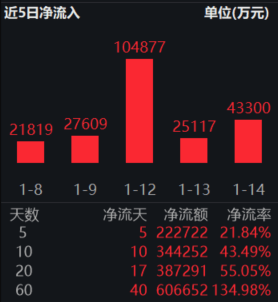
Group 1 - The Industrial Nonferrous ETF (560860) has seen a price increase of 0.94%, reaching 1.831 yuan, with a turnover rate of 1.15% [1] - The top ten weighted stocks in the ETF include Northern Rare Earth (up 1.83%), Luoyang Molybdenum (up 1.59%), and Huayou Cobalt (up 7.33%), among others [1] - The fund has attracted significant capital inflow, with a net inflow of 430 million yuan on January 13 and a total of 2.227 billion yuan over the past five trading days, exceeding 3.4 billion yuan in the last ten days [1] Group 2 - The fund's scale has rapidly increased, surpassing 10 billion yuan on January 6 and approaching 13 billion yuan by January 14 [3] - The Industrial Nonferrous ETF closely tracks the CSI Industrial Nonferrous Metals Theme Index, which includes 30 leading stocks in the industrial nonferrous metal sector, with copper (34.4%), aluminum (21.8%), and rare earths (13.6%) being the top three metals [5] - The top ten constituent stocks account for 56.18% of the index, indicating a concentrated weight in leading companies within the industrial metal sectors [9] Group 3 - The Industrial Nonferrous ETF (560860) is the only ETF product tracking the CSI Industrial Nonferrous Metals Theme Index, providing investors with an efficient one-stop solution for exposure in this sector [7] - Investors can also access the fund through connection classes (A class: 018489; C class: 018490) to capitalize on cyclical and policy-driven opportunities [7]
铜铝行情火热,工业有色ETF(560860)规模站上120亿
Sou Hu Cai Jing· 2026-01-13 02:11
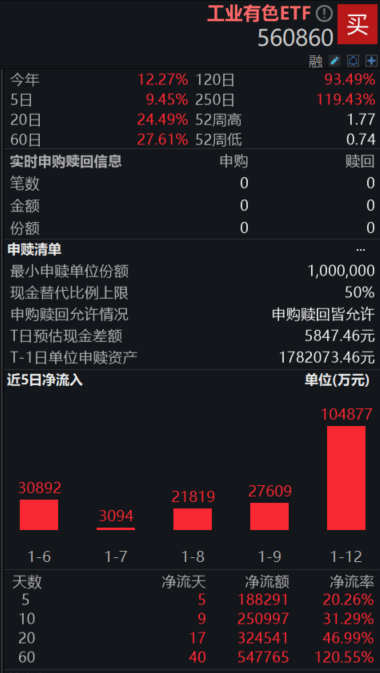
Core Viewpoint - Domestic copper and aluminum futures prices continue to rise, with over 10% increase in the past month, driven by strong demand expectations from the largest consumer and the growth of data centers for artificial intelligence [1] Group 1: Market Performance - As of January 12, 2026, international copper futures rose by 1.63%, closing at $13,209.5 per ton, nearing record highs [1] - The Industrial Nonferrous ETF (560860) has attracted significant capital inflows, with over 1 billion yuan net inflow on January 12 alone, totaling 18.8 billion yuan over the past five trading days and 54 billion yuan over the last 60 days [1][3] Group 2: ETF Details - The Industrial Nonferrous ETF (560860) tracks the CSI Industrial Nonferrous Metals Theme Index, covering leading companies in copper, aluminum, and rare earths [4] - The ETF has seen its scale grow rapidly, surpassing 10 billion yuan on January 6 and exceeding 12 billion yuan by January 12 [3] Group 3: Demand and Supply Outlook - The current loose monetary policy from the Federal Reserve, combined with strong demand and limited supply, is expected to support the ongoing nonferrous metal bull market [4] - The CSI Industrial Nonferrous Metals Theme Index consists of 30 leading companies in the industrial nonferrous metal sector, with copper (34.4%), aluminum (21.8%), and rare earths (13.6%) being the top three metals, accounting for nearly 70% of the index [6]
98只,大扩容!
中国基金报· 2026-01-12 08:10
Core Viewpoint - The "ETF Connect" program is set to expand significantly at the beginning of the year, with 98 new products being added, increasing the total from 273 to 364, representing a growth of over 30% [2][4][13]. Group 1: Expansion Details - On January 19, 54 ETFs listed on the Shanghai Stock Exchange will be included in the Northbound Shanghai Stock Connect, while 44 ETFs from the Shenzhen Stock Exchange will be added to the Northbound Shenzhen Stock Connect [5][8]. - A total of 7 ETFs will be temporarily removed from the mainland stock connect, resulting in a combined total of 364 products available for investment through the "ETF Connect" [8][13]. Group 2: Historical Performance - In 2025, the Northbound capital through "ETF Connect" reached a record high of 816.58 billion yuan, marking the highest annual amount since the program's inception [2][17]. - The trading volume for Northbound funds significantly increased, with the Shanghai Stock Connect reaching 51.14 billion yuan in July 2025, a nearly 50% increase compared to the previous month [17]. Group 3: Market Impact - The inclusion of more ETFs is expected to enhance the vitality and liquidity of the ETF markets in both regions, promoting further development [2][13]. - The expansion has diversified the investment options available under "ETF Connect," including the first inclusion of the CSI A500 ETF and various thematic ETFs, enriching investors' choices in specific sectors [13][15]. Group 4: Industry Insights - The growth in the number of ETFs and the increase in trading volume are attributed to the continuous expansion of available products, the appeal of ETFs as transparent and low-cost investment tools, and the attractive valuation of the A-share market [17]. - Major fund companies such as Huaxia, E Fund, and others have contributed significantly to the new additions, with Huaxia having the highest number of new ETFs included [13].